Managing business expenses becomes easier when you have the right financial tools. A business credit card can help you separate company purchases from personal spending, track expenses, earn rewards, and manage short-term cash flow.
Whether you run a small business, an online store, a consulting service, or a freelance operation, choosing the right business credit card can make everyday financial management more convenient.
However, not every card offers the same benefits. Some provide cashback on general purchases, while others reward office supplies, advertising, travel, or other business expenses. Annual fees, interest rates, credit limits, and eligibility requirements also vary.
In this guide, we compare popular U.S. business credit cards in 2026 and explain how to select an option that fits your company's spending habits and financial goals.
What Is a Business Credit Card?
A business credit card is a payment card designed for business-related expenses. It works similarly to a personal credit card but may include features tailored to business owners, such as employee cards, expense tracking, business rewards, and spending controls.
Business credit cards can be useful for:
Purchasing office supplies and equipment.
Paying for software, advertising, and online services.
Covering travel and accommodation expenses.
Managing recurring business subscriptions.
Tracking employee purchases.
Earning cashback or travel rewards on eligible spending.
Small-business credit cards are available to many types of business owners, including freelancers, independent contractors, sole proprietors, and owners of registered companies. Approval depends on the issuer's requirements and the applicant's financial profile.
A business credit card is not the same as a corporate card. Corporate cards often have different eligibility requirements, payment arrangements, and underwriting processes.
Best Business Credit Cards in 2026
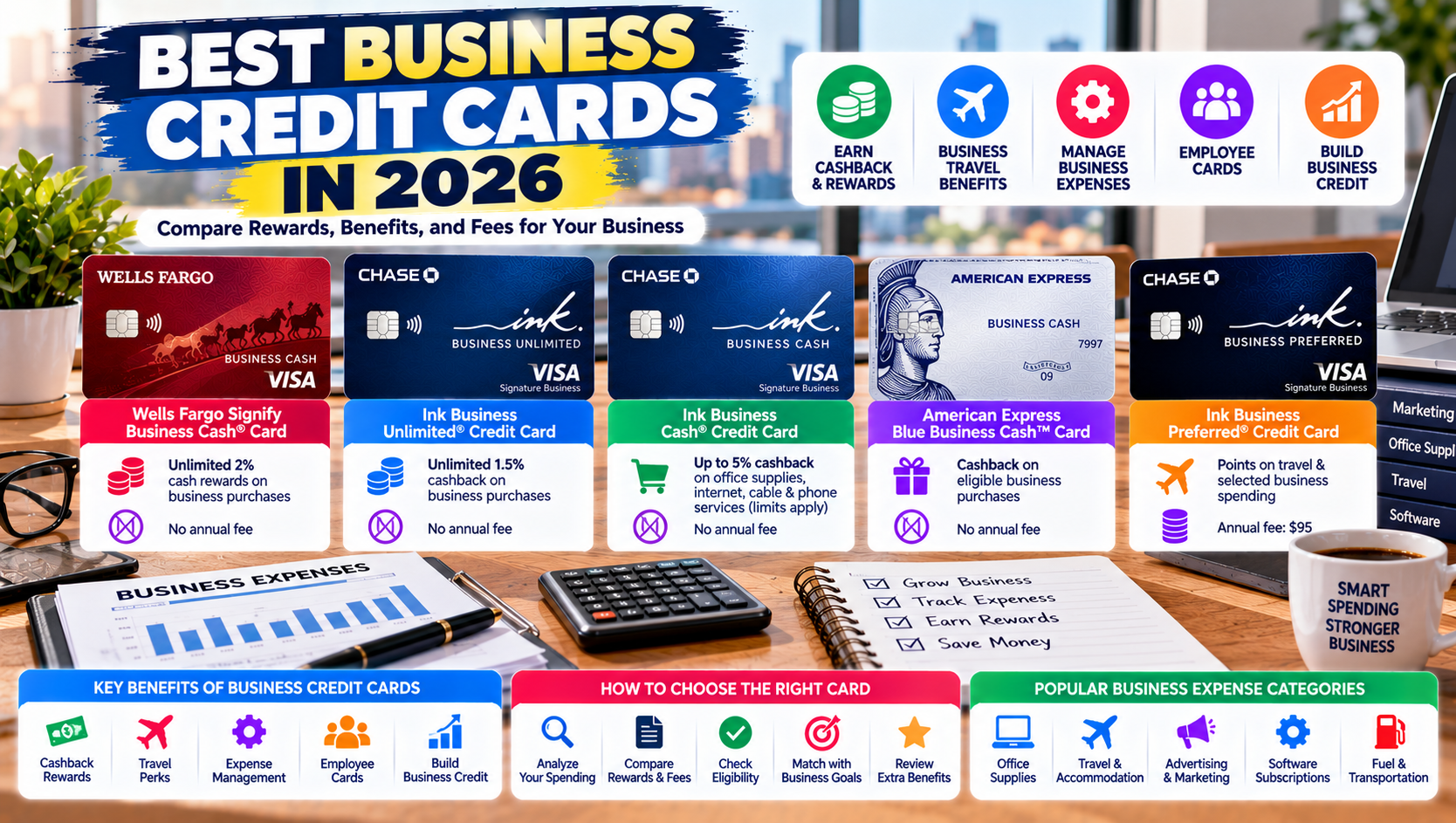
The following U.S. business credit cards are worth comparing based on their rewards, fees, and intended uses.
Business Credit Card | Best For | Annual Fee |
|---|---|---|
Wells Fargo Signify Business Cash® Card | Flat-rate cashback | $0 |
Ink Business Unlimited® Credit Card | Simple rewards on business purchases | $0 |
Ink Business Cash® Credit Card | Office supplies and selected business services | $0 |
American Express Blue Business Cash™ Card | Cashback for smaller businesses | $0 |
Ink Business Preferred® Credit Card | Travel rewards and selected business spending | $95 |
Annual fees and features are based on published 2026 information. Card terms, welcome offers, rewards, and eligibility requirements may change. Verify current details with each issuer before applying.
1. Wells Fargo Signify Business Cash® Card — Best for Flat-Rate Cashback
The Wells Fargo Signify Business Cash® Card is designed for business owners who prefer straightforward cashback without having to track multiple spending categories.
Key features:
Unlimited 2% cash rewards on eligible business purchases.
No annual fee.
A welcome bonus may be available for qualifying new accounts.
An introductory APR offer may apply to eligible purchases.
Employee cards may be available without an additional card fee.
Who should consider it?
This card may suit businesses with varied expenses, such as equipment, supplies, subscriptions, and general operating costs. A flat-rate rewards structure makes it easier to estimate cashback without calculating different rates for every purchase category.
Check the current welcome offer, promotional APR, and regular interest rate before applying. Paying interest on a carried balance can reduce the financial value of rewards.
2. Ink Business Unlimited® Credit Card — Best for Everyday Business Spending
The Ink Business Unlimited® Credit Card offers a simple rewards structure for businesses that want to earn cashback on a wide range of purchases.
Key features:
Unlimited 1.5% cashback on eligible business purchases.
No annual fee.
A welcome bonus may be available after meeting the required spending conditions.
An introductory APR offer may apply to eligible purchases.
Rewards can be redeemed through the available program options.
Who should consider it?
This card may work well for freelancers, service providers, and small companies that make purchases across many different categories.
Because the rewards structure is straightforward, business owners can use it for general operating expenses without constantly checking category restrictions.
Before applying, review the current introductory offer, foreign transaction fees, and redemption terms.
3. Ink Business Cash® Credit Card — Best for Office Supplies and Business Services
The Ink Business Cash® Credit Card is designed for businesses with recurring expenses in selected categories.
Key features:
Up to 5% cashback on eligible office supply purchases and qualifying internet, cable, and phone services, subject to spending limits.
Additional rewards on selected dining and gas purchases.
No annual fee.
A welcome bonus may be available for eligible new cardholders.
An introductory APR offer may apply to purchases.
Who should consider it?
This card may be suitable for small offices, agencies, consultants, and businesses that spend regularly on telecommunications and office supplies.
The main advantage is the ability to earn higher rewards in eligible categories. However, category spending limits and exclusions matter. Compare your actual expenses with the card's rewards structure before choosing it.
4. American Express Blue Business Cash™ Card — Best for Cashback Simplicity
The American Express Blue Business Cash™ Card is an option for small-business owners who want a straightforward cashback program.
Key features:
Cashback on eligible business purchases.
No annual fee.
A welcome offer may be available.
A credit limit and spending terms depend on approval and the issuer's agreement.
Who should consider it?
This card may appeal to newer businesses and independent professionals who want to earn cashback while keeping their card costs relatively simple.
Review the current rewards rate, annual spending limits, introductory APR, and American Express acceptance at the places where you typically make purchases.
5. Ink Business Preferred® Credit Card — Best for Travel Rewards
The Ink Business Preferred® Credit Card is designed for businesses that want to earn flexible points on selected business spending and travel.
Key features:
Points on eligible travel and selected business purchases.
Additional rewards on certain eligible spending categories, subject to limits.
A $95 annual fee.
A welcome bonus may be available after meeting qualifying spending requirements.
Eligible points may be redeemed through available travel and rewards options.
Who should consider it?
This card may suit businesses that frequently pay for travel, advertising, telecommunications, or other qualifying business expenses.
The annual fee may be worthwhile if the rewards you actually use exceed the cost. Compare redemption values and spending requirements before applying, and avoid making unnecessary purchases just to qualify for a bonus.
Business Credit Cards Comparison Table
Choosing the best business credit card requires comparing more than rewards rates.
Feature | No-Annual-Fee Cashback Card | Category Rewards Card | Travel Rewards Card |
|---|---|---|---|
Main benefit | Simple cashback | Higher rewards in selected categories | Points or miles for eligible spending |
Annual fee | Often $0 | Often $0 | May have an annual fee |
Best for | General business purchases | Businesses with predictable expenses | Businesses with regular travel |
Important consideration | Rewards rate and fees | Category limits and exclusions | Redemption value and travel benefits |
Expense tracking | Depends on issuer | Depends on issuer | Depends on issuer |
The best option depends on your spending patterns, repayment habits, and business priorities.
Benefits of Using a Business Credit Card
1. Separate Business and Personal Expenses
Using a dedicated card can make it easier to identify business purchases, organize receipts, and prepare financial reports.
This separation may also simplify bookkeeping. However, a business card does not automatically make an expense tax-deductible. Tax treatment depends on the nature of the expense and applicable tax rules.
2. Earn Rewards on Business Purchases
Business expenses can add up quickly. A rewards card may return a portion of eligible spending through cashback, points, or miles.
For example, a business spending $2,000 per month on eligible purchases with a 1.5% cashback card could earn approximately $360 in cashback over 12 months, assuming all purchases qualify and the rewards terms remain unchanged.
Actual rewards may differ because of exclusions, spending limits, fees, and changes to the program.
3. Track Employee Spending
Some business cards allow account holders to issue additional cards to employees. Depending on the issuer, the account administrator may be able to review transactions and set spending controls.
These tools can help businesses monitor expenses and reduce manual bookkeeping.
4. Manage Short-Term Cash Flow
A business credit card can provide a payment period between a purchase and its due date. This may help with timing expenses and incoming revenue.
However, credit is not a replacement for working capital or emergency savings. Carrying a balance can result in interest charges that increase business costs.
5. Build a Business Financial History
Some issuers report activity to business credit bureaus, which may help a business establish or strengthen its business credit profile.
Reporting practices vary by issuer, and some business cards also report account activity to consumer credit bureaus. Check the terms before applying.
How to Choose the Best Business Credit Card
1. Understand Your Business Expenses
Review your spending over the past three to six months. Identify your biggest categories, such as advertising, software, supplies, inventory, fuel, or travel.
Choose a card that rewards the categories where your business actually spends money.
2. Compare Annual Fees
A card with an annual fee may offer higher rewards or additional benefits. Calculate whether those benefits are worth more than the fee.
If your business spends relatively little, a no-annual-fee card may be a better starting point.
3. Review the Interest Rate
If you expect to carry a balance, compare the regular APR and any promotional APR offer. Rewards do not usually compensate for high interest charges over time.
Whenever possible, pay the statement balance in full by the due date to avoid interest on purchases when the card's terms provide an interest-free grace period.
4. Check Welcome Bonus Requirements
Some business credit cards offer bonus cashback or points after you spend a specified amount within a set period.
Before applying, make sure the spending requirement fits your normal business expenses. Avoid purchasing unnecessary items just to earn a bonus.
5. Consider Employee Cards and Expense Tools
If employees make purchases for your business, look for cards that offer additional cards, transaction alerts, expense categorization, and spending controls.
These features may save time and improve oversight as your company grows.
6. Check Eligibility Requirements
Issuers may consider personal credit history, business revenue, income, existing debt, and other factors.
You may be able to apply as a sole proprietor without forming a corporation or limited liability company, but the application must accurately reflect your business and financial information.
Approval and credit limits are not guaranteed.
Business Credit Cards vs. Personal Credit Cards
Feature | Business Credit Card | Personal Credit Card |
|---|---|---|
Main purpose | Business expenses | Personal purchases |
Rewards | May focus on business categories | Often focus on everyday spending |
Expense tracking | May offer business-focused tools | Usually designed for personal finances |
Employee cards | Often available | Additional authorized-user cards may be available |
Credit reporting | Depends on issuer and product | Commonly reported to consumer credit bureaus |
Liability | Depends on the agreement and guarantee | Depends on the agreement |
Business credit cards often require a personal guarantee, especially for small businesses. This means the owner may be personally responsible for repayment if the business cannot pay. Read the agreement carefully before applying.
Common Mistakes to Avoid
Choosing a card only for the welcome bonus: Consider ongoing rewards, fees, and spending requirements.
Ignoring interest charges: High APRs can outweigh the value of cashback or points.
Mixing personal and business expenses: This makes bookkeeping more difficult.
Overlooking reward limits: Higher category rewards may have annual or quarterly caps.
Missing payment deadlines: Late payments can result in fees and potentially affect credit history.
Applying for too many cards: Multiple applications can affect credit and complicate financial management.
Assuming all business purchases qualify: Some transactions may be excluded from rewards.
Ignoring personal guarantees: Understand your liability before opening an account.
Frequently Asked Questions
What is the best business credit card in 2026?
The best option depends on your business expenses. The Wells Fargo Signify Business Cash® Card is worth comparing for flat-rate cashback, Ink Business Cash® for selected office expenses, Ink Business Unlimited® for everyday purchases, and Ink Business Preferred® for travel rewards.
Can a small-business owner get a business credit card?
Yes. Many issuers accept applications from eligible small-business owners, freelancers, independent contractors, and sole proprietors. Approval depends on the issuer's criteria and the applicant's financial profile.
Do business credit cards have annual fees?
Some have no annual fee, while others charge a yearly fee in exchange for additional rewards or benefits. Check the current pricing and terms before applying.
Do business credit cards help build business credit?
They may help establish business credit when the issuer reports eligible account activity to business credit bureaus. Reporting practices differ, so confirm them with the issuer.
Can I use a business credit card for personal expenses?
Business credit cards are intended for business-related spending. Using them for personal purchases can complicate bookkeeping and tax records and may conflict with issuer terms. Keep personal and business spending separate whenever possible.
Are business credit card rewards taxable?
The tax treatment depends on the reward structure and applicable tax rules. Cashback received as a rebate on purchases may be treated differently from certain bonuses or business incentives. Consult a qualified tax professional for advice specific to your circumstances.
Is a business credit card better than a business loan?
They serve different purposes. A business credit card may be useful for recurring purchases and short-term expenses, while a business loan may provide a structured repayment plan for a larger investment. Compare interest rates, fees, repayment terms, and your ability to repay before borrowing.
Final Thoughts
The best business credit card in 2026 is one that matches your company's spending habits, budget, and financial goals. A flat-rate cashback card may work well for everyday expenses, while a category rewards card may benefit businesses with predictable spending patterns. Travel rewards cards can be valuable for companies that regularly book eligible travel.
Before applying, compare rewards, annual fees, interest rates, spending limits, employee-card features, and eligibility requirements. Most importantly, use business credit responsibly and maintain a clear repayment plan.
A well-chosen business credit card can simplify expense tracking and provide useful rewards, but it should support your business strategy rather than encourage unnecessary borrowing.
Disclaimer: This article is for general educational purposes only and is not individualized financial, legal, or tax advice. Credit card offers, rates, fees, rewards, and eligibility requirements can change. Verify current terms with the issuer before applying.