A 0% APR credit card can help you manage large purchases or pay down existing credit card debt without paying interest for a limited period. These cards offer an introductory annual percentage rate (APR) of 0% on eligible purchases, balance transfers, or sometimes both.
For example, if you need to purchase a laptop, cover an unexpected expense, or consolidate high-interest credit card debt, a card with a promotional 0% APR may give you additional time to repay your balance.
However, these offers do not last forever. When the introductory period ends, the card's regular interest rate generally applies to any remaining balance. Understanding the terms, fees, and repayment requirements is essential before applying.
In this guide, we explain how 0% APR credit cards work, compare popular U.S. options in 2026, and share practical tips for choosing the right card.
What Is a 0% APR Credit Card?
A 0% APR credit card is a credit card that charges no interest on qualifying transactions during a specified introductory period.
Depending on the offer, the promotional rate may apply to:
New purchases: Eligible purchases made with the card.
Balance transfers: Eligible debt moved from another credit card.
Both purchases and balance transfers: Some cards offer separate introductory periods for both transaction types.
A 0% introductory APR is usually temporary. Once the promotional period expires, the standard variable APR may apply to the remaining balance and new transactions.
It is also important to distinguish a 0% introductory APR from a deferred-interest offer. With deferred interest, unpaid interest may be charged retroactively if the balance is not paid in full by the deadline. Read the terms carefully to understand which type of promotion you are receiving.
Best 0% APR Credit Cards in 2026
The following U.S. credit cards are worth comparing for introductory interest offers, balance transfers, and additional benefits.
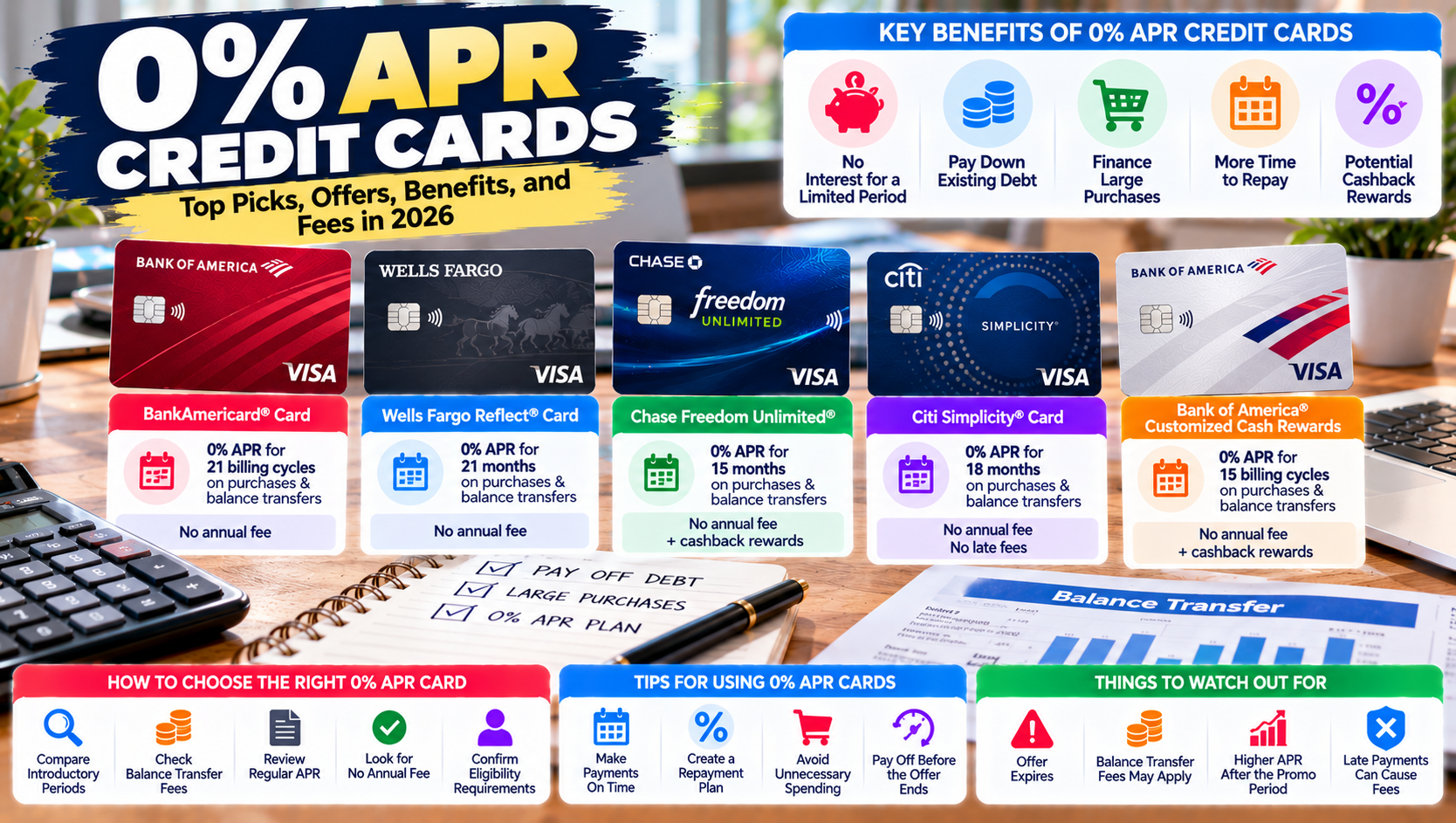
Credit Card | Best For | Introductory Offer |
|---|---|---|
BankAmericard® Credit Card | Long introductory period | 0% APR for 21 billing cycles on purchases and qualifying balance transfers |
Wells Fargo Reflect® Card | Extended repayment time | 0% APR for 21 months on purchases and qualifying balance transfers |
Chase Freedom Unlimited® | Interest savings plus cashback | 0% introductory APR for 15 months on purchases and qualifying balance transfers |
Citi Simplicity® Card | Balance transfer flexibility | 0% introductory APR for 18 months on purchases and qualifying balance transfers |
Bank of America® Customized Cash Rewards | Cashback and introductory APR | 0% APR for 15 billing cycles on purchases and qualifying balance transfers |
Offers shown are based on published 2026 information. Eligibility, qualifying transaction windows, balance transfer fees, regular APRs, and other conditions vary. Verify the current issuer terms before applying.
1. BankAmericard® Credit Card — Best for a Long Introductory Period
The BankAmericard® Credit Card is an option for people who want an extended introductory interest-free period without paying an annual fee.
Key features:
0% introductory APR for 21 billing cycles on purchases.
0% introductory APR for 21 billing cycles on qualifying balance transfers made within the required period.
No annual fee.
A regular variable APR applies after the promotional period.
Who should consider it?
This card may suit people who need time to pay off a planned purchase or transfer eligible debt from a higher-interest credit card.
Before applying, check the balance transfer deadline and fee. Calculate how much you need to repay each month to clear the balance before the promotional rate expires.
2. Wells Fargo Reflect® Card — Best for Extended Repayment Time
The Wells Fargo Reflect® Card is designed for people who prioritize a long introductory APR period over earning rewards.
Key features:
0% introductory APR for 21 months on purchases.
0% introductory APR for 21 months on qualifying balance transfers, subject to the offer's requirements.
No annual fee.
A regular variable APR applies after the introductory period.
Who should consider it?
This card may be useful if you have a large eligible expense or want to pay down qualifying credit card debt over a longer period.
Review the balance transfer terms carefully, including the deadline and any applicable fee. A long promotional period can help, but it does not remove the need for a realistic repayment plan.
3. Chase Freedom Unlimited® — Best for Cashback and Introductory APR
The Chase Freedom Unlimited® combines an introductory APR offer with cashback rewards on eligible purchases.
Key features:
0% introductory APR for 15 months on purchases and qualifying balance transfers.
Cashback rewards on eligible spending.
No annual fee.
A regular variable APR applies after the promotional period.
Who should consider it?
This card may appeal to people who want to earn cashback while paying down eligible purchases during an introductory interest-free period.
Remember that rewards should not be a reason to spend more than you can afford. Interest charges after the introductory period can outweigh the value of cashback earned.
4. Citi Simplicity® Card — Best for Balance Transfer Flexibility
The Citi Simplicity® Card is designed for consumers who value introductory APR offers and features intended to simplify repayment.
Key features:
0% introductory APR for 18 months on purchases.
0% introductory APR for 18 months on qualifying balance transfers, subject to the offer's deadline.
No annual fee.
No late fees under the card's published terms, although late payments can still have serious consequences.
Who should consider it?
This card may be worth comparing if your main goal is paying off eligible high-interest debt or financing a purchase without interest during the promotional period.
Check the current balance transfer fee, payment requirements, and regular APR before applying. A balance transfer is only useful if the total costs are lower than the interest you expect to avoid.
5. Bank of America® Customized Cash Rewards Credit Card — Best for Cashback and Introductory APR
The Bank of America® Customized Cash Rewards credit card combines cashback rewards with an introductory APR offer.
Key features:
0% introductory APR for 15 billing cycles on purchases.
0% introductory APR for 15 billing cycles on qualifying balance transfers made within the specified period.
No annual fee.
Cashback rewards in eligible spending categories.
Who should consider it?
This card may suit people who want to earn cashback on qualifying purchases while managing a planned expense.
Review the rewards categories and any spending limits. Also make sure the introductory APR applies to the specific transaction you intend to make.
0% APR Credit Cards Comparison
The best card depends on your primary goal, the promotional period, and the total cost of using the account.
Feature | Purchase APR Offer | Balance Transfer APR Offer |
|---|---|---|
Main purpose | Finance eligible new purchases | Move eligible existing credit card debt |
Potential benefit | More time to repay a purchase without interest | Reduce interest costs on existing debt |
Common cost | Regular APR after promotion | Possible transfer fee and regular APR afterward |
Important condition | Offer must cover your purchases | Transfer must qualify and meet the deadline |
Best repayment strategy | Pay the balance off before the offer ends | Compare transfer fees with expected interest savings |
Some cards offer both types of promotions, but the promotional periods and eligibility rules may differ.
How Does a 0% APR Credit Card Work?
Understanding the promotional period helps you avoid unexpected interest charges.
Step 1: Apply for an Eligible Credit Card
Choose a card whose introductory offer matches your needs. Approval and credit limits depend on the issuer's eligibility criteria and your financial profile.
Step 2: Confirm the Promotional Period
Check when the introductory APR begins and how long it lasts. Some offers are measured in billing cycles, while others are expressed in months from account opening.
Step 3: Make Eligible Purchases or Transfer a Balance
Read the terms to confirm which transactions qualify. A purchase APR offer does not automatically mean that balance transfers or cash advances receive the same rate.
Step 4: Make Every Required Payment on Time
A 0% introductory APR does not mean you can skip payments. You must continue making at least the required minimum payment.
Late payments can lead to fees and may affect your credit standing. Depending on the issuer's terms and applicable law, a missed payment can also affect promotional benefits.
Step 5: Pay Off the Balance Before the Offer Ends
Divide your balance by the number of months remaining in the promotional period to estimate a monthly repayment target.
For example, if you owe $1,800 and have 15 months to repay it, you would need to pay approximately $120 per month to clear the balance, assuming no additional purchases or fees.
Paying more than the minimum can help you avoid carrying debt into the regular APR period.
Benefits of 0% APR Credit Cards
1. Save on Interest
When eligible transactions receive a genuine 0% introductory APR, you can avoid interest on those transactions during the promotional period.
2. Manage Large Purchases
A promotional offer may give you time to repay an essential purchase through planned monthly payments rather than paying the entire cost immediately.
3. Pay Down Existing Credit Card Debt
A qualifying balance transfer may help reduce interest costs when you move debt from a high-interest card to a card with a 0% transfer offer.
However, balance transfer fees and the remaining promotional period must be included in your calculations.
4. Earn Rewards on Selected Cards
Some introductory APR cards also provide cashback or other rewards. Compare the reward structure, fees, and repayment terms instead of choosing a card based on the bonus alone.
5. Support a Structured Repayment Plan
A defined introductory period can help you set a repayment deadline and create a monthly budget.
Potential Drawbacks of 0% APR Credit Cards
Despite their benefits, these cards are not suitable for everyone.
The offer expires: The regular APR can apply to the remaining balance after the promotional period.
Balance transfer fees may apply: A transfer can cost a percentage of the amount moved.
Approval is not guaranteed: Issuers assess applications according to their eligibility requirements.
Credit limits may be insufficient: Your approved limit may not cover the entire purchase or debt transfer.
Late payments can cause problems: Missed payments may result in fees and other consequences.
Overspending can increase debt: An interest-free period does not make a purchase affordable by itself.
How to Choose the Best 0% APR Credit Card
Use the following factors to compare offers.
1. Compare the Introductory Period
Look for a promotional period long enough to repay the planned purchase or qualifying balance transfer. The longest offer is not necessarily the best if another card has lower overall costs.
2. Check the Balance Transfer Fee
For example, a 3% transfer fee on a $5,000 balance would cost $150.
Compare that fee with the interest you could avoid by moving the debt. Check the actual fee and minimum charge in the card agreement because fees vary.
3. Review the Regular APR
The regular APR matters if you cannot repay the full balance before the promotional period expires. Compare the ongoing rate with other available offers.
4. Check the Annual Fee
Many introductory APR cards have no annual fee, but you should still verify the current terms.
5. Confirm Which Transactions Qualify
Read the offer carefully to determine whether the 0% APR applies to purchases, balance transfers, or both. Cash advances commonly have different rates and fees.
6. Create a Monthly Repayment Plan
Before making a purchase or transferring debt, calculate how much you can afford to pay each month.
Choose a card based on your repayment capacity rather than the maximum credit limit offered.
Common Mistakes to Avoid
Applying without reading the full terms and conditions.
Assuming all transactions qualify for 0% APR.
Ignoring balance transfer fees.
Paying only the minimum each month without calculating the payoff timeline.
Making late payments.
Adding new purchases while trying to repay old debt.
Assuming the regular APR will remain low after the promotion ends.
Avoiding these mistakes can help you use an introductory APR offer more effectively.
Frequently Asked Questions
What does 0% APR mean on a credit card?
It means the card charges no interest on qualifying purchases or balance transfers during a specified introductory period. Other fees and payment obligations may still apply.
How long do 0% APR offers last?
Promotional periods vary by card and offer. Some current U.S. offers provide approximately 12 to 21 months of introductory APR, depending on the transaction type and issuer.
Do 0% APR credit cards have annual fees?
Many do not, but annual fees depend on the specific card. Check the current issuer terms before applying.
Can I transfer debt to a 0% APR credit card?
You may be able to transfer eligible debt if the card offers a qualifying balance transfer promotion. Transfer fees, deadlines, credit limits, and restrictions apply. Issuers commonly restrict transfers from certain accounts or related institutions.
Will I pay interest after the introductory period?
Generally, the regular APR applies to any remaining balance after the promotional period ends. Check your agreement for the exact terms.
Does a 0% APR card help build credit?
Responsible use may help build credit history when the issuer reports account activity to credit bureaus. Paying on time and keeping credit utilization under control are important, but opening a new card does not guarantee a higher score.
Is a 0% APR card better than a personal loan?
It depends on the repayment period, fees, interest rate after the promotion, and your ability to repay the balance on time. A personal loan may provide a fixed repayment schedule, while a 0% APR card can offer temporary interest savings on eligible transactions.
Can I use a 0% APR card for cash advances?
Cash advances are generally excluded from purchase introductory APR offers and may carry separate fees and interest from the transaction date. Review the card agreement before using a card for cash advances.
Final Thoughts
A 0% APR credit card can be a useful financial tool for financing eligible purchases or reducing interest on qualifying credit card debt. Cards such as the BankAmericard®, Wells Fargo Reflect®, Chase Freedom Unlimited®, Citi Simplicity®, and Bank of America® Customized Cash Rewards offer different combinations of introductory APR periods and other features.
The right choice depends on how long you need to repay the balance, whether you plan to transfer debt, and the fees and regular APR associated with the card.
Before applying, compare current offers, calculate your monthly repayment target, and read the full terms. Most importantly, avoid spending beyond your budget simply because an introductory interest-free offer is available.
Disclaimer: This article is for general educational purposes and is not individualized financial advice. Credit card offers, rates, fees, and eligibility criteria may change. Verify all details with the card issuer before applying.