Artificial intelligence is transforming the modern workplace. From automated administrative tasks and intelligent customer support to advanced data analysis and AI-powered content creation, businesses are increasingly using technology to improve productivity and change how employees work.
Tasks that once required hours of manual effort can now be completed more efficiently with AI-powered tools. Employees can use intelligent assistants to organize information, prepare reports, analyze data, write content, and support business decisions.
However, artificial intelligence is not simply changing how work gets done. It is also influencing job responsibilities, required professional skills, workplace structures, and the types of opportunities available in different industries.
As businesses continue adopting AI technologies, understanding these changes has become important for employees, employers, entrepreneurs, and professionals.
In this guide, we explore how artificial intelligence is changing the future of work, the industries experiencing transformation, the benefits and challenges of workplace AI, and the skills people need to remain competitive.
What Is the Role of Artificial Intelligence in the Workplace?
Artificial intelligence refers to technologies that enable computer systems to perform tasks associated with human intelligence, such as learning, recognizing patterns, understanding language, generating content, and supporting decisions.
In the workplace, AI can help employees and organizations complete tasks that involve large amounts of information, repetitive processes, and complex analysis.
Common workplace applications include:
Automating repetitive administrative tasks.
Generating and summarizing business documents.
Analyzing large datasets.
Supporting customer service operations.
Organizing employee information.
Improving business forecasting.
Assisting software development.
Supporting research and decision-making.
AI is increasingly being used as a productivity tool that works alongside employees rather than operating only as a standalone technology.
10 Ways Artificial Intelligence Is Changing the Future of Work
Artificial intelligence is influencing nearly every part of modern business operations. Here are ten important ways it is changing the workplace.
1. Automation of Repetitive Tasks
One of the most visible effects of AI is the automation of repetitive activities.
Many employees spend significant time performing routine tasks such as entering information, organizing documents, preparing reports, scheduling appointments, and responding to common inquiries.
AI-powered automation tools can reduce the manual effort involved in these activities.
Examples include:
Automatically organizing customer inquiries.
Processing and categorizing business documents.
Scheduling meetings and sending reminders.
Generating routine reports.
Updating records across business applications.
For example, a small business can connect its website forms to a customer relationship management system and automatically organize incoming leads.
Employees can then spend more time handling important customer relationships and business decisions.
2. Increased Employee Productivity
AI assistants can help employees complete everyday responsibilities more efficiently.
Instead of starting every task from scratch, professionals can use AI to generate initial drafts, summarize information, organize ideas, and identify relevant insights.
For example:
Writers can generate content outlines.
Managers can summarize lengthy reports.
Developers can receive coding assistance.
Researchers can organize information.
Marketing teams can prepare campaign ideas.
AI does not automatically guarantee better results. Employees still need to review outputs and verify important information.
However, when used appropriately, AI can reduce time spent on routine work and help employees focus on higher-value activities.
3. Transformation of Customer Service
Customer service is another area experiencing significant changes.
Traditional support teams often handle repeated questions about orders, product information, account access, and service availability.
AI-powered chatbots and virtual assistants can help answer common questions, organize inquiries, and direct customers toward relevant information.
How AI is transforming customer service:
Provides automated responses to common questions.
Supports customer service outside normal working hours.
Categorizes and routes inquiries.
Summarizes customer conversations.
Helps support representatives find relevant information.
Human representatives remain important for complex complaints, sensitive situations, and problems requiring judgment or empathy.
4. Changes in Marketing and Content Creation
AI is changing how marketing teams research audiences, develop campaigns, and create digital content.
Generative AI tools can help produce:
Blog outlines and article drafts.
Social media captions.
Email marketing content.
Advertising concepts.
Product descriptions.
Visual marketing ideas.
Traditional machine learning can also support audience segmentation, campaign analysis, and customer behavior predictions.
For example, a marketing agency can use AI to organize campaign data and prepare several versions of advertising copy for human review.
The result is a workflow where technology supports content production while marketers remain responsible for strategy, originality, accuracy, and brand voice.
5. More Data-Driven Decision-Making
Businesses generate large amounts of information through sales, customer interactions, financial activities, and operational systems.
AI can help organizations identify patterns, analyze trends, and generate insights from this information.
Examples include:
Forecasting product demand.
Analyzing customer purchasing behavior.
Identifying operational inefficiencies.
Monitoring business performance.
Supporting financial planning.
AI-generated insights can help managers understand business conditions more quickly.
However, important decisions should also consider data quality, business context, and human expertise.
6. Growth of Remote and Hybrid Work
AI-powered collaboration tools are helping distributed teams manage work across different locations.
Employees can use AI features to summarize meetings, organize shared documents, translate information, and manage project updates.
These capabilities can reduce communication barriers and make it easier for teams to coordinate responsibilities.
AI can also help remote employees access organizational knowledge and find relevant information without repeatedly asking colleagues.
7. Changes in Recruitment and Human Resources
Human resources departments are increasingly exploring AI for administrative and recruitment-related activities.
Possible applications include:
Organizing job applications.
Scheduling interviews.
Preparing onboarding documents.
Answering routine employee questions.
Managing training resources.
Analyzing workforce trends.
However, recruitment and employee evaluation require careful oversight.
AI systems can reproduce biases found in historical data, so organizations should avoid relying on automated systems as the sole basis for hiring, promotion, or termination decisions.
8. New Jobs and Career Opportunities
Although AI can automate certain tasks, it also creates demand for new skills and professional responsibilities.
As organizations adopt AI, they need people who can develop, manage, evaluate, secure, and responsibly implement these technologies.
Emerging and expanding career areas include:
AI and machine learning engineering.
Data science and analytics.
AI product management.
AI governance and compliance.
Cybersecurity.
Automation consulting.
AI-assisted software development.
AI training and implementation.
Not every new opportunity requires advanced programming skills. Many businesses also need professionals who understand how to apply AI tools within marketing, finance, operations, education, and other fields.
9. Personalized Employee Training
AI can support professional development by helping employees access learning resources relevant to their roles and skill levels.
Organizations can use AI-powered learning platforms to recommend training materials, generate practice exercises, and explain difficult topics.
For example, a sales employee could use an AI learning assistant to practice customer conversations, while a developer could receive explanations of unfamiliar programming concepts.
Human trainers and managers remain important for assessing performance and providing meaningful feedback.
10. Greater Focus on Human Skills
As AI becomes more capable of performing routine tasks, human skills remain important.
Businesses continue to need employees who can:
Think critically.
Solve complex problems.
Communicate effectively.
Understand customer needs.
Make ethical decisions.
Lead teams.
Develop creative ideas.
Manage relationships.
The future workplace will increasingly reward professionals who can combine technical knowledge with communication, judgment, and adaptability.
Industries Most Affected by Workplace AI
AI adoption is not limited to technology companies. Different industries are using artificial intelligence to improve productivity and transform their operations.
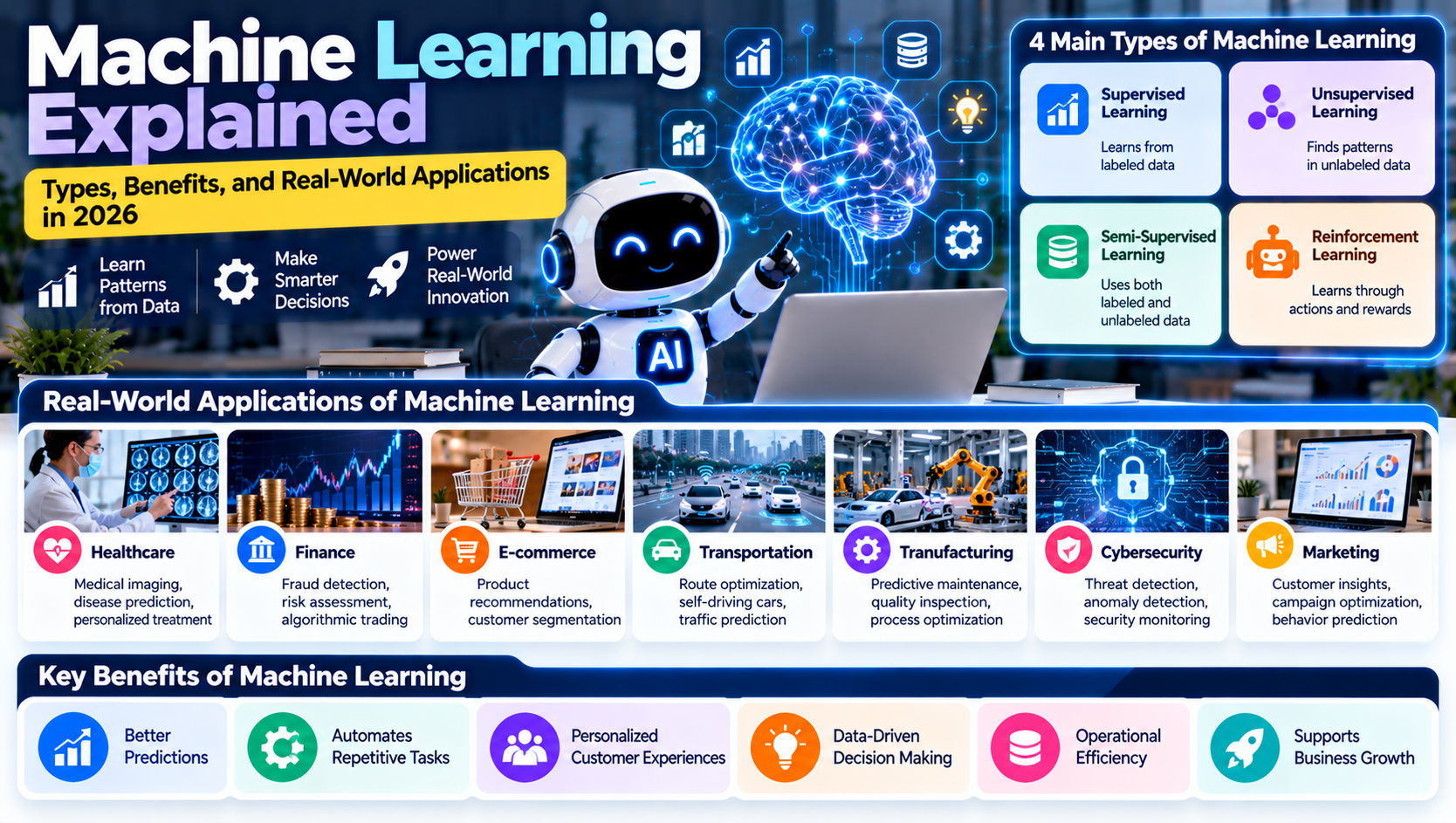
1. Healthcare
AI can support healthcare professionals by analyzing medical information, organizing documentation, assisting research, and improving administrative workflows.
Potential applications include:
Medical image analysis.
Clinical documentation support.
Appointment management.
Healthcare research.
Patient communication.
AI should support qualified healthcare professionals rather than replace clinical judgment.
2. Finance and Banking
Financial institutions use AI for analytical and operational activities.
Applications include:
Fraud detection.
Risk assessment.
Customer support.
Financial forecasting.
Document processing.
Compliance monitoring.
Generative AI can also help employees summarize reports and retrieve relevant information from approved internal resources.
3. Education
AI is changing how educational content is developed and delivered.
Teachers and students can use AI tools to:
Prepare lesson materials.
Generate practice questions.
Summarize educational content.
Explain complex topics.
Support language learning.
Organize research.
Educators remain essential for teaching, assessment, mentoring, and student development.
4. Manufacturing
Manufacturers use AI to improve production and equipment management.
Applications include:
Predictive maintenance.
Quality inspection.
Production planning.
Supply chain forecasting.
Inventory management.
AI can help manufacturers identify potential problems earlier and improve operational efficiency.
5. Retail and E-Commerce
Retail businesses use AI to understand customers and manage online operations.
Common applications include:
Product recommendations.
Inventory forecasting.
Customer service automation.
Personalized marketing.
Demand analysis.
Product content generation.
These capabilities can help businesses manage customer expectations and improve online shopping experiences.
6. Information Technology
The technology industry is experiencing significant changes through AI-assisted development and automation.
AI tools can help professionals:
Generate code suggestions.
Identify potential software errors.
Summarize technical documentation.
Support cybersecurity analysis.
Automate software testing.
Manage development workflows.
Human developers remain responsible for architecture, security, quality, and final implementation.
Benefits of Artificial Intelligence in the Workplace
When implemented responsibly, AI can provide several advantages to businesses and employees.
1. Higher Productivity
AI helps reduce the time required for repetitive and information-heavy tasks.
2. Reduced Operational Costs
Automation can reduce manual administrative work and improve resource allocation.
3. Faster Information Processing
AI can analyze and summarize large amounts of information, helping employees access relevant insights more efficiently.
4. Improved Customer Experiences
AI-powered support systems can help businesses provide faster responses and more consistent communication.
5. Better Business Insights
Predictive analytics and machine learning can help organizations identify patterns and understand potential business outcomes.
6. Greater Workplace Flexibility
AI-powered collaboration and productivity tools can support teams working across different locations and schedules.
7. More Opportunities for Innovation
By reducing routine work, AI can give employees more time to explore ideas, develop products, and improve business processes.
Challenges of Artificial Intelligence in the Workplace
Despite its benefits, AI adoption also introduces important challenges.
1. Job Displacement and Changing Responsibilities
Automation may reduce demand for certain repetitive tasks and change responsibilities within existing roles.
However, the effect differs across occupations. Many jobs involve multiple activities, some of which can be automated while others still require human involvement.
Employees and organizations should prepare for changing job requirements through continuous learning.
2. Skills Gaps
Some workers may not have the technical knowledge needed to use AI tools effectively.
Businesses can address this challenge through training programs, practical workshops, and ongoing professional development.
3. Data Privacy and Security
AI systems may process confidential company information, customer records, and employee data.
Organizations should establish clear policies about what information employees can share with AI tools.
They should also review security controls, data retention practices, access permissions, and relevant legal requirements.
4. Bias and Fairness
AI models can produce biased results when their training data or design reflects unfair patterns.
This is particularly important in recruitment, employee evaluation, lending, and other decisions affecting individuals.
Businesses should regularly evaluate AI systems and maintain appropriate human oversight.
5. Inaccurate AI Outputs
Generative AI can produce incorrect information, invented references, or misleading explanations.
Employees should verify important facts before using AI-generated content in reports, customer communications, or business decisions.
6. Overdependence on Technology
Relying too heavily on AI can reduce opportunities for employees to develop independent problem-solving and analytical skills.
Organizations should use AI to support human capabilities rather than remove meaningful human involvement from important tasks.
Skills Employees Need in the AI-Powered Workplace
The future of work will require a combination of technical knowledge and human capabilities.
Employees do not necessarily need to become AI engineers, but understanding how AI works and how to use it responsibly will become increasingly valuable.
1. AI Literacy
Professionals should understand basic AI concepts, common applications, limitations, and responsible usage.
2. Digital Skills
Comfort with modern business applications, cloud platforms, collaboration software, and digital workflows can help employees adapt to changing workplaces.
3. Critical Thinking
Employees must be able to evaluate information, identify errors, and make decisions beyond automated recommendations.
4. Data Literacy
Understanding basic data analysis, charts, trends, and metrics can help professionals work more effectively with AI systems.
5. Communication
Clear communication remains important for teamwork, customer relationships, leadership, and collaboration.
6. Adaptability
As technology changes, employees need to remain open to learning new tools and adjusting their responsibilities.
7. Creativity and Problem-Solving
AI can generate suggestions and content, but people remain important for defining problems, understanding context, and developing original solutions.
How Businesses Can Prepare for the Future of Work
Organizations should approach AI adoption strategically rather than introducing technology without understanding its business value.
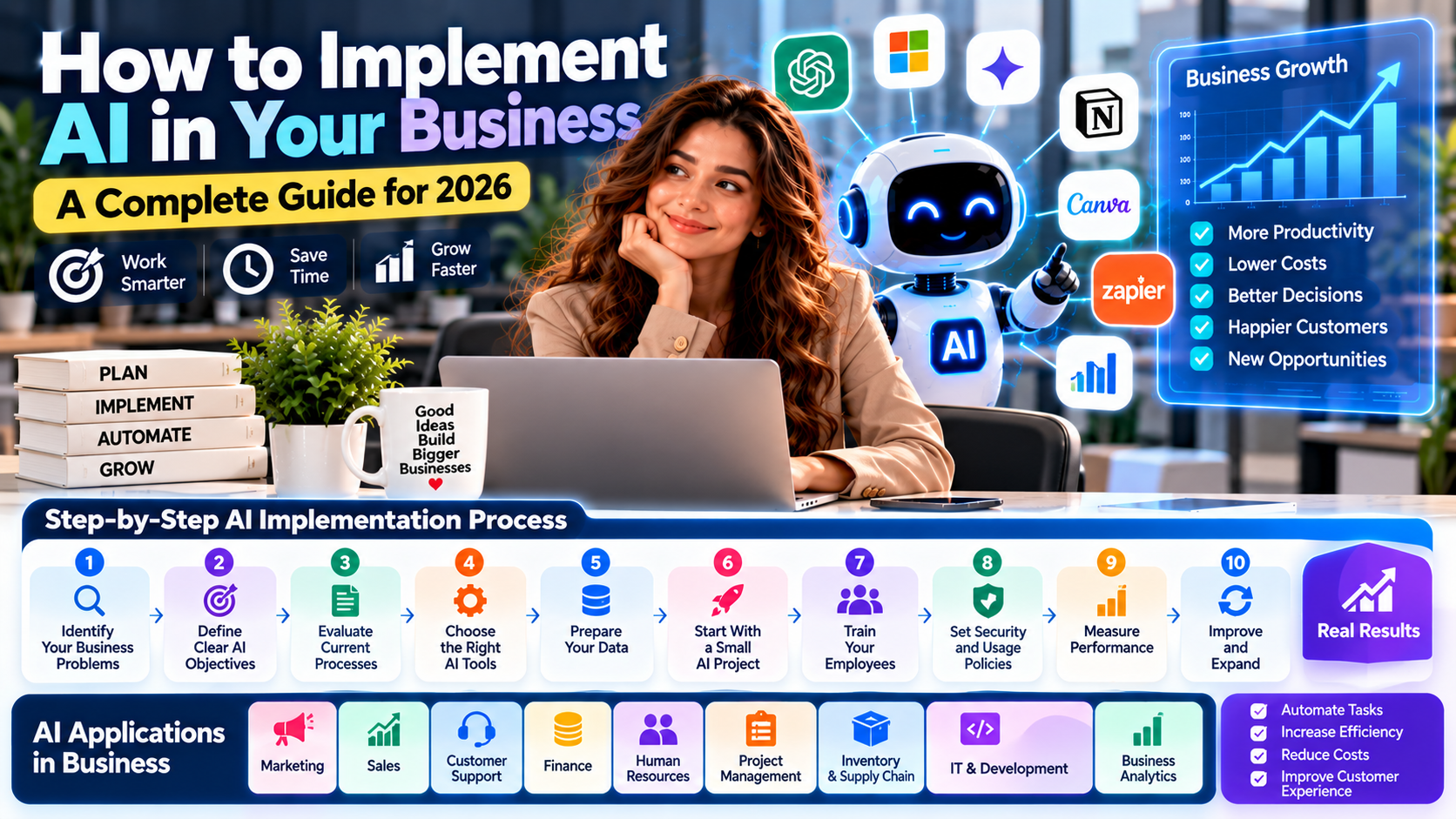
The following steps can help businesses prepare.
Step 1: Identify Repetitive Tasks
Review daily operations and identify activities that consume time without requiring complex human judgment.
Examples include data entry, routine reporting, document organization, and appointment scheduling.
Step 2: Select Suitable AI Tools
Choose tools according to business requirements, existing software, security needs, and available budgets.
Step 3: Train Employees
Provide practical training so employees understand how to use AI systems, evaluate their outputs, and recognize their limitations.
Step 4: Establish Responsible AI Policies
Create guidelines covering confidential information, approved applications, human review, data protection, and acceptable usage.
Step 5: Start With Small Projects
Test AI in one department or workflow before expanding it across the organization.
Step 6: Measure Performance
Track measurable results such as:
Time saved.
Workflow completion rates.
Customer response times.
Error rates.
Employee productivity.
Operating costs.
Step 7: Improve Continuously
Review AI performance regularly and adjust workflows as business needs and technology change.
Will Artificial Intelligence Replace Human Jobs?
One of the biggest questions about AI is whether it will replace human workers.
The answer is more complicated than a simple yes or no.
AI can automate certain tasks, particularly those involving repetitive processes, predictable patterns, and large amounts of information.
However, many jobs involve responsibilities that require human judgment, empathy, leadership, physical skills, creativity, and complex communication.
In many cases, AI is more likely to change how a job is performed rather than eliminate the entire occupation.
For example:
A marketer may use AI to generate campaign drafts but remain responsible for strategy.
An accountant may use automation for document processing but still review financial records.
A teacher may use AI to prepare educational materials but remain responsible for teaching and student development.
A developer may use AI coding assistance but still design, test, and maintain software systems.
The most important shift is that employees will increasingly need to understand how to work effectively with AI.
The Future of Work: What to Expect
Artificial intelligence will continue influencing workplace structures, business operations, and professional expectations.
Several trends are likely to shape the next stage of workplace transformation.
1. AI-Powered Workflows: More organizations will combine AI assistants, automation platforms, and business applications to manage multi-step processes.
2. Human-AI Collaboration: Employees will increasingly work alongside AI systems to improve productivity and support decision-making.
3. Growth of AI-Related Careers: Demand for AI implementation, governance, cybersecurity, data analysis, and technical expertise is likely to create new professional opportunities.
4. Continuous Learning: Employees will need to update their skills as technology and job responsibilities evolve.
5. More Personalized Work Experiences: AI tools may help employees organize information, access training, and manage certain responsibilities according to their needs.
6. Responsible AI Governance: Organizations will need stronger policies for privacy, transparency, security, fairness, and accountability.
The future workplace will not be defined by technology alone. It will depend on how effectively organizations combine AI capabilities with human knowledge and experience.
Frequently Asked Questions (FAQs)
1. How is artificial intelligence changing the future of work?
AI is changing the workplace by automating repetitive tasks, improving productivity, supporting decision-making, transforming customer service, and creating demand for new technical and professional skills.
2. Will AI replace human workers?
AI may automate some job tasks and change certain occupations, but many roles continue to require human judgment, communication, creativity, leadership, and specialized expertise.
3. Which industries are most affected by artificial intelligence?
Healthcare, finance, education, manufacturing, retail, marketing, and information technology are among the industries experiencing significant AI-related changes.
4. What skills are important in the AI-powered workplace?
AI literacy, digital skills, critical thinking, communication, data literacy, adaptability, creativity, and problem-solving are increasingly valuable.
5. How can employees prepare for AI-driven changes?
Employees can prepare by learning how AI tools work, developing digital skills, practicing critical thinking, and staying informed about changes within their industries.
6. How does AI improve workplace productivity?
AI can help automate routine tasks, summarize information, support research, generate content, organize data, and reduce the time required for certain business activities.
7. Can small businesses benefit from workplace AI?
Yes. Small businesses can use AI for customer support, marketing, scheduling, reporting, data organization, and workflow automation without necessarily building their own AI systems.
8. What is the future of human-AI collaboration?
Human-AI collaboration will likely involve employees using intelligent tools to complete tasks more efficiently while maintaining responsibility for judgment, creativity, relationships, and important decisions.
Conclusion
Artificial intelligence is reshaping the future of work by changing how businesses operate, how employees complete tasks, and what skills organizations need.
From workplace automation and AI-powered customer support to predictive analytics and content generation, these technologies are creating new opportunities while introducing challenges related to employment, privacy, security, and responsible use.
For employees, adapting to this transformation means developing digital knowledge, learning to use AI tools, and strengthening skills that technology cannot easily replace.
For businesses, successful AI adoption requires clear objectives, employee training, responsible policies, and continuous evaluation.
The future of work is not simply about replacing human capabilities with artificial intelligence. It is about combining technological efficiency with human creativity, experience, and judgment to build more productive and adaptable workplaces.