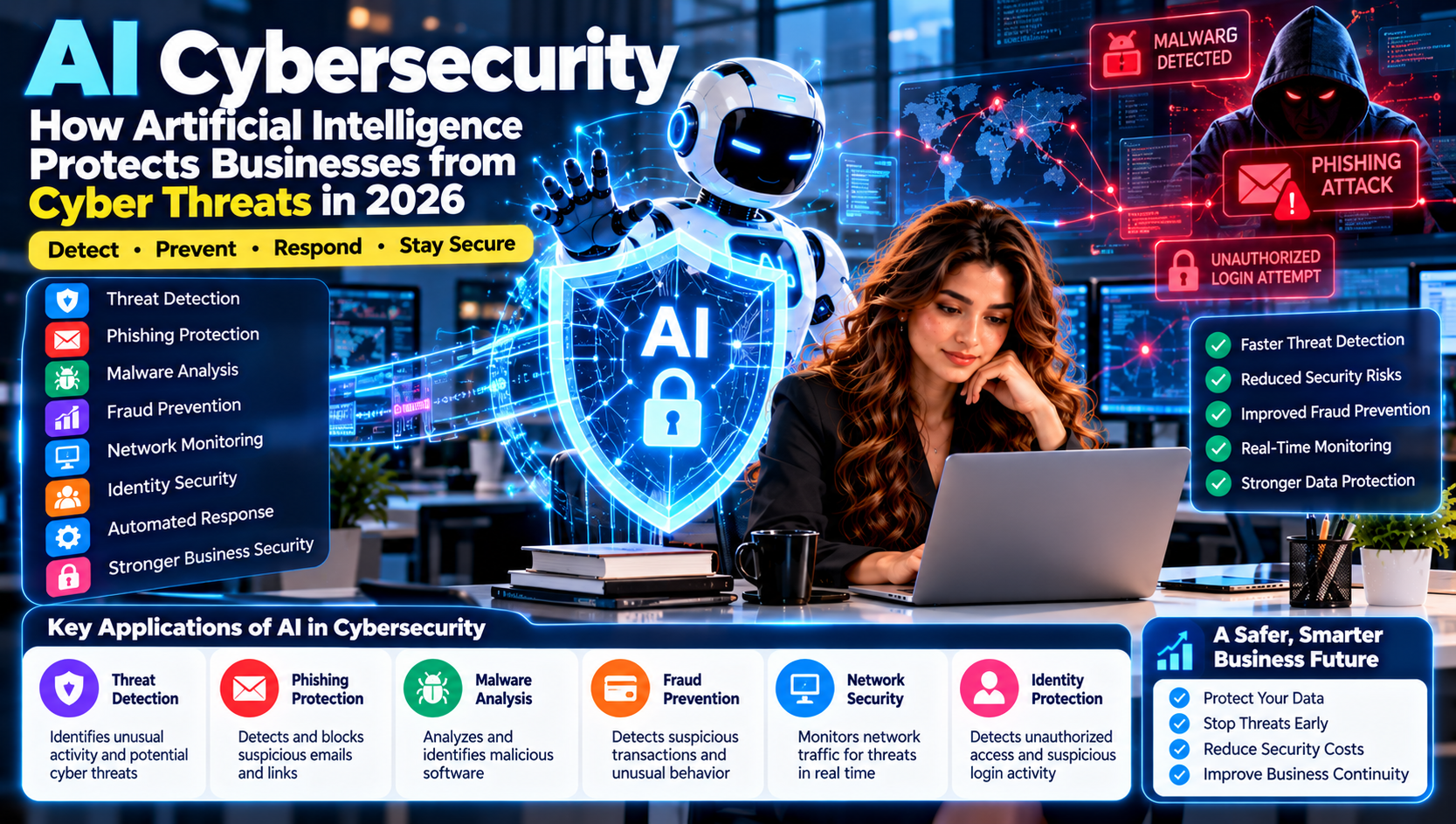
Cybersecurity has become one of the most important priorities for modern businesses. As organizations depend increasingly on cloud computing, online transactions, digital communication, and connected systems, the risks associated with cyberattacks continue to evolve.
Traditional security systems remain important, but modern cyber threats can be difficult to identify using fixed rules and manual monitoring alone.
Artificial intelligence is changing how organizations approach digital security. AI-powered cybersecurity systems can analyze large amounts of information, identify unusual activity, detect suspicious patterns, and help security teams respond to potential threats.
From identifying fraudulent transactions to monitoring network activity and analyzing malware, artificial intelligence is becoming an important part of modern cybersecurity strategies.
However, AI also introduces new security challenges. Cybercriminals can use AI to create convincing phishing messages, automate attacks, and develop more sophisticated scams.
This guide explains how AI cybersecurity works, its major applications, benefits, limitations, popular security platforms, and how businesses can implement AI-powered protection.
What Is AI Cybersecurity?
AI cybersecurity refers to the use of artificial intelligence and machine learning technologies to identify, analyze, prevent, and respond to digital security threats.
These systems process information from networks, computers, applications, user accounts, and other sources to identify patterns that may indicate suspicious activity.
Unlike security systems that depend entirely on predefined rules, machine learning models can learn from data and help recognize previously unseen patterns.
AI cybersecurity can support several security activities, including:
Threat detection.
Malware identification.
Network monitoring.
Phishing detection.
Fraud prevention.
User behavior analysis.
Security incident investigation.
Automated threat response.
Vulnerability prioritization.
For example, an AI-powered security platform may identify an unusual login attempt from an unfamiliar location, compare it with previous account activity, and flag it for further investigation.
AI does not eliminate the need for cybersecurity professionals. Instead, it helps security teams analyze information and respond more efficiently.
How Does AI Cybersecurity Work?
AI cybersecurity systems combine data collection, machine learning, behavioral analysis, and security automation.
Although different platforms use different technologies, most AI-driven security workflows follow several stages.
1. Data Collection
Security systems collect information from multiple sources, including:
Network traffic.
Login activity.
Computer systems.
Cloud applications.
Security logs.
Email communications.
Endpoint devices.
User activity.
This information helps security platforms understand normal system behavior and identify potential risks.
2. Data Analysis
AI models analyze collected information to identify unusual patterns, suspicious activities, and potential security incidents.
For example, a system may detect that an employee account is accessing an unusually large number of files within a short period.
3. Threat Identification
The system evaluates suspicious activity and determines whether it may represent a security threat.
Depending on the platform, AI can help identify:
Unusual login patterns.
Suspicious network connections.
Potential malware behavior.
Phishing attempts.
Abnormal file access.
Unexpected system changes.
4. Risk Assessment
AI-powered security platforms may prioritize alerts according to their severity, context, and potential impact.
This helps security teams focus on the incidents that require the most urgent attention.
5. Automated Response
Some platforms can initiate predefined security actions when certain conditions are met.
These may include:
Isolating a potentially compromised device.
Blocking suspicious network traffic.
Disabling a risky account session.
Requesting additional authentication.
Sending alerts to security teams.
High-impact actions should have appropriate approval procedures and human oversight.
6. Continuous Monitoring
Cybersecurity systems continue monitoring activity to identify new threats and evaluate whether security measures remain effective.
Machine learning models may also be updated as new information becomes available.
10 Ways Artificial Intelligence Is Transforming Cybersecurity
AI is changing cybersecurity across several important areas.
1. Advanced Threat Detection
Traditional security systems often depend on known attack signatures and predefined rules.
AI-powered platforms can also analyze behavior and identify unusual activity that does not match established patterns.
For example, an organization may experience an unexpected increase in network traffic from a particular device. AI-based monitoring can flag the activity for investigation.
Key applications:
Identifying unusual network behavior.
Detecting suspicious account activity.
Monitoring system changes.
Analyzing security events.
Prioritizing potential threats.
2. AI-Powered Phishing Detection
Phishing attacks attempt to trick individuals into revealing sensitive information, opening malicious files, or visiting fraudulent websites.
AI can help security systems analyze email content, sender behavior, links, attachments, and other indicators to identify suspicious messages.
It can support the detection of:
Fake business emails.
Suspicious payment requests.
Impersonation attempts.
Fraudulent login pages.
Malicious attachments.
However, AI cannot guarantee that every phishing message will be identified. Employee awareness and email security controls remain essential.
3. Malware Detection and Analysis
Malware is malicious software designed to damage systems, steal information, or gain unauthorized access.
Machine learning can help identify suspicious file characteristics and behavior.
AI-assisted malware analysis may examine:
File activity.
Process behavior.
System changes.
Network connections.
Unusual execution patterns.
Behavior-based detection can help security teams investigate suspicious files even when their exact signatures are not already known.
4. Fraud Detection
Financial institutions and online businesses use AI to analyze transaction patterns and identify potentially fraudulent activity.
AI systems can evaluate factors such as:
Transaction frequency.
Account behavior.
Device information.
Unusual purchasing patterns.
Geographic inconsistencies.
Historical transaction data.
For example, an online payment system may flag a transaction that differs significantly from a customer's normal activity.
The transaction can then be reviewed or subjected to additional verification.
5. Real-Time Network Monitoring
Organizations need to monitor their networks to identify unauthorized access, unusual connections, and potential attacks.
AI-powered monitoring systems can analyze network activity and highlight suspicious behavior.
Applications include:
Detecting unusual data transfers.
Identifying suspicious connections.
Monitoring network traffic.
Detecting abnormal device behavior.
Supporting incident investigation.
This can help security teams identify problems more quickly.
6. Identity and Access Protection
Identity-related attacks often involve stolen credentials, compromised accounts, or unauthorized access.
AI can support identity security by analyzing user behavior and identifying unusual login patterns.
For example, a security system may flag an account that suddenly attempts to access sensitive resources from an unfamiliar device.
Organizations can combine AI-assisted monitoring with:
Multi-factor authentication.
Strong password policies.
Role-based access controls.
Privileged access management.
Session monitoring.
7. Insider Threat Detection
Not every security threat originates outside an organization.
Insider threats can involve employees, contractors, or other authorized users who misuse their access or unintentionally expose sensitive information.
AI-powered behavioral monitoring can help identify unusual activities, such as unexpected file downloads or abnormal access patterns.
These alerts should be investigated carefully because unusual behavior does not automatically indicate wrongdoing.
8. Automated Security Operations
Security teams often receive large numbers of alerts from different systems.
AI can help organize alerts, summarize incidents, correlate information, and recommend investigation steps.
Security orchestration, automation, and response platforms can also execute predefined actions.
This can reduce repetitive work and help analysts focus on more complex incidents.
9. Vulnerability Management
Software vulnerabilities can expose businesses to cyberattacks when they remain unpatched.
AI-assisted security platforms can help analyze vulnerability information, identify potentially exposed systems, and prioritize remediation based on risk.
Organizations can use these capabilities alongside:
Regular security assessments.
Software updates.
Patch management.
Asset inventories.
Secure configuration reviews.
10. Security Incident Investigation
After a cyber incident, security teams need to understand what happened, which systems were affected, and what actions should be taken.
AI can help analyze security logs, summarize alerts, connect related events, and organize investigation information.
This can support incident response, but important conclusions should be verified by qualified security professionals.
Types of AI Technologies Used in Cybersecurity
Different AI techniques support different security tasks.
1. Machine Learning
Machine learning models learn patterns from security data and use them to identify suspicious activity.
Applications include:
Fraud detection.
Malware classification.
Network anomaly detection.
Spam identification.
User behavior analysis.
2. Deep Learning
Deep learning uses multi-layer neural networks to learn complex patterns from large datasets.
It can support:
Advanced malware analysis.
Network traffic classification.
Security image and pattern recognition.
Complex anomaly detection.
3. Natural Language Processing
Natural language processing (NLP) enables computer systems to analyze and understand human language.
In cybersecurity, NLP can help examine:
Phishing emails.
Suspicious messages.
Fraudulent communication.
Threat intelligence reports.
Security documentation.
4. Behavioral Analytics
Behavioral analytics focuses on identifying unusual patterns in user, device, and application activity.
It can help organizations detect:
Unusual login behavior.
Unexpected file access.
Abnormal data transfers.
Suspicious account activity.
5. Generative AI
Generative AI can assist cybersecurity professionals with summarizing security incidents, explaining technical findings, preparing reports, and searching approved security documentation.
It may also help analysts investigate threats by organizing complex information.
However, generative AI can produce inaccurate explanations, so security findings must be independently verified.
Popular AI Cybersecurity Tools and Platforms
Several cybersecurity providers offer AI-powered capabilities for enterprise security, endpoint protection, threat detection, and incident response.
1. Microsoft Security Copilot
<AsyncImage query="Microsoft Security Copilot cybersecurity analyst interface threat investigation" aspectRatio="16:9" width="100%"/>
<Entity value="Microsoft Security Copilot" category="software" disambig="Microsoft generative AI cybersecurity assistant"/> helps security professionals investigate threats, summarize incidents, and work with security information.
Key Features:
AI-assisted security investigations.
Threat intelligence summaries.
Incident analysis support.
Security workflow assistance.
Integration with supported Microsoft security products.
Best For: Organizations using Microsoft security technologies.
Official Website: https://www.microsoft.com/en-us/security/business/ai-machine-learning/microsoft-security-copilot
2. CrowdStrike Falcon
<AsyncImage query="CrowdStrike Falcon cybersecurity endpoint protection dashboard" aspectRatio="16:9" width="100%"/>
<Entity value="CrowdStrike Falcon" category="software" disambig="Endpoint security and threat detection platform"/> is a cybersecurity platform that provides endpoint protection, threat detection, and incident response capabilities.
Key Features:
Endpoint threat detection.
Behavioral analysis.
Threat intelligence.
Security investigation.
Incident response capabilities.
Best For: Organizations that need endpoint protection and threat monitoring.
Official Website: https://www.crowdstrike.com/platform/
3. Darktrace
<AsyncImage query="Darktrace AI cybersecurity network threat detection dashboard" aspectRatio="16:9" width="100%"/>
<Entity value="Darktrace" category="company" disambig="AI cybersecurity and threat detection company"/> develops AI-based cybersecurity products designed to identify unusual behavior across digital environments.
Key Features:
Network anomaly detection.
Behavioral analysis.
Threat investigation.
Autonomous response capabilities.
Cloud and email security solutions.
Best For: Organizations looking for AI-assisted monitoring across complex digital environments.
Official Website: https://www.darktrace.com/
4. SentinelOne Singularity
<AsyncImage query="SentinelOne Singularity cybersecurity endpoint security dashboard" aspectRatio="16:9" width="100%"/>
<Entity value="SentinelOne Singularity" category="software" disambig="AI-powered cybersecurity platform"/> provides endpoint security, threat detection, and response capabilities.
Key Features:
Endpoint protection.
Threat detection.
Automated response capabilities.
Security investigation.
AI-assisted security operations.
Best For: Businesses that need endpoint security and centralized threat management.
Official Website: https://www.sentinelone.com/platform/
5. IBM QRadar
<AsyncImage query="IBM QRadar SIEM cybersecurity security operations dashboard" aspectRatio="16:9" width="100%"/>
<Entity value="IBM QRadar" category="software" disambig="Security information and event management platform"/> supports security monitoring and investigation by helping organizations collect and analyze security events.
Key Features:
Security event management.
Threat investigation.
Log analysis.
Security alert prioritization.
Incident investigation support.
Best For: Organizations managing complex security environments and large volumes of security events.
Official Website: https://www.ibm.com/products/qradar-siem
6. Google Security Operations
<AsyncImage query="Google Security Operations cybersecurity threat detection dashboard" aspectRatio="16:9" width="100%"/>
<Entity value="Google Security Operations" category="software" disambig="Google cloud security operations platform"/> provides tools for security analytics, threat investigation, and security operations.
Key Features:
Security data analysis.
Threat intelligence.
Detection and investigation workflows.
Security operations automation.
Incident management support.
Best For: Organizations seeking centralized security operations and threat investigation capabilities.
Official Website: https://cloud.google.com/security/products/security-operations
Note: Product features, AI capabilities, licensing, and availability vary by platform and subscription. Review official provider documentation before purchasing.
AI Cybersecurity vs. Traditional Cybersecurity
Traditional cybersecurity and AI-powered cybersecurity are complementary approaches.
Traditional security relies heavily on predefined rules, known threat signatures, access controls, and manually configured security policies.
AI-powered security adds behavioral analysis, machine learning, and automated assistance to help identify suspicious patterns.
Comparison | Traditional Cybersecurity | AI-Powered Cybersecurity |
|---|---|---|
Detection approach | Rules and known signatures | Rules, patterns, and learned behavior |
Threat analysis | Often requires manual investigation | Can assist with large-scale analysis |
Unknown threats | May struggle without known indicators | Can identify unusual behavior |
Monitoring | Depends on configured systems and staff | Can support continuous automated analysis |
Response | Manual or rule-based actions | Can support automated and guided responses |
Adaptability | Requires updates to rules and signatures | Models can be updated using new data |
Human involvement | Essential | Essential for oversight and complex decisions |
AI does not replace traditional cybersecurity. Strong protection generally combines multiple security layers.
Benefits of AI in Cybersecurity
AI can provide important advantages when integrated into a well-designed security strategy.
1. Faster Threat Identification
AI can analyze large volumes of security information and help identify suspicious activity more quickly.
2. Improved Anomaly Detection
Machine learning can help identify behavior that differs from established patterns.
3. Reduced Alert Overload
AI-assisted systems can organize and prioritize alerts, helping analysts focus on important incidents.
4. Better Fraud Prevention
AI can analyze transaction patterns and identify potentially fraudulent activity.
5. More Efficient Security Operations
Automation can reduce repetitive investigation and reporting tasks.
6. Improved Visibility
AI-supported monitoring can help organizations understand activity across endpoints, networks, cloud applications, and user accounts.
7. Support for Security Professionals
AI assistants can summarize technical findings, explain security alerts, and organize incident information.
Risks and Limitations of AI Cybersecurity
Although AI can improve digital security, it is not a complete solution.
Organizations must understand the limitations of these technologies.
1. False Positives
AI systems may incorrectly classify legitimate activity as suspicious.
This can create unnecessary alerts and increase the workload of security teams.
2. False Negatives
A system may fail to identify a genuine threat.
No AI model can guarantee that every cyberattack will be detected.
3. Data Quality Problems
Machine learning systems depend on the quality and relevance of their training and operational data.
Incomplete or inaccurate information can affect model performance.
4. Adversarial Attacks
Attackers may attempt to manipulate AI systems by creating inputs designed to confuse or mislead models.
Organizations need testing, monitoring, and security controls to reduce these risks.
5. Privacy Concerns
Cybersecurity platforms may process sensitive user, employee, and business information.
Companies should review data handling practices, access permissions, and retention policies.
6. Implementation Costs
Advanced AI security platforms may require substantial investment in software, infrastructure, integrations, and employee training.
7. Overdependence on Automation
Automated security responses can create problems if they are poorly configured.
For example, incorrectly isolating an important business system could interrupt operations.
Human approval should be maintained for high-impact actions when appropriate.
How Businesses Can Implement AI Cybersecurity
AI cybersecurity should be introduced as part of a broader information security strategy.
Businesses can follow these steps to adopt AI responsibly.
Step 1: Assess Existing Security Risks
Begin by reviewing the organization's current security environment.
Identify:
Important business systems.
Sensitive information.
Existing security controls.
Common attack risks.
Vulnerable applications.
Current monitoring capabilities.
This assessment helps determine where AI-powered security may provide value.
Step 2: Define Security Objectives
Choose specific objectives before purchasing a platform.
Examples include:
Improve phishing detection.
Monitor suspicious account activity.
Strengthen endpoint protection.
Reduce security alert overload.
Improve incident investigation.
Monitor cloud environments.
Step 3: Choose the Right Security Platform
Select a solution according to your organization's size, infrastructure, and security requirements.
Consider:
Endpoint protection.
Network monitoring.
Cloud security.
Identity protection.
Security information and event management.
Incident response capabilities.
Step 4: Integrate Existing Security Systems
AI security tools should work with existing security controls where possible.
Organizations may integrate them with:
Firewalls.
Endpoint protection systems.
Identity management platforms.
Cloud environments.
Security monitoring systems.
Incident management software.
Step 5: Establish Data Protection Policies
Define how sensitive information is collected, stored, processed, and accessed.
Apply appropriate security controls, encryption, permissions, and retention policies.
Step 6: Train Security Teams
Employees should understand how AI security alerts work and how to investigate them.
Training should include:
Identifying phishing attempts.
Understanding security alerts.
Evaluating AI-generated recommendations.
Following incident response procedures.
Recognizing false positives.
Protecting sensitive information.
Step 7: Test and Monitor Performance
Evaluate the system using controlled testing and measurable performance indicators.
Important metrics include:
Threat detection rate.
False positive rate.
Mean time to detect.
Mean time to respond.
Number of unresolved security alerts.
Incident recurrence.
Security coverage.
Step 8: Improve Continuously
Review security performance regularly, update configurations, test incident response procedures, and improve detection rules.
AI cybersecurity should be treated as an ongoing process rather than a one-time software installation.
How Cybercriminals Are Using Artificial Intelligence
AI is not only helping cybersecurity professionals. Cybercriminals can also use AI technologies to make certain attacks more convincing and scalable.
Organizations should understand these emerging risks.
1. AI-Generated Phishing Messages
Attackers can use generative AI to create convincing emails and messages that imitate professional communication.
These messages may contain fewer spelling mistakes and appear more personalized.
2. Deepfake Impersonation
AI-generated audio and video can be used to impersonate executives, employees, or other trusted individuals.
For example, an attacker may attempt to convince an employee that a senior manager has requested an urgent financial transfer.
Businesses should verify sensitive requests through trusted communication channels rather than relying on voice or video alone.
3. Automated Social Engineering
AI can help attackers generate personalized messages based on publicly available information.
This can make social engineering attempts more difficult to recognize.
4. Faster Vulnerability Research
Attackers may use AI-assisted tools to analyze technical information and identify potential weaknesses.
Organizations should maintain timely security updates and vulnerability management procedures.
5. Malware Development Assistance
Generative AI may help attackers understand programming concepts or modify malicious software.
Security teams should focus on layered protection, behavioral monitoring, and secure system configurations.
Essential Cybersecurity Practices Every Business Should Follow
AI-powered tools should complement basic cybersecurity practices rather than replace them.
Every organization should consider the following measures:
1. Use Multi-Factor Authentication: Require additional verification for important accounts.
2. Maintain Software Updates: Install security updates and patches promptly.
3. Back Up Important Information: Keep protected backups and test recovery procedures.
4. Use Strong Access Controls: Give employees access only to the information they need.
5. Train Employees: Conduct regular security awareness training.
6. Protect Business Email: Use appropriate email security and phishing protection.
7. Monitor Network Activity: Review unusual activity and security alerts.
8. Prepare an Incident Response Plan: Define how the organization will respond to cyber incidents.
9. Secure Cloud Applications: Review account permissions, configurations, and access policies.
10. Review AI Tools Carefully: Assess privacy, security, and data handling before connecting business systems.
The Future of AI Cybersecurity in 2026 and Beyond
AI cybersecurity is developing rapidly as organizations face increasingly complex digital threats.
Several trends are likely to influence its future.
1. AI Security Agents: AI assistants and agents may increasingly support threat investigation, alert management, and security workflows under defined permissions.
2. Advanced Behavioral Detection: Machine learning will continue supporting the identification of unusual activity across networks, devices, and accounts.
3. AI-Powered Identity Protection: Organizations will increasingly explore behavioral signals to identify compromised accounts and suspicious access attempts.
4. Generative AI for Security Operations: Security teams may use AI assistants to summarize incidents, explain alerts, and retrieve relevant security information.
5. Protection Against Deepfakes: Businesses will need stronger identity verification and communication procedures to defend against synthetic impersonation.
6. AI Governance and Security: Organizations will need policies covering AI model security, privacy, transparency, and responsible automation.
7. Human-AI Collaboration: Cybersecurity professionals will continue combining technical expertise with AI-assisted analysis and automation.
The future of cybersecurity will depend on combining advanced technology with strong security practices, skilled professionals, and effective governance.
Frequently Asked Questions (FAQs)
1. What is AI cybersecurity?
AI cybersecurity is the use of artificial intelligence and machine learning to identify, analyze, prevent, and respond to digital threats.
2. How does AI help prevent cyberattacks?
AI can analyze network activity, user behavior, emails, files, and security events to identify suspicious patterns and support faster threat detection.
3. Can AI detect phishing emails?
Yes. AI-powered security tools can analyze message content, sender behavior, links, and other indicators to help identify phishing attempts. However, no system detects every malicious message.
4. What are the best AI cybersecurity tools?
Popular platforms with AI-powered or machine-learning-based security capabilities include Microsoft Security Copilot, CrowdStrike Falcon, Darktrace, SentinelOne Singularity, IBM QRadar, and Google Security Operations.
5. Can AI replace cybersecurity professionals?
No. AI can automate certain activities and support threat investigation, but cybersecurity professionals remain important for complex decisions, incident response, risk management, and security strategy.
6. How is machine learning used in cybersecurity?
Machine learning can help identify unusual network activity, classify malware, detect suspicious transactions, recognize phishing patterns, and analyze user behavior.
7. Can hackers use AI for cyberattacks?
Yes. Cybercriminals can use AI to create convincing phishing messages, impersonate individuals, automate certain activities, and assist with malicious technical tasks.
8. Is AI cybersecurity suitable for small businesses?
Yes. Small businesses can benefit from security products with AI-assisted threat detection, email protection, endpoint security, and identity monitoring. The right solution depends on their risks and budget.
9. What is the difference between traditional and AI-powered cybersecurity?
Traditional cybersecurity often relies on predefined rules and known threat signatures. AI-powered cybersecurity adds behavioral analysis and machine learning to help identify unusual patterns and support threat investigation.
Conclusion
Artificial intelligence is becoming an important part of modern cybersecurity. As businesses move more operations online, they need security systems capable of monitoring digital activity, identifying suspicious behavior, and supporting effective incident response.
AI can strengthen threat detection, improve phishing analysis, identify potential fraud, monitor networks, and reduce repetitive security work.
However, AI is not a replacement for strong security practices or experienced cybersecurity professionals. Organizations must also consider data privacy, false alerts, implementation costs, and the risks of AI-assisted cyberattacks.
The most effective approach combines AI-powered security technologies with multi-factor authentication, software updates, employee training, access controls, and human oversight.
In modern cybersecurity, AI can provide an important advantage, but strong protection still depends on a complete and well-managed security strategy.