Paying for college or graduate school can be expensive, especially when tuition, housing, textbooks, transportation, and other education-related costs exceed the financial aid available. For students who need additional funding, private student loans can help cover eligible educational expenses.
Private student loans are offered by banks, credit unions, and specialized financial institutions rather than the federal government. Depending on the lender, borrowers may find different interest rates, repayment terms, cosigner options, and payment arrangements.
However, private student loans are not suitable for every student. Interest rates and eligibility requirements often depend on credit history, income, and the financial strength of a cosigner. Private loans also generally lack the repayment flexibility and borrower protections available through federal student loan programs. <Cite refs={["turn342878search0","turn342878search1"]}/>
This guide compares private student loan lenders in 2026, explains how these loans work, and outlines what students and families should consider before borrowing.
What Are Private Student Loans?
Private student loans are education loans offered by private financial institutions to help students pay for college, university, graduate school, or certain eligible career-training programs.
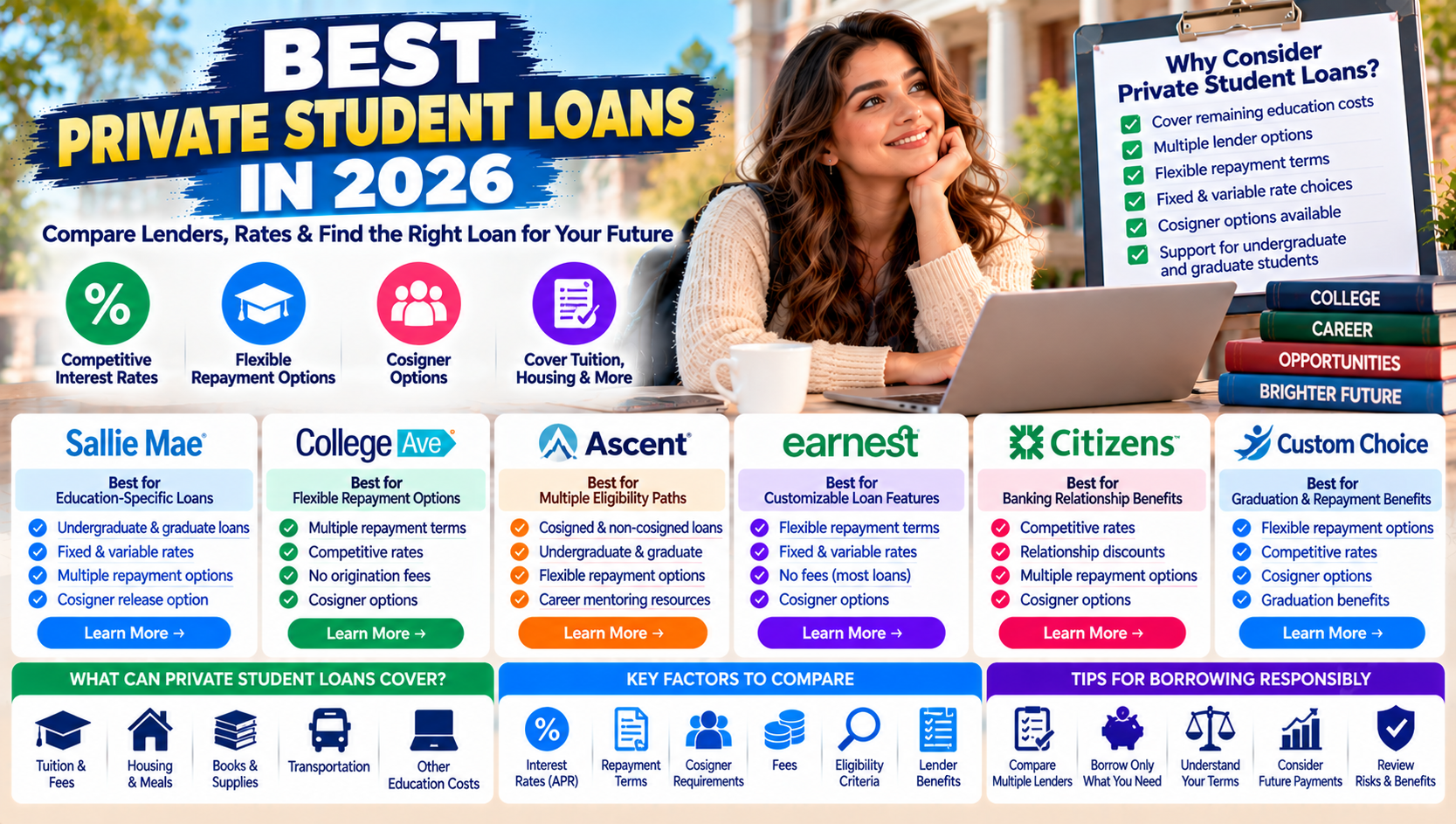
Depending on the lender and loan agreement, funds may cover expenses such as:
Tuition and mandatory academic fees
Housing and meals
Books and educational supplies
Transportation and other eligible education expenses
Remaining education costs not covered by other financial aid
Many lenders coordinate with the student's school to certify the amount needed and disburse approved funds.
Private student loans are different from federal student loans. Federal loans are issued under government programs and may offer income-driven repayment options, certain forgiveness programs, and federal hardship protections. Private loans follow the lender's contract and applicable consumer protection laws. <Cite refs={["turn342878search4","turn342878search6"]}/>
Best Private Student Loan Lenders in 2026
Several established lenders are worth comparing when researching private education loans in the United States.
The following companies offer different loan products, so the best option depends on the student's education level, credit profile, repayment preferences, and eligibility.
Lender | Potential strength | Best for |
|---|---|---|
Sallie Mae | Education-specific loan options | Students comparing undergraduate and graduate loans |
College Ave | Multiple repayment structures | Students seeking repayment flexibility |
Ascent | Different eligibility pathways | Students exploring cosigned and eligible non-cosigned options |
Earnest | Customizable loan features | Eligible borrowers comparing repayment choices |
Citizens | Banking relationship options | Borrowers exploring potential relationship discounts |
Custom Choice | Loan-specific benefits | Eligible students comparing repayment and graduation benefits |
These lenders are comparison candidates, not a guaranteed ranking. Rates, terms, benefits, and eligibility can change. Review each lender's current disclosures before applying. Recent lender comparisons from <Entity category="organization" value="NerdWallet" disambig="Personal finance comparison and editorial website"/> and <Entity category="organization" value="The Wall Street Journal" disambig="U.S. financial news publication"/> also discuss differences in private student loan products. <Cite refs={["turn342878search9","turn342878news12"]}/>
1. Sallie Mae
<Entity category="company" value="Sallie Mae" disambig="U.S. private student loan lender"/> offers private education loans for eligible students, including undergraduate and graduate borrowers.
Students may consider Sallie Mae when comparing education-specific financing options. Eligibility, loan amounts, repayment choices, and interest rates depend on the product and applicant's circumstances.
Before accepting an offer, review:
Fixed and variable interest rate options
Repayment arrangements while enrolled in school
Grace periods and repayment start dates
Cosigner requirements and release policies
Fees and hardship provisions
A cosigner may help an applicant qualify or obtain a more competitive rate, but the cosigner is legally responsible under the loan agreement if the student fails to repay.
2. College Ave
<Entity category="company" value="College Ave" disambig="Private student loan and education financing provider"/> provides private student loan products for eligible undergraduate and graduate students.
It may be worth comparing if you want to evaluate different repayment terms and options for managing payments while attending school.
Consider the full cost of the loan rather than focusing only on the monthly payment. A plan that postpones payments may allow more interest to accumulate before repayment begins.
Compare available interest rates, repayment terms, cosigner requirements, and the total amount payable after graduation.
3. Ascent
<Entity category="company" value="Ascent" disambig="Private student loan provider"/> offers student loan options with different eligibility pathways, including products designed for eligible borrowers applying with or without a cosigner.
Eligibility for a non-cosigned loan depends on the specific product and its requirements. Students should not assume that every applicant can qualify independently.
When evaluating Ascent, check:
The eligibility criteria for your education level
Whether a cosigner is required
The APR and repayment term
Available payment arrangements during school
Any benefits associated with graduation or repayment
Compare these features with competing offers before making a decision.
4. Earnest
<Entity category="company" value="Earnest" disambig="Online student loan and refinancing lender"/> offers private student loan products for eligible students and families.
Its loan options may appeal to borrowers who want to compare repayment structures and available loan features.
Before applying, review the current eligibility standards, interest rate options, cosigner policies, and any conditions attached to discounts or borrower benefits.
The most suitable loan is not necessarily the one with the lowest advertised rate. It is the one that offers affordable repayment and manageable overall borrowing costs for your situation.
5. Citizens
<Entity category="company" value="Citizens" disambig="U.S. retail bank and student loan provider"/> offers private student loan options for qualifying borrowers.
Depending on the product and current program rules, certain borrowers may be eligible for relationship-based or automatic-payment discounts.
Review whether any discount requires an eligible bank account, automatic withdrawals, or other conditions. Compare the rate before and after discounts, and check the loan's repayment and cosigner provisions.
6. Custom Choice
Custom Choice offers private student loan options through participating lending arrangements.
Eligible borrowers may wish to compare its current repayment terms and any available graduation-related benefits against other providers.
Read the official loan disclosures carefully to understand eligibility, the APR, repayment obligations, and whether any benefit depends on meeting specific conditions.
Private Student Loan Interest Rates in 2026
Private student loan interest rates vary by lender and borrower. Factors may include credit history, income, the presence of a cosigner, the amount borrowed, and the repayment term.
Lenders may offer fixed or variable rates.
Fixed interest rate: The rate remains the same throughout the loan term, helping make payments more predictable.
Variable interest rate: The rate can change according to the loan agreement and its reference rate, potentially increasing or decreasing borrowing costs.
Some lenders advertise low starting rates, but these are generally available only to applicants who meet specific credit and eligibility standards. Your actual rate may be considerably higher.
Instead of comparing advertised rates alone, review the APR, applicable fees, repayment term, and total amount payable. Current market offers should be verified directly with lenders because rates can change frequently. <Cite refs={["turn342878search3","turn342878search9"]}/>
Fixed vs. Variable Private Student Loans
Feature | Fixed-rate loan | Variable-rate loan |
|---|---|---|
Interest rate | Remains unchanged | Can change over time |
Payment predictability | Generally more predictable | Payments may increase or decrease |
Exposure to rising rates | Lower | Higher |
Potential initial rate | May be higher than some variable offers | May start lower, depending on the offer |
Best consideration | Budget certainty | Ability to handle possible rate increases |
A fixed-rate loan may be more appropriate for borrowers who value predictable payments throughout repayment. A variable-rate loan may appeal to borrowers who understand the risks and can manage potential increases.
Always check how frequently a variable rate can change, what benchmark it follows, and whether the contract sets any limits on rate increases.
How to Qualify for a Private Student Loan
Private lenders use their own underwriting standards to assess applications. Requirements vary, but common factors include the following.
Credit History
Lenders may evaluate the applicant's credit score and credit history. Students with limited credit histories may have difficulty qualifying independently.
Income and Repayment Ability
Some lenders review the borrower's income, employment, or other financial information to assess the ability to repay.
For students without sufficient income, a qualified cosigner may be required or may improve the application.
Cosigner Requirements
A cosigner is someone who agrees to be legally responsible for the loan if the primary borrower does not make the required payments.
A creditworthy cosigner may help a student qualify or obtain a better rate. However, cosigning creates financial risk for the cosigner and should be considered carefully.
Enrollment and Education Level
Lenders may require enrollment at an eligible institution and may have different requirements for undergraduate, graduate, professional, or career-training programs.
Citizenship and Residency
Some lenders impose citizenship, permanent residency, or other eligibility conditions. International students may need an eligible U.S. cosigner or a loan specifically designed for their circumstances.
Check the exact requirements for your chosen lender before submitting a full application. <Cite refs={["turn342878search10","turn342878search13"]}/>
Do You Need a Cosigner for a Private Student Loan?
Many undergraduate students apply with a parent, relative, or another creditworthy cosigner because they have limited credit histories or income.
A cosigner may help with approval or pricing, but approval and rate improvements are not guaranteed.
Before agreeing to cosign, consider the following:
The cosigner may be responsible for the entire outstanding balance if the student does not pay.
Missed payments may affect the cosigner's credit.
The debt may affect the cosigner's ability to qualify for other credit.
Cosigner release may be available only after meeting the lender's specific requirements.
If a lender offers cosigner release, review the conditions carefully. These may include a minimum number of consecutive on-time payments and a new credit or income assessment.
Repayment Options for Private Student Loans
Private student loan repayment arrangements differ by lender and product. Common structures include the following.
Immediate Repayment
The borrower begins making required principal and interest payments while enrolled in school.
This may reduce the amount of interest that accumulates before graduation, but it requires enough income or financial support to make payments during enrollment.
Interest-Only Payments
The borrower pays the interest that accrues during a specified period while enrolled.
This can prevent some interest from being added to the loan balance, depending on the contract, but the principal generally remains outstanding until principal repayment begins.
Fixed In-School Payments
Some lenders offer a smaller, specified payment while the student is enrolled. Interest may continue to accrue beyond the amount paid.
Deferred Repayment
Payments are postponed until a specified point, such as after leaving school or completing a grace period.
Although this arrangement can make studying more manageable, interest may accumulate during the deferment period and increase the balance owed later.
Compare the repayment options carefully. A lower payment during college may lead to a higher total cost over the life of the loan. <Cite refs={["turn342878search10","turn342878search13"]}/>
Private Student Loans vs. Federal Student Loans
Before choosing a private loan, compare it with federal student aid.
Feature | Federal student loans | Private student loans |
|---|---|---|
Provider | U.S. Department of Education | Banks and private lenders |
Interest rates | Set under federal program rules | Set by individual lenders |
Credit requirements | Many federal Direct Loans do not require a credit check | Credit and underwriting requirements commonly apply |
Cosigner | Generally not required for Direct Loans | Often required for students with limited credit |
Income-driven repayment | Available for eligible federal loans under applicable rules | Generally not available in the same federal-program form |
Federal forgiveness programs | May be available if eligibility requirements are met | Not eligible for federal student loan forgiveness programs |
Payment flexibility | Federal protections and options apply | Depends on the lender and contract |
For most borrowers, federal student loans should be considered before private loans because they generally offer stronger borrower protections. Students should complete the Free Application for Federal Student Aid (FAFSA) and explore available grants, scholarships, work-study, and federal loans before borrowing privately. <Cite refs={["turn342878search1","turn342878search4"]}/>
Advantages of Private Student Loans
Private student loans may help bridge a funding gap when other resources do not cover eligible education expenses.
Potential advantages include:
Additional education funding: May cover eligible costs remaining after other financial aid.
Different rate options: Some borrowers with strong credit may qualify for competitive interest rates.
Repayment choices: Certain lenders offer different in-school payment arrangements and repayment terms.
Cosigner options: A qualified cosigner may help some students qualify.
Specialized products: Certain lenders offer loans for particular education levels or eligible programs.
These advantages depend on the loan agreement and borrower qualifications. Private financing should be compared with other available funding sources before borrowing.
Disadvantages and Risks of Private Student Loans
Private loans can create long-term financial obligations. Understand the risks before signing an agreement.
1. Limited Repayment Flexibility
Private lenders generally do not offer the same federal income-driven repayment programs as eligible federal student loans. If your income falls after graduation, your contractual payment may still be due.
2. Variable Interest Rates
A variable-rate loan may become more expensive if its interest rate increases.
3. Cosigner Liability
If you cannot make payments, your cosigner may be legally required to repay the debt under the agreement.
4. Interest Accumulation
Interest may accrue while you are studying, particularly if payments are deferred. Unpaid interest may be added to the principal when permitted by the contract, increasing future borrowing costs.
5. Limited Forgiveness Options
Private student loans generally do not qualify for federal student loan forgiveness programs. Any cancellation or hardship assistance depends on the lender's policies and applicable law.
6. Credit Consequences
Missed or late payments may damage the credit history of the borrower and, where applicable, the cosigner.
For these reasons, borrowers should carefully compare private loans with federal aid and other ways to finance education. <Cite refs={["turn342878search0","turn342878search6"]}/>
How to Compare Private Student Loan Offers
Do not select a lender based on advertising or the lowest monthly payment alone. Use these factors to compare offers.
Annual percentage rate (APR): Compare the disclosed APR and understand which fees are included.
Total borrowing cost: Calculate the expected total payments over the loan term.
Repayment term: A longer term may lower monthly payments but increase total interest.
Payment start date: Determine whether payments begin immediately, during school, or after a grace period.
Cosigner provisions: Review cosigner requirements and any release process.
Hardship policies: Check what options may be available if you experience unemployment, illness, or financial difficulty.
Fees: Review origination fees, late fees, returned-payment fees, and other applicable charges.
Customer support: Consider how the lender handles billing, repayment questions, and account servicing.
Request estimates from several lenders where possible. Some lenders offer prequalification, which may use a soft credit inquiry, but verify the process before proceeding.
Example: Comparing Private Student Loan Costs
Consider a hypothetical student borrowing $20,000 with a ten-year repayment term.
Example loan | Interest rate | Approximate monthly payment | Approximate total payments |
|---|---|---|---|
Loan A | 6% fixed | $222 | $26,640 |
Loan B | 9% fixed | $253 | $30,360 |
Under these simplified assumptions, the difference is approximately $31 per month and $3,720 over ten years.
These figures are illustrative estimates, not current lender quotes. They assume standard monthly amortization and exclude fees, payment timing differences, and any rate changes.
The example demonstrates why comparing interest rates matters. However, borrowers should also assess whether they qualify for the offer and whether the repayment schedule is affordable.
Tips for Borrowing Responsibly
Before taking out a private student loan, follow these practical steps:
Apply for grants and scholarships before borrowing.
Complete the FAFSA and review federal student loan eligibility.
Borrow only what is needed for eligible education expenses.
Compare multiple lenders and review the full APR.
Calculate the total amount you may repay after graduation.
Understand when interest starts accruing.
Discuss cosigner responsibilities before applying together.
Keep copies of loan disclosures and agreements.
Maintain a realistic budget for future monthly payments.
Contact your lender promptly if you expect difficulty making payments.
A smaller loan balance can reduce the pressure of repayment after graduation, so consider lower-cost education options and part-time work where practical.
Frequently Asked Questions
What are the best private student loans in 2026?
Sallie Mae, College Ave, Ascent, Earnest, Citizens, and Custom Choice are lenders worth researching. The best option depends on your eligibility, interest rate, repayment needs, and the terms offered.
Are private student loans better than federal student loans?
Not necessarily. Federal student loans generally provide stronger repayment protections and access to certain federal benefits. Private loans may be useful when grants, scholarships, and federal aid do not cover all eligible education costs.
Can I get a private student loan without a cosigner?
Some borrowers qualify independently, depending on their credit, income, education level, and the lender's requirements. Students with limited credit histories often need a qualified cosigner.
Do private student loans have fixed interest rates?
Many lenders offer fixed and variable rate options, although the available choices depend on the specific loan product. Compare the APR and understand the risks of variable rates.
Can international students get private student loans in the United States?
Some lenders offer loans to eligible international students, often with additional requirements such as a qualified U.S. cosigner. Availability varies by lender, institution, and immigration or residency status.
When do private student loan payments begin?
The start date depends on the loan agreement. Some loans require payments during school, while others allow interest-only payments, fixed in-school payments, or deferred payments until after enrollment ends.
Can private student loans be forgiven?
Private student loans generally do not qualify for federal student loan forgiveness programs. Cancellation, discharge, or hardship options depend on the contract, lender policies, and applicable law.
Does applying for a private student loan affect my credit score?
Prequalification may involve a soft credit inquiry, which generally does not affect your score. A full application may require a hard inquiry. Check the lender's process before applying.
Can I refinance a private student loan later?
Eligible borrowers may be able to refinance through a private lender in the future. Approval and terms depend on credit, income, and lender criteria. Refinancing should be considered only after comparing costs and repayment consequences.
Final Thoughts
Private student loans can help students cover education expenses when scholarships, grants, savings, and federal aid are insufficient. Lenders such as Sallie Mae, College Ave, Ascent, Earnest, Citizens, and Custom Choice offer options that may suit different borrower needs.
Before borrowing, compare interest rates, APRs, repayment terms, cosigner requirements, and total costs. Understand when payments begin and how unpaid interest may affect your balance.
Most importantly, explore federal student aid first and borrow only what you reasonably need. A carefully chosen loan can help finance an education, while excessive borrowing can create financial pressure long after graduation.
Disclaimer: This article is for informational and educational purposes only and does not constitute financial, legal, or tax advice. Lender products, rates, fees, eligibility requirements, and repayment terms may change. Verify current information directly with lenders and consult a qualified financial professional when appropriate.