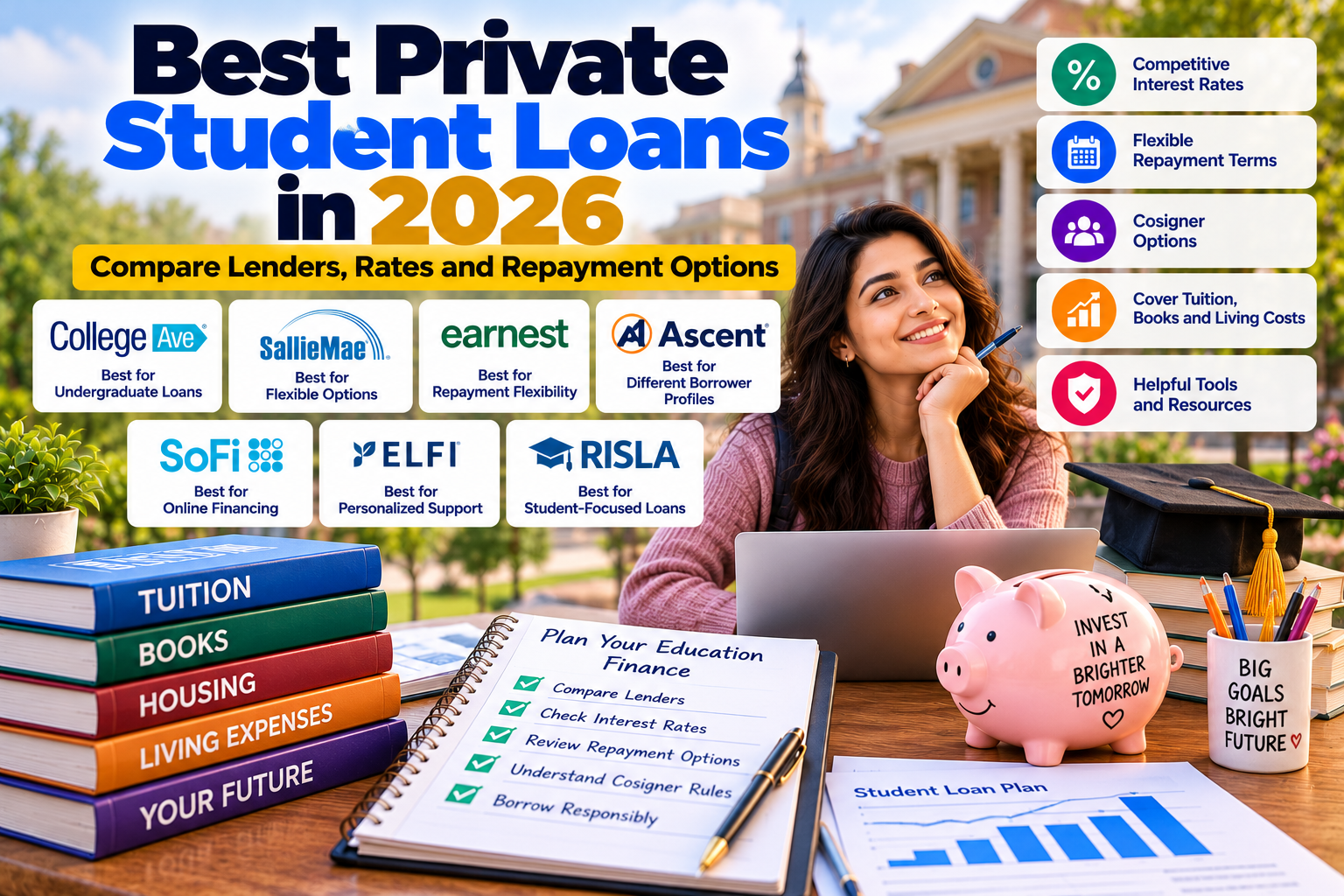
Paying for college can be expensive, especially when tuition, housing, textbooks, and other education costs exceed the financial aid available to a student. Private student loans can help cover the remaining gap, but choosing the right lender requires careful research.
The best private student loans in 2026 offer competitive interest rates, manageable repayment terms, transparent fees, and flexible options for eligible borrowers. Depending on the lender, students may be able to choose fixed or variable interest rates, apply with a cosigner, and select different repayment arrangements while studying.
However, private student loans generally do not offer the same borrower protections as federal student loans. Students should explore scholarships, grants, and federal financial aid before borrowing privately. <Cite refs={["turn632846search2","turn632846search6"]}/>
This guide compares private student loan lenders, explains how interest rates work, and provides practical tips for borrowing responsibly.
What Are Private Student Loans?
Private student loans are education loans offered by banks, credit unions, and private financial companies rather than the federal government.
Students may use eligible private loans to help cover education expenses, such as:
College or university tuition.
Required fees and educational supplies.
Books and course materials.
Housing and other eligible living expenses.
Remaining education costs after grants, scholarships, and other financial aid.
The amount available and the expenses covered depend on the lender, the school's certification process, and the loan agreement.
Private lenders typically consider credit history, income, existing debt, and other eligibility factors. Many undergraduate students have limited credit histories, so applying with a creditworthy cosigner may improve their chances of approval or help them qualify for a better rate.
Unlike federal student loans, private loans can have variable interest rates, and their repayment protections depend on the lender's policies and contract. <Cite refs={["turn632846search1","turn632846search6"]}/>
Best Private Student Loan Companies in 2026
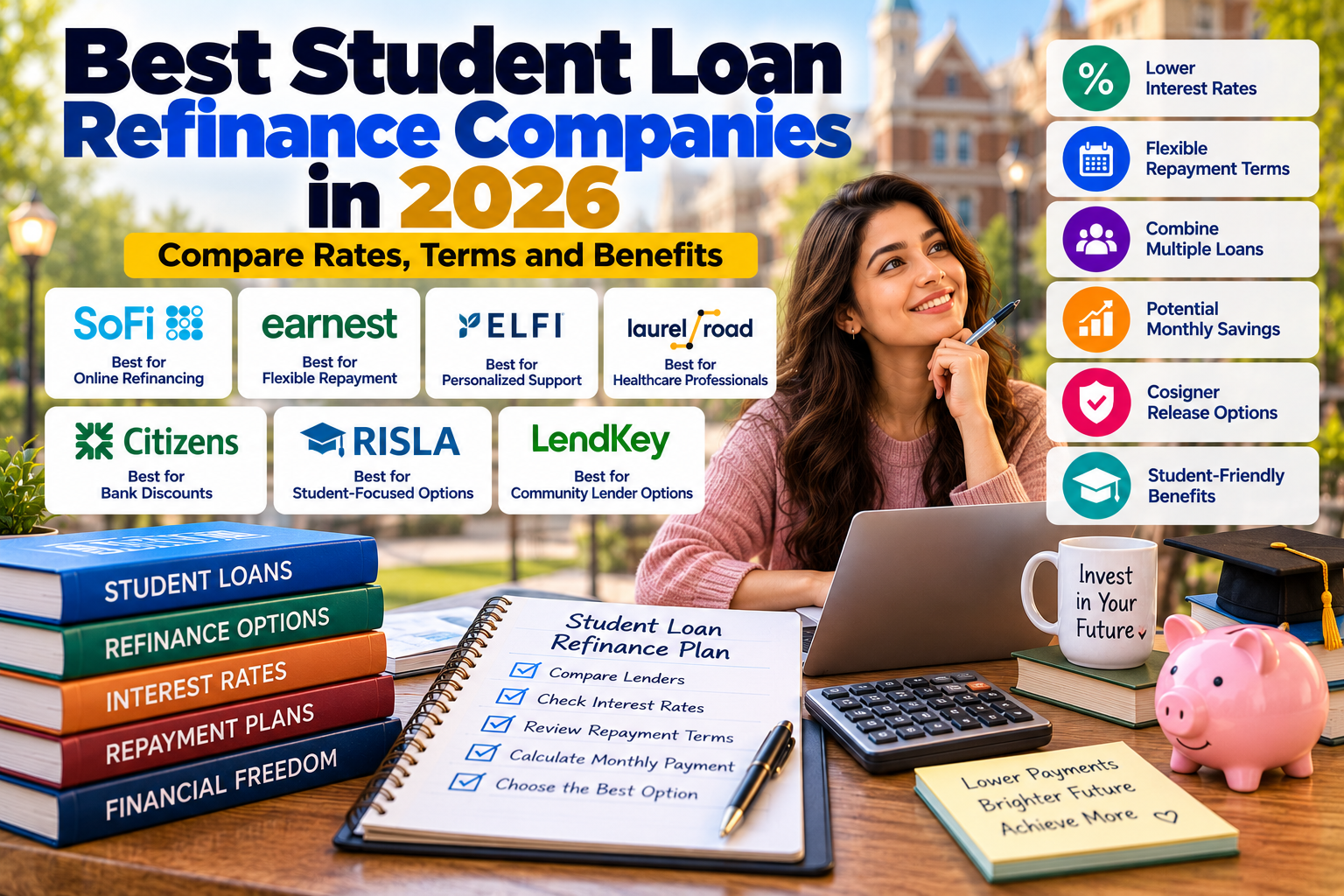
The following lenders are worth comparing for U.S. students and families. They offer different loan products and repayment features, so availability and eligibility should be verified directly.
1. College Ave — Best for Comparing Undergraduate Loan Options
College Ave offers private student loans for eligible undergraduate and graduate students.
Features to compare:
Available fixed and variable interest rates.
Multiple repayment term options.
Different repayment arrangements during school.
Options for eligible borrowers applying with a cosigner.
What to consider: Review the available repayment options carefully. A lower payment while studying may mean interest continues to accumulate, potentially increasing the amount owed later.
Best for: Students looking for a range of education financing and repayment choices.
Website: College Ave
2. Sallie Mae — Best for Multiple Repayment Choices
Sallie Mae offers private education loans for eligible students and families.
Features to compare:
Undergraduate and graduate student loan products.
Fixed and variable rate options, where available.
Repayment arrangements during enrollment.
Cosigner-related requirements and release conditions.
What to consider: Check the interest rate, repayment period, fees, and any requirements for cosigner release. Approval and pricing depend on the applicant's creditworthiness and other factors.
Best for: Students who want to compare different repayment arrangements.
Website: Sallie Mae
3. Earnest — Best for Exploring Repayment Flexibility
Earnest offers private student loans to eligible borrowers and provides options worth comparing for students who want to understand their repayment choices.
Features to compare:
Fixed and variable interest rate options, where available.
Repayment terms.
Eligibility requirements for students and cosigners.
Available borrower assistance features.
What to consider: Verify whether you meet the lender's academic, credit, and income requirements. Read the loan agreement to understand what happens if you experience financial hardship.
Best for: Eligible students who prioritize reviewing repayment flexibility.
Website: Earnest
4. Ascent — Best for Comparing Different Borrower Profiles
Ascent offers private student loan products for eligible undergraduate and graduate students. Its available options and qualification criteria vary by product.
Features to compare:
Loan options for different educational programs.
Available repayment terms.
Eligibility requirements for independent borrowers and cosigners.
Potential borrower benefits and repayment assistance provisions.
What to consider: Review the exact product you qualify for and confirm whether a cosigner is required. Do not assume that every applicant qualifies for the same rate or benefits.
Best for: Students who want to compare loan options based on their academic and financial circumstances.
Website: Ascent
5. SoFi — Best for Comparing Online Education Financing
SoFi offers private student loan products for eligible borrowers, along with digital account management and other financial services.
Features to compare:
Available education loan products.
Interest rate and repayment term choices.
Application and account management features.
Current borrower benefits and eligibility requirements.
What to consider: Confirm that the product is appropriate for your educational program and that the repayment terms fit your budget. Compare the total borrowing cost with competing lenders.
Best for: Students and families who prefer an online application and account management experience.
Website: SoFi
6. ELFI — Best for Comparing Personalized Support
Education Loan Finance, or ELFI, offers private student loan products and refinancing services. Students seeking a new loan should confirm which education financing options are currently available.
Features to compare:
Eligible student loan products.
Application support.
Available rates and repayment periods.
Requirements for borrowers and cosigners.
What to consider: Distinguish between loans for current education expenses and refinancing for existing student debt. These are different products with different eligibility requirements.
Best for: Borrowers who want to investigate available education financing and support options.
Website: ELFI
7. RISLA — Best for Exploring Student-Focused Financing
The Rhode Island Student Loan Authority (RISLA) offers education financing products, with eligibility and availability depending on the particular program.
Features to compare:
Current student loan products.
Available repayment terms.
Interest rates and fees.
State residency or other eligibility conditions.
What to consider: Verify whether you qualify for the specific program. State-focused or nonprofit-related loan programs may have restrictions that do not apply to all borrowers.
Best for: Students and families who want to compare additional education financing options.
Website: RISLA
Important: This list is a starting point for research, not a guaranteed ranking. Rates, eligibility, and product availability can change. Compare written offers before choosing a lender. Forbes Advisor and NerdWallet also provide lender comparisons and explain the criteria used to evaluate private student loans. <Cite refs={["turn632846search0","turn632846search5"]}/>
Private Student Loan Comparison
Lender | Potential fit | What to compare |
|---|---|---|
College Ave | Undergraduate and graduate students | Repayment options, APR, loan terms |
Sallie Mae | Students seeking different repayment arrangements | Rates, fees, cosigner terms |
Earnest | Borrowers interested in repayment flexibility | Eligibility, terms, hardship options |
Ascent | Different borrower and cosigner profiles | Qualification rules, available benefits |
SoFi | Online education financing | Current products, APR, borrower benefits |
ELFI | Education financing and refinancing research | Product type, eligibility, terms |
RISLA | Student-focused financing options | Program availability, rates, restrictions |
The best loan depends on the terms available to you, not simply the lender's advertised starting rate.
Private Student Loan Interest Rates in 2026
Private student loan interest rates vary by lender and applicant. Your credit history, income, existing debt, degree program, loan amount, and cosigner's financial profile may affect the rate you receive.
Lenders generally offer two types of interest rates.
Fixed interest rates
A fixed interest rate remains unchanged throughout the agreed loan term.
Potential advantages include:
Predictable monthly payments.
Easier long-term budgeting.
Protection from increases in market interest rates.
The starting rate may be higher than some variable-rate offers, depending on the lender and borrower.
Variable interest rates
A variable interest rate can change over time based on the loan's terms and the relevant benchmark.
Potential advantages include an initially lower rate in some cases. However, if the rate increases, the loan may become more expensive and payments could rise.
How to compare APRs
The annual percentage rate (APR) helps borrowers compare the cost of borrowing, including interest and certain fees.
Before accepting an offer, review:
The actual APR offered to you.
Any origination or other fees.
The repayment term.
The expected monthly payment.
Whether the rate is fixed or variable.
The total amount payable over the loan's life.
Do not choose a loan solely because its advertised starting rate looks attractive. Private student loan rates depend on creditworthiness, and the rate you receive may be substantially higher than the minimum advertised rate. <Cite refs={["turn632846search1","turn632846search5"]}/>
Example: How Much Could a Private Student Loan Cost?
Suppose a student borrows $20,000 through a private student loan with a hypothetical fixed interest rate of 7% and a 10-year repayment term. Assume repayment begins immediately, with no fees or interest capitalization.
Loan details | Illustrative amount |
|---|---|
Original loan balance | $20,000 |
Fixed annual interest rate | 7% |
Repayment term | 10 years |
Estimated monthly payment | $232 |
Estimated total payments | $27,840 |
Estimated interest paid | $7,840 |
These are illustrative estimates, not a lender quote. The actual cost depends on the rate, fees, repayment schedule, and whether interest accrues while the student is enrolled.
If the loan has a variable rate, the cost may change. If payments are deferred while the student studies, interest may accumulate and increase the balance that must eventually be repaid.
Federal vs. Private Student Loans
Before applying for a private loan, students should understand the key differences between federal and private education financing.
Feature | Federal student loans | Private student loans |
|---|---|---|
Provider | U.S. federal government | Banks and private lenders |
Credit review | Many federal loans do not require a credit check | Credit review is common |
Interest rate | Set under federal program rules | Depends on lender and borrower |
Cosigner | Usually not required for standard Direct Loans | May be required or helpful |
Repayment protections | Federal repayment and relief provisions may apply | Depends on lender and contract |
Forgiveness eligibility | Certain federal programs may apply | Generally not eligible for federal student loan forgiveness |
Federal loans are generally the preferred starting point for most students because they can offer protections and repayment options that private loans do not provide.
Students should complete the federal financial aid process and investigate grants and scholarships before using private loans to cover a remaining funding gap. <Cite refs={["turn632846search2","turn632846search6"]}/>
How to Apply for a Private Student Loan
Applying for a private student loan typically involves several steps.
Step 1: Calculate your funding gap
Determine the total cost of attendance, including tuition and eligible living expenses. Subtract grants, scholarships, savings, and other financial aid to estimate how much additional funding you need.
Avoid borrowing more than necessary.
Step 2: Complete the federal aid process
For U.S. students, review available federal student aid through the official Federal Student Aid website. Check your eligibility before deciding how much private funding to seek.
Step 3: Compare lenders
Review multiple lenders and compare APRs, repayment terms, fees, eligibility criteria, and hardship options.
Step 4: Consider a cosigner
If you have limited credit history or income, a creditworthy cosigner may improve your chances of approval or help you qualify for a lower rate.
However, a cosigner is legally responsible for the debt if you fail to repay it. Confirm whether the lender offers cosigner release and what conditions apply. <Cite refs={["turn632846search1","turn632846search6"]}/>
Step 5: Prepare documentation
You may need information about your school, enrollment status, expected education costs, income, credit history, and cosigner.
The lender may also require the school to certify the requested loan amount.
Step 6: Review the final loan agreement
Before signing, check the interest rate, fees, disbursement schedule, repayment start date, and conditions for deferment or hardship assistance.
Make sure you understand when interest begins accruing and how unpaid interest may affect your balance.
Private Student Loans for Students With No Credit
Students who are new to borrowing may have difficulty qualifying independently because lenders often assess credit history and ability to repay.
Potential options include:
Applying with a creditworthy cosigner.
Comparing lenders with eligibility criteria suited to students.
Looking for scholarships and grants to reduce the amount borrowed.
Asking the school's financial aid office about institutional assistance.
Comparing state-based education loan programs where available.
A cosigner may improve approval odds, but the responsibility is significant. Missed payments can affect both the student's and cosigner's credit histories.
Do not apply for a loan based only on a promise of guaranteed approval. Verify the lender and understand the full cost before providing sensitive financial information.
Common Private Student Loan Mistakes to Avoid
Students can reduce borrowing risks by avoiding these common mistakes:
Borrowing more than necessary. A larger loan means more interest and a greater repayment obligation after graduation.
Ignoring federal aid. Private loans should generally be considered after reviewing federal loans, grants, scholarships, and other assistance.
Choosing a variable rate without understanding the risk. Payments or total costs may increase if the rate changes.
Selecting a loan only by monthly payment. A longer repayment term may lower the monthly payment but increase the total interest paid.
Overlooking cosigner obligations. A cosigner may be responsible for the entire debt if the student cannot pay.
Ignoring hardship provisions. Check whether the lender offers temporary payment relief and what conditions must be met.
Falling for loan scams. Be wary of guaranteed approval claims, upfront fees for supposed loan access, and requests for passwords or unnecessary personal information.
Frequently Asked Questions
What is the best private student loan in 2026?
There is no single best loan for every student. College Ave, Sallie Mae, Earnest, Ascent, SoFi, ELFI, and RISLA are options to compare based on interest rates, repayment terms, eligibility, and borrower benefits.
Are private student loans better than federal student loans?
For most students, federal loans are the preferred starting point because they generally offer stronger borrower protections. Private loans may be useful when other aid does not cover the remaining education costs.
Can I get a private student loan without a cosigner?
Some students qualify independently, depending on the lender's credit, income, and eligibility requirements. Students with limited credit histories may have better chances with a qualified cosigner.
Do private student loans have fixed interest rates?
Many lenders offer fixed-rate options, while some also offer variable rates. Check the terms of the specific loan before applying.
When do private student loan payments begin?
The repayment start date depends on the lender and repayment plan. Some loans require payments while the student is enrolled, while others allow deferred or reduced payments. Interest may continue accruing during school.
Can private student loans be forgiven?
Private student loans generally do not qualify for federal student loan forgiveness programs. Any discharge or cancellation rights depend on applicable law and the loan agreement.
Can international students apply for private student loans in the United States?
Some lenders offer loans to eligible international students, often with specific visa, school, enrollment, or cosigner requirements. Policies vary, so verify eligibility directly with the lender.
Final Thoughts
The best private student loans in 2026 can help eligible students cover education costs that remain after other financial aid. However, the right choice depends on the borrower's financial situation, credit history, available repayment options, and ability to repay after graduation.
Compare College Ave, Sallie Mae, Earnest, Ascent, SoFi, ELFI, and RISLA carefully, and focus on the actual APR, total repayment cost, and borrower protections rather than advertised rates alone.
Most importantly, explore federal student aid, grants, and scholarships first. If you need a private loan, borrow only what is necessary and make sure you understand the repayment obligations before signing.
Disclaimer: This article is for educational purposes only and does not constitute financial, legal, or tax advice. Rates, fees, eligibility, and loan terms may change. Verify current details with lenders and consult your school's financial aid office before borrowing.