Managing multiple credit cards, personal loans, and other high-interest debts can make it difficult to stay on top of monthly payments. A debt consolidation loan may help by combining eligible balances into one new loan with a single monthly payment. Depending on the interest rate, fees, and repayment term, it may also reduce borrowing costs.
The best debt consolidation loans in 2026 offer competitive annual percentage rates (APRs), manageable repayment terms, transparent fees, and flexible qualification requirements. However, the right choice depends on your credit profile, income, existing debt, and the terms you can actually qualify for.
This guide compares leading U.S. lenders, explains how debt consolidation works, and outlines what borrowers should consider before applying.
What Is a Debt Consolidation Loan?
A debt consolidation loan is usually a personal installment loan used to pay off multiple outstanding debts. Instead of making several payments to different creditors, you repay one lender according to a new schedule.
For example, someone with three credit card balances might use a consolidation loan to pay those cards off and then make one fixed monthly payment toward the new loan.
Debt consolidation may help borrowers:
Simplify monthly payments and due dates.
Secure a lower interest rate if they qualify.
Establish a predictable repayment schedule.
Pay off debt over a defined period.
Reduce the chance of missing payments across several accounts.
However, consolidation does not automatically eliminate debt or guarantee savings. Origination fees, longer repayment periods, and higher interest rates can make a new loan more expensive than the original debts.
Best Debt Consolidation Loans in 2026
The following lenders are worth comparing when looking for a debt consolidation loan in the United States. Each has different eligibility rules, loan amounts, rates, and features. Availability and terms may vary by state and borrower.
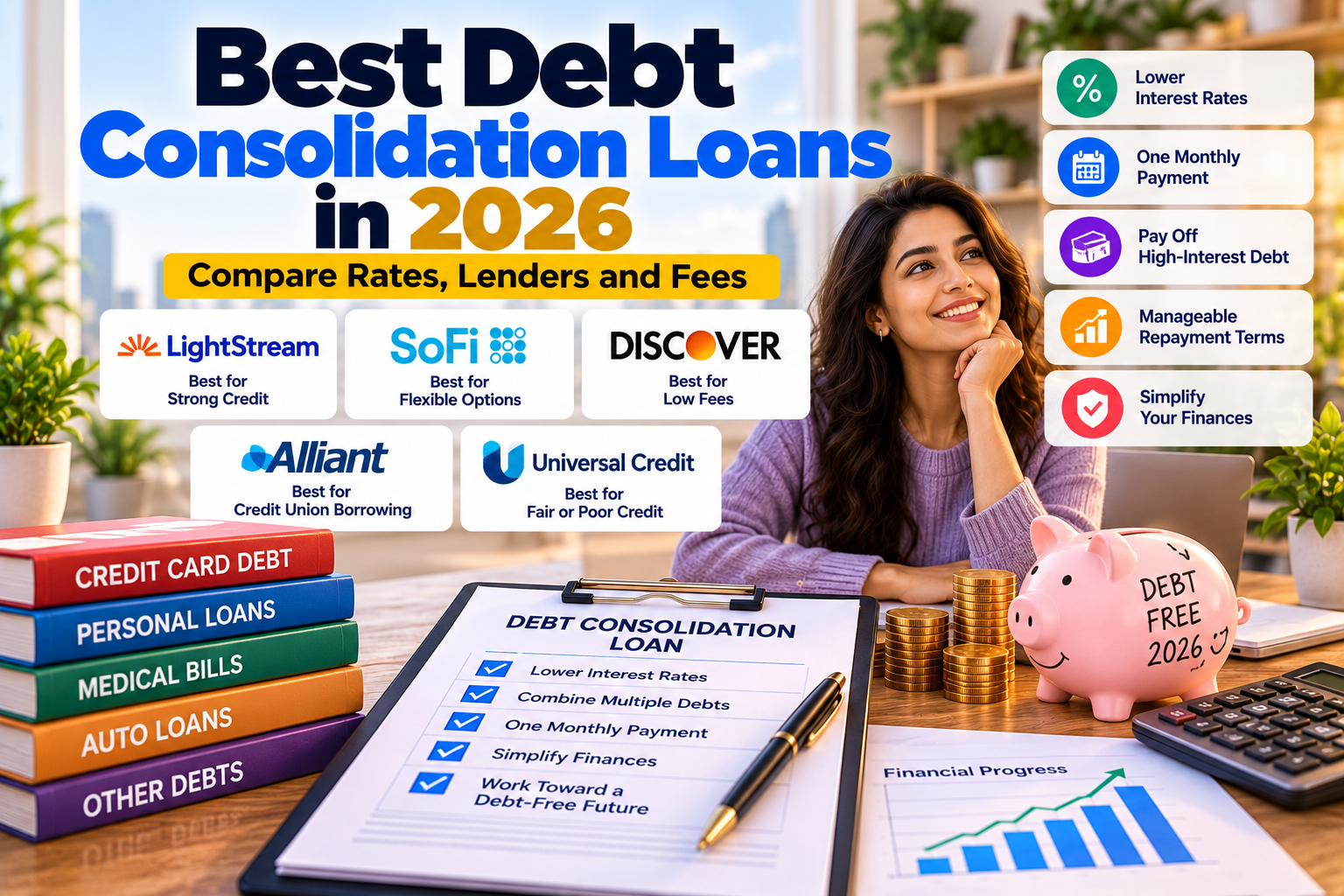
1. LightStream — Best for Borrowers With Strong Credit
LightStream is worth considering for borrowers with strong credit histories who want to compare larger personal loan offers.
Potential advantages:
Offers personal loans for eligible debt consolidation needs.
Has advertised loans without origination fees.
Provides a range of repayment terms and loan amounts.
May be suitable for borrowers with established credit and stable income.
What to consider: Approval and pricing depend on the applicant's creditworthiness and financial profile. A borrower with a limited or damaged credit history may need to consider other options.
Best for: Borrowers with strong credit seeking competitive loan terms.
2. SoFi — Best for Flexible Online Borrowing
SoFi offers online personal loans that eligible borrowers can use for debt consolidation. Its digital application process and loan management tools may appeal to people who prefer handling their finances online.
Potential advantages:
Online application and account management.
Personal loans for eligible consolidation purposes.
Potential rate discounts for qualifying borrowers.
Options that may allow payments to creditors directly.
What to consider: Check the APR, any origination fee, and the final repayment amount. The lowest advertised rate may be available only to borrowers who meet specific requirements.
Best for: Borrowers who want an online application process and convenient loan management.
3. Discover — Best for Comparing Fee-Free Options
Discover has offered personal loans that can be used to consolidate eligible debts. Borrowers should review its current terms alongside competing offers.
Potential advantages:
Fixed monthly payments on eligible installment loans.
A structured repayment schedule.
Potentially no origination fee, depending on the current product terms.
A straightforward way to compare the cost of a new loan with existing balances.
What to consider: Check current loan availability, minimum and maximum amounts, repayment terms, and eligibility requirements before applying.
Best for: Borrowers who prioritize clear repayment terms and want to compare loan costs.
4. Alliant Credit Union — Best for Credit Union Borrowing
Alliant Credit Union is another option to investigate when comparing personal loans and other borrowing products.
Potential advantages:
Credit union membership and financial services.
Personal borrowing options for eligible applicants.
An alternative to traditional bank and online lender offers.
What to consider: Membership eligibility and current loan availability matter. Confirm that a suitable debt consolidation product is available to you and compare its APR and fees with other lenders.
Best for: Borrowers who prefer exploring credit union options.
5. Universal Credit — Best to Consider With Fair or Poor Credit
Universal Credit may be worth comparing for applicants who have difficulty qualifying for lower-rate loans elsewhere.
Potential advantages:
Offers personal loan options for eligible borrowers.
May consider applicants outside the highest credit-score ranges.
Provides an online application process.
What to consider: Borrowers with lower credit scores may receive higher APRs and fees. A loan that is easier to obtain is not necessarily the least expensive option.
Best for: Borrowers with less-than-excellent credit who want to compare available offers carefully.
Important: These are comparison candidates, not a guarantee of approval or a promise of the lowest rate. Verify current lender terms directly before applying. Rates and product availability can change.
Debt Consolidation Loan Comparison
Lender | Potential fit | What to compare |
|---|---|---|
LightStream | Strong-credit borrowers | APR, fees, repayment term |
SoFi | Online borrowing | Direct creditor payment, discounts, total cost |
Discover | Structured repayment | Current terms, fees, eligibility |
Alliant Credit Union | Credit union option | Membership, loan availability, APR |
Universal Credit | Fair- or lower-credit applicants | APR, origination fees, monthly payment |
The most suitable lender is not necessarily the one with the lowest advertised starting APR. Compare the actual offer you qualify for, including all fees and the total amount you will repay.
How Does Debt Consolidation Work?
Debt consolidation generally follows five steps.
Step 1: List your existing debts.
Write down each balance, interest rate, minimum payment, and remaining repayment period. Include credit cards, eligible personal loans, and other debts you want to consolidate.
Step 2: Calculate the amount you need.
Add the balances you want to pay off. Avoid borrowing more than necessary, since extra borrowing increases the amount you must repay.
Step 3: Compare loan offers.
Review APRs, origination fees, repayment periods, monthly payments, and early repayment conditions. Prequalification may let you view estimated terms through a soft credit inquiry, although the lender should confirm whether its process affects your credit.
Step 4: Apply and use the funds to repay creditors.
If approved, the lender may send payments directly to your creditors or deposit funds into your account. Follow the lender's instructions and verify that the old balances have been paid.
Step 5: Make payments on the new loan.
Set up reminders or automatic payments if appropriate. Avoid building up new credit card balances while paying off the consolidation loan.
What Interest Rates Can You Expect in 2026?
Debt consolidation loan rates vary widely. Lenders consider factors such as credit score, income, debt-to-income ratio, credit history, loan amount, and repayment term.
Borrowers with strong credit may qualify for lower rates, while applicants with weaker credit may receive substantially more expensive offers. Published APR ranges are estimates, not guaranteed rates.
The annual percentage rate is especially important because it reflects interest and certain loan fees, giving borrowers a more useful comparison than the interest rate alone.
Before accepting an offer, check:
The actual APR offered to you.
Any origination or administrative fee.
The monthly payment.
The repayment period.
The total amount payable over the life of the loan.
Whether the rate is fixed or variable.
A lower monthly payment may result from extending the repayment term rather than reducing the cost of borrowing.
Example: Could a Debt Consolidation Loan Save Money?
Suppose a borrower has $10,000 in credit card debt at an illustrative 25% annual interest rate. The borrower considers a three-year consolidation loan at a fixed 12% APR, assuming no additional fees.
The following figures are estimates for illustration only.
Details | Existing debt | New consolidation loan |
|---|---|---|
Starting balance | $10,000 | $10,000 |
Illustrative annual rate | 25% | 12% |
Repayment period | 3 years | 3 years |
Estimated monthly payment | $398 | $332 |
Estimated total payments | $14,328 | $11,960 |
Under these assumptions, the new loan could reduce the monthly payment by about $66 and lower total payments by approximately $2,368.
Actual results will depend on how the existing debt is repaid, the loan's APR, fees, and payment schedule. A high origination fee or longer repayment period could reduce or eliminate the savings.
How to Qualify for a Debt Consolidation Loan
Lenders assess whether an applicant is likely to repay the loan. Common factors include:
Credit score and history
A stronger credit history can improve the chances of qualifying for favorable rates. Applicants with late payments, defaults, or limited credit histories may have fewer options.
Income and employment
Lenders may review income, employment, and other sources of funds to assess whether the proposed monthly payment is affordable.
Debt-to-income ratio
Your debt-to-income ratio compares monthly debt obligations with gross monthly income. A high ratio may make approval more difficult because it indicates that a large share of your income is already committed to debt.
Loan amount and repayment term
The requested amount should match the debts you intend to repay. A lender may approve less than requested or offer different repayment terms based on its assessment.
Documentation
Applicants may need identification, proof of income, housing information, and details of their existing debts. Requirements vary by lender.
Debt Consolidation Loans for Bad Credit
Borrowers with poor credit may still find lenders willing to review their applications, but the available loans can be expensive.
Before accepting a high-APR loan, consider these alternatives:
Credit union options: Ask whether you qualify for a personal loan or financial counseling.
Nonprofit credit counseling: A counselor may help you develop a budget and explore a debt management plan.
Negotiating with creditors: Ask whether a creditor can reduce your interest rate, waive certain fees, or adjust your payment schedule.
Balance transfer credit cards: If you qualify, a promotional rate may reduce interest for a limited period, but transfer fees and the rate after the promotion matter.
A co-borrower or secured loan: These may improve eligibility in some cases, but a co-borrower assumes repayment responsibility and collateral can be at risk.
Do not choose a loan solely because it promises fast approval. Calculate the total cost and confirm that the payment fits your budget.
Debt Consolidation Loan vs. Balance Transfer Card
Both options can help manage eligible credit card debt, but they work differently.
Feature | Consolidation loan | Balance transfer card |
|---|---|---|
How it works | Replaces selected debts with a new installment loan | Moves eligible balances to another credit card |
Interest | Fixed or variable, depending on the loan | May offer a promotional low or 0% rate |
Repayment | Usually scheduled monthly payments | Requires payments under the card agreement |
Fees | May include an origination fee | May include a balance transfer fee |
Main risk | High APR or longer repayment period | Promotional rate expires before repayment |
A balance transfer card may be attractive if you qualify for a promotional offer and can repay the balance before the promotional period ends. A consolidation loan may offer a more predictable schedule. Compare the total costs before choosing.
Risks to Consider Before Consolidating Debt
Debt consolidation can simplify repayment, but it is not a solution for every financial situation.
You may pay more over time. Extending repayment can reduce the monthly payment while increasing total interest.
Fees can reduce savings. Origination fees and other charges may make a seemingly low-rate loan less attractive.
Your credit score may change. Applying for credit can involve a hard inquiry, and opening or closing accounts may affect your credit profile. Consistent payments may help over time, but improvements are not guaranteed.
You may accumulate new debt. If you pay off credit cards and then continue spending on them, you could end up with both the new loan and fresh card balances.
Secured loans put assets at risk. If you use a home equity loan or another secured product, failure to repay could put the collateral in jeopardy.
The Consumer Financial Protection Bureau recommends reviewing alternatives, understanding the cost of consolidation, and considering nonprofit credit counseling when appropriate.
How to Choose the Best Debt Consolidation Loan
Use the following checklist before accepting a loan:
Compare at least three offers, if practical.
Focus on the actual APR, not just the advertised starting rate.
Calculate the total repayment amount, including fees.
Choose a payment you can afford without missing essential expenses.
Confirm how the lender will pay your existing creditors.
Review late-payment charges and early repayment terms.
Avoid taking on new high-interest debt after consolidating.
Read the loan agreement and verify the lender's identity.
The best debt consolidation loan should make repayment more manageable without creating a larger financial burden.
Frequently Asked Questions
What is the best debt consolidation loan in 2026?
There is no single best loan for everyone. LightStream, SoFi, Discover, Alliant Credit Union, and Universal Credit are options to compare based on your credit profile, loan amount, APR, fees, and repayment needs.
Can I get a debt consolidation loan with a 600 credit score?
Possibly. Some lenders consider applicants with credit scores around this level, but approval is not guaranteed. Rates may be higher, and income, existing debt, and credit history also influence eligibility.
Do debt consolidation loans hurt your credit?
Applying may cause a hard inquiry, depending on the lender's process. Opening a new account can also affect your credit profile. On-time payments may help build a positive history, but no particular credit-score outcome is guaranteed.
Does debt consolidation erase debt?
No. A consolidation loan typically replaces existing debts with a new debt. You still have to repay the amount borrowed, plus any applicable interest and fees.
Is debt consolidation better than debt settlement?
They are different approaches. Consolidation generally involves borrowing to repay existing balances. Debt settlement attempts to negotiate a reduced payoff and can carry significant risks, including credit damage and potential collection activity. Understand the terms before working with a debt relief company.
Can I consolidate credit cards and personal loans together?
Potentially, if the lender permits those uses and you qualify for enough money. Confirm eligible loan purposes and make sure the new loan's cost is lower or otherwise more manageable than the debts it replaces.
Final Thoughts
The best debt consolidation loans in 2026 can help eligible borrowers organize multiple debts into one predictable payment and potentially reduce interest costs. However, the benefits depend on qualifying for suitable terms and maintaining a realistic repayment plan.
Compare lenders carefully, evaluate the full APR and fees, and avoid extending repayment solely to achieve a lower monthly payment without understanding the long-term cost. If a new loan is too expensive, nonprofit credit counseling or direct negotiations with creditors may be worth exploring.
Disclaimer: This article is for educational purposes only and does not constitute financial, tax, or legal advice. Rates, terms, and eligibility requirements can change. Confirm current offers with lenders and assess your personal financial circumstances before borrowing