Every time someone creates an online account, purchases a product, downloads an application, or subscribes to a digital service, personal information may be collected and processed.
This information can include names, email addresses, phone numbers, payment details, location information, browsing activity, and other personal data.
For businesses, collecting customer information can improve services, support marketing activities, and make operations more efficient. However, it also creates an important responsibility: protecting that information from unauthorized access, misuse, and unnecessary exposure.
This is where data privacy becomes essential.
Data privacy refers to the principles, policies, and practices that determine how personal information is collected, used, stored, shared, and protected. It helps individuals understand and exercise control over their information while requiring organizations to handle data responsibly.
In 2026, businesses face growing privacy challenges as artificial intelligence, cloud computing, digital payments, connected devices, and online platforms continue to expand.
A single privacy failure can damage customer trust, create legal problems, and lead to financial losses.
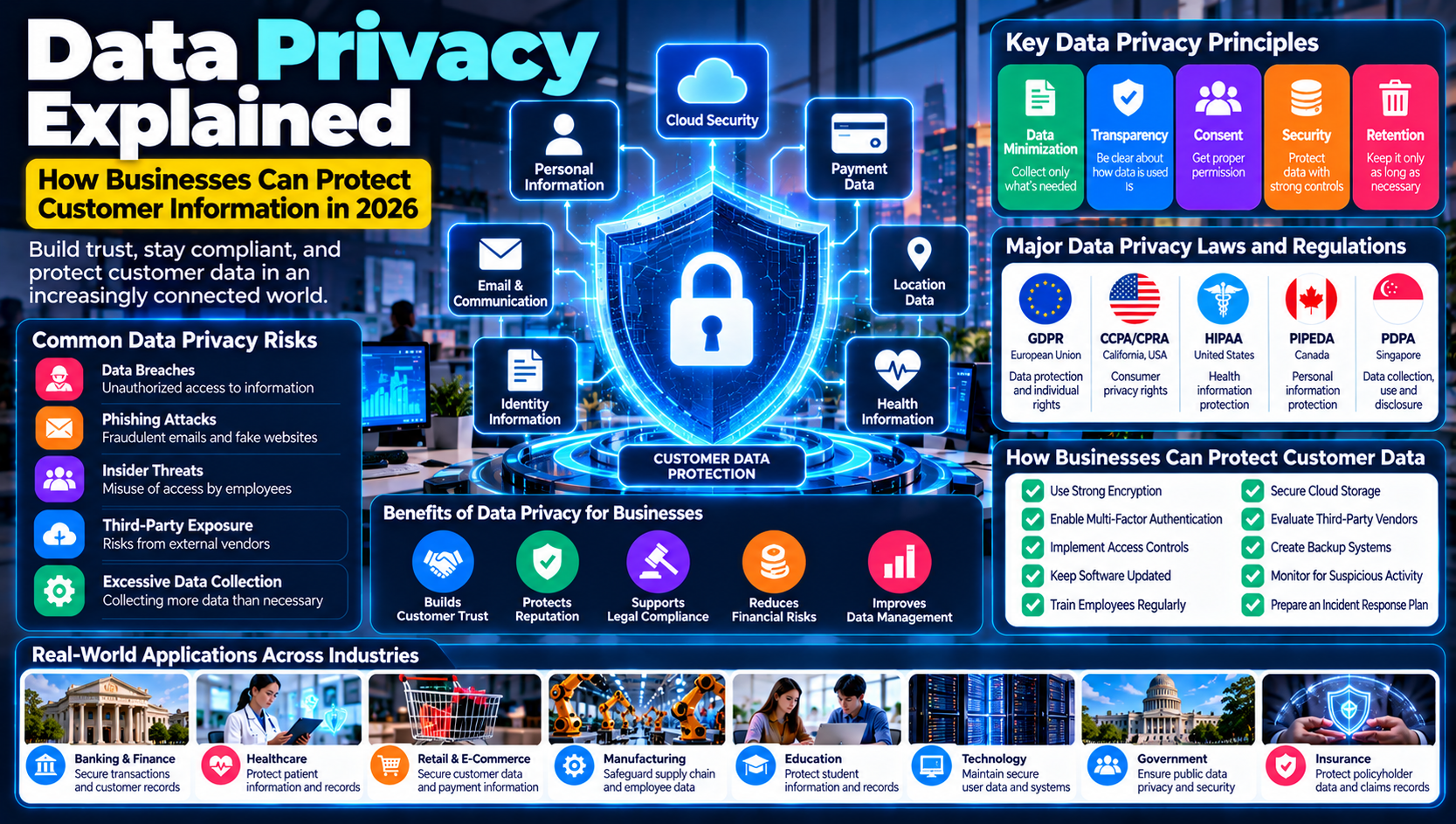
This comprehensive guide explains what data privacy is, why it matters, common privacy risks, important regulations, and practical strategies businesses can use to protect customer information.
What Is Data Privacy?
Data privacy is the protection and responsible handling of personal information throughout its lifecycle.
It focuses on how organizations collect, access, use, share, retain, and delete information relating to individuals.
Personal information may include:
Full names
Email addresses
Phone numbers
Home or business addresses
Identification numbers
Payment information
Location data
Online account details
Browsing and purchasing activity
Health-related information
Biometric information
Not all data is equally sensitive. Some information, such as a person's name or email address, may be relatively ordinary in one context but become sensitive when combined with financial, health, or identity information.
For example, an e-commerce company may collect a customer's name, delivery address, email address, and payment details to complete an order.
Responsible data privacy practices require the company to collect only what is necessary, explain how the information will be used, protect it appropriately, and retain it only for a justified period.
In simple terms, data privacy is about ensuring that personal information is handled responsibly and according to appropriate rules and expectations.
Data Privacy vs. Data Security: What Is the Difference?
Data privacy and data security are closely related, but they are not the same.
Data privacy focuses on how personal information is collected, used, shared, and managed.
Data security focuses on protecting information against unauthorized access, modification, destruction, or disclosure.
For example, a company may use encryption and access controls to secure customer information. These are data security measures.
However, if the company collects unnecessary personal information or shares customer records without an appropriate legal basis, it may still have a data privacy problem.
Comparison of Data Privacy and Data Security
Feature | Data Privacy | Data Security |
|---|---|---|
Main Focus | Responsible use of personal information | Protection of information |
Key Question | How should data be collected and used? | How can data be protected? |
Main Activities | Consent, transparency, retention, access rights | Encryption, authentication, access controls |
Main Goal | Respect individual privacy | Prevent unauthorized access and misuse |
Example | Obtaining appropriate permission for data use | Encrypting customer records |
Both are essential. Strong security supports privacy, but technical protection alone does not guarantee responsible data handling.
Why Is Data Privacy Important for Businesses?
Data privacy is no longer simply an IT concern. It is an important part of business operations, customer relationships, risk management, and long-term reputation.
1. Builds Customer Trust
Customers are more likely to engage with businesses that explain how personal information is collected and protected.
Clear privacy policies and responsible data practices can strengthen customer confidence.
2. Protects Business Reputation
A data breach or privacy violation can damage an organization's reputation.
Customers may lose confidence in a company that fails to protect their information.
3. Supports Legal Compliance
Different countries and regions have privacy and data protection requirements.
Businesses that collect or process personal information may need to follow applicable laws, depending on their location, activities, and customer base.
4. Reduces Financial Risks
Privacy incidents can create costs associated with investigation, legal support, customer notifications, system recovery, and regulatory penalties where applicable.
Preventive privacy practices can help reduce these risks.
5. Improves Data Management
Privacy programs encourage organizations to understand what information they collect, where it is stored, who can access it, and how long it should be retained.
This can improve internal data management.
6. Strengthens Competitive Advantage
Responsible data practices can become a positive part of a company's reputation.
Organizations that demonstrate transparency and accountability may build stronger relationships with customers and business partners.
7. Supports Responsible Innovation
Businesses increasingly use AI, analytics, and cloud technologies.
Privacy controls help organizations use information more responsibly while reducing unnecessary exposure.
Types of Personal Data Businesses Need to Protect
Businesses collect different types of personal information depending on their products, services, and operations.
Understanding these categories helps organizations apply suitable protection measures.
1. Personally Identifiable Information (PII)
Personally identifiable information is information that can identify an individual directly or indirectly.
Examples include:
Full name
Email address
Phone number
Government identification number
Residential address
Account identifiers
2. Financial Information
Financial information includes details related to a person's financial activities.
Examples include:
Bank account details
Payment card information
Transaction records
Billing addresses
Financial account information
3. Health Information
Health-related information can include medical history, treatment details, diagnostic information, and other health records.
This category often receives additional legal protection.
4. Biometric Information
Biometric information may include fingerprints, facial recognition data, voice characteristics, and other measurements used to identify individuals.
Organizations should apply appropriate safeguards when handling biometric information.
5. Location Information
Location data may reveal where a person lives, works, travels, or spends time.
Examples include GPS information, device location history, and location-based application records.
6. Online Activity Data
Websites and digital platforms may collect information about how people interact with their services.
Examples include:
Browsing activity
Search history
Device information
IP addresses
Application usage
Advertising interactions
7. Sensitive Personal Information
Some categories of personal information may require additional protections under applicable laws.
These can include health details, biometric identifiers, precise location information, financial information, and other legally defined sensitive data categories.
The exact definition varies across jurisdictions.
Common Data Privacy Risks and Threats
Businesses face several risks when collecting and managing customer information.
Understanding these threats is the first step toward building an effective privacy program.
1. Data Breaches
A data breach occurs when information is accessed, disclosed, altered, or acquired without authorization.
Breaches can happen because of cyberattacks, software vulnerabilities, human error, or inadequate security controls.
For example, attackers may gain access to a company's customer database and obtain personal records.
2. Phishing Attacks
Phishing involves deceptive messages or websites designed to trick individuals into revealing sensitive information or performing unsafe actions.
Employees may receive fake emails that appear to come from managers, customers, or trusted service providers.
Businesses can reduce phishing risks through security awareness training, email protection, and multi-factor authentication.
3. Insider Threats
Employees, contractors, or other authorized users may misuse their access to sensitive information.
Insider threats can be intentional or accidental.
Organizations should limit access based on job responsibilities and monitor sensitive activities appropriately.
4. Weak Passwords
Simple or reused passwords can make it easier for attackers to access business accounts.
Strong authentication practices and multi-factor authentication help reduce this risk.
5. Third-Party Data Exposure
Businesses often share information with payment providers, cloud platforms, marketing services, and other vendors.
If a third party experiences a security incident or mishandles information, customer data may be exposed.
Organizations should evaluate vendors before sharing personal information and maintain appropriate contractual safeguards.
6. Excessive Data Collection
Collecting more information than necessary creates additional privacy risks.
If the information is exposed or misused, the consequences may be greater.
Businesses should apply data minimization principles and collect only information needed for legitimate purposes.
7. Poor Data Storage Practices
Unprotected databases, unsecured backups, outdated systems, and poorly configured cloud storage can expose sensitive records.
Organizations should regularly review storage configurations and security controls.
8. Artificial Intelligence Privacy Risks
AI systems may process large amounts of personal information.
Privacy concerns can arise when organizations use personal data without appropriate authorization, enter confidential information into unsuitable AI tools, or fail to understand how data is retained and processed.
Businesses should establish clear policies for AI data usage.
Important Data Privacy Laws and Regulations
Data privacy requirements differ across countries and regions.
Organizations must understand which regulations apply to their operations, customers, and data processing activities.
The following are some widely recognized privacy frameworks and laws.
1. General Data Protection Regulation (GDPR)
The <Entity value="General Data Protection Regulation (GDPR)" category="other" disambig="European Union data protection law"/> is a major data protection regulation that applies in the European Union and European Economic Area, with certain provisions extending to organizations outside the region that process personal data within its scope.
It establishes requirements concerning:
Lawful processing
Transparency
Data minimization
Purpose limitation
Data accuracy
Storage limitation
Security and accountability
Individual data rights
The GDPR also provides individuals with rights such as access, correction, and, under certain conditions, erasure of personal information.
Organizations should assess their specific obligations rather than assuming the regulation applies identically to every business.
2. California Consumer Privacy Act (CCPA) and CPRA
California's privacy framework includes the <Entity value="California Consumer Privacy Act (CCPA)" category="other" disambig="California consumer privacy law"/> as amended by the California Privacy Rights Act (CPRA).
It provides qualifying California residents with certain rights concerning personal information.
These can include rights to:
Know what personal information is collected
Request deletion in certain circumstances
Correct inaccurate information
Opt out of certain sales or sharing of personal information
Limit certain uses of sensitive personal information
The exact obligations depend on whether a business falls within the relevant legal requirements.
3. Health Insurance Portability and Accountability Act (HIPAA)
The <Entity value="Health Insurance Portability and Accountability Act (HIPAA)" category="other" disambig="United States health information privacy and security law"/> establishes requirements for protecting certain health information in the United States.
It applies to covered entities and business associates within its scope.
Healthcare organizations and relevant service providers must follow applicable privacy, security, and breach notification requirements.
4. Personal Information Protection and Electronic Documents Act (PIPEDA)
Canada's <Entity value="Personal Information Protection and Electronic Documents Act (PIPEDA)" category="other" disambig="Canadian federal private-sector privacy law"/> governs certain private-sector organizations' handling of personal information in commercial activities.
It includes principles concerning consent, accountability, safeguards, and individual access.
5. Personal Data Protection Act (PDPA)
Several jurisdictions have enacted laws known as Personal Data Protection Acts.
For example, Singapore's PDPA regulates how organizations collect, use, and disclose personal data in Singapore.
Malaysia and other countries also have their own personal data protection frameworks.
Businesses must identify the specific jurisdiction and legal requirements relevant to their activities.
6. Data Protection Frameworks in Pakistan
Businesses operating in Pakistan should monitor applicable privacy, cybersecurity, telecommunications, and electronic transaction requirements, along with the development and status of national personal data protection legislation.
The legal position and implementation requirements can change. Organizations should consult current official government publications and qualified legal professionals rather than assuming that a proposed bill is already enforceable law.
Comparison of Selected Privacy Regulations
Regulation | Main Jurisdiction | General Focus |
|---|---|---|
GDPR | EU/EEA and certain cross-border processing | Personal data protection and individual rights |
CCPA/CPRA | California, USA | Consumer privacy rights |
HIPAA | United States | Certain protected health information |
PIPEDA | Canada | Private-sector personal information |
Singapore PDPA | Singapore | Personal data collection, use, and disclosure |
Pakistan privacy framework | Pakistan | Applicable data, cyber, and sector-specific requirements |
This table is an overview, not a complete legal compliance checklist.
Essential Data Privacy Principles Every Business Should Follow
An effective privacy program is based on principles that guide how personal information is handled.
1. Data Minimization
Collect only the information required for a legitimate business purpose.
For example, an online newsletter subscription may need an email address but not a customer's home address.
2. Purpose Limitation
Use personal information for clearly defined and legitimate purposes.
Businesses should not automatically reuse customer information for unrelated activities without an appropriate legal basis.
3. Transparency
Explain what information is collected, why it is collected, how it is used, and whether it is shared with other organizations.
4. Consent and Lawful Processing
Where consent is the applicable legal basis, organizations should obtain it appropriately and respect valid withdrawal requests.
Some privacy laws recognize other lawful bases for processing, so consent is not always the only permitted option.
5. Data Accuracy
Organizations should take reasonable steps to keep personal information accurate and up to date where necessary.
6. Storage Limitation
Do not keep personal information indefinitely without a legitimate reason.
Create retention schedules and securely delete or anonymize information when it is no longer needed, subject to legal retention requirements.
7. Accountability
Organizations should assign responsibility for privacy compliance, document important decisions, and regularly review their practices.
How Businesses Can Protect Customer Information
Protecting customer information requires a combination of technology, policies, employee awareness, and responsible management.
Here are practical measures organizations can implement.
1. Use Strong Data Encryption
Encryption converts information into a protected format that cannot easily be understood without the appropriate decryption key.
Businesses should consider encryption for:
Data stored in databases
Backups
Sensitive documents
Information transmitted over networks
Portable devices
Encryption should be implemented using appropriate modern standards and secure key management.
2. Enable Multi-Factor Authentication
Multi-factor authentication requires users to provide additional verification beyond a password.
For example, a user may need an authentication app or security key to access a sensitive business account.
This can reduce the impact of stolen passwords.
3. Implement Role-Based Access Control
Employees should only access information necessary for their responsibilities.
For example, a customer service employee may need access to order information but not complete payment card details.
Regularly review permissions and remove access when employees change roles or leave the organization.
4. Maintain Regular Software Updates
Outdated applications and operating systems may contain vulnerabilities.
Businesses should establish a patch management process to identify, test, and install security updates.
5. Secure Cloud Storage
Many businesses store customer information using cloud platforms.
Organizations should:
Configure storage permissions correctly
Enable encryption
Use strong authentication
Monitor access activity
Protect backup systems
Review cloud security settings regularly
6. Conduct Employee Training
Employees play an important role in protecting personal information.
Regular training should cover phishing, password security, safe file sharing, privacy policies, and incident reporting.
7. Create a Data Backup Strategy
Backups can help businesses recover information after accidental deletion, system failure, or ransomware incidents.
Backups should be protected from unauthorized modification and tested regularly.
8. Monitor Systems for Suspicious Activity
Businesses should monitor systems for unusual logins, unexpected data transfers, unauthorized access attempts, and other warning signs.
Security monitoring can help organizations identify incidents earlier.
9. Evaluate Third-Party Vendors
Before sharing customer information with external providers, review their security practices, privacy policies, data processing arrangements, and relevant certifications.
Contracts should clearly establish responsibilities for protecting information.
10. Develop an Incident Response Plan
Organizations should prepare for possible privacy and security incidents.
An incident response plan should explain:
How incidents are identified
Who is responsible for responding
How affected systems are contained
How evidence is preserved
How customers and regulators are notified when legally required
How systems are restored
How future incidents are prevented
The Role of Artificial Intelligence in Data Privacy
Artificial intelligence is changing how organizations collect, analyze, and use information.
AI systems can process large datasets, identify patterns, automate decisions, and support customer services.
However, these capabilities also create privacy concerns.
AI Privacy Risks
1. Excessive Data Collection: AI systems may require large amounts of information, creating risks if unnecessary personal data is collected.
2. Unauthorized Data Use: Personal information may be used for AI training or analysis without an appropriate legal basis.
3. Sensitive Information Exposure: Confidential information entered into poorly governed AI tools may be stored or processed in ways users do not expect.
4. Automated Decision-Making: Some AI systems may influence decisions affecting individuals, raising questions about fairness, transparency, and applicable legal rights.
5. Data Retention: Organizations may not fully understand how long information is retained by an AI service or its providers.
How Businesses Can Protect Privacy When Using AI
Businesses should:
Establish clear rules for entering personal information into AI tools.
Avoid submitting unnecessary confidential information.
Review AI vendor privacy and data retention policies.
Use access controls for AI systems.
Assess privacy risks before launching AI projects.
Validate automated decisions where appropriate.
Maintain human oversight for important decisions.
Follow applicable data protection requirements.
AI can improve business efficiency, but privacy should be included in system design from the beginning.
Data Privacy in Cloud Computing
Cloud computing allows businesses to store and process information using remote infrastructure.
It offers flexibility and scalability, but it also creates responsibilities for protecting information.
Cloud privacy depends on several factors, including service configuration, access controls, provider practices, contracts, and applicable laws.
Common Cloud Privacy Risks
Publicly exposed storage
Weak account authentication
Misconfigured permissions
Unauthorized data sharing
Unprotected backups
Unclear data residency arrangements
Inadequate vendor oversight
Cloud Data Protection Best Practices
Businesses should use strong authentication, encryption, restricted access, secure backup procedures, and continuous monitoring.
They should also understand the division of security responsibilities between the cloud provider and the customer.
Using a major cloud platform does not automatically make a business compliant with every privacy law.
Data Privacy Checklist for Small Businesses
Small businesses may not have large cybersecurity departments, but they can still adopt practical privacy controls.
Use this checklist as a starting point.
Privacy Practice | Recommended Action |
|---|---|
Data Collection | Collect only necessary information |
Privacy Policy | Explain data practices clearly |
Access Control | Limit access to authorized employees |
Password Security | Use strong passwords and MFA |
Encryption | Protect sensitive information |
Software Updates | Patch systems regularly |
Data Backups | Maintain secure backups |
Employee Training | Provide privacy and security awareness |
Vendor Management | Review external service providers |
Data Retention | Delete information when no longer needed |
Incident Response | Prepare a breach response plan |
Privacy Reviews | Assess practices regularly |
Small businesses should prioritize the controls that address their most significant risks and legal obligations.
What Happens When a Business Fails to Protect Customer Data?
A failure to protect personal information can create consequences that extend beyond the immediate security incident.
1. Financial Losses
Businesses may face investigation costs, legal expenses, recovery costs, and potential regulatory penalties.
2. Loss of Customer Trust
Customers may stop using a service if they believe their personal information is not being handled responsibly.
3. Reputational Damage
News of a privacy incident can affect a company's public image and business relationships.
4. Legal Consequences
Organizations may face regulatory investigations, enforcement actions, or legal claims depending on the incident and applicable laws.
5. Operational Disruption
A serious incident may interrupt customer services, internal systems, and business operations.
6. Increased Security Costs
After an incident, businesses may need to invest in stronger systems, audits, staff training, and external security services.
Preventive measures are often more effective than trying to repair trust and systems after a major privacy failure.
How to Build a Data Privacy Program in Your Business
A data privacy program provides a structured approach to managing personal information.
Businesses can develop one through the following steps.
Step 1: Identify the Personal Data You Collect
Create an inventory of the personal information your organization collects, stores, and processes.
Include information held in websites, applications, databases, spreadsheets, and third-party platforms.
Step 2: Understand Why You Collect It
Document the business purpose and applicable legal basis for each type of personal information.
Avoid collecting information without a clear and legitimate reason.
Step 3: Map How Data Moves Through Your Business
Identify where information comes from, where it is stored, who can access it, and which external organizations receive it.
Step 4: Review Privacy and Security Risks
Assess potential risks involving unauthorized access, data sharing, retention, vendor relationships, and system configuration.
Step 5: Create Clear Privacy Policies
Develop privacy notices and internal procedures that explain how personal information should be handled.
Step 6: Implement Technical Controls
Use encryption, multi-factor authentication, access restrictions, backups, monitoring, and secure development practices.
Step 7: Train Employees
Make sure employees understand their privacy responsibilities and know how to report possible incidents.
Step 8: Review Vendors
Assess service providers that process customer information and document their responsibilities.
Step 9: Prepare for Privacy Incidents
Create a response process for suspected data breaches and other privacy violations.
Step 10: Monitor and Improve
Review the privacy program regularly as business operations, technologies, and legal requirements change.
The Future of Data Privacy in 2026 and Beyond
Data privacy is becoming increasingly important as organizations adopt new digital technologies.
Several developments are likely to shape privacy practices in the coming years.
1. Stronger Privacy Regulations
Governments and regulators continue to develop and update data protection requirements.
Businesses operating across borders will need to understand different legal frameworks.
2. Privacy-Focused Artificial Intelligence
Organizations are exploring privacy-conscious AI practices, including data minimization, controlled access, and privacy-enhancing technologies.
3. Privacy-Enhancing Technologies
Technologies such as differential privacy, secure multiparty computation, and federated learning can help reduce certain privacy risks when appropriately implemented.
These approaches have different capabilities and limitations and are not substitutes for a complete privacy program.
4. Greater Consumer Awareness
Customers are becoming more aware of how companies collect and use personal information.
Clear explanations and responsible data handling will remain important for maintaining trust.
5. Increased Cloud Security Investment
As organizations move more operations to cloud platforms, they will need stronger identity management, configuration controls, encryption, and monitoring.
6. Responsible Data Sharing
Businesses will increasingly need to evaluate how information is shared with partners, advertisers, AI providers, and other external organizations.
7. Privacy by Design
Privacy is increasingly being considered during the design of products, services, and digital systems rather than being added after development.
The future of data privacy will depend on combining effective technology, responsible business practices, legal compliance, and respect for individual rights.
Frequently Asked Questions About Data Privacy
1. What is data privacy in simple words?
Data privacy means protecting personal information and ensuring that it is collected, used, stored, and shared responsibly.
2. Why is data privacy important for businesses?
Data privacy helps businesses protect customer information, maintain trust, reduce risks, support legal compliance, and improve responsible data management.
3. What is the difference between data privacy and data security?
Data privacy focuses on how personal information is handled, while data security focuses on protecting information from unauthorized access, modification, or disclosure.
4. What are examples of personal data?
Examples include names, email addresses, phone numbers, identification numbers, financial details, location information, health records, and online activity.
5. What are the biggest data privacy risks?
Common risks include data breaches, phishing attacks, insider threats, weak passwords, third-party exposure, excessive data collection, and unauthorized data sharing.
6. What is GDPR?
GDPR is a European data protection regulation that establishes requirements for processing personal data and provides individuals with certain privacy rights.
7. How can small businesses protect customer information?
Small businesses can use strong passwords, multi-factor authentication, encryption, restricted access, secure backups, employee training, and clear privacy policies.
8. How does AI affect data privacy?
AI systems may process personal information for analysis, prediction, and automation. Organizations must consider data collection, consent or other lawful bases, security, transparency, and retention.
9. What is data minimization?
Data minimization means collecting and processing only the personal information necessary for a specific legitimate purpose.
10. What is the future of data privacy?
Future developments include stronger privacy regulation, privacy-focused AI, privacy-enhancing technologies, improved cloud security, and greater consumer control over personal information.
Conclusion
Data privacy has become an essential responsibility for businesses operating in today's digital economy.
Organizations collect customer information to provide services, process transactions, improve products, and understand user needs. However, these activities must be balanced with the responsibility to protect personal information and respect individual privacy.
By applying data minimization, encryption, access controls, employee training, vendor assessments, and clear privacy policies, businesses can reduce risks and build stronger customer relationships.
As artificial intelligence, cloud computing, and digital services continue to expand, privacy management will become even more important.
Businesses that make data privacy a core part of their operations will be better prepared to protect customer information, meet applicable legal requirements, and build long-term trust.