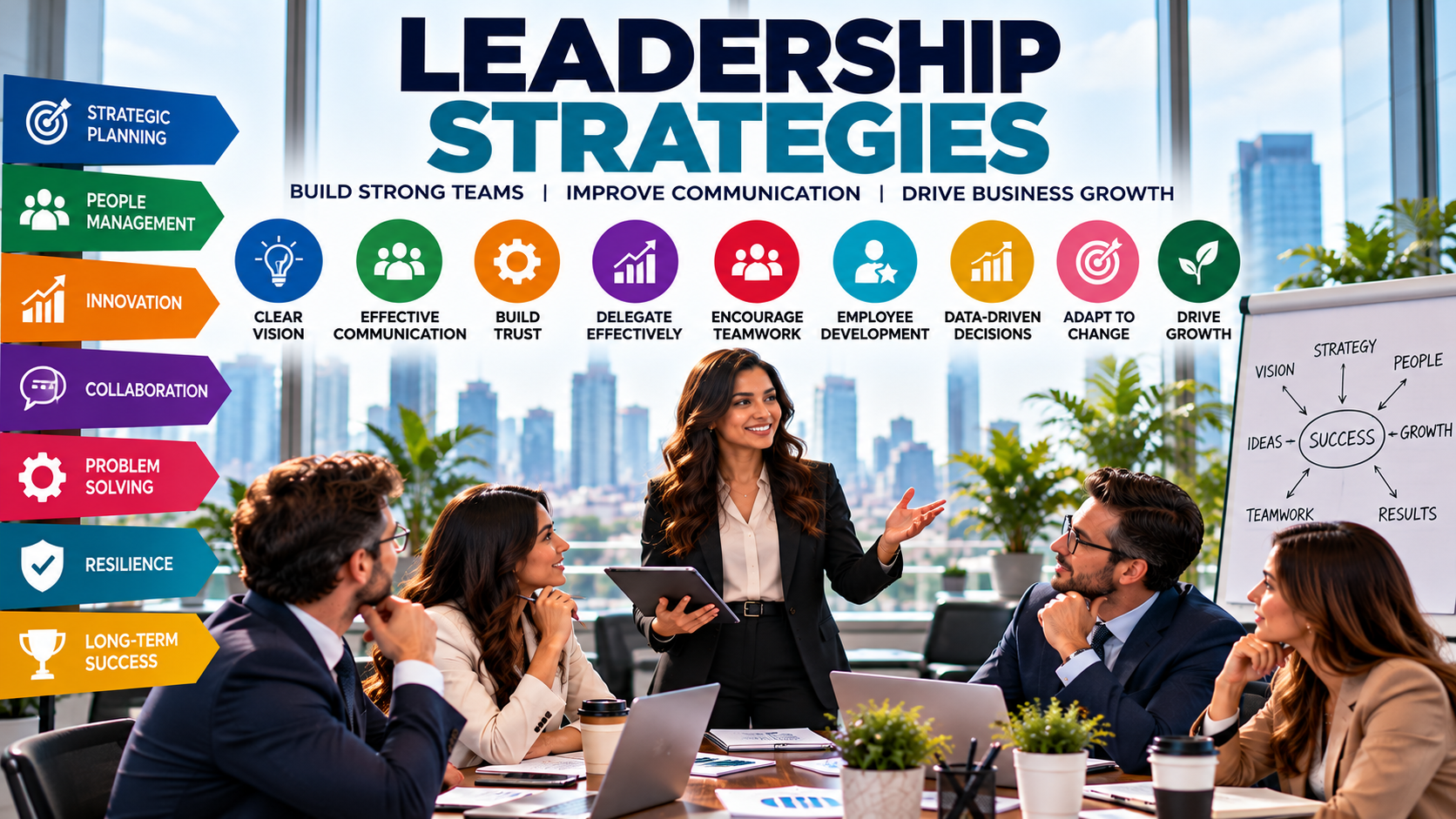
Effective leadership is one of the most important factors in long-term business success. In a competitive business environment, organizations need leaders who can make informed decisions, motivate employees, manage change, and guide teams toward shared objectives. Strong leadership is not simply about giving instructions. It involves building trust, communicating clearly, solving problems, and creating an environment where people can perform at their best.
Leadership strategies provide a structured approach to managing people, setting priorities, improving performance, and achieving organizational goals. Whether someone leads a small team, manages a growing business, or holds an executive position, the right leadership techniques can improve collaboration, strengthen workplace culture, and support sustainable growth.
As businesses adapt to technological change, evolving customer expectations, and new workplace models, leaders must continually develop their skills. Understanding modern leadership strategies can help professionals respond to challenges, inspire employees, and build more resilient organizations.
What Are Leadership Strategies?
Leadership strategies are practical methods and approaches that leaders use to guide teams, influence decisions, and achieve business objectives. They help leaders determine how to communicate expectations, delegate responsibilities, resolve conflicts, develop employees, and measure success.
A leadership strategy may focus on improving employee engagement, strengthening accountability, encouraging innovation, or preparing an organization for change. The most effective approach depends on the organization's goals, team structure, industry, and workplace culture.
For example, a startup introducing a new product may benefit from a flexible leadership approach that encourages experimentation. A company managing a major operational change may need clear communication, structured planning, and consistent performance monitoring.
Successful leaders understand that no single leadership style works in every situation. They adapt their methods while remaining consistent in their values, expectations, and commitment to their teams.
Why Leadership Strategies Matter in Modern Business
Organizations face challenges that require thoughtful decisions and effective people management. Competition, changing technologies, economic uncertainty, and employee expectations can all affect business performance.
Strong leadership strategies help organizations respond to these challenges in several ways.
1. Improving Team Performance
Clear goals and defined responsibilities help employees understand what they need to accomplish. Leaders who establish priorities, provide useful feedback, and remove obstacles can help teams work more efficiently.
2. Strengthening Employee Engagement
Employees are more likely to contribute when they feel respected, supported, and connected to organizational goals. Leaders who listen to their teams and recognize meaningful contributions can help build a more engaged workforce.
3. Supporting Better Decision-Making
Effective leaders consider evidence, evaluate alternatives, consult relevant stakeholders, and assess potential risks before making important decisions. This approach can reduce avoidable mistakes and improve organizational planning.
4. Encouraging Innovation
Businesses need new ideas to remain competitive. Leadership strategies that encourage constructive discussion, experimentation, and learning from failure can help employees identify opportunities for improvement.
5. Managing Organizational Change
Whether a business adopts new technology, restructures departments, or enters a new market, employees need clear direction. Strong leadership helps explain why change is necessary, what it means for the team, and how progress will be measured.
10 Effective Leadership Strategies for Business Success
1. Establish a Clear Vision
A strong vision gives employees a shared understanding of what the organization wants to achieve. Leaders should communicate both the desired outcome and the reasons behind it.
A clear vision helps teams prioritize tasks, align decisions, and understand how their work contributes to broader objectives.
To develop an effective leadership vision:
Define realistic long-term goals.
Explain the organization's purpose and priorities.
Connect individual responsibilities to business objectives.
Communicate the vision consistently.
Review progress as market conditions change.
For example, a business leader who wants to improve customer retention should explain how better service, faster response times, and improved product quality contribute to that goal.
2. Communicate Clearly and Consistently
Communication is a foundation of effective leadership. Employees need accurate information about expectations, responsibilities, deadlines, and organizational changes.
Poor communication can create confusion, reduce trust, and cause teams to duplicate work. Clear communication helps everyone understand priorities and raise concerns before small issues become larger problems.
Effective leaders use team meetings, one-to-one conversations, written updates, and feedback sessions to keep employees informed.
They also adapt their communication style to the situation. Complex strategic decisions may require detailed explanations, while routine updates may be communicated more efficiently through short written messages.
Most importantly, communication should be two-way. Leaders must listen carefully, ask relevant questions, and respond constructively to feedback.
3. Build Trust Through Accountability
Trust develops when leaders behave consistently, fulfill commitments, and take responsibility for their decisions. Employees are more likely to respect leaders who demonstrate honesty and apply expectations fairly.
Accountability also means accepting responsibility when something goes wrong. Instead of immediately blaming individuals, effective leaders investigate the causes, identify lessons, and establish corrective actions.
Practical ways to strengthen accountability include:
Define responsibilities clearly.
Establish measurable expectations.
Follow through on commitments.
Address problems promptly and fairly.
Recognize individual and team contributions.
Admit mistakes and communicate corrective steps.
A culture of accountability should support learning rather than create unnecessary fear. Employees need to understand that performance matters and that mistakes can provide opportunities for improvement when handled responsibly.
4. Develop Emotional Intelligence
Emotional intelligence helps leaders understand their own emotions and respond thoughtfully to the emotions of others. It includes self-awareness, self-regulation, empathy, and interpersonal skills.
Leaders with strong emotional intelligence can manage difficult conversations, respond calmly under pressure, and recognize when employees need support.
For example, an employee experiencing a temporary performance decline may need clear guidance, additional training, or a conversation about workload. A thoughtful leader investigates the situation before making assumptions.
Emotional intelligence can be developed through reflection, active listening, constructive feedback, and deliberate practice.
It does not mean avoiding difficult decisions. Instead, it helps leaders address challenges respectfully while maintaining appropriate standards.
5. Delegate Responsibilities Effectively
Delegation allows leaders to distribute work, develop employee skills, and focus on higher-priority responsibilities. However, effective delegation requires more than assigning tasks.
Leaders should match responsibilities to employees' abilities, explain expected outcomes, provide necessary resources, and establish appropriate checkpoints.
Good delegation involves:
Selecting the right person for the responsibility.
Explaining the desired result and deadline.
Providing authority appropriate to the task.
Offering guidance without unnecessary interference.
Reviewing results and sharing feedback.
Micromanagement can reduce employee confidence and slow decision-making. On the other hand, unclear delegation can create confusion and missed deadlines.
The goal is to provide sufficient direction while allowing employees to take ownership of their work.
6. Encourage Collaboration and Teamwork
Business objectives often require cooperation across departments and professional backgrounds. Leadership strategies that encourage collaboration help teams share information, combine expertise, and solve complex problems.
Leaders can support collaboration by establishing shared goals, encouraging respectful disagreement, and creating opportunities for employees to work together.
For example, a product launch may require marketing, sales, finance, customer support, and technology teams to coordinate their activities.
When each department understands its role and the responsibilities of other teams, the organization can reduce delays and improve the customer experience.
Effective collaboration does not require agreement on every issue. It requires a shared commitment to finding the best solution.
7. Invest in Employee Development
Strong leaders recognize that employee development contributes to organizational performance. Training, mentorship, coaching, and career planning can help employees improve their skills and prepare for greater responsibility.
A practical employee development strategy begins by identifying the skills the organization needs and comparing them with current team capabilities.
Leaders can then create development plans that include training courses, stretch assignments, mentoring relationships, and regular progress reviews.
Investing in employee development can also support succession planning. When employees are prepared to take on more senior responsibilities, organizations may be better equipped to manage future transitions.
Development should be connected to real business needs while considering individual strengths, interests, and career goals.
8. Make Data-Informed Decisions
Modern leaders must evaluate information carefully before making strategic choices. Data can help identify performance trends, assess risks, measure progress, and determine whether an initiative is achieving its objectives.
Useful information may include revenue growth, customer satisfaction, employee retention, project completion rates, and operational costs.
However, data should support judgment rather than replace it. Leaders need to consider the quality of the information, its limitations, and the context behind the numbers.
For example, a decline in sales may result from pricing changes, seasonal demand, supply problems, or shifts in customer behavior. Understanding the underlying cause is essential before choosing a solution.
The strongest decisions combine reliable evidence, practical experience, stakeholder input, and a clear understanding of business priorities.
9. Adapt to Change and Innovation
Change is a regular part of modern business. New competitors, customer expectations, digital tools, and economic conditions can require organizations to revise their strategies.
Adaptable leaders remain open to new information and adjust their plans when circumstances change. They also help employees understand why changes are necessary and what support is available during implementation.
To lead change effectively:
Explain the reason for the change.
Identify the expected benefits and potential risks.
Involve relevant employees in planning.
Provide training and necessary resources.
Set realistic milestones.
Review results and adjust the approach.
Innovation also requires a workplace where employees can suggest improvements without fear of unfair criticism. Leaders should encourage thoughtful experimentation while maintaining appropriate financial, legal, and operational controls.
10. Recognize Performance and Celebrate Progress
Recognition helps employees understand which contributions are valued by the organization. Effective leaders acknowledge achievements, provide specific feedback, and celebrate meaningful progress toward shared goals.
Recognition does not always require financial rewards. A sincere thank-you, public acknowledgment when appropriate, a development opportunity, or greater responsibility can also communicate appreciation.
Recognition should be fair, timely, and connected to genuine contributions. Leaders should avoid rewarding visibility alone while overlooking employees who consistently deliver important work behind the scenes.
Celebrating milestones can also strengthen team morale and remind employees that long-term objectives are achieved through consistent progress.
Different Leadership Styles and When to Use Them
Leadership strategies become more effective when leaders understand different leadership styles and when each approach may be appropriate.
Leadership style | Main characteristics | Best suited for |
|---|---|---|
Transformational | Inspires change, innovation, and a shared vision | Business growth and organizational transformation |
Democratic | Encourages employee input and shared decision-making | Collaborative teams and complex problem-solving |
Servant leadership | Prioritizes employee support and development | Trust-building and employee growth |
Autocratic | Makes decisions centrally with clear direction | Time-sensitive situations requiring rapid decisions |
Transactional | Uses defined expectations, targets, and performance rewards | Structured operations and measurable tasks |
Situational | Adapts leadership behavior to the circumstances | Teams with varying experience and changing needs |
No style is universally superior. A leader may use a collaborative approach when developing a strategy but make a faster, more directive decision during an urgent operational problem.
Effective leadership depends on understanding the situation, communicating expectations, and choosing an approach that supports both people and business objectives.
Leadership Strategies for Remote and Hybrid Teams
Remote and hybrid work arrangements require leaders to manage communication, accountability, and collaboration across different locations.
Without regular in-person interaction, employees may experience unclear expectations, reduced connection with colleagues, or difficulty accessing information.
Leaders can address these challenges through structured communication and clear working practices.
Set Clear Expectations
Define priorities, deadlines, communication channels, and responsibilities. Focus on agreed outcomes rather than measuring productivity solely by online presence.
Create Regular Check-Ins
Use team meetings and individual conversations to review progress, identify obstacles, and provide support. Meetings should have a clear purpose and avoid unnecessary repetition.
Build Team Connection
Encourage informal conversations, cross-functional projects, and opportunities for employees to share knowledge. Make sure remote employees have fair access to information and development opportunities.
Support Employee Well-Being
Respect reasonable working boundaries and monitor workloads. Leaders should encourage employees to raise concerns when responsibilities become difficult to manage.
Use Technology Thoughtfully
Collaboration platforms, project management systems, and shared documents can improve coordination. However, too many tools or notifications can create distraction. Choose systems that support the team's actual needs.
How to Measure Leadership Effectiveness
Leadership performance should be evaluated through observable outcomes rather than personal impressions alone.
Organizations can use a combination of business metrics, employee feedback, and team performance indicators to understand whether leadership strategies are working.
Useful indicators include:
Employee engagement and satisfaction.
Staff retention and turnover.
Progress toward strategic objectives.
Team productivity and project delivery.
Customer satisfaction and retention.
Quality of decision-making.
Employee development and internal promotions.
Communication effectiveness.
Achievement of financial and operational targets.
No single metric provides a complete picture. For example, strong short-term revenue does not necessarily indicate healthy team culture or sustainable performance.
Leaders should review several indicators over time, seek honest feedback, and use the findings to improve their approach.
Common Leadership Mistakes to Avoid
Even experienced leaders can make mistakes that weaken team performance or damage trust. Recognizing these issues is an important part of leadership development.
Micromanaging Employees
Excessive supervision limits autonomy and can prevent employees from developing problem-solving skills. Leaders should establish expectations and checkpoints while allowing appropriate independence.
Avoiding Difficult Conversations
Ignoring poor performance, workplace conflict, or unclear responsibilities usually allows problems to grow. Address concerns promptly, respectfully, and with specific examples.
Making Decisions Without Listening
Leaders who ignore employee input may miss important operational details or discourage future participation. Gathering perspectives does not mean every suggestion must be accepted, but people should have a fair opportunity to contribute.
Resisting Feedback
Leaders who treat criticism as a personal attack may miss opportunities to improve. Constructive feedback should be evaluated thoughtfully, with attention to evidence and potential solutions.
Failing to Recognize Employee Contributions
When good work repeatedly goes unnoticed, employees may become disengaged. Specific, fair recognition reinforces positive performance and strengthens workplace relationships.
Setting Unrealistic Goals
Ambitious goals can motivate teams, but targets that ignore available resources, timelines, and competing priorities can create unnecessary pressure. Effective leaders set challenging yet realistic objectives and review them as conditions change.
How to Develop a Personal Leadership Strategy
Developing an effective leadership approach requires self-awareness, consistent practice, and a willingness to learn.
Start with the following steps:
Step 1: Assess your current strengths. Identify the leadership skills you use effectively, such as communication, decision-making, relationship building, or problem-solving.
Step 2: Identify improvement areas. Ask for feedback from colleagues, employees, mentors, or managers. Look for recurring patterns rather than relying on a single opinion.
Step 3: Set measurable development goals. Instead of aiming to become a better communicator in general, commit to actions such as holding regular one-to-one meetings or clarifying project expectations at the start of each assignment.
Step 4: Practice consistently. Apply new techniques in everyday situations, including meetings, project planning, feedback conversations, and decision-making.
Step 5: Review your progress. Evaluate what has improved, what remains difficult, and what needs to change.
Step 6: Continue learning. Read leadership research, participate in professional communities, seek mentorship, and learn from both successful outcomes and mistakes.
Leadership development is an ongoing process. Small improvements practiced consistently can strengthen a leader's effectiveness over time.
The Future of Leadership Strategies
The future of leadership will be shaped by technology, changing employee expectations, global competition, and the growing importance of organizational adaptability.
Artificial intelligence and data analytics are providing leaders with new tools for planning, forecasting, and evaluating performance. At the same time, leaders must consider data quality, privacy, fairness, and the human impact of automated decisions.
Emotional intelligence, clear communication, ethical judgment, and collaboration will remain important because technology cannot independently establish trust or replace responsible human leadership.
Organizations will also need leaders who can support continuous learning, manage change, and create environments where employees can contribute ideas.
The most effective leadership strategies will combine technological awareness with human understanding, measurable goals, and a clear sense of organizational purpose.
Conclusion
Leadership strategies are essential for building strong teams, improving workplace culture, and achieving sustainable business growth. By establishing a clear vision, communicating effectively, building trust, delegating responsibilities, developing employees, and making informed decisions, leaders can create conditions in which people and organizations succeed.
Successful leadership is not defined by a single management style. It requires adaptability, accountability, emotional intelligence, and a commitment to continuous improvement.
Whether leading a small team or managing a large organization, professionals can strengthen their leadership effectiveness by applying practical strategies, listening to feedback, and aligning everyday decisions with long-term objectives.
In a changing business environment, leaders who invest in their own development and support the growth of their teams are better positioned to navigate challenges, encourage innovation, and create lasting value.
Frequently Asked Questions About Leadership Strategies
What are the most effective leadership strategies?
Effective leadership strategies include setting clear goals, communicating consistently, building trust, delegating responsibilities, encouraging teamwork, developing employees, using data-informed decisions, and adapting to change.
Why are leadership strategies important?
Leadership strategies help organizations align employees with business objectives, improve decision-making, strengthen accountability, support innovation, and manage change more effectively.
How can leaders motivate their teams?
Leaders can motivate employees by setting meaningful goals, recognizing contributions, providing development opportunities, listening to feedback, and creating a fair and supportive workplace.
What is the best leadership style?
There is no single best leadership style for every situation. Transformational, democratic, servant, transactional, and situational approaches can each be useful depending on team needs, organizational objectives, and the circumstances.
How can leadership effectiveness be measured?
Leadership effectiveness can be assessed through employee engagement, retention, team performance, project delivery, customer satisfaction, progress toward strategic goals, and feedback from relevant stakeholders.
How can someone improve leadership skills?
Individuals can improve leadership skills through self-assessment, mentorship, practical experience, communication training, constructive feedback, and consistent practice.
What leadership skills are important in modern business?
Important leadership skills include strategic thinking, communication, emotional intelligence, decision-making, adaptability, collaboration, accountability, and the ability to develop others.