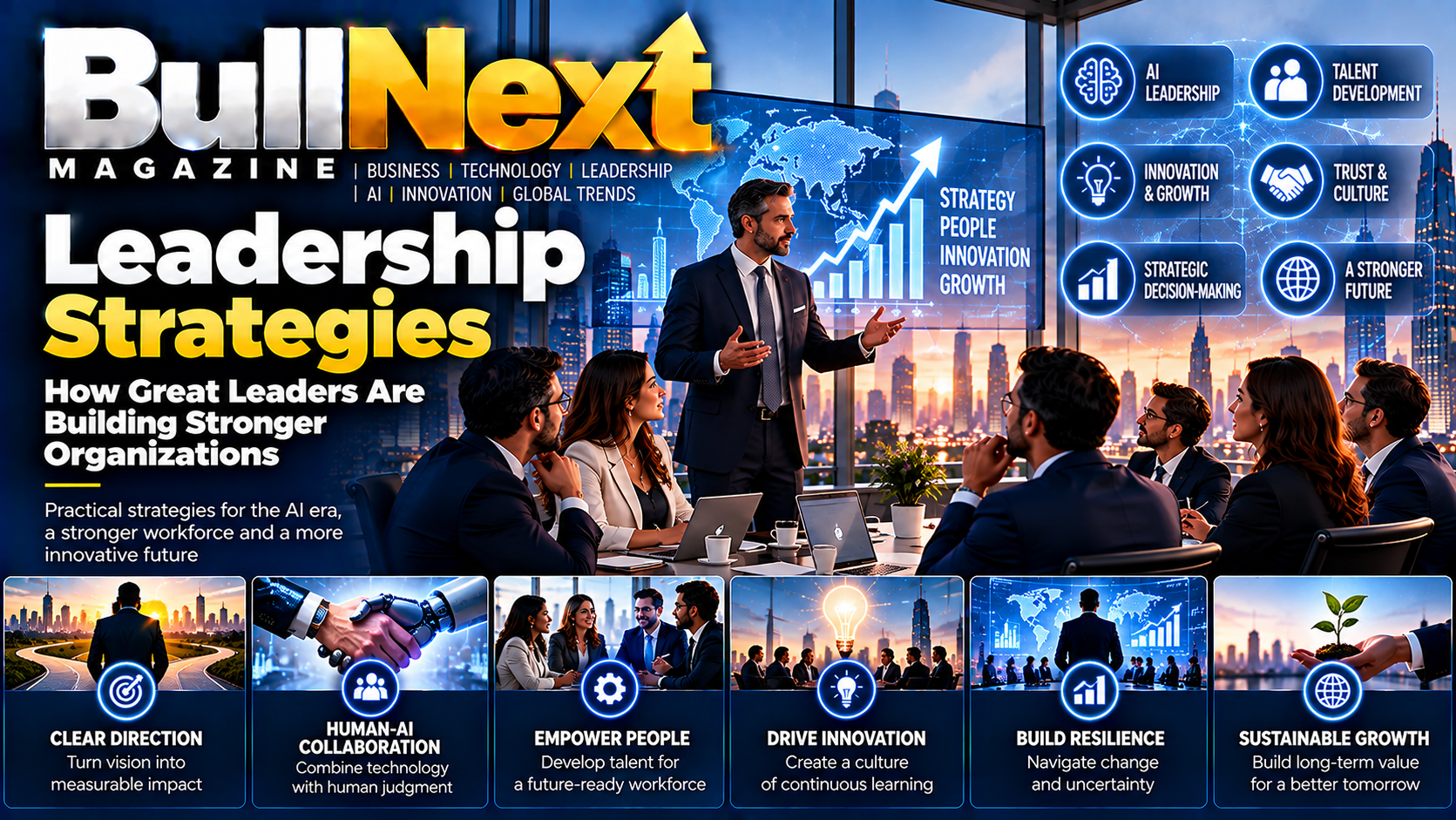
Leadership strategies is entering a new era.
Organizations are dealing with rapid advances in artificial intelligence, economic uncertainty, geopolitical disruption, changing customer expectations and a workforce that increasingly expects flexibility, purpose and opportunities to develop new skills.
In this environment, leadership cannot depend only on experience, authority or technical expertise.
The strongest leaders must create clarity when conditions are unclear, build trust during periods of change and help their organizations adapt without losing sight of long-term objectives.
Artificial intelligence is making this transformation even more significant. The World Economic Forum reported in 2026 that human-centered capabilities are becoming increasingly important as AI takes on more technical and repetitive work. Its research also found that 95% of HR leaders consider middle managers crucial to ensuring employees use AI effectively.
McKinsey similarly argues that AI does not eliminate the need for leadership. Instead, it makes human capabilities such as setting direction, building trust, making difficult decisions and holding people accountable even more important.
For modern organizations, effective leadership therefore requires a combination of strategic thinking, human judgment, technological fluency and organizational adaptability.
Leadership Is No Longer About Having All the Answers
Traditional leadership often rewarded expertise.
The person who knew the most about a particular function could become the leader of that function.
But technology is changing the value of expertise.
AI can increasingly analyze information, identify patterns, produce content, write software and support complex decision-making.
That does not make expertise irrelevant.
Instead, it changes what leaders do with expertise.
Modern leaders need to ask better questions.
They need to distinguish valuable information from noise.
They need to challenge assumptions.
They need to understand context.
And they need to decide what should happen next.
The World Economic Forum notes that as AI becomes more capable, human judgment and the ability to identify new problems are becoming increasingly valuable leadership capabilities.
This creates a fundamental shift:
The best leader is not necessarily the person who knows the most. It is increasingly the person who can create clarity from complexity.
Strategy One: Create a Clear Direction
Employees cannot execute a strategy they do not understand.
One of the most important responsibilities of leadership is therefore creating clarity.
A strong leader should be able to answer three basic questions:
Where are we going?
Why does it matter?
How will we know we are making progress?
These questions sound simple, but organizations often struggle to answer them.
Companies may have too many priorities.
Departments may pursue competing objectives.
Employees may not understand how their work contributes to the company's strategy.
Technology initiatives may be launched without clear business outcomes.
Effective leaders reduce this confusion.
They establish a limited number of strategic priorities and communicate them consistently.
A clear strategy does not mean predicting the future perfectly.
It means giving people a direction while remaining flexible enough to adapt.
Strategy Two: Lead With Human Judgment
AI can provide recommendations.
It can analyze data.
It can identify patterns.
It can generate possible solutions.
But leadership decisions often involve ambiguity, competing priorities and human consequences.
That requires judgment.
A leader may have to decide:
Which risk is acceptable?
Which customer should receive priority?
When should a company invest?
When should it stop a project?
Which employee deserves greater responsibility?
How much should the organization automate?
Where should humans remain directly involved?
These decisions cannot always be reduced to a mathematical formula.
The World Economic Forum has highlighted the growing importance of human judgment as AI takes over more prediction and routine work.
The leadership strategy for the AI era is therefore not to compete with AI.
It is to combine AI's analytical capabilities with human judgment.
Strategy Three: Treat AI as a Business Strategy
One of the biggest leadership mistakes is treating AI as simply another technology upgrade.
AI can influence:
Business models
Customer experience
Operations
Workforce structures
Product development
Marketing
Finance
Supply chains
Decision-making
The World Economic Forum's September 2026 leadership guidance argues that organizations should treat AI as a business transformation effort rather than merely a technology initiative.
Leaders should therefore begin with business questions.
Instead of asking:
“Where can we use AI?”
Ask:
“What business problem are we trying to solve?”
This change in thinking can dramatically improve AI strategy.
A company might discover that the best AI opportunity is not a flashy chatbot but an internal workflow that reduces repetitive work.
Another company may find that AI can improve customer service.
Another may use AI to identify new market opportunities.
The technology should follow the strategy.
Strategy Four: Build an Organization That Learns
The speed of technological change makes continuous learning essential.
A skill that is valuable today may become less important tomorrow.
New tools appear constantly.
Entire workflows may be redesigned.
Employees therefore need opportunities to learn continuously.
The World Economic Forum reports that the skills required for highly AI-exposed jobs are changing faster than those in less exposed roles, reinforcing the need for workforce investment alongside technology investment.
Strong leaders create learning organizations.
That means encouraging employees to:
Experiment
Ask questions
Learn new technologies
Share knowledge
Develop new skills
Reflect on mistakes
Challenge outdated processes
Learning should not be treated as an occasional training event.
It should become part of everyday work.
Strategy Five: Strengthen Middle Management
Senior executives often receive most of the attention in leadership discussions.
But middle managers can determine whether organizational strategy actually reaches employees.
They translate executive decisions into daily work.
They understand operational problems.
They coach employees.
They manage performance.
They influence culture.
And they are often closest to the practical implementation of new technology.
The World Economic Forum's 2026 research found that 95% of HR leaders view middle managers as crucial to ensuring employees use AI effectively, while 92% consider them important for redefining jobs as AI changes work.
Yet organizations may not provide these managers with enough development.
Leadership strategy should therefore include deliberate investment in middle management.
Managers need training in:
AI literacy
Communication
Coaching
Change management
Conflict resolution
Decision-making
Strategic thinking
Workforce planning
Strong middle managers create stronger organizations.
Strategy Six: Communicate During Uncertainty
Uncertainty creates anxiety.
Employees want to know what is happening, why it is happening and what it means for them.
Silence creates speculation.
Poor communication creates confusion.
Strong communication creates confidence.
The World Economic Forum's 2026 leadership analysis emphasizes clarity and trust as critical leadership responsibilities during technological and organizational disruption.
Effective leaders should communicate:
What we know.
What we do not know.
What we are doing about it.
What employees should expect next.
This approach is particularly important during restructuring, AI adoption, economic pressure or major strategic changes.
Leaders do not need to pretend they have every answer.
They need to demonstrate that the organization has a thoughtful process for finding answers.
Strategy Seven: Build Trust Before You Need It
Trust is one of the most valuable assets an organization can have.
It determines whether employees speak openly.
It influences whether teams collaborate.
It affects whether customers believe corporate promises.
And it becomes especially important during crises.
Trust cannot be created overnight.
It is built through consistent behavior.
Leaders build trust by:
Keeping commitments
Communicating honestly
Taking responsibility
Listening to employees
Explaining decisions
Recognizing contributions
Admitting mistakes
Treating people fairly
Technology makes trust even more important.
Employees may question how AI is being used.
Customers may question how their data is handled.
Teams may worry about automation.
Leaders must therefore combine technological progress with transparency.
Strategy Eight: Give Employees a Reason to Adapt
Change management often fails because leaders focus on the technology rather than the people.
An executive may announce a new AI platform and expect employees to immediately adopt it.
But employees may ask:
Why are we doing this?
Will this change my role?
What happens to my responsibilities?
Will I receive training?
How will success be measured?
What happens if the technology makes mistakes?
Effective leaders answer these questions before resistance develops.
The World Economic Forum has warned that AI adoption can create uncertainty when employees do not understand how technology will affect their future.
Leaders should therefore connect transformation with opportunity.
Instead of saying:
“AI will automate your work.”
A better leadership message is:
“AI will change parts of your work, and we are investing in the skills and systems needed to help you succeed in that new environment.”
That difference matters.
Strategy Nine: Develop AI Fluency at Every Level
AI literacy should not belong only to the technology department.
Executives need it.
Managers need it.
Marketing teams need it.
Finance teams need it.
HR teams need it.
Operations teams need it.
Customer-service teams need it.
Every department may eventually interact with AI differently.
Leaders should therefore create organization-wide AI learning programs.
The goal is not to turn everyone into an AI engineer.
The goal is to help employees understand:
What AI can do
What AI cannot do
How to evaluate AI outputs
How to use AI responsibly
How AI changes workflows
When human judgment is necessary
How to protect sensitive information
This creates a more capable workforce.
Strategy Ten: Focus on Tasks, Not Just Jobs
One of the most important leadership questions surrounding AI is whether technology will replace entire jobs.
A more useful question is:
Which tasks within each job can AI automate, augment or accelerate?
The World Economic Forum's 2026 leadership research emphasizes this task-level perspective as organizations redesign work.
A marketing role, for example, may contain tasks involving:
Research
Writing
Data analysis
Customer communication
Creative strategy
Relationship management
AI may automate some activities while strengthening others.
The job itself may not disappear.
Instead, its composition may change.
Leaders who understand this distinction can design better workforce strategies.
Strategy Eleven: Encourage Constructive Disagreement
A strong leadership team should not be an agreement machine.
If everyone agrees with the leader all the time, important risks may remain hidden.
Effective leaders create environments where employees can challenge ideas respectfully.
This requires psychological safety.
Employees should be able to say:
“I think this strategy has a weakness.”
“This assumption may be wrong.”
“Our customers may react differently.”
“The data does not support this conclusion.”
“This AI recommendation may be incorrect.”
Leaders should reward thoughtful challenge rather than punish disagreement.
Better decisions often emerge from competing perspectives.
Strategy Twelve: Make Accountability Clear
Leadership requires accountability.
Teams need to know:
Who owns the decision?
Who owns the project?
What outcome is expected?
When will it be delivered?
How will performance be measured?
Without clear ownership, organizations can become slow.
Everyone may participate, but nobody is responsible.
Strong leaders create clear accountability while avoiding unnecessary bureaucracy.
Every major initiative should have an owner.
Every strategic objective should have measurable outcomes.
Every important decision should have a defined decision-maker.
Strategy Thirteen: Balance Short-Term Performance With Long-Term Preparation
Organizations naturally focus on immediate results.
Revenue.
Profit.
Customers.
Costs.
Deadlines.
But leaders must also prepare for the future.
This creates a dual responsibility.
One horizon focuses on today's performance.
The other focuses on tomorrow's capabilities.
The World Economic Forum's 2026 leadership analysis describes this as balancing current operational performance with the need to prepare people and organizations for future disruption.
Leaders should therefore reserve resources for:
Innovation
Research
Employee development
Technology experimentation
New business models
Leadership development
Strategic partnerships
A company that only manages the present may eventually become unprepared for the future.
Strategy Fourteen: Make Customer Understanding a Leadership Priority
Leadership strategies often focus on internal operations.
But organizations ultimately exist to serve customers.
Leaders should remain close to customer reality.
That means reviewing:
Customer feedback
Complaints
Retention
Satisfaction
Buying behavior
Product usage
Customer support interactions
Market trends
Executives should regularly ask:
What is changing for our customers?
Technology can provide data, but leaders need to interpret what that data means.
Customer understanding should influence product strategy, marketing, operations and investment decisions.
Strategy Fifteen: Build Cross-Functional Leadership
Modern problems rarely belong to one department.
AI adoption involves technology, HR, finance, legal and operations.
Cybersecurity involves IT, risk, legal and executive leadership.
Customer experience involves marketing, product, sales and service.
Sustainability may involve operations, finance, procurement and strategy.
This makes cross-functional leadership essential.
Leaders should create teams that bring different disciplines together around shared outcomes.
The goal is to reduce organizational silos.
A company becomes more adaptable when departments understand one another and collaborate toward common objectives.
Strategy Sixteen: Measure What Matters
Leadership requires measurement.
But measuring everything can create its own problems.
Employees can become overwhelmed by dashboards and KPIs.
The solution is to identify the metrics that actually matter.
A leadership team might focus on:
Revenue growth
Customer retention
Profitability
Productivity
Employee engagement
Innovation
AI adoption
Customer satisfaction
Operational resilience
Metrics should connect directly to strategic priorities.
If a metric does not influence decisions, leaders should question why it exists.
Strategy Seventeen: Develop Future Leaders Before You Need Them
Leadership succession should not begin when an executive leaves.
It should begin years earlier.
Organizations need leadership pipelines.
Potential leaders should receive:
Stretch assignments
Mentorship
Cross-functional exposure
Decision-making opportunities
Coaching
Strategic projects
International experience where appropriate
AI is also changing how future leaders develop.
If automation removes some traditional entry-level tasks, organizations may need to deliberately create opportunities for employees to develop judgment and leadership experience.
The World Economic Forum has highlighted this challenge as AI reshapes traditional career pathways.
The organizations that solve this problem early will have a stronger leadership pipeline.
Strategy Eighteen: Use AI to Strengthen Leadership, Not Replace It
AI can become a leadership assistant.
Executives can use AI to:
Summarize information
Analyze scenarios
Prepare questions
Identify patterns
Research markets
Generate alternatives
Challenge assumptions
Organize information
But leaders should avoid outsourcing judgment.
McKinsey's 2026 research emphasizes that AI can support leaders but cannot replace core leadership responsibilities such as setting aspirations, making difficult calls, building trust and holding people accountable.
A useful principle is:
Use AI to expand your thinking, not to eliminate your thinking.
Strategy Nineteen: Create a Culture of Experimentation
Innovation requires experimentation.
Not every experiment will succeed.
That is acceptable.
The objective is to learn quickly without creating unacceptable risk.
Leaders can establish controlled experimentation through:
Small pilots
Clear hypotheses
Defined success metrics
Limited budgets
Fast feedback
Post-experiment reviews
This is particularly useful for AI.
Instead of making a massive technology investment immediately, organizations can test smaller use cases, measure results and scale what works.
The World Economic Forum's 2026 AI leadership guidance emphasizes moving beyond isolated pilots toward embedding successful AI capabilities into everyday workflows.
Strategy Twenty: Lead With Purpose
Technology can improve efficiency.
But purpose gives organizations direction.
Employees increasingly want to understand why their work matters.
Customers increasingly care about what companies stand for.
Leaders therefore need to connect business performance with a broader sense of purpose.
Purpose does not mean ignoring profitability.
It means understanding what the organization contributes to customers, employees and society while maintaining sustainable business performance.
A strong purpose can become a powerful source of alignment.
The Leadership Model of the Future
The leadership model of the future will be different from the traditional command-and-control model.
It will increasingly be based on:
Clarity instead of confusion.
Trust instead of fear.
Judgment instead of automatic decision-making.
Learning instead of fixed expertise.
Collaboration instead of silos.
Adaptability instead of rigid planning.
Human-AI partnership instead of technology replacing human responsibility.
The World Economic Forum's 2026 leadership research emphasizes that effective leaders increasingly need to combine AI fluency with human-centered skills.
This does not mean traditional leadership skills disappear.
Vision still matters.
Accountability still matters.
Communication still matters.
Strategic thinking still matters.
But the context has changed.
Conclusion: Leadership Is Becoming More Human
The future of leadership will be shaped by technology, but successful leadership will remain fundamentally human.
AI can process information.
Leaders create meaning.
AI can identify patterns.
Leaders determine what matters.
AI can generate recommendations.
Leaders make decisions.
AI can automate tasks.
Leaders develop people.
That is why leadership strategies must evolve alongside technology.
The organizations that succeed will not necessarily be those that automate the most.
They will be those that understand where technology creates leverage and where human judgment creates value.
Modern leaders need to create clarity, build trust, develop talent, encourage learning, strengthen middle management, embrace AI strategically and maintain a long-term view.
Most importantly, they must bring people with them.
As the World Economic Forum notes, the future of effective leadership increasingly depends on balancing technological progress with human capability, trust and resilience.
The ultimate leadership strategy is therefore simple:
Build organizations that can adapt, learn and grow — without losing the human qualities that make leadership matter.
Frequently Asked Questions
What are the most important leadership strategies in 2026?
leadership strategies include creating clarity, building trust, developing AI fluency, investing in employees, strengthening middle management, encouraging experimentation, improving cross-functional collaboration and maintaining a balance between short-term performance and long-term preparation.
How is AI changing leadership?
AI is automating and augmenting many technical and repetitive activities. This increases the importance of human capabilities such as judgment, communication, strategic thinking, creativity, trust-building and decision-making.
What makes an effective leader today?
Effective leaders provide clear direction, communicate transparently, build trust, adapt to change, develop employees and use technology strategically while maintaining human accountability.
Why is middle management important?
Middle managers translate strategy into everyday execution. They influence employee adoption, culture, performance and change management, making them especially important during AI and organizational transformation.
How can leaders prepare employees for AI?
Leaders can provide AI training, redesign workflows, explain how roles are changing, create opportunities for reskilling and establish clear guidelines for responsible AI use.
Should leaders rely on AI for decision-making?
AI can support decision-making with analysis and recommendations, but leaders should retain responsibility for judgment, accountability, ethical considerations and final decisions.
What is the biggest leadership challenge in the AI era?
One of the biggest challenges is balancing technological acceleration with human development. Organizations must adopt AI while ensuring employees continue to develop judgment, creativity, leadership and other capabilities that technology cannot fully replace.
What will leadership look like in the future?
Future leadership will increasingly combine strategic vision, AI fluency, human judgment, adaptability, collaboration, continuous learning and the ability to guide people through constant change.