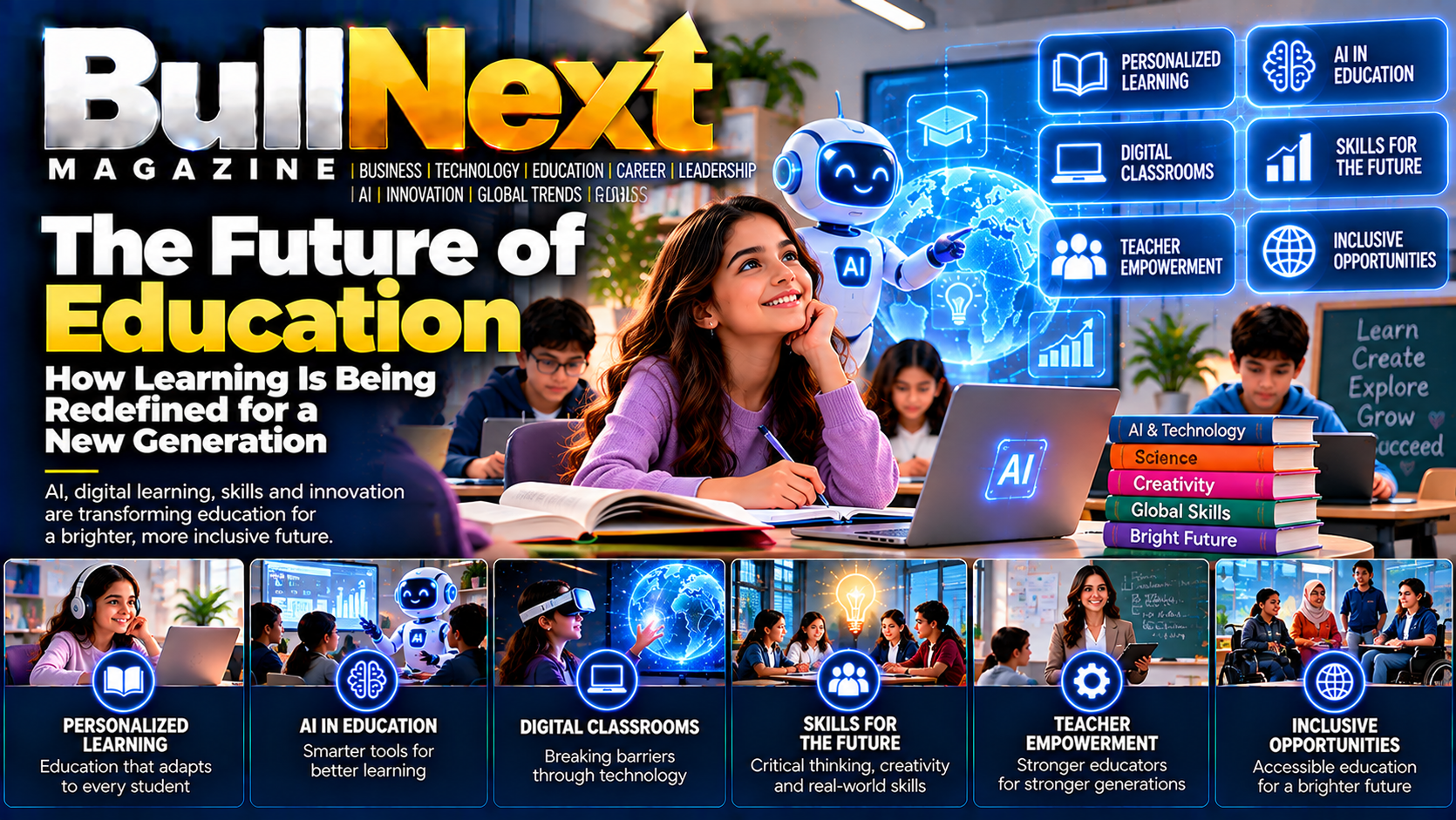
Education has always evolved alongside society. The classroom of one generation rarely looks exactly like the classroom of the next. But the transformation taking place today is different in both speed and scale.
Artificial intelligence, digital platforms, changing labor markets, demographic shifts and growing demand for flexible learning are reshaping how people acquire knowledge and skills. Education is moving beyond the traditional model in which students primarily memorize information, complete examinations and graduate with a fixed set of qualifications.
The emerging model places greater emphasis on critical thinking, creativity, problem-solving, adaptability, digital literacy, collaboration and lifelong learning.
Artificial intelligence is accelerating this transformation. AI tutors can provide personalized support, digital platforms can expand access to educational resources, and intelligent systems can help teachers with planning and administrative tasks. At the same time, educators and policymakers face difficult questions about academic integrity, student privacy, inequality, cognitive development and the role of human judgment.
The World Economic Forum's 2026 report Shaping the Future of Learning: Education Readiness for the Age of AI argues that AI adoption in education must strengthen human learning, equity and trust rather than simply introduce new technology into classrooms.
The future of education, therefore, is unlikely to be about choosing between humans and technology. It will be about designing learning environments in which technology supports people while human capabilities remain at the center.
Education Is Moving From Information to Capability
For centuries, access to information was one of the major advantages provided by education.
Students went to school because teachers, books and libraries provided access to knowledge that was otherwise difficult to obtain.
The internet dramatically changed that equation.
Today, students can access lectures, research papers, tutorials, simulations and educational resources from almost anywhere. Generative AI has accelerated this shift even further by allowing learners to ask questions, receive explanations and explore concepts interactively.
As information becomes easier to access, simply remembering information becomes less valuable as an educational objective.
The more important question becomes:
What can a learner do with information?
This shifts education toward capability.
Students increasingly need to learn how to:
Evaluate information
Identify unreliable sources
Ask better questions
Solve unfamiliar problems
Communicate ideas clearly
Work with technology
Collaborate with other people
Think independently
Apply knowledge to real situations
Continue learning after formal education ends
The World Economic Forum has highlighted the growing importance of human skills in an AI-driven world, arguing that education must give learners opportunities to develop capabilities that technology cannot simply substitute for.
AI Is Becoming Part of the Learning Environment
Artificial intelligence is no longer a distant technology discussed only by technology companies.
It is increasingly becoming part of education.
Students can use AI systems to brainstorm ideas, explain difficult concepts, practice languages, generate questions and receive feedback. Teachers can use AI to help prepare lessons, organize materials and create differentiated learning activities.
But this creates a fundamental challenge.
If students allow AI to perform the thinking for them, technology can make learning easier while simultaneously making learning weaker.
The goal should not be to prevent students from using AI altogether. Instead, education systems need to teach students how to use AI responsibly.
UNESCO's current approach emphasizes human agency, critical thinking and ethics alongside AI and digital competencies.
That means a student should learn to treat AI as a learning partner rather than an unquestioned authority.
For example, instead of asking AI to write an entire assignment and submitting the result, a student could use AI to:
Generate possible research questions.
Explain difficult concepts.
Challenge an initial argument.
Identify gaps in reasoning.
Suggest alternative perspectives.
Help organize research.
Provide practice questions.
Compare different explanations.
The student still has to think, verify, decide and create.
That distinction could become one of the most important principles of education in the AI era.
The Teacher's Role Is Changing, Not Disappearing
Whenever a new technology enters education, one question inevitably appears:
Will technology replace teachers?
The more likely future is different.
Teachers may spend less time performing repetitive administrative tasks and more time doing work that depends on judgment, mentorship, emotional intelligence and human connection.
A teacher can recognize when a student is frustrated.
A teacher can encourage a student who has lost confidence.
A teacher can understand classroom dynamics.
A teacher can inspire curiosity.
Technology can support these activities, but it does not automatically replace the human relationship behind them.
The World Economic Forum and UNESCO both emphasize that successful AI integration requires human capacity, appropriate governance and thoughtful educational design rather than simply adding technology to classrooms.
The future teacher may therefore become less of a lecturer and more of a:
Mentor
Coach
Facilitator
Learning designer
Critical-thinking guide
Technology navigator
Student advocate
This could make teaching more strategic rather than less important.
Critical Thinking Becomes a Core Educational Skill
One of the biggest challenges created by generative AI is that students can receive convincing answers almost instantly.
But an answer that sounds intelligent is not necessarily correct.
AI systems can make mistakes, misunderstand questions, produce outdated information or present biased conclusions with confidence.
That means education must teach students to question information rather than simply consume it.
Critical thinking involves asking:
Where did this information come from?
What evidence supports it?
Is the source reliable?
What assumptions are being made?
Are there alternative explanations?
What information might be missing?
Does the conclusion logically follow from the evidence?
This is especially important as synthetic content becomes more widespread.
UNESCO's 2026 Digital Learning Week focused on questions surrounding facts, synthetic knowledge, AI-generated content, educational integrity and the future of human agency.
In the future, being educated may increasingly mean knowing how to question information, not simply knowing more information.
Creativity Could Become More Valuable
AI can generate text, images, presentations, code and ideas.
That does not make creativity irrelevant.
Instead, it may change what creativity means.
When machines can generate numerous possible outputs, human creativity increasingly involves deciding:
What problem is worth solving?
Which idea matters?
Which direction is original?
Which solution is appropriate?
What should be created?
Who is it for?
Why should it exist?
Students therefore need opportunities to create rather than only reproduce.
Project-based learning, entrepreneurship, research, design challenges, writing, arts, experimentation and collaborative problem-solving can help develop this capability.
The classroom of the future may place less emphasis on producing the one correct answer and more emphasis on understanding why a solution works and whether it is meaningful.
The Digital Divide Is Still a Major Challenge
Technology can expand educational opportunity, but only when people can actually access it.
A sophisticated AI learning platform is of little value to a student without reliable connectivity, electricity, appropriate devices or trained educators.
UNESCO reports that only around 40% of primary schools and 50% of lower-secondary schools globally are connected to the internet.
This means the future of education cannot simply focus on the most technologically advanced classrooms.
It must also address:
Internet access
Affordable devices
Teacher training
Digital literacy
Accessible educational content
Language barriers
Infrastructure
Disability inclusion
Rural and underserved communities
Otherwise, AI could create a new educational divide between students who understand and use advanced technology and those who cannot access it.
The objective should be to use technology to close educational gaps rather than widen them.
Education Must Become More Personalized
Traditional education often places large groups of students in the same classroom, gives them similar materials and evaluates them through standardized assessments.
But students learn differently.
Some need additional explanations. Others need more challenging material. Some learn best through visual demonstrations, while others prefer reading, discussion or practical activities.
AI and digital platforms could help educators personalize learning at a scale that was previously difficult.
A learning system could potentially identify where a student is struggling and recommend additional practice.
Another student could receive more advanced material because they have already mastered the basics.
Teachers could receive information that helps them identify common misconceptions across a classroom.
However, personalization should not become excessive surveillance.
Educational technology must balance personalization with privacy, security and student autonomy.
Assessment Will Need to Change
One of the biggest educational questions of the AI era concerns examinations and assignments.
If AI can generate essays, solve equations, write code and produce presentations, traditional homework may no longer provide a reliable measurement of what a student actually understands.
This does not mean assessment becomes impossible.
It means assessment may need to become more focused on:
Oral explanation
Practical projects
Presentations
Research processes
Problem-solving
Collaboration
Reflection
Demonstrations
Real-world applications
Defending conclusions
Instead of asking only, "What answer did you produce?" educators may increasingly ask:
"How did you reach that answer?"
That distinction can help preserve academic integrity while encouraging students to use AI responsibly.
UNESCO's 2026 survey of UNESCO Chairs in higher education found that 93% of respondents believed students were using generative AI to produce assignments, while 63% perceived a decline in students' cognitive capacities. The findings underline why institutions are increasingly reconsidering how learning and assessment should work in an AI environment.
Digital Literacy Is Becoming Basic Literacy
Digital literacy used to mean knowing how to operate a computer.
That definition is no longer sufficient.
Modern digital literacy includes understanding:
Search engines
Online information
Digital security
Data privacy
Artificial intelligence
Algorithms
Online communication
Digital identity
Misinformation
Content creation
Cybersecurity
Responsible technology use
AI literacy is becoming another important component.
Students do not necessarily need to become programmers.
But they should understand what AI systems can do, what they cannot reliably do, how AI-generated information should be evaluated and what ethical responsibilities accompany its use.
The World Economic Forum has described AI literacy as an emerging dividing line between people who merely consume AI outputs and those who understand how to use the technology effectively.
Education Should Connect More Closely With Real Life
Another major shift could be the movement away from purely theoretical learning.
Students often ask:
"When will I ever use this?"
The future of education should create more opportunities to answer that question.
Students can learn through:
Internships
Research projects
Entrepreneurship
Community projects
Industry partnerships
Simulations
Competitions
Apprenticeships
Freelance projects
Volunteering
Practical experiments
The World Economic Forum has argued that experience—including internships, research, entrepreneurship and community engagement—can become an important part of preparing students for changing labor markets.
This approach helps students connect knowledge with action.
A student studying business could build a small business.
A science student could conduct a research project.
A computer science student could create software.
A communications student could develop a real campaign.
A design student could work with a real client.
Education becomes more powerful when students can see how knowledge operates outside the classroom.
Lifelong Learning Will Become Normal
The traditional education model assumes that people complete their education and then enter the workforce.
That model is becoming increasingly outdated.
Technology changes industries.
Jobs evolve.
New professions emerge.
Entire workflows can be automated.
As a result, people increasingly need to update their skills throughout their lives.
Lifelong learning could become a normal part of professional life rather than something reserved for students.
People may repeatedly return to education through:
Short courses
Professional certificates
Online learning
Industry training
Microcredentials
University programs
Workshops
Boot camps
Professional communities
Independent study
This does not necessarily mean everyone needs another university degree.
In many cases, targeted learning may be more useful than restarting an entire educational pathway.
Education and Employment Are Becoming More Connected
The changing workplace is putting pressure on educational institutions to reconsider what they teach.
Employers increasingly need people who can combine technical understanding with communication, judgment, collaboration and adaptability.
That means the most valuable education may not be the one that provides the longest list of facts.
It may be the one that develops the ability to learn, apply and adapt.
Students should graduate with more than a certificate.
They should have evidence of what they can do.
That evidence could include:
Projects
Research
Publications
Portfolios
Presentations
Software
Business ideas
Community work
Internships
Practical experience
This creates a stronger bridge between education and employment.
The Future Student Will Need a Broader Skill Set
The future learner will likely need a combination of technical and human capabilities.
Technical capabilities
These may include:
AI literacy
Data literacy
Digital tools
Cybersecurity awareness
Research skills
Basic automation
Technology fluency
Human capabilities
These include:
Critical thinking
Creativity
Communication
Empathy
Collaboration
Leadership
Ethical judgment
Adaptability
Problem-solving
The combination is powerful.
Technology can increase productivity, but human judgment determines how that productivity should be used.
Education Needs Better AI Governance
Technology adoption without rules can create problems.
Educational institutions need clear policies around:
Student data
AI-generated work
Academic integrity
Privacy
Bias
Transparency
Age-appropriate technology
Teacher responsibilities
Procurement
Algorithmic decision-making
UNESCO's 2026 ministerial statement on AI and education emphasized governance, public accountability and respect for the rights of learners and teachers.
This is important because education is not simply another commercial technology market.
It shapes citizens, workers and societies.
Technology decisions made today can influence generations of learners.
What Schools and Universities Can Do Now
Educational institutions do not need to wait for the perfect technology strategy.
They can begin with practical steps.
1. Teach AI literacy
Students should understand AI capabilities, limitations, risks and responsible use.
2. Train teachers
Teachers need opportunities to experiment with AI and digital tools while developing appropriate classroom policies.
3. Redesign assessments
Institutions should emphasize understanding, reasoning, projects and practical application.
4. Strengthen critical thinking
Students should regularly evaluate sources, evidence and competing arguments.
5. Expand experiential learning
Internships, projects, research and entrepreneurship can connect education to real-world challenges.
6. Protect student privacy
Technology adoption should not come at the expense of personal data.
7. Improve digital access
Infrastructure and affordability must remain central to education policy.
8. Encourage lifelong learning
Education should prepare people not only for their first job but for multiple stages of their lives.
What Students Can Do
Students also have a role in shaping the future of education.
They can begin by developing a personal learning strategy.
Instead of asking only:
"What degree should I get?"
students can also ask:
"What problems do I want to be capable of solving?"
That question changes everything.
A strong learner can:
Develop one technical skill deeply.
Build strong communication skills.
Learn how to use AI responsibly.
Practice independent research.
Create real projects.
Develop a professional portfolio.
Learn from people outside their field.
Stay curious about emerging technologies.
Question information rather than accepting it automatically.
Continue learning after graduation.
The goal is not to predict exactly what the future will look like.
The goal is to become capable of adapting when it changes.
The Future of Education Will Be Human-Centered
The most important lesson from the current education transformation is that technology itself is not the destination.
A school does not become better simply because it has more devices.
A university does not become more innovative simply because it introduces AI software.
A student does not become more educated simply because they have access to an AI chatbot.
The real measure is whether technology improves learning.
UNESCO's current education framework emphasizes that digital innovation should support educational access, inclusion, quality and lifelong learning while keeping human agency and ethics central.
That principle is likely to define successful education systems in the years ahead.
The strongest institutions will not necessarily be those that adopt the most technology.
They will be those that understand when technology helps, when humans are needed and how the two can work together.
Conclusion
The future of education is not simply digital.
It is adaptive, personalized, practical, human-centered and increasingly lifelong.
Artificial intelligence is changing how students access knowledge, how teachers work and how institutions think about learning. But the rise of AI also makes human capabilities more important—not less.
Critical thinking, creativity, communication, curiosity, collaboration, ethics and independent judgment will remain essential.
The education system of the future should therefore prepare people not merely to pass examinations, but to navigate uncertainty, solve problems, evaluate information and continue learning throughout their lives.
The central question is no longer whether technology will change education.
It already has.
The bigger question is whether education systems can change wisely enough to ensure that technology strengthens human potential rather than replacing the very thinking education is supposed to develop.
Frequently Asked Questions
What is the future of education?
The future of education is expected to combine traditional teaching with digital tools, AI, personalized learning, practical experiences and lifelong skills development.
Will AI replace teachers?
AI is more likely to change the role of teachers than eliminate it. Teachers can increasingly focus on mentorship, critical thinking, emotional support, learning design and human connection while AI handles certain repetitive tasks.
Why is critical thinking important in AI education?
AI systems can produce inaccurate or misleading information. Critical thinking helps students evaluate evidence, identify errors and make independent judgments.
How will AI change student learning?
AI can provide personalized explanations, practice, feedback and learning support. However, students need guidance to ensure that AI supports their thinking rather than replacing it.
What skills will students need in the future?
Important skills include AI and digital literacy, critical thinking, creativity, communication, collaboration, problem-solving, adaptability and ethical judgment.
Is online education replacing traditional education?
Not necessarily. Online and digital learning are likely to complement schools, universities and face-to-face education rather than completely replace them.
Why is lifelong learning becoming important?
Technology and labor markets are changing rapidly. Lifelong learning allows people to update their knowledge and skills as industries and job requirements evolve.
What is human-centered education?
Human-centered education places learners, teachers, human agency, wellbeing, ethics and meaningful learning at the center while using technology as a supporting tool.
Final Thought
The greatest advantage of future education may not be giving learners more information.
It may be teaching them how to learn, how to think and how to adapt.
That is a skill that remains valuable—even when the technology around us changes.