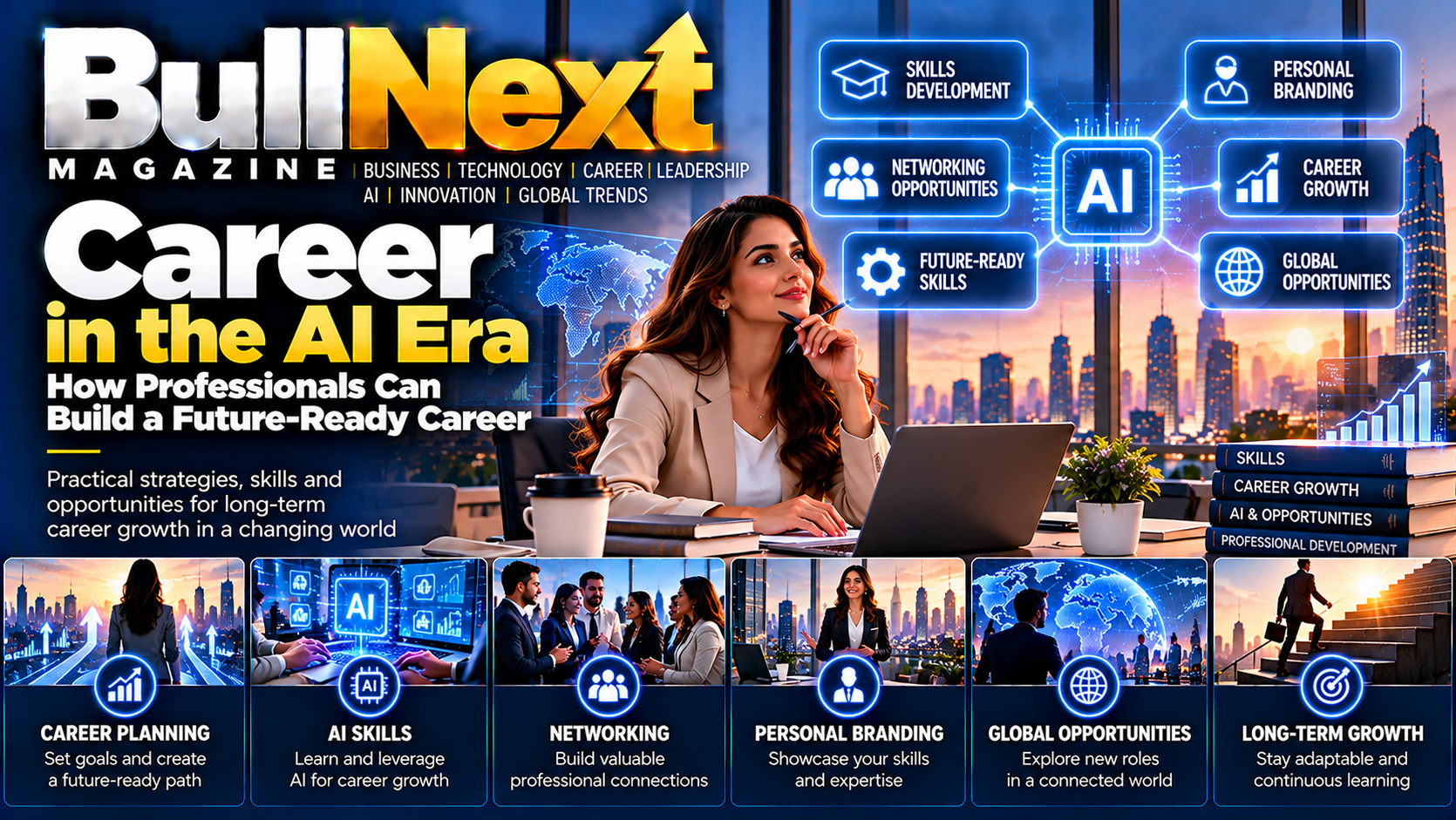
The traditional career path is changing.
For decades, professionals often followed a relatively predictable formula: earn a degree, enter an industry, build experience, move into increasingly senior positions and eventually reach leadership.
That model is becoming less certain.
Artificial intelligence is changing how companies hire, how employees work and which skills organizations value. At the same time, businesses are navigating economic uncertainty, technological disruption and changing customer expectations.
For professionals, this creates both challenges and opportunities.
The goal is no longer simply to find a job and keep it.
Professionals increasingly need to build careers that can adapt.
LinkedIn's 2026 research shows that employers are increasingly prioritizing skills over degrees, job titles and traditional linear career paths. Its “Skills on the Rise” research also highlights growing demand for AI-related capabilities, business growth skills and human abilities such as collaboration, communication and mentorship.
At the same time, LinkedIn reports that more than half of professionals globally are looking for a new role in 2026, while many job seekers feel less prepared for today's competitive hiring environment.
The message is clear:
Careers are becoming more dynamic, and professionals need to become more adaptable.
The New Definition of Career Success
Career success used to be strongly associated with job titles.
Promotion.
Salary.
Company prestige.
Management responsibility.
These remain important, but they are no longer the only measures of career strength.
A future-ready career is built around several forms of capital:
Skills
Experience
Relationships
Reputation
Adaptability
Financial stability
Industry knowledge
Personal credibility
Continuous learning
Someone with a strong combination of these assets can move between opportunities more easily.
This is especially important as technology changes job descriptions.
A professional should not define themselves only by what their current job title says.
Instead, they should understand what capabilities they can bring to different problems.
AI Is Changing the Career Equation
Artificial intelligence is becoming one of the biggest forces shaping careers.
AI can already assist with research, writing, programming, analysis, customer service, design and many administrative activities.
But AI is also creating new roles.
LinkedIn reported in 2026 that more than 1.3 million new AI-enabled jobs had emerged globally over the previous two years, contributing to what it describes as a new-collar era combining technical capabilities with human strengths.
This means professionals should not think about AI only as a threat.
It can also be a career accelerator.
People who learn how to use AI effectively can potentially increase their productivity, expand their capabilities and qualify for emerging roles.
The important question is no longer:
“Will AI replace my job?”
A better question is:
“How will AI change my profession, and how can I become more valuable because of it?”
Build AI Literacy, Not Just AI Hype
Professionals do not necessarily need to become AI engineers.
But almost every knowledge worker can benefit from understanding how AI works and where it can be applied.
AI literacy can include:
Prompting
AI-assisted research
Data interpretation
Workflow automation
AI-powered productivity
Responsible AI use
AI limitations
Information verification
Privacy and security
Human oversight
LinkedIn's 2026 skills research highlights the increasing importance of technical and strategic AI capabilities, including prompt engineering and large language model knowledge.
AI skills should therefore become part of a broader professional toolkit.
The strongest professionals will combine AI capabilities with domain expertise.
The Rise of the Hybrid Professional
One of the most valuable career profiles is becoming the hybrid professional.
A hybrid professional combines expertise from different areas.
Examples include:
Marketing + AI
Finance + Data Analytics
HR + Technology
Design + AI
Law + Technology
Healthcare + Data
Engineering + Business
Sales + Automation
This combination can be more powerful than having only one specialized skill.
Technology creates leverage, while industry knowledge provides context.
Professionals who can connect both may become particularly valuable.
Human Skills Are Becoming More Important
It may seem strange that AI would increase the importance of human skills.
But that is exactly what is happening.
As machines become better at generating information, humans may become more valuable for deciding what to do with that information.
Important human capabilities include:
Communication
Leadership
Critical thinking
Creativity
Collaboration
Negotiation
Empathy
Adaptability
Problem-solving
Relationship building
LinkedIn's 2026 labor-market research says 75% of companies agree that people skills are becoming more important in the age of AI, with employers increasingly seeking adaptability, problem-solving and critical thinking alongside technical capabilities.
The future is therefore unlikely to be purely technical.
It will favor people who can combine technology with human judgment.
Career Strategy One: Become a Continuous Learner
A career can no longer depend entirely on what someone learned several years ago.
Technology changes.
Industries change.
Customer expectations change.
Job requirements change.
Continuous learning is therefore becoming a career strategy rather than an optional activity.
Professionals should regularly ask:
What is changing in my industry?
Which skills are becoming more valuable?
Which skills are becoming less valuable?
What technology is changing my profession?
What should I learn next?
Learning does not always require another university degree.
It can come from:
Online courses
Professional certifications
Industry reports
Workshops
Books
Podcasts
Mentorship
Projects
Conferences
Practical experimentation
The key is consistency.
Career Strategy Two: Build Skills Before You Need Them
One of the biggest career mistakes is waiting until a skill becomes necessary.
By then, the market may already have moved.
A better approach is to identify emerging skills early.
LinkedIn's 2026 data shows that skill requirements are changing rapidly across industries, while employers are increasingly focusing on what people can actually do.
Professionals should therefore develop skills before they become mandatory.
For example, someone working in marketing might begin learning AI automation before their company requires it.
A finance professional might learn advanced data tools.
An HR professional might learn workforce analytics and AI governance.
An engineer might develop business communication skills.
Early preparation creates career flexibility.
Career Strategy Three: Develop a Skill Stack
Instead of trying to become the world's best expert in one narrow area, professionals can build a skill stack.
A skill stack is a combination of complementary capabilities.
For example:
Digital Marketing + SEO + AI + Analytics + Communication
can create a powerful marketing profile.
Similarly:
Finance + Data + AI + Strategy + Leadership
can create a strong modern finance profile.
The advantage of a skill stack is differentiation.
Thousands of people may have one particular skill.
Far fewer may possess the exact combination of five complementary skills.
That combination can become a professional advantage.
Career Strategy Four: Build a Professional Brand
A strong career is increasingly visible.
Professional reputation can influence opportunities before a formal application is even submitted.
Professionals can build their reputation through:
LinkedIn
Industry publications
Professional communities
Speaking
Research
Portfolio projects
Articles
Case studies
Conferences
Thought leadership
The objective is not to become an online celebrity.
It is to make your expertise discoverable.
A strong professional profile should clearly communicate:
What do you know?
What problems can you solve?
What results can you create?
What makes your perspective valuable?
This is particularly important in a skills-based hiring environment.
Career Strategy Five: Build a Network Before You Need a Job
Networking is often treated as something people do when they are unemployed.
That is too late.
The strongest professional networks are built while things are going well.
A network can provide:
Career opportunities
Industry information
Mentorship
Partnerships
Referrals
Knowledge
Feedback
Business opportunities
LinkedIn's 2026 labor-market research indicates that professional connections can materially influence hiring outcomes, reinforcing the value of relationships alongside skills.
A professional network should not simply consist of people from the same job.
It should include:
Industry peers
Former colleagues
Managers
Entrepreneurs
Recruiters
Executives
Specialists
Mentors
People in adjacent industries
A diverse network creates more possibilities.
Career Strategy Six: Focus on Results, Not Responsibilities
Many professionals describe themselves by what they do.
For example:
“I manage social media.”
“I prepare financial reports.”
“I manage a team.”
“I write content.”
“I handle customer service.”
A stronger professional positioning focuses on outcomes.
Instead of:
“I manage social media.”
Consider:
“I develop social strategies that increase qualified audience engagement and brand visibility.”
Instead of:
“I prepare financial reports.”
Consider:
“I transform financial data into insights that support better business decisions.”
The difference is important.
Employers increasingly want to know what value a professional can create.
Career Strategy Seven: Build a Portfolio
A resume tells people what you claim to have done.
A portfolio can demonstrate it.
This is particularly valuable for careers involving:
Design
Marketing
Writing
Software
Data
Research
Consulting
Photography
Video
AI
Content creation
A portfolio can include:
Projects
Case studies
Campaigns
Reports
Designs
Websites
Research
Presentations
Before-and-after results
For early-career professionals, a strong portfolio can compensate for limited formal experience.
Career Strategy Eight: Learn to Work With AI
The future professional will increasingly work alongside AI.
That means understanding how to divide work between humans and machines.
AI may be useful for:
Research
First drafts
Data organization
Summarization
Brainstorming
Repetitive tasks
Pattern detection
Workflow automation
Humans remain particularly important for:
Judgment
Strategy
Relationships
Accountability
Creativity
Negotiation
Leadership
Ethical decisions
The goal should not be to automate everything.
The goal should be to automate low-value work so professionals can spend more time on high-value activities.
Career Strategy Nine: Learn to Verify AI Output
AI can increase productivity, but it can also produce inaccurate information.
Professionals therefore need a new skill:
AI verification.
Before using AI-generated information, professionals should ask:
Is the information accurate?
What is the original source?
Is the data current?
Does the recommendation make sense?
Are there missing details?
Could the AI have misunderstood the context?
This becomes particularly important in law, finance, healthcare, journalism, research and other fields where errors can have significant consequences.
AI literacy without critical thinking is incomplete.
Career Strategy Ten: Develop Communication Skills
Technical ability can open a door.
Communication can determine how far someone progresses.
Professionals who communicate clearly can:
Explain complex ideas
Influence decision-makers
Lead teams
Present to executives
Negotiate
Build customer relationships
Resolve conflicts
Communication includes more than speaking.
It also includes:
Writing
Listening
Presentation
Storytelling
Executive communication
Digital communication
As organizations become more cross-functional, communication becomes increasingly important.
Career Strategy Eleven: Become Comfortable With Change
Career resilience requires adaptability.
A professional may change:
Roles
Companies
Industries
Technologies
Responsibilities
Locations
Work models
LinkedIn's 2026 Work Change research shows that professionals entering the workforce today are on pace to hold substantially more jobs over their careers than previous generations, while the skills required for many jobs continue to change.
The implication is important.
Career planning should not focus only on one job.
It should focus on building the ability to navigate multiple transitions.
Career Strategy Twelve: Understand Your Industry
Skills are important, but context matters.
A professional who understands their industry can make better decisions.
They should know:
Major competitors
Customer trends
Regulatory developments
Technology changes
Business models
Major risks
Emerging opportunities
Industry knowledge allows professionals to connect their skills with real business problems.
This makes them more valuable.
Career Strategy Thirteen: Find Mentors
Mentorship can accelerate professional development.
A mentor can provide:
Career perspective
Honest feedback
Industry knowledge
Decision-making advice
Introductions
Confidence
Lessons from experience
A mentor does not need to be someone with the exact same career.
In some cases, a person from a different industry may provide a more useful perspective.
The best mentor relationship is based on trust and mutual respect.
Career Strategy Fourteen: Do Not Ignore Financial Career Planning
Career strategy is not only about professional development.
It is also about financial resilience.
Professionals should consider:
Emergency savings
Income diversification
Skill investment
Career insurance through transferable skills
Long-term financial goals
A financial cushion can provide greater freedom to make strategic career decisions.
Someone with savings may be more comfortable leaving a poor-fit job, investing time in learning or pursuing entrepreneurship.
Financial stability can therefore strengthen career flexibility.
Career Strategy Fifteen: Prepare for New Types of Jobs
The job market is creating roles that did not exist in the same form a few years ago.
LinkedIn's 2026 labor-market research highlights emerging AI-enabled roles and describes a broader “new-collar” workforce combining technology with human capabilities.
Examples include:
AI Engineer
AI Integrator
Responsible AI Specialist
AI Product Manager
AI Consultant
AI Governance Specialist
Data Center Technician
AI Operations Specialist
Professionals should watch these emerging categories.
A new role can sometimes create a faster career path than competing for traditional positions with hundreds of applicants.
Career Strategy Sixteen: Do Not Abandon Entry-Level Development
AI is particularly important for early-career professionals.
The World Economic Forum reported in 2026 that more than one in three young workers globally are employed in occupations with medium to high exposure to AI-driven task change. Its research emphasizes the need to rethink job access, job design, talent pipelines and education alignment.
This creates a challenge.
If AI performs many traditional entry-level tasks, how do young professionals gain experience?
The answer may involve redesigning early-career work rather than eliminating development opportunities.
Young professionals should therefore seek opportunities that build:
Judgment
Customer interaction
Problem-solving
Communication
Project ownership
Collaboration
Technical skills
Entry-level workers should not compete with AI on repetitive tasks.
They should use AI to accelerate learning while developing capabilities that require human judgment.
Career Strategy Seventeen: Become Known for Solving Problems
A powerful career identity is built around problems rather than job titles.
Instead of saying:
“I am a marketer.”
A professional might say:
“I help companies build digital acquisition strategies.”
Instead of:
“I am a designer.”
Try:
“I help technology companies communicate complex products visually.”
Instead of:
“I am an analyst.”
Try:
“I turn complex data into decisions for business leaders.”
This approach makes professional value easier to understand.
Career Strategy Eighteen: Stay Visible
Good work is not always automatically noticed.
Professionals should learn to communicate achievements without excessive self-promotion.
That can include:
Sharing useful insights
Publishing projects
Documenting lessons
Participating in industry discussions
Speaking at events
Contributing to professional communities
Visibility creates opportunities.
But credibility matters more than volume.
The objective should be to become known for useful knowledge rather than simply posting frequently.
Career Strategy Nineteen: Create a Personal Career Dashboard
Professionals can treat their careers like a long-term project.
Every few months, review:
Skills: What have I learned?
Experience: What meaningful projects have I completed?
Network: Who have I connected with?
Reputation: What am I known for?
Income: Has my earning power improved?
Opportunities: What new possibilities have appeared?
Future: What could make my current skills less valuable?
This creates career awareness.
It also makes it easier to identify problems early.
Career Strategy Twenty: Think in Five-Year Capabilities, Not Five-Year Job Titles
The future is difficult to predict.
It may be impossible to know exactly what job someone will hold five years from now.
But it is possible to build capabilities that remain valuable.
These might include:
Learning quickly
Communicating effectively
Working with AI
Solving complex problems
Building relationships
Managing projects
Understanding data
Leading people
Adapting to change
A career built around these capabilities can survive changes in job titles and technologies.
The Future of Career Development
The future of careers will probably be less linear.
Professionals may move between:
Full-time employment
Freelancing
Entrepreneurship
Consulting
Contract work
Portfolio careers
Multiple professional identities
Technology makes these transitions easier.
Digital platforms make skills more visible.
AI lowers the cost of producing certain types of work.
Online education makes learning more accessible.
Professional networks make opportunities easier to discover.
But competition also increases.
That makes differentiation important.
Career Resilience Will Become a Competitive Advantage
Career resilience does not mean avoiding change.
It means becoming capable of responding to change.
A resilient professional has:
Transferable skills
Strong relationships
Continuous learning habits
Financial awareness
Industry knowledge
Adaptability
Professional credibility
Such professionals may be better positioned when industries change or companies restructure.
Conclusion: Build a Career That Can Adapt
The future of work will not be defined by one technology or one job market.
It will be defined by continuous change.
Artificial intelligence is creating new opportunities while changing existing jobs. Employers are increasingly evaluating skills, professionals are increasingly expected to learn continuously and traditional career paths are becoming less predictable.
This does not mean careers are becoming impossible.
It means career strategy is becoming more important.
Professionals who continuously build skills, develop AI literacy, strengthen human capabilities, create meaningful networks and communicate their value can position themselves for opportunities that do not yet exist.
The strongest career strategy is therefore not trying to predict exactly what the future will look like.
It is becoming capable of succeeding in several possible futures.
Build skills. Build relationships. Build credibility. Keep learning.
And most importantly:
Do not build a career that depends on staying the same. Build one that becomes stronger as the world changes.
Frequently Asked Questions
What skills are most important for careers in 2026?
AI literacy, communication, critical thinking, adaptability, collaboration, problem-solving, data literacy and industry-specific expertise are increasingly valuable.
Will AI replace jobs?
AI is changing tasks within many jobs and creating new roles at the same time. The impact varies significantly by industry and occupation. Professionals who learn to work effectively with AI can improve their ability to adapt.
How can I make my career future-ready?
Develop transferable skills, learn how AI affects your industry, build a professional network, maintain a visible portfolio, continue learning and focus on measurable results.
Is a university degree still important?
Degrees remain valuable for many professions, but employers are increasingly placing greater emphasis on demonstrated skills and capabilities alongside traditional qualifications. LinkedIn's 2026 research specifically highlights the growing importance of skills over linear career paths.
How important is networking for career growth?
Networking can provide access to information, mentorship, referrals and opportunities that may not be visible through traditional job searches. Strong professional relationships are increasingly valuable in a changing labor market.
What is a skill stack?
A skill stack is a combination of complementary skills that creates a distinctive professional profile, such as marketing + analytics + AI + communication.
How can young professionals compete in an AI-driven job market?
They should focus on developing judgment, communication, problem-solving, AI literacy, technical skills and real-world experience rather than relying only on academic qualifications.
What is the most important career strategy?
Continuous learning and adaptability are among the most important long-term strategies because the skills required by employers continue to change.