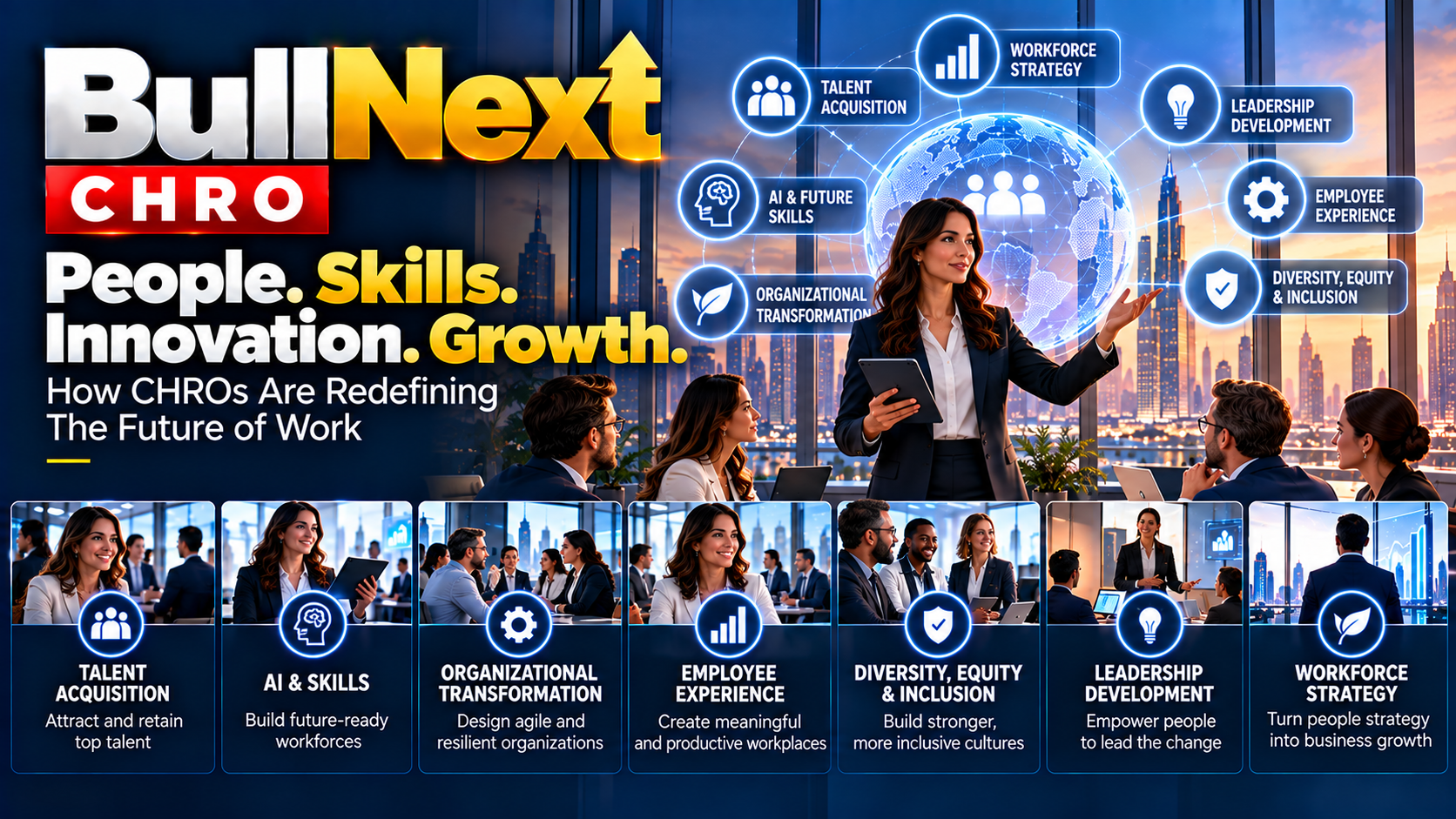
role of the Chief Human Resources Officer is changing faster than almost any other executive position.
For years, HR was often viewed primarily as the function responsible for hiring, employee relations, compensation, policies and organizational administration.
Those responsibilities remain important.
But the modern CHRO is increasingly responsible for something much bigger: designing the workforce and organization needed for the future of the business.
Artificial intelligence is changing jobs and skills. Employees expect greater flexibility and development opportunities. Companies are redesigning organizational structures. Talent shortages are becoming more specialized. Leaders are trying to improve productivity while maintaining trust and engagement.
The World Economic Forum's 2026 Chief People Officers' Outlook identifies organizational redesign, upskilling and reskilling, and responsible AI and automation as major workforce priorities. World Economic Forum
At the same time, PwC reports that forward-looking CHROs are moving beyond isolated AI experiments and redesigning HR workflows, employee experiences and workforce systems around business value. PwC
This means the CHRO is no longer simply the executive responsible for people.
The CHRO is becoming an architect of organizational transformation.
The CHRO Role Is Becoming More Strategic
The traditional HR model focused heavily on processes.
Recruit people.
Manage benefits.
Handle employee relations.
Conduct performance reviews.
Support managers.
Maintain policies.
The modern CHRO must still oversee these activities, but the strategic questions are becoming more important.
A CHRO increasingly needs to ask:
What skills will the company need in three years?
Which jobs will change because of AI?
Where should the organization reskill employees?
How should teams be redesigned?
Which capabilities should be developed internally?
How can leaders maintain employee trust during transformation?
How should performance be measured in an AI-enabled workplace?
McKinsey's 2026 HR research describes a workforce environment shaped by economic pressures, AI disruption and changing employee expectations, with significant gaps remaining between workforce planning and strategic foresight. McKinsey & Company
The CHRO is therefore becoming increasingly involved in business strategy.
AI Is Making the CHRO More Important
Artificial intelligence is often discussed as a technology issue.
But every major AI transformation is also a people transformation.
When AI changes a workflow, jobs may change.
When automation removes repetitive tasks, employees may need new skills.
When AI agents take over parts of a process, managers may need to supervise work differently.
When organizations introduce AI tools, employees need to understand how and when to use them.
That places the CHRO at the center of the transformation.
PwC's recent research says HR leaders need to guide the enterprise through AI transformation while simultaneously transforming HR itself. McKinsey & Company
This creates a dual responsibility.
Transform the workforce.
Transform HR.
From HR Automation to AI-Powered HR
Many organizations initially approached AI in HR through individual use cases.
Examples included:
Resume screening
Employee chatbots
Automated scheduling
Job-description generation
HR document processing
Employee surveys
Basic workforce analytics
These applications can provide value.
But leading CHROs are increasingly thinking beyond isolated tools.
PwC's September 2026 research describes a shift toward integrated, value-focused HR transformation using agentic AI to redesign workflows and employee experiences. PwC
The bigger opportunity is therefore not simply:
"How can AI automate HR?"
It is:
"How should HR work differently because AI exists?"
That is a much more strategic question.
The CHRO as Workforce Architect
One of the most important emerging responsibilities for CHROs is redesigning jobs.
Traditional job descriptions often define roles according to tasks.
But AI is increasingly changing who—or what—performs those tasks.
PwC's 2026 research argues that organizations need to rethink job architecture around tasks, outcomes and human-AI collaboration rather than relying on pre-AI role structures. PwC
For example, an analyst who previously spent most of the day collecting and organizing information may increasingly use AI to perform those activities.
The employee's value may shift toward:
Interpreting information
Making judgments
Communicating insights
Managing stakeholders
Designing strategies
Checking AI outputs
The job has not necessarily disappeared.
The job has changed.
The CHRO's responsibility is to recognize those changes and redesign the organization accordingly.
Skills Are Becoming More Important Than Job Titles
The traditional workforce was organized around positions.
The emerging workforce is increasingly organized around skills.
A company may discover that it does not simply need "more employees."
It needs more people with:
AI literacy
Data analysis
Strategic thinking
Communication
Creativity
Leadership
Problem-solving
Industry expertise
This is why skills-based workforce planning is becoming increasingly important.
The World Economic Forum's 2026 Chief People Officers' Outlook identifies skills mismatches as a defining workforce challenge and highlights upskilling, reskilling and internal mobility as important responses. World Economic Forum
For CHROs, this means understanding the organization's skills inventory.
Who has the skills today?
Who can develop them?
Which skills can AI amplify?
Which capabilities must remain human?
Where are the biggest gaps?
These questions can directly influence business strategy.
Reskilling Is Becoming a Strategic Investment
When technology changes jobs, organizations have two broad choices.
They can replace employees.
Or they can help employees adapt.
Increasingly, leading organizations are looking at the second option.
The World Economic Forum has highlighted internal mobility and skills investment as important responses to AI-driven workforce disruption. World Economic Forum
Reskilling can provide several benefits.
Retaining institutional knowledge
Existing employees understand the company's customers, culture and systems.
Reducing recruitment pressure
Developing internal talent can reduce dependence on external hiring.
Increasing employee trust
Workers are more likely to support transformation when they see a pathway to participate in it.
Improving adaptability
A workforce that can continuously learn can respond faster to changing technology.
The CHRO therefore needs to think of learning not as an employee benefit but as organizational infrastructure.
The Internal Talent Advantage
Companies often look outside when new skills are required.
But the next great hire may already be inside the organization.
Internal mobility allows employees to move into roles where their existing knowledge can be combined with newly developed skills.
For example, an experienced customer-service employee might transition into an AI-supported customer experience role.
A finance analyst might move into data-driven business planning.
A recruiter might become an AI-enabled talent strategist.
A marketing specialist might develop advanced analytics capabilities.
This approach can preserve institutional knowledge while developing new capabilities.
The World Economic Forum has highlighted internal mobility and skills investment as increasingly important as AI reshapes roles and workforce requirements. World Economic Forum
The CHRO and the Future of Leadership
AI is also changing what organizations expect from managers and leaders.
When routine work becomes more automated, human leadership can become more important.
Leaders need to provide:
Direction
Context
Judgment
Coaching
Accountability
Communication
Trust
The World Economic Forum reports that around one-third of workplace tasks are now automated and emphasizes the importance of human-centered skills and leadership development in the AI era. World Economic Forum
This makes leadership development a major CHRO responsibility.
The question is not simply:
Who are our current leaders?
It is:
Who will be capable of leading an AI-enabled workforce?
Middle Managers Are Critical
Senior executives may define transformation strategy.
But middle managers often determine whether transformation actually works.
They translate executive decisions into everyday work.
They answer employee questions.
They monitor performance.
They provide feedback.
They identify operational problems.
They influence employee trust.
That makes middle management a critical part of AI transformation.
The World Economic Forum's 2026 research notes that HR leaders see middle managers as important to ensuring AI is directed appropriately, while also highlighting the need for greater training. World Economic Forum
CHROs therefore need to invest in managers rather than assuming transformation will automatically flow downward from the executive team.
Employee Trust Becomes a Competitive Asset
AI can create excitement.
It can also create uncertainty.
Employees may ask:
Will AI replace my job?
How will my performance be evaluated?
Will the company monitor how I use AI?
What happens if AI makes a mistake?
Will I receive training?
How will my career change?
If leaders fail to answer these questions, uncertainty can become resistance.
PwC's 2026 workforce research highlights the relationship between AI adoption, skills, trust and employee confidence. PwC
The CHRO therefore has an important communication responsibility.
Employees need to understand not only what technology is being introduced but why it is being introduced and how the organization plans to support them.
Responsible AI Is a CHRO Responsibility
AI in the workplace creates ethical questions.
Who is accountable for an automated decision?
How should employee data be used?
Can AI be involved in hiring?
How should algorithmic bias be monitored?
What information should employees be allowed to enter into AI systems?
How should performance data be handled?
These questions cannot be left entirely to IT or legal departments.
They involve people.
That makes responsible AI a CHRO concern as well.
The World Economic Forum identifies responsible AI and automation deployment as one of the strategic priorities for people leaders. World Economic Forum
The CHRO needs to help establish clear principles for how technology affects employees.
The CHRO Must Understand AI
CHROs do not need to become AI engineers.
But AI literacy is becoming increasingly important.
A modern CHRO should understand:
What generative AI can do
What AI agents can do
Where automation is appropriate
Where human judgment is required
How AI changes jobs
How AI affects skills
How AI can create bias
How AI affects employee experience
How AI investment should be measured
Without this knowledge, HR leaders may struggle to participate meaningfully in strategic AI discussions.
PwC's 2026 research notes that AI fluency is increasingly important for HR professionals as AI becomes embedded in everyday HR operations. PwC
HR Data Is Becoming More Strategic
The CHRO has access to enormous amounts of workforce information.
Examples include:
Hiring data
Turnover
Skills
Compensation
Performance
Absence
Employee engagement
Learning
Career progression
Workforce demographics
Historically, HR often used this data retrospectively.
The emerging opportunity is predictive.
AI can help identify patterns and provide workforce intelligence.
For example:
Could a particular team face high turnover?
Where are critical skills concentrated?
Which employees may be ready for internal mobility?
Where are leadership gaps developing?
Which capabilities are becoming scarce?
This can move HR from reporting what happened toward helping executives understand what may happen next.
The CHRO and Business Performance
HR strategy should ultimately connect to business performance.
That means CHROs increasingly need to understand:
Revenue
Productivity
Customer experience
Operating costs
Innovation
Growth
Risk
Capital investment
This does not mean HR should become finance.
It means workforce decisions should be connected to organizational outcomes.
For example, if a company wants to expand into a new market, the CHRO needs to understand what talent and leadership capabilities are required.
If the company wants to automate operations, HR needs to understand which roles will change.
If the company wants to increase productivity, HR needs to help redesign work.
The CHRO becomes a business partner rather than simply a functional administrator.
The CHRO and Organizational Design
AI can challenge traditional organizational structures.
Historically, companies created specialized departments and roles.
But AI can allow employees to perform activities across traditional boundaries.
PwC's 2026 research describes role convergence as an important workforce shift, with AI enabling broader, outcome-based responsibilities and requiring new workforce models. PwC
This could lead to organizations with:
Fewer rigid job boundaries
More project-based teams
Greater internal mobility
AI-enabled generalists
Highly specialized experts
More flexible organizational structures
CHROs will play an important role in designing these models.
Compensation and Performance Must Evolve
If jobs change, performance systems may need to change as well.
Traditional performance reviews often focus on activities.
But AI-enabled roles may be judged more by outcomes.
For example, an employee may complete fewer manual tasks but generate significantly more valuable analysis.
Another employee may supervise AI systems rather than directly perform every task.
The organization therefore needs performance frameworks that recognize:
Judgment
Collaboration
Innovation
Problem-solving
AI fluency
Leadership
Business impact
Compensation structures may also need to evolve as roles converge and skill requirements change.
The CHRO as Chief Change Officer
Every major organizational transformation creates change-management challenges.
Employees may resist.
Managers may struggle.
Processes may become unclear.
Leadership communication may be inconsistent.
Productivity can temporarily decline.
The CHRO is increasingly responsible for helping organizations navigate these transitions.
McKinsey describes HR's AI mandate as both guiding the enterprise through transformation and transforming HR itself. McKinsey & Company
That requires more than communication.
It requires organizational design, leadership development, workforce planning and continuous feedback.
Building a Culture of Continuous Learning
The traditional model of education was simple:
Learn at school.
Join a company.
Build a career.
Retire.
That model is increasingly outdated.
Technology changes too quickly.
Employees may need to learn new skills repeatedly throughout their careers.
The CHRO therefore needs to help create a culture where learning is part of normal work.
This could include:
AI training
Leadership development
Internal certifications
Mentorship
Cross-functional projects
Skills marketplaces
Internal mobility
Peer learning
The goal is not simply to offer courses.
The goal is to make learning part of organizational behavior.
The CHRO and Employee Experience
Employee experience is becoming more strategic.
Employees interact with an organization through dozens of systems and processes.
Recruitment.
Onboarding.
Performance management.
Learning.
Communication.
Benefits.
Career development.
HR support.
If these experiences are fragmented, employees can become frustrated.
AI offers an opportunity to simplify many interactions.
But technology should not remove the human dimension.
Some employee situations require empathy, judgment and personal communication.
The best CHROs will therefore determine where technology should automate and where humans should remain deeply involved.
The Human Advantage
As AI becomes more capable, uniquely human capabilities may become more valuable.
These include:
Empathy
Judgment
Creativity
Leadership
Negotiation
Trust-building
Complex communication
Ethical reasoning
PwC's 2026 AI Jobs Barometer found that AI-exposed roles are increasingly emphasizing human skills such as judgment and leadership. PwC
This creates an important paradox.
The more technology advances, the more organizations may need to invest in human capabilities.
The CHRO is responsible for helping organizations recognize that shift.
The CHRO Network
Just as CEOs and CFOs benefit from executive networks, CHROs can gain significant value from connecting with other people leaders.
A CHRO network can provide insight into:
AI adoption
Workforce planning
Compensation
Talent shortages
Organizational design
Employee engagement
Leadership development
Skills strategies
Internal mobility
Responsible AI
Peer networks allow CHROs to learn from real-world experiences rather than relying exclusively on theoretical frameworks.
A trusted CHRO peer might have already faced the workforce challenge another organization is beginning to encounter.
That knowledge can be extremely valuable.
How CHROs Can Prepare for the Future
The modern CHRO can focus on several priorities.
1. Build AI Fluency
Understand the technology well enough to participate in strategic decisions.
2. Redesign Jobs
Move beyond traditional job descriptions toward skills, outcomes and human-AI collaboration.
3. Invest in Reskilling
Prepare employees for changing roles rather than relying entirely on external hiring.
4. Strengthen Middle Managers
Equip managers to lead teams through continuous transformation.
5. Build Trust
Communicate openly about AI, workforce changes and organizational decisions.
6. Use Workforce Data
Move from retrospective reporting toward predictive workforce intelligence.
7. Develop Internal Talent
Create pathways for employees to move into emerging roles.
8. Connect HR to Business Strategy
Measure workforce initiatives according to organizational outcomes.
What the CHRO of 2030 May Look Like
The CHRO of the future may look very different from the traditional HR executive.
They may spend less time managing administrative processes and more time on:
Workforce architecture
AI transformation
Organizational design
Skills strategy
Leadership development
Internal mobility
Employee trust
Workforce analytics
Business strategy
HR itself may become increasingly automated.
But the strategic importance of the CHRO could increase.
Why?
Because when machines perform more routine work, organizations need stronger human systems.
They need leaders who understand how people learn.
How teams collaborate.
How organizations change.
How trust is created.
And how human capabilities can be combined with technology.
The Future CHRO Is an Organization Architect
The CHRO's biggest opportunity may be to move from managing the workforce to designing the future workforce.
That includes deciding:
What work should humans perform?
What work should AI perform?
What skills will employees need?
How should teams be structured?
How should leaders be developed?
How should performance be measured?
How should employees move through the organization?
How should technology and people work together?
These are business questions.
And increasingly, they are CHRO questions.
Conclusion
The CHRO role is being transformed by the same forces reshaping the global economy.
AI is changing jobs.
Skills are changing.
Employees are demanding new experiences.
Organizations are becoming more flexible.
Traditional hierarchies are being challenged.
And businesses need to become more adaptable.
In this environment, HR cannot remain focused primarily on administration.
The modern CHRO must help design the organization itself.
That means combining workforce strategy with technology, business strategy with talent, automation with human judgment and productivity with trust.
The strongest CHROs will not simply prepare employees for the future.
They will help build the future organization.
The future of HR is therefore not about replacing people with technology.
It is about designing organizations where people and technology can create more value together.
FAQs
What is a CHRO?
CHRO stands for Chief Human Resources Officer. The CHRO is the senior executive responsible for an organization's people, workforce and human-capital strategy.
What does a modern CHRO do?
A modern CHRO oversees traditional HR responsibilities while increasingly focusing on workforce strategy, organizational design, AI transformation, skills, leadership, employee experience and business performance.
Why is AI important for CHROs?
AI is changing jobs, skills, workflows and organizational structures. CHROs need to help companies redesign work and prepare employees for these changes.
What skills will CHROs need?
Important CHRO capabilities include strategic thinking, AI literacy, workforce analytics, organizational design, communication, change management, leadership development and human-centered decision-making.
What is the CHRO's role in reskilling?
CHROs can identify changing skill requirements, develop learning programs, support internal mobility and help employees transition into emerging roles.
Will AI replace HR?
AI is likely to automate many routine HR activities, but strategic HR responsibilities involving judgment, leadership, trust, organizational design and complex human relationships will remain important.
Why is employee trust important during AI transformation?
Employees need clarity about how AI will affect their roles, careers and performance. Transparent communication and investment in skills can help organizations build confidence during transformation.
What is the future of the CHRO?
The CHRO is likely to become increasingly focused on workforce architecture, AI-enabled organizations, skills strategy, leadership development, organizational transformation and the connection between people strategy and business performance.
Disclaimer
This article is provided for general informational and educational purposes only. It does not constitute human resources, employment, legal, financial, business or management advice. Organizations should evaluate their individual circumstances and seek appropriate professional guidance before making significant workforce or organizational decisions.