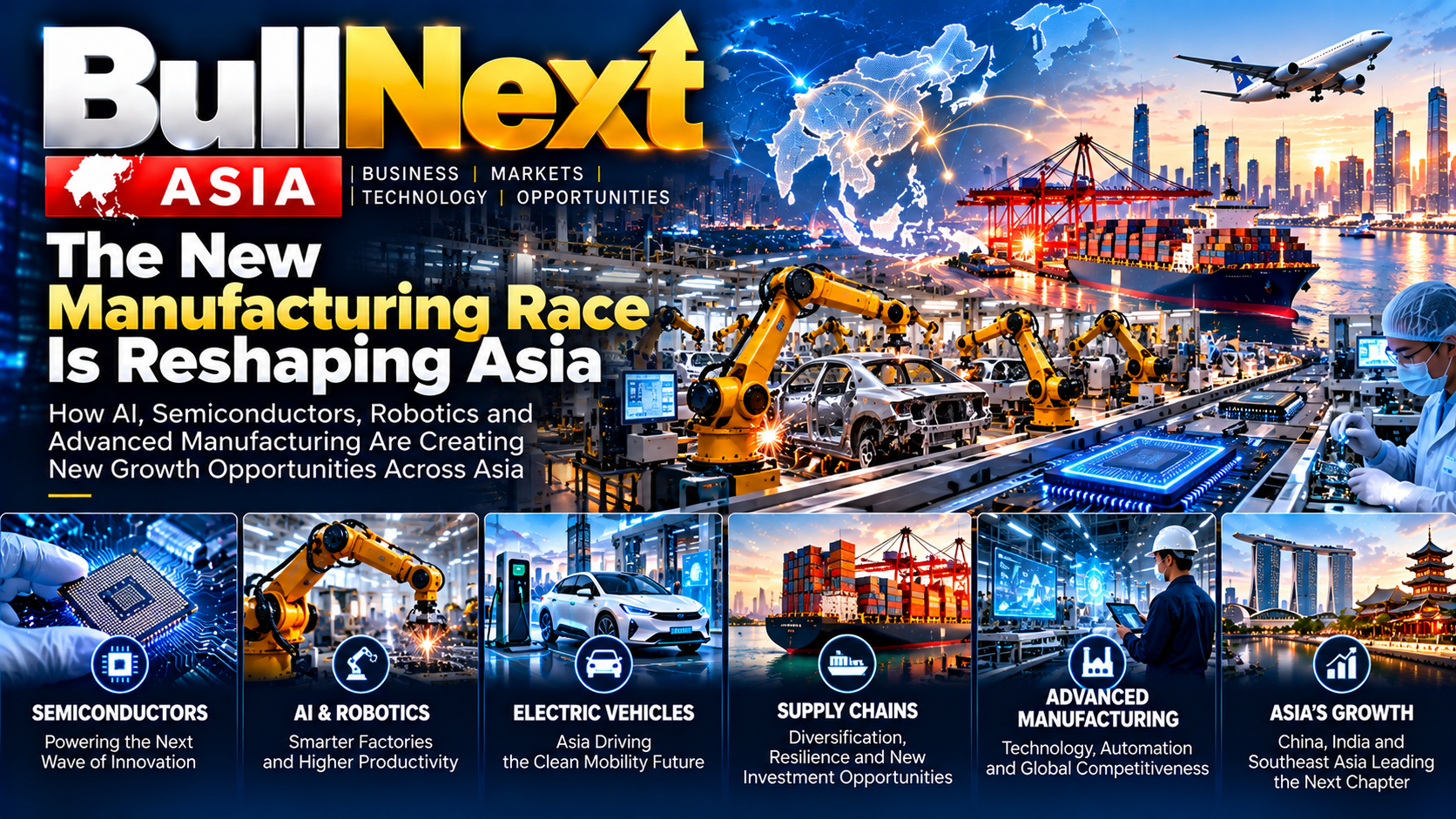
Asia has spent decades building its position at the center of global manufacturing.
Today, however, the region is entering a new phase.
Manufacturing is no longer simply about producing more goods at lower costs. The next generation of Asian manufacturing is increasingly about semiconductors, artificial intelligence, robotics, electric vehicles, advanced electronics, batteries, automation and high-value industrial technology.
This transformation is creating new opportunities across both established economic powers and emerging markets.
China continues to dominate large parts of the global manufacturing ecosystem. Japan remains a major force in robotics, machinery and advanced industrial technology. South Korea and Taiwan are critical to the semiconductor industry. India is expanding its manufacturing and technology capabilities, while Southeast Asian economies are attracting new factories and investment.
Recent economic data shows how closely Asia's manufacturing performance is becoming connected to the global AI boom. The World Bank says East Asia and the Pacific have benefited from strong production and exports of high-tech goods linked to AI-related demand.
The result is a new manufacturing race.
And it could reshape Asia's economic landscape for years to come.
Manufacturing Is Becoming More Technological
Traditional manufacturing focused heavily on labor, raw materials, transportation and production capacity.
Modern manufacturing adds another layer: technology.
Factories increasingly depend on:
Industrial robots
Artificial intelligence
Machine vision
Advanced sensors
Cloud computing
Predictive maintenance
Automated warehouses
Digital twins
Semiconductor technology
Data analytics
Smart energy systems
This means the most competitive manufacturing locations may not simply be those with the lowest labor costs.
They may be the countries capable of combining skilled workers, infrastructure, technology, capital and reliable supply chains.
That is changing the competitive landscape across Asia.
The AI Boom Is Supporting Asian Manufacturing
Artificial intelligence has become one of the most important drivers of technology investment.
AI requires processors, memory, networking equipment, servers, cooling systems, power infrastructure and data centers.
Many of these products are manufactured or assembled across Asia.
The World Bank said in October 2026 that several East Asian and Pacific economies have grown faster than expected because of manufacturing and exports of high-tech goods supporting the global AI boom.
This creates a powerful feedback loop:
AI demand → semiconductor demand → manufacturing investment → infrastructure investment → more technology capacity.
The cycle is benefiting companies throughout the technology supply chain.
China Remains a Manufacturing Giant
China remains central to the Asian manufacturing ecosystem.
Its advantages include enormous industrial capacity, extensive supplier networks, infrastructure, engineering expertise and a large domestic market.
China is also moving further into advanced manufacturing.
Industries such as:
Electric vehicles
Batteries
Solar equipment
Robotics
Electronics
Industrial machinery
Artificial intelligence
Renewable-energy technology
are increasingly important to the country's industrial strategy.
At the same time, China's economy is facing structural challenges, including weaker domestic demand and continued adjustments in the property sector. The World Bank currently expects China's 2026 growth at around 4.4%.
For global businesses, this creates a more complicated picture.
China remains essential to manufacturing, but companies are also increasingly interested in diversification.
India Wants a Larger Role
India is becoming one of the most important manufacturing stories in Asia.
The country's huge domestic market gives manufacturers something many smaller economies cannot offer: the ability to produce for both local consumers and international markets.
India is developing opportunities in:
Electronics
Semiconductors
Automobiles
Pharmaceuticals
Renewable energy
Defense manufacturing
Telecommunications
Industrial equipment
Consumer products
The country's broader economic momentum is also attracting attention.
The World Bank recently raised its 2026/27 growth forecast for India to 7.1%, reinforcing the country's role as one of the major growth engines in South Asia.
The challenge will be converting strong economic growth into deeper manufacturing capabilities, infrastructure and high-value exports.
Vietnam Is Becoming a Major Manufacturing Hub
Vietnam has emerged as one of the most closely watched manufacturing economies in Southeast Asia.
The country has attracted investment in electronics, consumer products, machinery and other export-oriented industries.
Its location, trade relationships and manufacturing ecosystem have helped it become an important part of global supply chains.
Recent performance has been particularly strong.
Vietnam's economy grew 9.95% year over year in the third quarter of 2026, according to Reuters, while industrial production rose 16.7%. Foreign direct investment also increased.
However, rapid growth also brings challenges.
Energy availability, inflation, infrastructure capacity and dependence on imported inputs will remain important considerations for businesses operating in the country.
Southeast Asia Is Building a Manufacturing Network
Vietnam is not the only country attracting attention.
Indonesia, Malaysia, Thailand, Singapore and the Philippines each have different strengths.
Indonesia
Indonesia has a large domestic market and important natural resources, making it increasingly relevant to batteries, electric vehicles and industrial processing.
Malaysia
Malaysia has established expertise in electronics and semiconductor-related manufacturing and is benefiting from increased interest in advanced technology supply chains.
Thailand
Thailand has long been an important automotive manufacturing center and is now adapting to the growth of electric vehicles.
Singapore
Singapore offers advanced infrastructure, financial services, logistics and technology capabilities, making it an important regional business and investment hub.
Philippines
The Philippines has strong potential in services, electronics, business-process operations and technology-related industries.
Together, these markets are creating a more diversified Southeast Asian manufacturing ecosystem.
The Semiconductor Race
No discussion of Asia's manufacturing future is complete without semiconductors.
Chips are the foundation of modern technology.
They power:
Smartphones
Cars
Computers
Industrial equipment
Cloud computing
AI systems
Medical equipment
Telecommunications
Consumer electronics
Taiwan remains one of the world's most important semiconductor manufacturing centers.
South Korea is another major player, particularly in memory chips and advanced electronics.
Japan has significant strengths in semiconductor materials, manufacturing equipment and industrial technology.
China is investing heavily in developing greater domestic semiconductor capabilities.
India and Southeast Asian economies are also seeking larger roles in the semiconductor value chain.
The result is increasing competition for semiconductor investment.
Why Semiconductor Investment Matters
A semiconductor factory can generate economic activity far beyond the factory itself.
It can create demand for:
Engineers
Construction companies
Chemicals
Specialized machinery
Electricity
Water infrastructure
Logistics
Data networks
Research institutions
Professional services
This creates a multiplier effect.
A country that attracts semiconductor investment may also attract supporting industries.
That is why governments across Asia are competing to establish stronger semiconductor ecosystems.
Robotics Could Transform Asian Factories
Robotics is another major part of the manufacturing transition.
Asian factories increasingly use robots for repetitive, precise or dangerous tasks.
Robotics can improve:
Production speed
Quality control
Worker safety
Efficiency
Precision
Inventory management
Artificial intelligence is making robots more capable.
Instead of simply repeating fixed movements, newer systems can increasingly analyze their environment, identify objects and adapt to changing conditions.
This could make automation more useful for smaller production runs and more flexible manufacturing.
The Rise of Smart Factories
The factory of the future may look very different from the traditional factory.
Machines can be connected to sensors.
Sensors can produce data.
AI systems can analyze that data.
Managers can receive real-time information.
Maintenance systems can identify potential equipment failures.
Robots can adjust production.
Warehouses can automatically track inventory.
This creates the concept of the smart factory.
For Asian manufacturers, smart factories can become an important tool for remaining competitive as wages rise and global customers demand higher quality.
Supply Chains Are Becoming More Diversified
Global businesses learned important lessons from recent disruptions.
Many companies now want greater resilience rather than relying on a single manufacturing location.
This does not necessarily mean moving production away from China entirely.
Instead, companies may develop multiple manufacturing locations.
A company could maintain major operations in China while adding capacity in Vietnam, India, Malaysia or Indonesia.
This approach can provide:
Greater flexibility
Reduced concentration risk
Additional market access
More production options
Greater supply-chain resilience
For Southeast Asia and India, this creates an opportunity to capture new investment.
Infrastructure Is the Foundation
Manufacturing cannot grow without infrastructure.
Factories require:
Roads
Ports
Railways
Airports
Electricity
Water
Telecommunications
Industrial parks
Warehousing
Digital infrastructure
This is particularly important for high-tech industries.
A semiconductor facility, for example, requires highly reliable infrastructure.
A data center requires enormous electricity capacity and high-quality connectivity.
An automated factory requires reliable digital networks.
Infrastructure investment therefore becomes an important competitive advantage.
Energy Could Determine the Next Manufacturing Winners
Technology-intensive manufacturing requires significant amounts of electricity.
AI data centers, semiconductor plants, battery factories and automated production facilities can all create substantial energy demand.
This makes energy availability an increasingly important factor when companies choose where to invest.
Countries that can provide reliable and reasonably priced electricity may become more attractive to manufacturers.
Renewable energy can also become part of the competitiveness equation.
Companies increasingly want to manage energy costs and, in some markets, reduce emissions associated with production.
The Role of AI in Factory Management
AI can affect manufacturing far beyond robotics.
Companies can use AI to analyze:
Production data
Equipment performance
Inventory
Demand forecasts
Quality-control information
Transportation
Energy consumption
Predictive systems can potentially identify problems before they cause major disruptions.
For example, an AI system could detect unusual equipment behavior and alert engineers before a machine fails.
That can reduce downtime.
AI can also help companies forecast demand and manage inventory more efficiently.
Asian Businesses Are Moving Up the Value Chain
One of the most important long-term changes is the shift from low-cost manufacturing toward higher-value production.
bullnext Asia economies increasingly want to produce not just finished goods but also:
Advanced components
Software
Semiconductor technology
Industrial equipment
Robotics
Batteries
AI infrastructure
Engineering services
This can create higher-value jobs and increase domestic technological capabilities.
The transformation will not happen equally across every country.
Different economies will specialize in different parts of the value chain.
The New Competition Is About Ecosystems
A modern manufacturing company does not choose a location based on wages alone.
It may evaluate:
Skilled workers
Electricity availability
Transport infrastructure
Supplier networks
Government policy
Tax incentives
Market access
Technology capabilities
Political stability
Digital infrastructure
This means countries increasingly compete by building complete industrial ecosystems.
The strongest ecosystems can attract additional companies because suppliers and skilled workers are already available.
That can create a self-reinforcing cycle.
What Investors Should Watch
For investors following Asian markets, several manufacturing indicators may become increasingly important.
Semiconductor Investment
New chip facilities can signal long-term technology demand.
Factory Construction
New industrial facilities can indicate rising corporate confidence.
Export Growth
Strong exports can reveal increasing global demand for Asian products.
Foreign Direct Investment
FDI flows can show where multinational companies are allocating capital.
Infrastructure Spending
Ports, roads, railways, electricity and digital networks can support future industrial growth.
Automation
Rising investment in robotics and AI can improve productivity.
Energy Availability
Power shortages or rising electricity prices can affect industrial competitiveness.
Challenges Could Slow the Boom
The Asian manufacturing opportunity is significant, but it is not without risks.
Energy Costs
Higher energy prices can raise manufacturing costs.
Geopolitical Tensions
Trade restrictions and geopolitical disputes can affect supply chains.
Inflation
Rising wages, energy prices and input costs can reduce margins.
Skills Shortages
Advanced manufacturing requires engineers, technicians and specialized workers.
Infrastructure Gaps
Fast industrial growth can put pressure on electricity, transportation and logistics networks.
Global Demand
Manufacturing economies remain exposed to changes in global consumer and business demand.
The Asian Development Bank expects developing Asia and the Pacific to grow around 5.0% in 2026, while warning that energy-price volatility, geopolitical tensions and other external pressures remain risks.
The Future of Asian Manufacturing
The next decade could produce a very different Asian manufacturing landscape.
China will likely remain an enormous industrial force.
India could expand its role across electronics, automobiles, pharmaceuticals and advanced manufacturing.
South Korea and Taiwan will remain critical to the semiconductor ecosystem.
Japan can continue to contribute robotics, machinery and advanced materials.
Southeast Asia could attract additional manufacturing investment as companies diversify production.
The result may not be one country replacing another.
Instead, Asia could develop a more interconnected and specialized manufacturing network.
What Businesses Can Do Now
Companies looking to benefit from Asia's manufacturing transformation can consider several strategies.
Diversify Production
Evaluate whether critical production depends too heavily on one country.
Build Local Partnerships
Local suppliers and business partners can help companies understand regulations and market conditions.
Invest in Automation
Automation can improve productivity and help address labor constraints.
Adopt AI
AI can improve forecasting, maintenance, quality control and operational decision-making.
Secure Energy
Businesses should evaluate electricity availability and long-term energy costs before expanding.
Develop Talent
Advanced manufacturing requires skilled engineers, technicians and technology specialists.
Strengthen Supply Chains
Companies should map critical suppliers and develop contingency plans.
Asia's Manufacturing Future Is Also a Technology Story
The biggest change may be that manufacturing and technology are becoming difficult to separate.
A modern factory is increasingly a technology platform.
It uses software.
It generates data.
It depends on AI.
It requires digital networks.
It uses advanced machines.
It needs semiconductor components.
It consumes significant amounts of electricity.
This convergence means the future of Asian manufacturing will be shaped by both industrial policy and technology policy.
Conclusion
Asia is entering a new manufacturing era.
The region is moving beyond the traditional model of low-cost mass production toward a more sophisticated ecosystem built around AI, semiconductors, robotics, advanced manufacturing, batteries, electric vehicles and digital infrastructure.
The global AI boom is already supporting demand for high-tech manufacturing across parts of Asia, while countries are competing to attract investment and strengthen domestic capabilities.
For businesses, the opportunity is significant.
For investors, the transformation creates new sectors to watch.
For governments, the challenge is building the infrastructure, skills and policies needed to compete.
And for Asia as a whole, the manufacturing race could become one of the defining economic stories of the next decade.
The future may not belong simply to the country that produces the most goods.
It may belong to the economies capable of producing the most advanced goods, using the smartest technology, with the strongest infrastructure and most resilient supply chains.
bullnext Asia's manufacturing story is entering its next chapter — and technology is writing it.
Frequently Asked Questions
What is changing in Asian manufacturing?
Asian manufacturing is increasingly moving toward advanced technology, AI, robotics, semiconductors, automation and high-value industrial production.
Which Asian countries are important manufacturing hubs?
China, Japan, South Korea, Taiwan, India, Vietnam, Malaysia, Thailand, Singapore and Indonesia all play important but different roles in Asian manufacturing.
Why are semiconductors important?
Semiconductors power AI systems, automobiles, smartphones, computers, industrial equipment and many other modern technologies.
Why is Vietnam attracting manufacturing investment?
Vietnam offers a growing industrial base, export-oriented economy, strategic location and expanding infrastructure, although businesses also need to consider energy and cost pressures.
How is AI changing factories?
AI can support predictive maintenance, quality control, demand forecasting, inventory management, robotics and production optimization.
Will China remain important to Asian manufacturing?
China remains a major global manufacturing center, although companies are increasingly considering diversified production networks across Asia.
Why is India important to the manufacturing future?
India combines a large domestic market with strong economic growth and expanding capabilities in electronics, automobiles, technology and other industries.
What are the biggest risks for Asian manufacturing?
Energy prices, geopolitical tensions, trade restrictions, inflation, skills shortages, infrastructure constraints and changes in global demand are among the major risks.