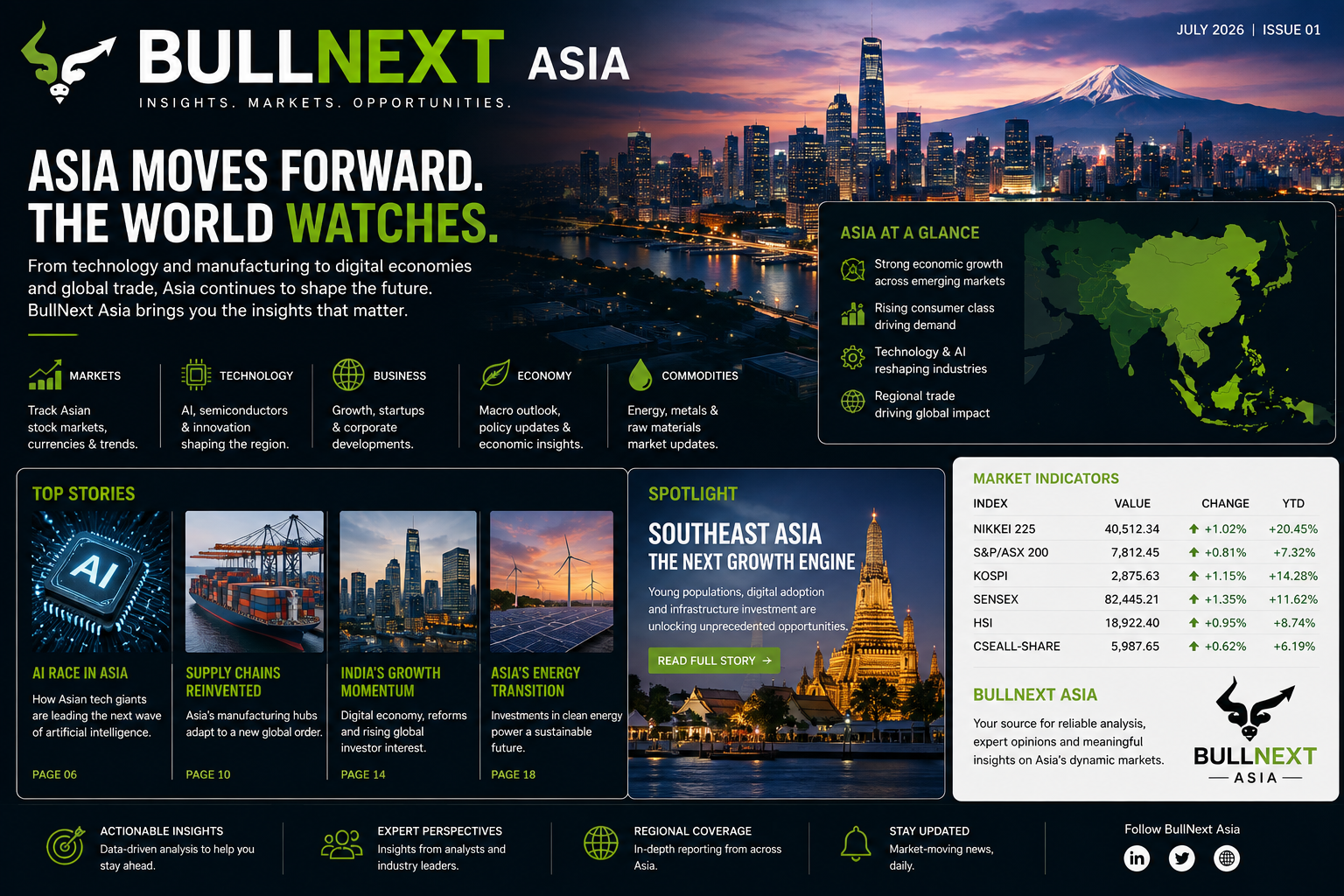
Asia remains one of the most important regions in the global economy. From the technology centers of East Asia to the rapidly expanding consumer markets of South and Southeast Asia, the region continues to influence global trade, investment, technology, manufacturing, and business.
For readers following BullNext Asia, understanding these changes means looking beyond individual stock prices. Asian markets are being shaped by artificial intelligence, changing interest rates, manufacturing investment, consumer growth, digital payments, energy demand, and evolving trade relationships.
BullNext's Asia-focused coverage includes areas such as Asian Markets, technology, business, commodities, leadership, and economic developments, making the region an important part of its broader financial and business coverage.
Asia's Growing Role in the Global Economy
Asia contains some of the world's largest economies and fastest-growing markets.
China, Japan, India, South Korea, Indonesia, Singapore, and other economies play different but interconnected roles in the global economy.
China remains a major manufacturing and export center. Japan continues to be an important technology and industrial economy. India has become increasingly important in technology, services, manufacturing, and consumer markets. Meanwhile, Southeast Asian economies are attracting investment as companies diversify their supply chains.
This diversity makes Asia particularly important for investors and businesses trying to understand global economic trends.
Asian Markets in 2026
Asian financial markets are being influenced by several major themes.
Interest Rates
Central-bank policies continue to influence currencies, bonds, borrowing costs, and equity valuations.
Changes in interest-rate expectations can affect capital flows between countries and regions.
Investors therefore pay close attention to inflation data, central-bank decisions, economic growth, and currency movements.
Technology
Technology remains one of Asia's strongest economic themes.
The region is home to major semiconductor manufacturers, electronics companies, software businesses, ecommerce platforms, and artificial-intelligence developers.
AI is becoming increasingly important across manufacturing, financial services, logistics, healthcare, retail, and telecommunications.
Manufacturing
Asia remains central to global manufacturing.
Companies are increasingly examining where they produce goods, where they source components, and how they manage international supply chains.
This is creating opportunities for countries that can offer competitive labor costs, infrastructure, skilled workers, and access to major consumer markets.
India and the Rise of a Major Consumer Market
India is becoming increasingly important to global investors.
A large population, expanding digital economy, growing middle class, and increasing technology adoption have created significant opportunities across multiple industries.
Areas attracting attention include:
Technology
Financial services
Ecommerce
Telecommunications
Manufacturing
Renewable energy
Infrastructure
Consumer goods
India's digital-payment ecosystem has also changed how consumers and businesses interact with financial services.
As more people gain access to smartphones, internet services, banking, and digital payments, companies can reach customers through increasingly sophisticated digital platforms.
China's Changing Economic Landscape
China remains central to the Asian and global economy.
Its enormous manufacturing base, domestic consumer market, technology sector, and international trade relationships make developments in China important for investors worldwide.
However, China's economy is also undergoing structural changes.
Growth is increasingly influenced by areas such as:
Advanced manufacturing
Artificial intelligence
Electric vehicles
Renewable energy
Semiconductors
Domestic consumption
High-tech exports
Chinese companies are competing internationally in several technology and manufacturing industries.
For investors, this creates both opportunities and challenges.
Japan's Technology and Industrial Strength
Japan continues to play an important role in Asian markets.
The country has globally recognized expertise in:
Automobiles
Robotics
Electronics
Machinery
Industrial technology
Advanced materials
Japanese companies are also participating in the development of technologies required for the next generation of manufacturing.
The country's financial markets can also respond strongly to changes in currency movements, corporate earnings, interest rates, and global demand.
South Korea and the Semiconductor Industry
South Korea is another critical part of Asia's technology economy.
The country is particularly important in semiconductors, electronics, displays, batteries, automobiles, and advanced manufacturing.
Semiconductors are increasingly strategic because they power everything from smartphones and computers to electric vehicles and AI data centers.
As demand for artificial intelligence infrastructure grows, semiconductor manufacturers and suppliers remain closely watched by global investors.
Southeast Asia Attracts Investment
Southeast Asia is becoming increasingly important for international businesses.
Countries including Vietnam, Indonesia, Thailand, Malaysia, Singapore, and the Philippines offer different advantages.
Businesses are considering the region for:
Manufacturing
Technology
Consumer markets
Logistics
Tourism
Digital services
Renewable energy
The region's young populations and expanding digital economies can provide long-term growth opportunities.
At the same time, investors must consider differences in regulations, infrastructure, currencies, political environments, and economic conditions across individual countries.
The Growth of Asian Digital Economies
One of the most important developments across Asia is the rapid expansion of digital commerce.
Consumers increasingly use smartphones for:
Shopping
Banking
Payments
Entertainment
Transportation
Communication
Financial services
This has created opportunities for technology companies and startups.
Digital platforms can also allow smaller businesses to reach customers without requiring traditional physical infrastructure.
The result is an increasingly connected consumer economy.
Artificial Intelligence in Asia
Artificial intelligence is becoming one of the region's most significant technology themes.
Asian companies are investing in AI for:
Manufacturing
Customer service
Financial analysis
Healthcare
Logistics
Robotics
Advertising
Ecommerce
Cybersecurity
Software development
AI could also change the competitive landscape between countries.
Nations with strong semiconductor industries, research institutions, engineering talent, energy infrastructure, and technology companies may have an advantage in developing AI ecosystems.
Commodities and Asian Growth
Asia's economic growth also affects global commodity markets.
Rapid industrialization and urban development can increase demand for:
Oil
Natural gas
Copper
Lithium
Iron ore
Aluminum
Agricultural commodities
Energy demand is particularly important as economies expand their manufacturing and technology infrastructure.
At the same time, Asian countries are investing in renewable energy, batteries, electric vehicles, and other technologies intended to reduce dependence on traditional energy sources.
Asian Markets and Global Trade
Asia is deeply connected to international trade.
Products manufactured in one country may use components from several others before being sold to consumers around the world.
This means changes in tariffs, shipping costs, trade agreements, and geopolitical relationships can affect companies throughout the region.
Supply-chain diversification has become an important strategy.
Companies may choose to maintain production in multiple countries rather than relying on a single manufacturing location.
This creates potential opportunities for emerging manufacturing hubs across Asia.
What Investors Should Watch
Anyone following Asian markets should monitor several key indicators.
Economic Growth
GDP growth provides an important picture of economic activity.
Inflation
Inflation influences consumer spending, interest rates, and business costs.
Currency Movements
Asian currencies can significantly affect exporters, importers, and international investors.
Corporate Earnings
Strong economic growth doesn't automatically mean every company will perform well. Individual corporate earnings remain critical.
Government Policy
Tax changes, regulations, trade policies, and industrial strategies can influence entire industries.
Technology Investment
AI, semiconductors, robotics, batteries, and digital infrastructure remain important long-term themes.
Asia's Emerging Consumer Class
Consumer growth is another major theme.
As incomes rise in many Asian economies, consumers may spend more on:
Travel
Electronics
Cars
Financial services
Healthcare
Education
Entertainment
Fashion
Food delivery
Digital subscriptions
This creates opportunities for both local and international companies.
Companies that understand local consumer preferences can potentially build strong positions in these expanding markets.
The Role of Infrastructure
Infrastructure development remains essential to Asia's economic future.
New roads, ports, railways, airports, data centers, power systems, and telecommunications networks can support economic growth.
Digital infrastructure is becoming especially important.
Data centers require significant amounts of electricity and connectivity, while AI applications increase demand for computing infrastructure.
This creates investment opportunities across technology, construction, energy, and telecommunications.
Risks in Asian Markets
Asia also presents significant risks.
Investors should consider:
Currency volatility
Geopolitical tensions
Trade restrictions
Regulatory changes
Inflation
High valuations
Economic slowdowns
Supply-chain disruptions
Political uncertainty
Different countries also have different levels of market accessibility and regulatory transparency.
A strong regional outlook does not mean every market or company will perform well.
Why Asia Matters for Global Investors
Asia's importance extends far beyond the region itself.
A major development in an Asian economy can affect companies around the world.
For example, semiconductor production affects global technology companies. Chinese manufacturing affects consumer-product prices. Asian energy demand influences commodity markets. Japanese and Korean industrial companies supply products and components used internationally.
This interconnectedness means that investors increasingly need a global perspective.
The Future of Asian Markets
The next decade could bring significant changes to Asia's economic landscape.
Artificial intelligence may transform manufacturing and services.
Electric vehicles could reshape automobile supply chains.
Renewable energy could change energy markets.
Digital payments could expand financial inclusion.
New manufacturing hubs could emerge across Southeast Asia and South Asia.
At the same time, established economic powers will continue investing in advanced technology and infrastructure.
The result could be a more diversified and technologically advanced Asian economy.
Final Thoughts
BullNext Asia provides a useful framework for following the economic and financial developments shaping one of the world's most important regions.
Asian markets are being influenced by several powerful forces at once: AI, technology, manufacturing, consumer growth, digital transformation, infrastructure investment, commodities, and global trade.
India's expanding digital economy, China's technology and manufacturing capabilities, Japan's industrial expertise, South Korea's semiconductor strength, and Southeast Asia's growing role in global supply chains all contribute to the region's economic importance.
For investors and businesses, the key is not simply watching headline market movements. Understanding the underlying trends can provide a clearer picture of where opportunities and risks may emerge.
As Asia continues to evolve, its influence on the global economy is likely to become even more significant.
Frequently Asked Questions
What is BullNext Asia?
BullNext is a publishing platform with an Asian Markets section covering financial and economic developments across the region.
Why are Asian markets important?
Asia includes several of the world's largest economies and is a major center for manufacturing, technology, trade, finance, and consumer growth.
What Asian markets should investors watch?
China, Japan, India, South Korea, and major Southeast Asian economies are among the markets frequently followed by global investors.
Why is AI important to Asian markets?
AI is affecting semiconductor demand, manufacturing, software, robotics, data centers, financial services, and other industries across the region.
What are the biggest risks?
Major risks include geopolitical tensions, currency movements, inflation, regulation, trade restrictions, economic slowdowns, and market volatility.