Artificial intelligence is moving beyond chatbots, experiments, and futuristic demonstrations. Businesses are now looking for AI that can perform real work—processing information, handling repetitive operations, supporting customers, and improving business workflows.
This is the space BullsNext is targeting.
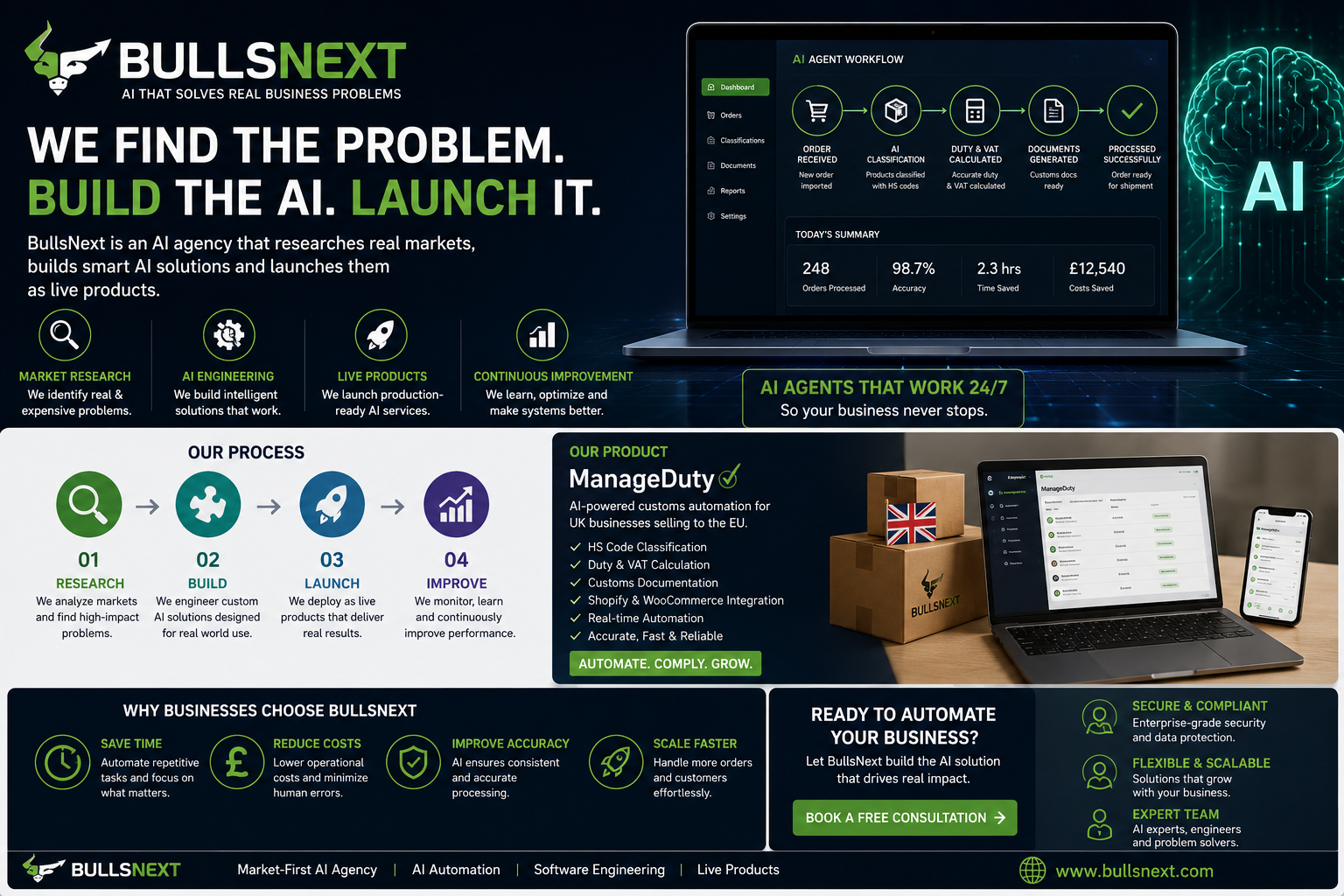
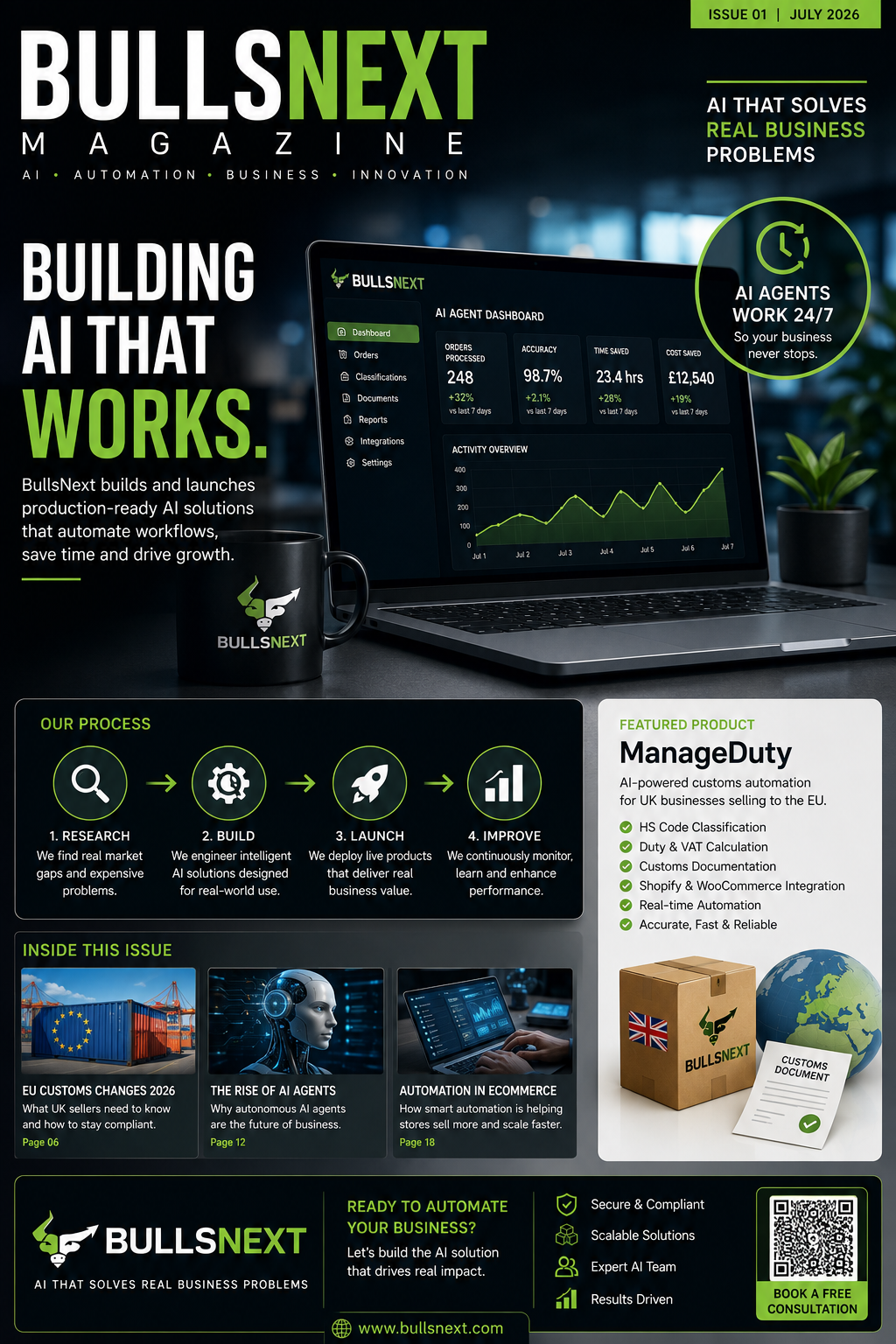
BullsNext describes itself as an AI and software studio focused on real business problems. Its philosophy is straightforward: research the market, identify expensive friction, build an AI solution, launch it as a working product, and continuously improve it.
Rather than treating AI as a decorative technology, BullsNext positions AI as infrastructure that can become part of everyday business operations.
The Shift From AI Hype to AI That Works
For years, businesses heard about the potential of artificial intelligence without necessarily knowing how to apply it.
AI demonstrations could be impressive, but a demonstration is very different from a system operating inside a real company.
A business doesn't necessarily need another chatbot.
It may need an automated system that can:
Process incoming orders
Analyze business information
Classify products
Generate documents
Handle repetitive customer workflows
Monitor processes
Identify exceptions
Connect different software systems
Run continuously
This distinction is central to BullsNext's positioning.
The company says its products are designed for production rather than remaining demonstrations or prototypes.
The BullsNext Philosophy
BullsNext presents its approach around four major ideas:
1. Market-First Thinking
Instead of beginning with a technology and searching for somewhere to use it, BullsNext says it begins by researching the market.
The objective is to discover where businesses are losing time, money, and opportunities.
This can involve looking at repetitive processes, operational bottlenecks, customer friction, and tasks that require unnecessary human involvement.
2. Precision Over Hype
AI systems need to work correctly when they are connected to real business processes.
BullsNext emphasizes precision and practical execution rather than simply making impressive claims about AI.
3. Real-World AI
The company says it builds systems intended to operate in production environments.
That means the goal isn't simply to create a prototype that looks impressive in a presentation. The goal is to create something that performs useful work.
4. Partnership
BullsNext says it remains involved after launch, monitoring systems and improving them over time.
This is important because business workflows change. Products change. Regulations change. Customers change.
An AI system that never improves can quickly become less useful.
From Market Gap to AI Product
The BullsNext process can be summarized as:
Research → Build → Launch → Improve
The first step is understanding the market.
The second is engineering a solution around the specific problem.
The third is launching the system as a live product.
The fourth is continuously improving it based on real-world use.
BullsNext describes this as a market-first model in which products begin with real problems rather than assumptions.
ManageDuty: A Real Example
One example of this approach is ManageDuty, a customs automation product aimed at UK ecommerce businesses shipping to EU customers.
BullsNext says ManageDuty connects with Shopify and WooCommerce and automates several customs-related processes, including HS-code classification, duty and VAT calculations, and customs documentation.
This illustrates an important concept in AI development.
The product isn't simply "AI for ecommerce."
Instead, it addresses a specific operational problem:
International ecommerce orders can require complicated customs information, and manually handling that information can consume significant time.
ManageDuty is designed to automate parts of that workflow.
Why Business Automation Matters
Imagine an online store processing hundreds of orders.
Every order can potentially involve multiple pieces of information.
A team might have to check:
Product descriptions
Product classifications
Destination country
Tax information
Customs requirements
Documentation
Shipping information
When this work is repeated hundreds or thousands of times, even small inefficiencies can become expensive.
Automation can turn a long manual workflow into a structured digital process.
Instead of:
Order → Employee checks information → Employee researches product → Employee calculates charges → Employee prepares documentation
the goal becomes:
Order → AI processes information → System calculates → Document generated → Human handles exceptions
That is the type of transformation that makes AI commercially interesting.
AI Agents and 24/7 Operations
BullsNext also emphasizes AI agents that can operate continuously.
The idea is simple.
A traditional employee may work a defined number of hours each day.
An automated system can continue processing tasks outside normal business hours.
For example:
9 AM: Orders begin arriving.
2 PM: The system continues processing.
8 PM: The business closes.
2 AM: Automated workflows continue running.
8 AM: The team returns to completed processes and highlighted exceptions.
This doesn't mean every business process should be fully autonomous. Human oversight can remain important, especially for unusual, high-risk, or ambiguous situations.
The opportunity is to allow AI to handle repetitive work while people focus on decisions that genuinely require human judgment.
Why the BullsNext Blog Matters
BullsNext also operates a blog focused on AI, software engineering, automation, compliance, and product strategy. Its stated goal is to publish practical ideas that work in production.
Recent articles focus heavily on ecommerce and customs compliance.
For example, BullsNext has published articles discussing EU customs requirements, HS codes, IOSS, and WooCommerce orders shipped from the UK to EU customers.
This content strategy fits the company's wider positioning.
Instead of only publishing general articles such as "What is AI?", BullsNext can create content around specific problems that businesses are actively trying to solve.
The Power of Problem-Focused Content
A business owner may not search for:
"Best AI agency."
They may search for:
"Why is my EU order stuck at customs?"
Or:
"How do I automatically generate customs invoices?"
Or:
"How do I assign HS codes to WooCommerce products?"
Problem-focused content can therefore connect an AI company with people already experiencing a specific business challenge.
This creates a natural path:
Problem → Educational article → Solution → Product
For BullsNext, this is particularly relevant because its stated business model is based on finding market problems and building solutions around them.
AI and the Future of Ecommerce
Ecommerce is one area where AI automation could have a major impact.
Online stores already operate through software systems, making them natural environments for automation.
AI can potentially help with:
Product classification
Customer support
Order processing
Inventory analysis
Marketing workflows
Fraud detection
Document generation
Data analysis
Personalization
International shipping
The challenge is not simply connecting AI to a business.
The challenge is making sure the AI understands the workflow, produces reliable results, integrates with existing software, and knows when a human should take over.
Building AI for Real Businesses
One of the strongest ideas behind BullsNext's positioning is that AI should be practical.
Businesses don't necessarily care how sophisticated an underlying model is.
They care about outcomes.
Does it save time?
Does it reduce repetitive work?
Does it improve accuracy?
Does it help employees?
Does it reduce operational costs?
Does it help the company serve more customers?
Those are the questions that ultimately determine whether an AI system is valuable.
BullsNext describes its approach as building AI that solves real market problems and deploying those systems as live products.
What Comes Next?
The next stage of AI adoption may not be about adding AI to everything.
Instead, businesses may become more selective.
They will identify their most expensive operational bottlenecks and determine whether AI can solve them.
That could create a new generation of specialized AI products.
Instead of one generic system trying to do everything, businesses could use multiple focused AI agents:
One for customer support.
One for compliance.
One for document processing.
One for sales operations.
One for financial workflows.
One for ecommerce operations.
These systems could eventually communicate with each other and form an automated business infrastructure.
The BullsNext Vision
BullsNext's message can ultimately be reduced to one idea:
AI should do real work.
The company says it doesn't want to build technology simply because AI is popular. It wants to identify genuine business problems, engineer solutions, launch them, and improve them continuously.
That philosophy could become increasingly important as businesses move from experimenting with AI to depending on it.
The winners in this next phase may not be companies that simply use the most AI.
They may be companies that use AI in the right places.
Final Thoughts
BullsNext represents a practical approach to artificial intelligence: find the problem first, then build the technology around it.
Its market-first model focuses on identifying operational friction, creating specialized AI systems, deploying those systems in production, and continuously improving them.
ManageDuty provides one example of this strategy by targeting customs automation for UK ecommerce businesses selling into the EU.
As AI becomes more deeply integrated into business operations, the conversation is likely to move away from "What can AI do?" and toward a more valuable question:
"What should AI be doing for my business?"
That is where practical AI companies like BullsNext are attempting to make their mark.