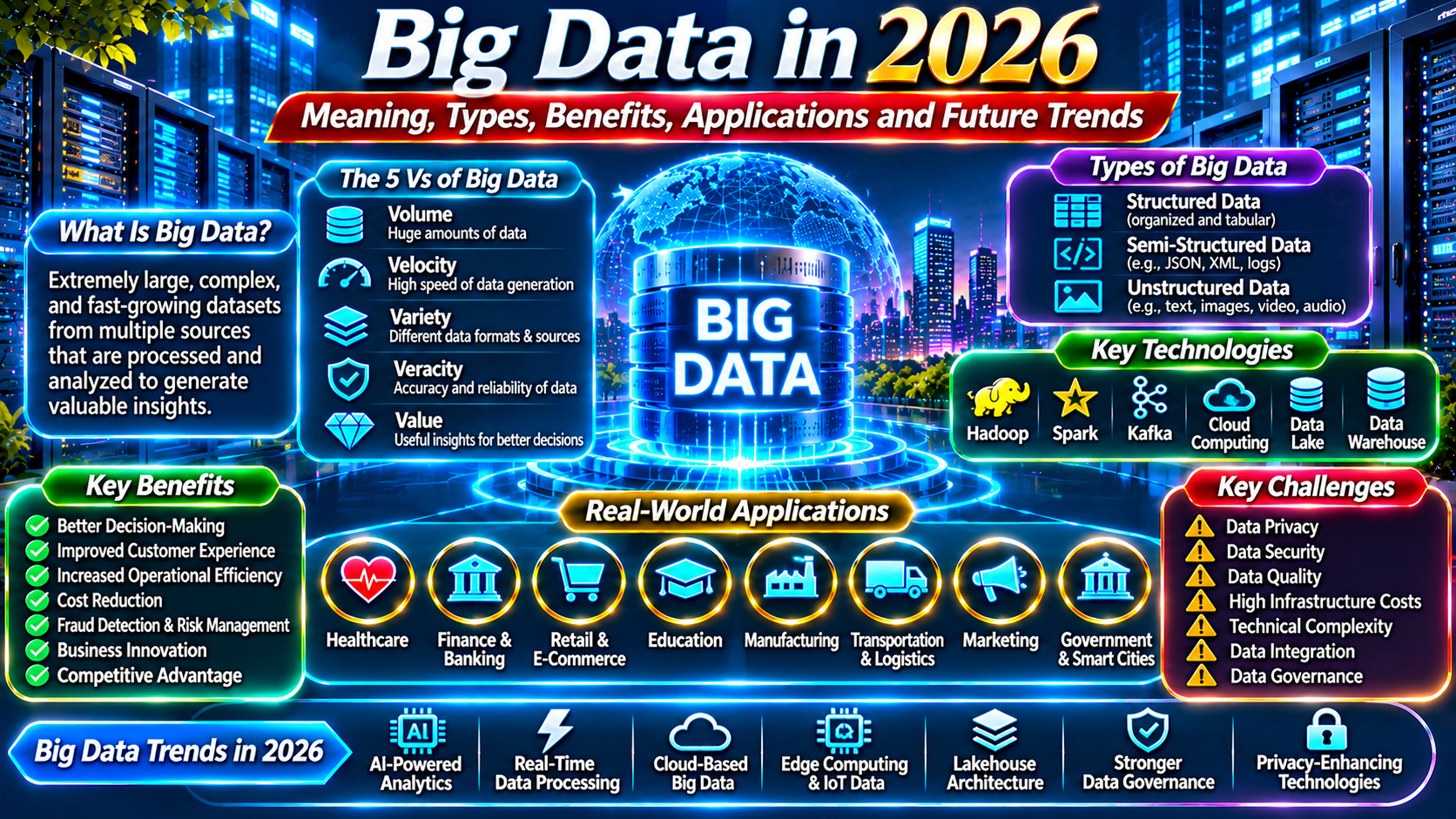
Big data refers to extremely large, complex, and rapidly generated datasets that traditional data-processing systems may struggle to store, manage, and analyze efficiently. These datasets can contain structured, semi-structured, and unstructured information collected from multiple sources.
Examples include online shopping transactions, social media interactions, financial records, website activity, GPS information, medical records, smart devices, and industrial sensors.
The purpose of big data is not simply to collect massive amounts of information. Its real value lies in discovering patterns, identifying trends, understanding relationships, and generating insights that support better decisions.
For example, an online retailer can analyze millions of customer interactions to understand which products are popular, what customers frequently purchase together, and when demand is likely to increase. A healthcare organization can examine large datasets to identify patterns that may help researchers understand diseases and improve healthcare planning.
Big data is therefore an important foundation of modern analytics and digital transformation.
How Does Big Data Work?
Big data systems use a combination of technologies and processes to collect, store, process, analyze, and present information.
Although the architecture differs between organizations, most big data workflows include several common stages.
1. Data Collection
The process begins with collecting information from different sources. These may include websites, mobile applications, business databases, sensors, social media platforms, customer transactions, and connected devices.
Organizations must identify which data is relevant to their objectives and establish reliable collection methods.
2. Data Storage
Large datasets require storage systems capable of handling significant volumes and different information formats.
Businesses may use cloud storage, distributed file systems, data lakes, data warehouses, and specialized database technologies.
The choice depends on the amount of information, performance requirements, security needs, and budget.
3. Data Processing
Collected information is often incomplete, duplicated, inconsistent, or stored in different formats.
Data-processing systems organize, clean, transform, and prepare information for analysis.
Some systems process data in batches, while others process information continuously or as it arrives.
4. Data Analysis
Once information has been prepared, analytical tools help identify patterns, relationships, trends, and unusual activities.
Organizations may use statistical methods, machine learning, artificial intelligence, and data-mining techniques to understand their datasets.
5. Data Visualization and Reporting
The final stage involves presenting insights in a useful format.
Dashboards, reports, charts, and interactive visualizations help decision-makers understand findings and take appropriate action.
For example, a sales dashboard may display revenue trends, customer acquisition, product performance, and regional demand.
The 5 Vs of Big Data
Big data is commonly explained through five characteristics known as the 5 Vs. These characteristics describe why managing large datasets requires specialized technologies and analytical methods.
1. Volume
Volume refers to the enormous quantity of information generated and collected by digital systems.
Businesses may process millions of transactions, customer records, website visits, and sensor readings. Traditional storage systems may not be suitable for every large-scale data requirement.
Distributed storage and cloud infrastructure help organizations manage growing data volumes.
2. Velocity
Velocity describes how quickly information is generated, transmitted, and processed.
Online payments, financial markets, connected vehicles, and industrial monitoring systems can produce information continuously.
Some applications require real-time or near-real-time processing to identify important events and respond quickly.
3. Variety
Variety refers to the different formats and sources of information.
Big data can include:
Structured data, such as database tables.
Semi-structured data, such as JSON and XML files.
Unstructured data, such as images, videos, audio recordings, emails, and documents.
Organizations need technologies that can manage these different formats.
4. Veracity
Veracity refers to the quality, accuracy, consistency, and reliability of information.
Incorrect, incomplete, outdated, or duplicated data can produce misleading analytical results.
Data validation, cleaning, governance, and quality monitoring help improve reliability.
5. Value
Value represents the useful outcomes that organizations obtain from analyzing data.
Large datasets do not automatically create business benefits. Information becomes valuable when it helps organizations improve services, reduce costs, identify opportunities, manage risks, or make informed decisions.
Types of Big Data
Big data is generally divided into three main categories based on its structure and organization.
1. Structured Data
Structured data is organized according to a predefined format, often using rows and columns.
Examples include:
Customer databases.
Financial transactions.
Employee records.
Sales reports.
Inventory information.
Banking records.
Structured information is generally easier to organize, search, and analyze using relational database systems.
2. Unstructured Data
Unstructured data does not follow a fixed tabular format. It can include large collections of content that require specialized processing methods.
Examples include:
Videos and photographs.
Audio recordings.
Social media posts.
Emails.
PDF documents.
Customer reviews.
Medical images.
Artificial intelligence and machine learning can help organizations extract useful information from these sources.
3. Semi-Structured Data
Semi-structured data has some organizational elements but does not follow the strict structure of a traditional relational database.
Examples include JSON files, XML documents, application logs, and certain web records.
This type of data is widely used in modern software applications and digital platforms.
Important Big Data Technologies
Big data depends on a broad ecosystem of technologies that support data collection, storage, processing, analysis, and management.
Apache Hadoop
Apache Hadoop is an open-source framework designed to support distributed storage and processing of large datasets across clusters of computers.
Its ecosystem includes technologies such as the Hadoop Distributed File System (HDFS) and processing tools that support large-scale data workloads.
Hadoop has played an important role in the development of big data infrastructure.
Apache Spark
Apache Spark is an open-source distributed processing engine used for large-scale data analytics.
It supports batch processing, SQL analytics, streaming workloads, machine learning, and graph processing through different libraries and components.
Spark is widely used when organizations need to process large datasets across distributed computing environments.
Apache Kafka
Apache Kafka is a distributed event-streaming platform.
It allows organizations to collect, publish, store, and process streams of events from applications and digital systems.
Common applications include real-time monitoring, transaction processing, log collection, and data integration.
Cloud Computing Platforms
Cloud computing has made it easier for organizations to access scalable storage and processing resources without maintaining all infrastructure themselves.
Major platforms include:
Amazon Web Services (AWS).
Microsoft Azure.
Google Cloud.
These platforms provide services for data storage, data integration, analytics, machine learning, and large-scale processing.
Data Warehouses
A data warehouse is a centralized system designed to store organized information from different sources for reporting and analysis.
Examples of modern data warehouse platforms include Snowflake, Google BigQuery, Amazon Redshift, and Microsoft Fabric's data warehousing capabilities.
Data Lakes
A data lake stores large amounts of raw information in its original or near-original format.
It can hold structured, semi-structured, and unstructured data, allowing organizations to prepare information for different analytical needs.
Data lakes are particularly useful when businesses need flexibility in how information is processed and analyzed.
Benefits of Big Data
Big data provides several advantages for organizations across different industries.
1. Better Decision-Making
Businesses can use data analytics to make decisions based on evidence rather than relying entirely on assumptions.
By analyzing historical performance, customer activity, and market trends, decision-makers can better understand their options.
2. Improved Customer Experience
Companies can study customer preferences, purchasing patterns, and feedback to develop more relevant products and services.
For example, an e-commerce platform may use customer activity to recommend products that match individual interests.
3. Increased Operational Efficiency
Data analytics can help organizations identify delays, inefficiencies, and unnecessary expenses.
Manufacturers can analyze production information to improve equipment performance, while logistics companies can study transportation data to improve delivery planning.
4. Cost Reduction
Big data can help organizations identify inefficient processes and use resources more effectively.
Predictive maintenance, improved inventory management, and demand forecasting can reduce avoidable costs.
5. Fraud Detection and Risk Management
Banks and financial institutions can analyze transaction patterns to identify suspicious activities.
Analytics systems can detect unusual behavior and flag transactions for further investigation.
6. Business Innovation
Organizations can use data insights to identify new markets, understand changing customer needs, and develop new products and services.
Data-driven experimentation can also help businesses evaluate ideas before making major investments.
7. Competitive Advantage
Companies that use reliable data effectively may respond more quickly to market changes and customer expectations.
This can improve strategic planning and help organizations identify opportunities that competitors may overlook.
Real-World Applications of Big Data
Big data is used across many industries. Its applications range from improving customer services to supporting scientific research and managing complex operations.
1. Big Data in Healthcare
Healthcare organizations generate large amounts of information through patient records, laboratory systems, medical imaging, wearable devices, and clinical research.
Big data analytics can help healthcare professionals and researchers:
Study disease patterns.
Analyze treatment outcomes.
Support hospital resource planning.
Monitor public health trends.
Improve administrative efficiency.
Support medical research.
For example, researchers may analyze large collections of clinical information to identify relationships between health conditions, treatments, and patient outcomes.
However, medical information is highly sensitive. Healthcare organizations must protect patient privacy and ensure that analytical findings are interpreted appropriately by qualified professionals.
2. Big Data in Banking and Finance
Financial institutions use big data to understand customer activity, monitor transactions, and manage financial risks.
Important applications include fraud detection, transaction monitoring, customer segmentation, risk assessment, and financial forecasting.
For example, a bank may analyze transaction behavior to identify activities that differ significantly from a customer's usual patterns.
These findings can help security teams investigate potentially suspicious transactions.
3. Big Data in Retail and E-Commerce
Retail businesses use data analytics to understand customer preferences and improve shopping experiences.
Common applications include:
Personalized product recommendations.
Inventory management.
Sales forecasting.
Customer segmentation.
Price analysis.
Marketing campaign evaluation.
An online retailer may study purchasing patterns to identify products that customers frequently buy together.
This information can support product recommendations and marketing strategies.
4. Big Data in Education
Educational institutions can use analytics to understand student performance, evaluate learning programs, and improve administrative processes.
Possible applications include:
Tracking learning progress.
Identifying areas where students need support.
Evaluating educational resources.
Improving course planning.
Managing institutional resources.
Learning analytics can provide useful insights, but student data should be handled responsibly and should not be used as the sole basis for important academic decisions.
5. Big Data in Manufacturing
Manufacturing companies use data from production systems, machinery, industrial sensors, and quality-control processes.
This information can help manufacturers monitor equipment performance, identify production problems, and improve product quality.
Predictive maintenance is an important application. By analyzing machine data, organizations can identify patterns that may indicate equipment problems before a failure occurs.
6. Big Data in Transportation and Logistics
Transportation companies generate data through GPS systems, vehicle sensors, delivery platforms, and traffic-monitoring technologies.
Big data analytics can support:
Route optimization.
Traffic analysis.
Fleet management.
Delivery forecasting.
Fuel-efficiency improvements.
Supply chain planning.
For example, a logistics company can analyze traffic and delivery information to select more efficient transportation routes.
7. Big Data in Marketing
Marketing teams use large datasets to understand audience behavior and measure campaign performance.
They may analyze website visits, social media interactions, advertising results, customer feedback, and purchase history.
These insights can help businesses identify valuable audiences, improve campaign targeting, and measure return on investment.
8. Big Data in Government and Smart Cities
Government organizations can use big data to improve public services and support urban planning.
Smart city projects may collect information from transportation networks, environmental sensors, public infrastructure, and utility systems.
Potential applications include traffic management, energy planning, waste management, emergency response, and environmental monitoring.
Strong privacy safeguards and transparent governance are essential when public-sector systems collect information about citizens.
Big Data and Artificial Intelligence
Big data and artificial intelligence are closely connected technologies.
Big data provides large collections of information that AI systems can use for training, analysis, and decision-making. Artificial intelligence provides techniques that help organizations extract insights from complex datasets.
For example, machine learning models can analyze historical sales information to predict future demand. Natural language processing can examine customer reviews to identify common complaints and opinions.
Generative AI can also help users interact with organizational data through natural-language questions and automated reporting.
However, more data does not always produce better AI results. Data quality, relevance, representativeness, privacy, and model design are all important.
When big data and AI are combined responsibly, they can support more advanced analytics and business automation.
Big Data vs. Traditional Data
Traditional data management systems are generally designed for structured information and specific operational requirements. Big data technologies are intended to support larger, more varied, and sometimes faster-moving datasets.
Feature | Traditional Data | Big Data |
|---|---|---|
Data volume | Usually smaller | Often very large |
Data formats | Mainly structured | Structured, semi-structured, and unstructured |
Processing | Often centralized | Frequently distributed |
Storage | Traditional databases | Distributed storage, lakes, warehouses, and cloud systems |
Analysis | Conventional reporting | Advanced analytics and machine learning |
Scalability | Depends on system design | Often designed for horizontal scaling |
Common use | Routine business records | Large-scale analytics and complex data processing |
The distinction is not absolute. Modern traditional databases can handle substantial workloads, and many big data platforms now combine features of databases, warehouses, and distributed processing systems.
Challenges of Big Data
Although big data creates opportunities, organizations must overcome several challenges to use it effectively.
1. Data Privacy
Large datasets may contain personal, financial, medical, or commercially sensitive information.
Organizations must follow applicable privacy laws and establish clear policies for collecting, storing, processing, and sharing information.
2. Data Security
Large data environments can become attractive targets for cybercriminals.
Security measures should include encryption, access controls, identity management, monitoring, backups, and incident-response procedures.
3. Data Quality
Incomplete, duplicated, outdated, or inaccurate information can produce misleading results.
Businesses need data-cleaning processes, validation rules, and ongoing quality monitoring.
4. Infrastructure Costs
Large-scale data processing can require significant computing power, storage capacity, networking resources, and technical expertise.
Cloud services can reduce some infrastructure-management responsibilities, but organizations still need to monitor usage and control costs.
5. Technical Complexity
Building and managing big data systems requires expertise in databases, distributed computing, analytics, cloud infrastructure, and data engineering.
Organizations may need to train existing employees or recruit specialists.
6. Data Integration
Businesses often collect information from different applications and systems.
Combining these sources can be difficult when data formats, naming conventions, definitions, and quality standards are inconsistent.
7. Data Governance
Organizations need clear rules for data ownership, access, retention, quality, and permitted use.
Without effective governance, large data environments can become difficult to manage and audit.
Big Data Trends in 2026
Big data continues to evolve as cloud platforms, AI technologies, connected devices, and analytical tools improve.
Several developments are particularly important in 2026.
1. AI-Powered Data Analytics
Artificial intelligence is making data analysis more accessible and sophisticated.
Organizations can use AI-assisted tools to identify patterns, generate summaries, detect anomalies, and support analytical workflows.
Natural-language interfaces are also helping nontechnical users explore data without writing complex queries for every task.
2. Real-Time Data Processing
Many businesses need information quickly enough to respond to events as they happen.
Streaming technologies allow organizations to process continuous data flows from applications, payment systems, sensors, and digital platforms.
This is valuable for fraud monitoring, logistics, operational alerts, and customer-facing services.
3. Cloud-Based Big Data Solutions
Cloud platforms provide flexible storage and computing resources for organizations with changing data requirements.
Businesses can scale resources according to demand and use managed services for data integration, analytics, and machine learning.
Cost management, data security, and regulatory requirements remain important considerations.
4. Edge Computing and IoT Data
The Internet of Things (IoT) connects devices that generate continuous streams of information.
Edge computing processes some of this information closer to where it is produced instead of sending every data point to a central cloud environment.
This can reduce latency and network usage in applications such as industrial monitoring, connected vehicles, and smart infrastructure.
5. Data Lakes and Lakehouse Architecture
Organizations increasingly need platforms that combine flexible data storage with reliable analytical capabilities.
Lakehouse architectures aim to bring together elements of data lakes and data warehouses, supporting different data formats and analytical workloads within a more unified environment.
6. Data Governance and Responsible AI
As businesses use data for more important decisions, governance is becoming increasingly significant.
Organizations need to understand where information comes from, whether it is reliable, who can access it, and how it is used by AI systems.
Responsible data practices can improve trust and reduce operational and regulatory risks.
7. Privacy-Enhancing Technologies
Privacy-enhancing technologies are designed to support useful data analysis while reducing unnecessary exposure of sensitive information.
Examples include differential privacy, federated learning, encryption-based techniques, and secure data-sharing approaches.
These methods can help organizations balance analytical needs with privacy requirements.
What Is the Future of Big Data?
The future of big data will be shaped by artificial intelligence, cloud computing, automation, connected devices, and improvements in data infrastructure.
Organizations will continue to generate information from digital services, industrial systems, online platforms, and everyday connected devices. As these sources expand, the ability to manage and interpret data will become increasingly important.
AI-powered analytics may make it easier to discover patterns, automate reporting, and support business decisions. Real-time processing will help organizations respond more quickly to changing conditions, while edge computing may support applications that require rapid local analysis.
At the same time, privacy, cybersecurity, transparency, and data governance will remain essential.
The future will not simply belong to organizations that collect the most information. It will belong to those that can transform reliable data into meaningful insights while using it securely and responsibly.
Frequently Asked Questions About Big Data
1. What is big data in simple words?
Big data refers to very large and complex collections of information that require specialized technologies to store, process, and analyze effectively.
2. What are the 5 Vs of big data?
The 5 Vs are Volume, Velocity, Variety, Veracity, and Value. They describe the amount, speed, formats, reliability, and usefulness of data.
3. What are the three main types of big data?
The three main types are structured data, unstructured data, and semi-structured data.
4. Why is big data important?
Big data helps organizations understand customers, improve operations, identify trends, manage risks, reduce costs, and make more informed decisions.
5. What are examples of big data?
Examples include social media posts, online shopping transactions, banking records, medical information, GPS data, website activity, and information generated by connected devices.
6. Which technologies are used in big data?
Common technologies include Apache Hadoop, Apache Spark, Apache Kafka, cloud computing platforms, data warehouses, data lakes, and distributed databases.
7. What is the difference between big data and data analytics?
Big data refers to large and complex datasets, while data analytics refers to the methods and processes used to examine information and generate insights. Analytics can be performed on both small and large datasets.
8. How is big data used in artificial intelligence?
Big data can provide information for training and evaluating machine learning models. AI technologies can then analyze the information to identify patterns, make predictions, and support automated tasks.
9. What are the biggest challenges of big data?
Major challenges include privacy, security, data quality, infrastructure costs, technical complexity, data integration, and governance.
10. What is the future of big data in 2026 and beyond?
The future of big data is expected to involve greater AI integration, real-time analytics, cloud-based platforms, edge computing, privacy-enhancing technologies, and more advanced data governance.
Conclusion
Big data has become an essential part of the modern digital world. From healthcare and finance to retail, manufacturing, education, and transportation, organizations use large datasets to understand complex situations and improve their operations.
Technologies such as Apache Spark, Hadoop, Kafka, cloud computing, and modern data warehouses provide the infrastructure needed to manage and analyze information at scale.
As artificial intelligence and real-time analytics continue to develop, big data will play an even greater role in business innovation and digital transformation.
However, successful data-driven strategies require more than advanced technology. Organizations must also focus on information quality, privacy, security, governance, and responsible use.
By combining reliable data with effective analytical tools, businesses can turn information into valuable knowledge and make better decisions in an increasingly connected world.