Malaysia has become home to some of Southeast Asia's most successful entrepreneurs, investors, industrialists, and business families. From global agribusiness and property development to banking, retail, manufacturing, and technology, the country's wealthiest individuals have built businesses that influence international markets.
In 2026, Malaysia's billionaire community experienced substantial wealth growth. A stronger Malaysian ringgit, economic expansion, rising industrial demand, and an active initial public offering (IPO) market helped increase the fortunes of many leading business figures.
According to Forbes' April 2026 ranking of Malaysia's 50 Richest, Robert Kuok retained his position as the country's wealthiest person, with an estimated net worth of $13.6 billion. The 102-year-old business magnate built an international empire with interests in agribusiness, hospitality, property, and other industries.
Koon Poh Keong and his siblings secured second place with a combined fortune of $9.7 billion, while brothers Lee Yeow Chor and Lee Yeow Seng ranked third with $8.5 billion.
The combined wealth of Malaysia's 50 richest people increased by nearly 30%, reaching approximately $116 billion in 2026, compared with $90 billion in 2025.
The country's economic growth, stronger currency, and successful stock-market listings contributed to this increase. Businesses connected to aluminum, palm oil, retail, property, healthcare, and infrastructure also benefited from changing market conditions.
Malaysia's wealthiest people represent a diverse group of entrepreneurs who have built their fortunes through long-term investments, international business expansion, innovation, and strategic ownership.
This article explores Malaysia's richest people in 2026, their estimated net worth, major companies, business achievements, and the industries shaping the country's billionaire economy.
Top 10 Richest People in Malaysia in 2026
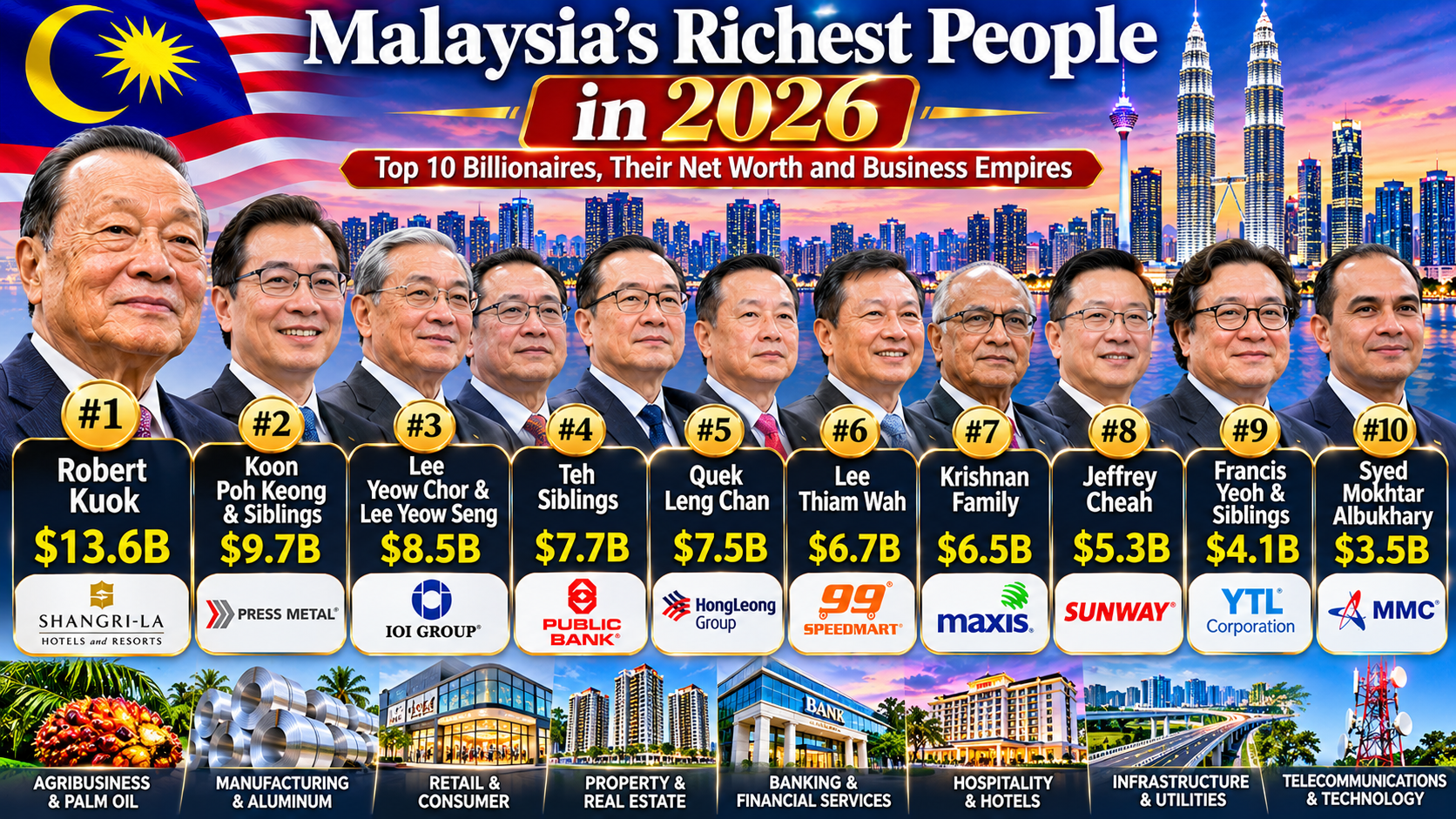
According to Forbes' April 15, 2026 annual ranking, the top 10 wealthiest individuals and families are:
Rank | Name | Estimated Net Worth |
|---|---|---|
1 | Robert Kuok | $13.6 billion |
2 | Koon Poh Keong and Siblings | $9.7 billion |
3 | Lee Yeow Chor and Lee Yeow Seng | $8.5 billion |
4 | Teh Siblings | $7.7 billion |
5 | Quek Leng Chan | $7.5 billion |
6 | Lee Thiam Wah | $6.7 billion |
7 | Krishnan Family | $6.5 billion |
8 | Jeffrey Cheah | $5.3 billion |
9 | Francis Yeoh and Siblings | $4.1 billion |
10 | Syed Mokhtar Albukhary | $3.5 billion |
All net worth figures are estimated in US dollars. Family fortunes are combined where applicable.
1. Robert Kuok – Malaysia's Richest Person
Estimated Net Worth: $13.6 Billion
Main Sources of Wealth: Agribusiness, Hospitality, Property, and Investments
Robert Kuok is Malaysia's richest person in 2026 and one of Asia's most influential business magnates. Known internationally as the Sugar King of Asia, he has built a diversified business empire spanning several industries.
Born in Johor Bahru, Malaysia, in 1923, Kuok began his business journey in the trading industry. He eventually established a major presence in sugar refining, agricultural commodities, property development, shipping, and hospitality.
One of the foundations of his success was the establishment of Kuok Brothers, which developed into an international business group.
His business interests expanded into sugar production and trading, helping him become one of the most influential figures in the global sugar industry.
Kuok also established significant interests in palm oil and other agricultural commodities through companies associated with his business group.
His international business portfolio includes investments in hotels, property, logistics, and infrastructure.
One of his most recognizable business interests is Shangri-La Hotels and Resorts, an international luxury hospitality brand with properties across Asia and other regions.
The company helped establish Kuok as an important figure in the international hotel industry.
His business group has also been expanding into emerging opportunities, including data centers, reflecting the increasing importance of digital infrastructure.
According to Forbes' 2026 ranking, Kuok's estimated fortune increased by 19% to $13.6 billion.
His success demonstrates the importance of diversification, international trade, long-term investment, and identifying opportunities across different industries.
Despite his advanced age, Robert Kuok remains a central figure in Malaysia's business history and continues to hold the top position among the country's wealthiest individuals.
2. Koon Poh Keong and Siblings – The Aluminum Manufacturing Billionaires
Combined Estimated Net Worth: $9.7 Billion
Main Source of Wealth: Aluminum Manufacturing
Koon Poh Keong and his siblings are among Malaysia's most successful industrial entrepreneurs.
Their wealth is closely connected to Press Metal Aluminium Holdings, one of Southeast Asia's largest integrated aluminum producers.
The company has developed a strong position in the aluminum manufacturing industry, supplying materials used in construction, transportation, packaging, electronics, and industrial production.
Aluminum is an important material in the modern economy because it is lightweight, durable, recyclable, and suitable for numerous applications.
Growing demand from electric vehicle manufacturers, renewable energy companies, construction businesses, and technology infrastructure providers has created opportunities for aluminum producers.
Press Metal has expanded its production capabilities and developed an international customer base.
Its manufacturing operations have helped strengthen Malaysia's position in the global metals industry.
Koon Poh Keong and his siblings experienced one of the largest wealth increases in Forbes' 2026 ranking.
Their combined fortune increased by approximately 80% to $9.7 billion, helping them secure second place for the first time.
The company's share price gained approximately 73% during the year covered by the ranking, supported by higher aluminum prices and demand from emerging industries.
Their business success demonstrates how industrial manufacturing and strategic investment can create substantial international wealth.
3. Lee Yeow Chor and Lee Yeow Seng – The IOI Group Brothers
Combined Estimated Net Worth: $8.5 Billion
Main Sources of Wealth: Palm Oil and Property Development
Lee Yeow Chor and Lee Yeow Seng are prominent Malaysian business leaders associated with IOI Group.
The brothers inherited and developed major business interests connected to one of Malaysia's leading palm oil and property groups.
IOI Corporation is a major participant in the palm oil industry, with operations covering plantations, resource processing, and manufacturing.
Palm oil is an important agricultural commodity used in food production, cosmetics, personal care products, and industrial applications.
Malaysia is one of the world's leading palm oil-producing countries, making the industry an important contributor to its economy.
Beyond agriculture, the brothers have developed significant interests in property through IOI Properties Group.
The company has investments in residential developments, commercial properties, retail centers, and international real estate projects.
Its business activities extend beyond Malaysia into other regional markets.
In 2026, Lee Yeow Chor and Lee Yeow Seng moved up three positions in Forbes' ranking, reaching third place with a combined fortune of $8.5 billion.
Their wealth increased partly because of the performance of IOI-related businesses and plans to unlock value through real estate investment trust listings in Malaysia and Singapore.
Their business journey demonstrates the value of combining agricultural production with property development and international investments.
4. The Teh Siblings – Banking and Financial Services Wealth
Combined Estimated Net Worth: $7.7 Billion
Main Source of Wealth: Banking and Financial Services
The Teh siblings are associated with the banking legacy of Public Bank Berhad, one of Malaysia's largest financial institutions.
The family's business fortune is connected to the late Teh Hong Piow, who founded Public Bank in 1966.
He built the institution into a major banking group with operations in Malaysia and other Asian markets.
Public Bank provides financial services to individuals, businesses, and corporate customers.
Its operations include personal banking, commercial lending, investment services, and wealth management.
The bank has established a strong reputation for its focus on financial management, customer services, and long-term business development.
The Teh family's wealth reflects its ownership interests and the financial legacy established by the bank's founder.
Financial institutions play a significant role in Malaysia's economy by supporting businesses, providing loans, managing savings, and facilitating investment.
According to Forbes' April 2026 ranking, the Teh siblings held fourth place with an estimated combined fortune of $7.7 billion.
Their position demonstrates how banking and financial services can create substantial generational wealth.
5. Quek Leng Chan – The Hong Leong Business Magnate
Estimated Net Worth: $7.5 Billion
Main Sources of Wealth: Banking, Property, and Investments
Quek Leng Chan is one of Malaysia's most prominent business magnates and a leading figure in the Hong Leong business group.
His business empire has interests in financial services, property development, manufacturing, and other commercial activities.
Hong Leong Financial Group is an important part of the family's business interests, with operations in banking, insurance, and financial services.
The group has developed a strong position in Malaysia's financial industry and maintains connections with international markets.
Quek's business interests also extend into property development and investments through companies associated with Hong Leong Group.
Real estate has historically been an important source of wealth in Malaysia because of urban development, housing demand, commercial construction, and infrastructure expansion.
His investment strategy reflects the importance of diversification and long-term ownership.
According to Forbes' 2026 ranking, Quek Leng Chan had an estimated fortune of $7.5 billion, placing him fifth among Malaysia's wealthiest people.
His business career demonstrates how financial institutions and diversified corporate holdings can support long-term wealth creation.
6. Lee Thiam Wah – Founder of 99 Speed Mart
Estimated Net Worth: $6.7 Billion
Main Source of Wealth: Retail and Supermarkets
Lee Thiam Wah is the founder of 99 Speed Mart, one of Malaysia's largest convenience and minimarket retail chains.
His entrepreneurial journey is an example of how a relatively small retail operation can develop into a nationwide business.
Lee started his business with a small grocery store before expanding into a larger network of neighborhood minimarkets.
Over time, 99 Speed Mart became a familiar retail brand across Malaysia.
The company focuses on providing groceries, household essentials, packaged foods, beverages, and everyday consumer products.
Its business model emphasizes convenience, competitive pricing, efficient distribution, and a wide network of stores.
The company has expanded rapidly, adding hundreds of outlets and serving customers across urban and suburban communities.
In 2024, 99 Speed Mart became publicly listed on Bursa Malaysia, providing the business with access to additional capital and increasing its market visibility.
According to Forbes, Lee's fortune nearly doubled to $6.7 billion in 2026.
The company added 259 stores during 2025, taking its nationwide total to more than 3,000 outlets.
His success demonstrates the importance of understanding consumer behavior, building an efficient supply chain, and expanding a successful retail concept.
7. The Krishnan Family – Wealth from Telecommunications and Investments
Combined Estimated Net Worth: $6.5 Billion
Main Source of Wealth: Telecommunications and Investments
The Krishnan family is associated with the business legacy of the late Ananda Krishnan, one of Malaysia's most prominent entrepreneurs.
Ananda Krishnan built a diversified business empire with interests in telecommunications, media, entertainment, energy, and international investments.
He was particularly recognized for his involvement in the development of major telecommunications businesses.
One of the most important companies associated with his business legacy was Maxis, a leading Malaysian telecommunications provider.
Telecommunications has become an essential part of modern economic activity because businesses and individuals rely on mobile networks, broadband services, and digital communication.
The family's wider business interests also included entertainment and infrastructure investments.
In Forbes' 2026 ranking, the Krishnan family held seventh place with an estimated fortune of $6.5 billion.
Their business history demonstrates the importance of international investments and the expansion of digital communication networks.
8. Jeffrey Cheah – Founder of Sunway Group
Estimated Net Worth: $5.3 Billion
Main Sources of Wealth: Property, Healthcare, Education, and Infrastructure
Jeffrey Cheah is the founder of Sunway Group, one of Malaysia's major diversified business conglomerates.
He began his entrepreneurial journey in the industrial sector before expanding into property development and other industries.
Sunway Group has developed an extensive portfolio of businesses covering real estate, construction, healthcare, education, hospitality, and retail.
The company is especially recognized for its integrated township developments, which combine residential properties, commercial buildings, shopping malls, educational institutions, and healthcare facilities.
Sunway City is one of the group's most recognizable developments.
It demonstrates the company's approach to combining different services and infrastructure within a single urban environment.
Sunway Group has also expanded its healthcare operations through Sunway Healthcare Holdings.
In March 2026, Sunway Healthcare completed a major public listing, raising approximately $732 million.
The listing was one of Malaysia's largest IPOs in almost a decade.
Forbes estimated Jeffrey Cheah's wealth at $5.3 billion in 2026, representing an increase of approximately 76% compared with the previous year.
His career demonstrates how long-term planning and diversification can transform a property business into a major international conglomerate.
9. Francis Yeoh and Siblings – The YTL Corporation Business Empire
Combined Estimated Net Worth: $4.1 Billion
Main Sources of Wealth: Infrastructure, Utilities, Property, and Hospitality
Francis Yeoh and his siblings are associated with YTL Corporation, one of Malaysia's most recognized infrastructure and investment groups.
The company was established by the late Yeoh Tiong Lay and developed into an international business group under the leadership of the next generation.
YTL Corporation has interests in electricity generation, water services, construction, property development, hotels, and telecommunications.
Infrastructure businesses are important because they support the essential services required by households, companies, and industries.
YTL's operations include power generation and utility services in Malaysia and international markets.
The company also has interests in real estate and hospitality through various subsidiaries.
Its property portfolio includes residential and commercial developments, while its hospitality operations include international hotel investments.
The family has focused on expanding the company's international presence and diversifying its business portfolio.
According to Forbes' 2026 ranking, Francis Yeoh and his siblings had a combined estimated fortune of $4.1 billion.
Their business achievements demonstrate the importance of infrastructure investment and international corporate expansion.
10. Syed Mokhtar Albukhary – Industrial and Infrastructure Business Magnate
Estimated Net Worth: $3.5 Billion
Main Sources of Wealth: Logistics, Infrastructure, Agriculture, and Investments
Syed Mokhtar Albukhary is one of Malaysia's most influential entrepreneurs.
He built a diversified business empire through investments in logistics, transportation, agriculture, manufacturing, and infrastructure.
His business interests include companies associated with the MMC Group, which has operations in ports, engineering, utilities, and transportation infrastructure.
He is also associated with DRB-HICOM, a major Malaysian industrial group with interests in automotive manufacturing and other commercial activities.
The automotive sector has played an important role in Malaysia's industrial development, and companies associated with the group have participated in manufacturing and distribution activities.
Syed Mokhtar's business strategy has involved acquiring and developing companies across essential industries.
His investments reflect the importance of transportation, logistics, infrastructure, and industrial production in Malaysia's economy.
Forbes estimated his fortune at $3.5 billion in 2026, placing him tenth among the country's wealthiest individuals.
His entrepreneurial career demonstrates how diversification and participation in large-scale infrastructure projects can generate significant wealth.
Other Notable Malaysian Billionaires and Entrepreneurs
Beyond the top 10, Malaysia has several other successful business figures who have built substantial fortunes.
Lee Kar Whatt
Lee Kar Whatt is the co-founder and managing director of Eco-Shop Marketing, a discount retail chain with hundreds of outlets across Malaysia.
He entered Forbes' 2026 rich list at number 18 with an estimated fortune of $1.5 billion following the company's public listing in 2025.
His business demonstrates the growth potential of affordable retail and value-focused shopping.
Chu Jenn Weng
Chu Jenn Weng is the co-founder of ViTrox, a Malaysian technology company specializing in automated vision inspection equipment.
Its products are used in semiconductor and electronics manufacturing.
The growing demand for artificial intelligence hardware helped increase interest in the company's technology.
He returned to Forbes' 2026 ranking with an estimated fortune of approximately $565 million.
Vincent Tan
Vincent Tan is the founder of Berjaya Corporation, a diversified business group with interests in retail, property, hospitality, food and beverage, and other sectors.
His business career demonstrates the importance of diversification and international commercial partnerships.
Forbes ranked him 29th in Malaysia's 2026 rich list with an estimated fortune of $940 million.
Danny Tan
Danny Tan is associated with Tropicana Corporation, a Malaysian property development company.
His business interests include residential communities, commercial developments, and property investments.
He was ranked 32nd in Forbes' 2026 list with an estimated fortune of $850 million.
How Malaysia's Wealthiest People Built Their Fortunes
Malaysia's richest individuals have developed businesses across several important industries.
1. Agribusiness and Palm Oil
Agriculture and commodity trading have historically been important sources of wealth in Malaysia.
The country is one of the world's leading palm oil producers, supplying agricultural products to international markets.
Companies connected to Robert Kuok and the Lee family have built substantial business interests in agricultural production, trading, and processing.
2. Manufacturing and Industrial Production
Manufacturing has created major opportunities for Malaysian entrepreneurs.
Companies producing aluminum, electronics, automotive components, and industrial materials support both domestic and international markets.
Koon Poh Keong's success with Press Metal demonstrates the value of industrial manufacturing.
3. Real Estate and Property Development
Property development remains an important source of private wealth.
Growing cities, infrastructure investment, commercial expansion, and residential demand have created opportunities for major developers.
Jeffrey Cheah, Quek Leng Chan, and the Lee brothers have developed significant property-related businesses.
4. Banking and Financial Services
Malaysia's financial industry supports economic activity through banking, insurance, investment, and lending services.
Established financial institutions have helped create substantial wealth for their founders and shareholders.
The Teh family and Quek Leng Chan are examples of business figures connected to this sector.
5. Retail and Consumer Products
Retail businesses serve millions of Malaysian households.
Companies such as 99 Speed Mart have expanded by offering convenient access to everyday consumer products.
Their success is connected to efficient distribution, affordable pricing, and nationwide expansion.
6. Infrastructure and Energy
Infrastructure and energy businesses are essential to economic development.
Ports, electricity generation, transportation systems, and industrial facilities support international trade and domestic business operations.
Entrepreneurs associated with YTL, MMC, and other industrial groups have developed significant interests in these sectors.
Malaysia's Economy and the Billionaire Wealth Boom in 2026
Malaysia experienced a strong economic performance in 2025, with growth reaching 5.2%, according to Forbes' 2026 wealth-list coverage.
Several factors supported the increase in billionaire fortunes.
A stronger ringgit improved the value of locally held assets when measured in US dollars.
The country's IPO market was also active, with approximately 60 new listings during 2025.
Stock-market performance helped increase the estimated wealth of business owners with substantial stakes in publicly traded companies.
Forbes reported that the collective fortune of Malaysia's 50 richest increased from $90 billion in 2025 to $116 billion in 2026.
A total of 41 people and families on the list experienced increases in their estimated wealth.
The minimum fortune required to enter the ranking also increased from $335 million to approximately $422 million.
These developments highlight the relationship between economic growth, stock-market performance, currency strength, and private wealth.
However, billionaire net worth is not the same as cash in a bank account. Much of it is tied to company ownership, investments, and other assets whose values can change.
Challenges Facing Malaysia's Richest Business Leaders
Despite strong economic growth, Malaysia's wealthiest entrepreneurs face several challenges.
Global Economic Uncertainty
International trade conditions, inflation, interest rates, and changing consumer demand can influence business performance.
Companies with international operations must adapt to changing economic conditions.
Currency Fluctuations
Changes in the Malaysian ringgit can affect the value of international investments and the US-dollar estimates of personal fortunes.
Currency movements are particularly important for annual billionaire rankings.
Technology Competition
Industrial and technology companies must invest continuously in research, automation, and innovation.
Businesses that fail to modernize may face increasing competition from international manufacturers.
Environmental Sustainability
Industries such as palm oil, aluminum, and energy face growing expectations regarding environmental management and sustainability.
Companies must balance production growth with responsible resource management.
Stock Market Volatility
Many billionaire fortunes depend on shares in publicly traded companies.
A decline in share prices can reduce estimated personal wealth, even when the underlying business continues operating.
What Is the Future of Malaysia's Billionaire Economy?
Malaysia has opportunities to develop new business leaders across several emerging industries.
Artificial intelligence, semiconductor manufacturing, renewable energy, healthcare, digital finance, logistics, and advanced manufacturing may contribute to future wealth creation.
The country's established industrial infrastructure provides a foundation for businesses seeking to expand into international markets.
Demand for aluminum and advanced materials may continue creating opportunities for manufacturers.
Meanwhile, the expansion of digital services and modern retail may support new entrepreneurs.
Malaysia's agricultural sector could also benefit from investment in technology, sustainable production, and international food supply chains.
The next generation of Malaysian billionaires may emerge from businesses that combine innovation, operational efficiency, and international expansion.
Long-term success will depend on investment, skilled workers, financial discipline, and the ability to respond to changing global demand.
Conclusion
Malaysia's richest people in 2026 represent a diverse group of entrepreneurs, industrialists, investors, and business families.
Robert Kuok retained the top position with an estimated net worth of $13.6 billion, followed by Koon Poh Keong and his siblings with $9.7 billion, and Lee Yeow Chor and Lee Yeow Seng with $8.5 billion.
Their businesses operate across agribusiness, aluminum manufacturing, palm oil, retail, banking, real estate, infrastructure, and technology.
The combined wealth of Malaysia's 50 richest reached approximately $116 billion in 2026, reflecting the country's economic expansion, stronger ringgit, and active IPO market.
Their achievements demonstrate how entrepreneurship, long-term investment, strategic diversification, and international business relationships can create substantial wealth.
As Malaysia continues developing its industrial and digital economy, new opportunities will emerge for established business groups and future entrepreneurs.
The story of Malaysia's richest people is ultimately a story of business innovation, economic development, and companies that have helped connect the country with global markets.