Taiwan has become one of Asia's most influential economic powerhouses, attracting worldwide attention for its advanced technology industry, semiconductor manufacturing, electronics production, and financial services. Although the island is relatively small geographically, its contribution to the global economy is enormous. Some of the world's most successful technology companies operate in Taiwan, and several of its business leaders have accumulated extraordinary fortunes through innovation, manufacturing, and international expansion.
In 2026, Taiwan's billionaire community has experienced remarkable growth, largely driven by increasing demand for artificial intelligence (AI), advanced semiconductor technologies, electronic components, and data-center infrastructure. The global technology boom has created significant opportunities for Taiwanese entrepreneurs, investors, and industrial leaders.
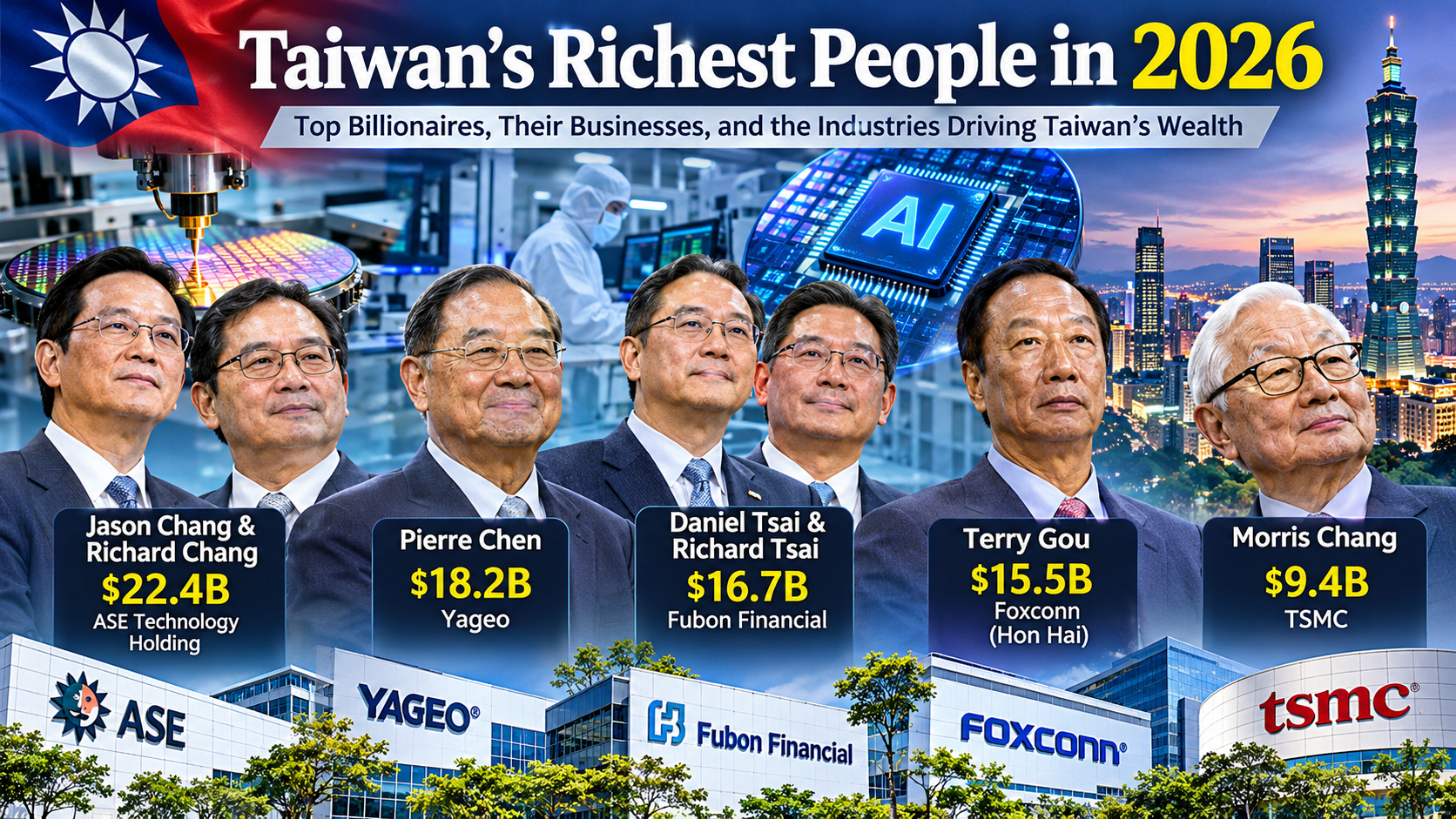
According to Forbes' June 2026 ranking of Taiwan's 50 richest people, brothers Jason Chang and Richard Chang, associated with ASE Technology Holding, secured the number-one position with a combined estimated fortune of $22.4 billion. However, billionaire rankings change frequently as stock prices and company valuations fluctuate. Forbes' real-time rankings and other November 2026 tracking data have shown different leaders at different points in the year.
The fortunes of Taiwan's wealthiest individuals demonstrate how technology, financial investment, industrial manufacturing, and international business relationships can create enormous economic value. From electronics manufacturing to semiconductor packaging, these entrepreneurs have built businesses that serve customers across the world.
This article explores Taiwan's richest people in 2026, their business backgrounds, major companies, sources of wealth, and the industries contributing to Taiwan's growing billionaire economy.
1. Jason Chang and Richard Chang: The Brothers Behind Taiwan's Wealthiest Business Empire
Combined estimated net worth: $22.4 billion (Forbes June 2026 ranking)
Jason Chang and Richard Chang became Taiwan's wealthiest business figures in the 2026 Forbes annual ranking. Their success is closely connected to ASE Technology Holding, one of the world's leading companies in semiconductor packaging, assembly, and testing.
The semiconductor industry has become increasingly important as businesses worldwide invest in artificial intelligence, cloud computing, smartphones, automotive technology, and high-performance computing. While semiconductor designers and manufacturers often receive the most public attention, packaging and testing companies play an equally important role in bringing advanced chips to market.
ASE Technology Holding provides essential services that help transform semiconductor components into finished products ready for integration into electronic devices. Its operations support customers across multiple industries, including consumer electronics, telecommunications, automotive manufacturing, and computing.
The growing complexity of modern semiconductor chips has increased demand for advanced packaging technologies. Artificial intelligence processors, in particular, require sophisticated packaging solutions to improve performance, manage heat, and support high-speed communication between components.
This technological shift has strengthened ASE's position in the global semiconductor supply chain.
The brothers' combined fortune increased significantly during the AI-driven technology rally. Forbes reported that their wealth grew by approximately $14.5 billion, helping them rise six positions and claim the top spot in its 2026 Taiwan ranking for the first time.
Their success demonstrates that some of the biggest opportunities in technology exist beyond the companies designing popular consumer products. Businesses supplying essential infrastructure and manufacturing services can also generate enormous wealth.
ASE Technology Holding's international operations and relationships with global semiconductor companies have helped establish Taiwan as a critical part of the worldwide electronics ecosystem.
2. Pierre Chen: The Billionaire Behind Yageo
Estimated net worth: $18.2 billion (Forbes June 2026 ranking)
Pierre Chen is the founder and chairman of Yageo Corporation, a major Taiwanese manufacturer of electronic components. He became the second-richest individual in Forbes' 2026 Taiwan ranking.
His wealth reflects the importance of electronic components in modern technology. Although resistors, capacitors, and other passive components are not always visible to consumers, they are essential parts of almost every electronic device.
Yageo manufactures components used in smartphones, computers, automobiles, telecommunications equipment, industrial machinery, and other electronic products.
As global demand for advanced electronics continues to increase, component manufacturers have benefited from expanding markets and growing technological requirements.
One important factor behind Yageo's growth has been its acquisition strategy. The company has expanded its international presence through investments and acquisitions, strengthening its product portfolio and customer relationships.
Its business strategy demonstrates how companies can achieve international growth by combining manufacturing expertise with strategic acquisitions.
Pierre Chen's fortune also illustrates the close relationship between Taiwan's technology industry and global financial markets. When demand for electronic components increases and investors become more optimistic about the sector, company valuations can rise substantially.
Yageo's position in the electronics supply chain makes it an important contributor to Taiwan's industrial economy.
3. Daniel Tsai and Richard Tsai: Financial Industry Billionaires
Combined estimated net worth: $16.7 billion (Forbes June 2026 ranking)
Daniel Tsai and Richard Tsai are prominent figures in Taiwan's financial services industry. Their wealth is associated with Fubon Financial Holding, one of Taiwan's major financial conglomerates.
Unlike technology entrepreneurs whose fortunes primarily depend on manufacturing and semiconductor demand, the Tsai brothers have built their business influence through finance, insurance, banking, and investment activities.
Fubon Financial operates across several financial sectors, including banking, life insurance, property and casualty insurance, securities, and asset management.
This diversified business model allows the company to participate in different areas of the financial economy.
The financial services industry is essential to economic development because it supports businesses, households, investors, and international commercial activity. Insurance companies help manage financial risks, banks provide credit, and investment institutions help direct capital toward productive opportunities.
Fubon Financial's investment activities have also contributed to the family's wealth. Forbes highlighted the company's strong stock performance in its 2026 ranking.
The Tsai brothers were ranked first in the previous year's Taiwan rich list but moved to third place in June 2026, despite an increase in their combined fortune.
Their position demonstrates that billionaire rankings are competitive and can change significantly when other industries experience faster growth.
4. Terry Gou: The Founder of Foxconn
Estimated net worth: $15.5 billion (Forbes June 2026 ranking)
Terry Gou is one of Taiwan's most internationally recognized entrepreneurs and the founder of Hon Hai Precision Industry, widely known as Foxconn.
His business journey is an example of how manufacturing expertise and international partnerships can create a global industrial empire.
Foxconn is one of the world's largest electronics contract manufacturers. It produces and assembles electronic products for major international technology companies.
Its manufacturing operations cover a broad range of products, including smartphones, computers, networking equipment, consumer electronics, and advanced server systems.
Foxconn's business model is based on large-scale manufacturing, efficient production systems, supply-chain management, and international operations.
The company has become particularly important as technology businesses expand their investments in artificial intelligence infrastructure.
AI systems require powerful servers, specialized electronic components, advanced cooling systems, and large-scale computing facilities. Foxconn's manufacturing capabilities have positioned it to participate in this expanding market.
Terry Gou's fortune has been closely connected to Foxconn's business performance and stock-market valuation.
Forbes placed him fourth in its June 2026 Taiwan ranking, with an estimated fortune of $15.5 billion.
Beyond manufacturing, Gou has also been involved in Taiwan's public and political life. His entrepreneurial background has made him one of the country's most recognizable business personalities.
His career demonstrates the importance of operational efficiency, international partnerships, and the ability to scale manufacturing businesses across multiple countries.
5. Tsai Hong-tu and Tsai Cheng-ta: Leaders in Financial Services
Combined estimated net worth: $15 billion (Forbes June 2026 ranking)
Tsai Hong-tu and Tsai Cheng-ta are associated with Cathay Financial Holdings, another major financial group in Taiwan.
The Cathay business empire has developed an extensive presence in financial services, including insurance, banking, securities, and asset management.
Taiwan's financial industry has played an important role in supporting the country's economic development. Financial institutions provide capital for businesses, support consumer spending, manage investments, and help individuals protect their assets.
Cathay Financial has established a significant position in the domestic financial market and maintains international business activities.
The brothers' combined fortune reflects the value of long-term investments and diversified financial operations.
Their ranking among Taiwan's wealthiest families also demonstrates that the country's billionaire economy is not limited to technology entrepreneurs. Financial services remain an important source of substantial private wealth.
6. Barry Lam: The Technology Entrepreneur Behind Quanta Computer
Estimated net worth: $14.9 billion (Forbes June 2026 ranking)
Barry Lam is the founder of Quanta Computer, a major Taiwanese electronics manufacturing company.
Quanta has established itself as an important manufacturer of notebook computers, servers, and other computing equipment. Its customers include some of the world's leading technology companies.
The growth of cloud computing and artificial intelligence has created additional opportunities for server manufacturers.
Large technology companies require extensive computing infrastructure to operate cloud platforms, train AI models, process information, and deliver digital services.
Quanta's manufacturing expertise has helped it participate in this growing market.
The company's importance goes beyond traditional computer production. Its involvement in server systems and advanced computing equipment demonstrates how established manufacturers can adapt to changing technological requirements.
Barry Lam's fortune reflects the international demand for computing infrastructure and Taiwan's ability to serve as a major manufacturing center for the global technology industry.
7. Bruce Cheng: Founder of Delta Electronics
Estimated net worth: $14.5 billion (Forbes June 2026 ranking)
Bruce Cheng founded Delta Electronics, a company known for its power-management solutions, electronic components, automation systems, and energy-related technologies.
His business success is connected to the growing importance of efficient electricity management in modern industries.
As technology becomes more advanced, the demand for reliable power systems continues to increase. Data centers, AI servers, telecommunications networks, electric vehicles, and industrial equipment all require sophisticated power solutions.
Delta Electronics supplies technologies that help improve energy efficiency and support reliable electronic operations.
The company has benefited from growing demand for power-management systems used in advanced computing infrastructure.
Artificial intelligence is particularly important because powerful computing systems consume substantial amounts of electricity. Efficient power conversion, cooling, and energy management have become essential requirements for data-center operators.
Bruce Cheng's rise in the 2026 wealth ranking reflects the increasing value investors place on companies that support the infrastructure behind emerging technologies.
His career demonstrates that innovation in industrial electronics can create significant international business opportunities.
8. Tsai Ming-kai: The Semiconductor Leader Behind MediaTek
Estimated net worth: $10.9 billion (Forbes June 2026 ranking)
Tsai Ming-kai is the chairman of MediaTek, one of Taiwan's most important semiconductor companies.
MediaTek designs chips used in smartphones, smart televisions, wireless communication equipment, connected devices, and other consumer electronics.
The company operates in a highly competitive industry where technological innovation and research investment are essential for long-term success.
Semiconductor designers must continually improve chip performance, energy efficiency, processing capabilities, and connectivity.
MediaTek has become an important supplier in the global smartphone market, competing with other major chip designers.
The expansion of artificial intelligence features in consumer electronics has created additional opportunities for semiconductor companies.
Modern smartphones and connected devices increasingly rely on advanced processors capable of handling photography, communication, gaming, and AI-powered applications.
Tsai Ming-kai's business success demonstrates the value of developing intellectual property and advanced semiconductor technologies.
His position among Taiwan's wealthiest people reflects the global importance of the semiconductor design industry.
9. Morris Chang: The Founder of Taiwan Semiconductor Manufacturing Company
Estimated net worth: $9.4 billion (Forbes June 2026 ranking)
Morris Chang is one of the most influential figures in the history of Taiwan's technology industry.
He founded Taiwan Semiconductor Manufacturing Company, commonly known as TSMC, in 1987.
TSMC transformed the semiconductor industry by developing a dedicated foundry business model. Instead of designing and manufacturing its own branded chips, the company focused on manufacturing semiconductors for other businesses.
This model allowed semiconductor designers to concentrate on research and product development while relying on specialized manufacturers for production.
Over time, TSMC became one of the world's most important semiconductor manufacturing companies.
Its customers include major technology companies that require advanced chips for smartphones, computers, AI processors, networking equipment, and other applications.
The global growth of artificial intelligence has increased the importance of advanced semiconductor manufacturing.
Powerful AI systems require highly sophisticated processors, and manufacturing these chips demands substantial investment, technical expertise, and specialized facilities.
Morris Chang's influence extends beyond his personal wealth. His work helped establish Taiwan as a central location in the global semiconductor supply chain.
Although he retired from active leadership, his contribution to the development of Taiwan's technology sector remains significant.
His career is an example of how long-term investment in research, engineering, and industrial innovation can transform an entire economy.
10. The Wei Family: Building a Food and Beverage Business Empire
Combined estimated net worth: $9 billion (Forbes June 2026 ranking)
The Wei family is associated with Ting Hsin International Group, a business with operations in food, beverages, and consumer products.
Unlike several of Taiwan's wealthiest technology entrepreneurs, the family built its fortune in the consumer goods industry.
Food and beverage companies operate in a competitive market where product quality, distribution, brand recognition, and consumer demand are essential.
The group's business activities have included packaged foods, cooking oils, beverages, and other consumer products.
The consumer goods sector remains important because it serves everyday household needs across different economic conditions.
The Wei family's position in Taiwan's wealth ranking demonstrates the ability of established consumer businesses to generate significant long-term wealth.
It also highlights the diversity of Taiwan's billionaire economy, where technology, finance, manufacturing, and food production all contribute to private fortunes.
Other Notable Taiwanese Billionaires
Taiwan has many other successful business leaders whose companies contribute to its international economic influence.
Several entrepreneurs have built substantial wealth through industries such as electronics, semiconductors, real estate, manufacturing, shipping, and consumer goods.
These business figures include:
Lin Tsung-chi: Founder of King Slide Works, a manufacturer of server rail systems and other precision components. The company's products have benefited from growing demand for AI server infrastructure.
Zhang Congyuan: Founder of Huali Industrial Group, a major footwear manufacturing business.
Lin Shu-hong: Associated with Taiwan's petrochemical industry and industrial investments.
Tsai Eng-meng: Chairman of Want Want China, a major food and beverage company.
Jeffrey Koo Jr.: A prominent figure associated with Taiwan's financial services industry.
Chang Kuo-hua: Associated with the shipping and transportation industry.
These entrepreneurs demonstrate the variety of industries capable of generating billionaire-level wealth in Taiwan.
How Did Taiwan Become Home to So Many Billionaires?
Taiwan's growing billionaire population is closely connected to its economic structure, international trade relationships, and industrial development.
Several major factors explain the country's success.
1. Semiconductor Manufacturing
Semiconductors are among the most important products in the modern global economy.
They are used in smartphones, computers, vehicles, medical equipment, industrial machinery, communication networks, and artificial intelligence systems.
Taiwan has developed an internationally competitive semiconductor ecosystem that includes chip designers, manufacturers, packaging companies, and testing specialists.
Companies such as TSMC and ASE Technology Holding have become important participants in this industry.
The country's semiconductor expertise has attracted international investment and helped create substantial wealth for business founders and shareholders.
2. Artificial Intelligence Growth
Artificial intelligence has become one of the most important technological developments of the decade.
Companies worldwide are investing in AI software, data centers, advanced processors, robotics, and cloud computing.
These developments require specialized hardware and advanced electronic components.
Taiwanese businesses are positioned to supply many of these products and services.
Manufacturers of AI servers, semiconductor packaging systems, power components, and electronic equipment have benefited from increasing global demand.
This is one of the major reasons Taiwan's billionaire wealth increased significantly in 2026.
3. International Manufacturing Networks
Taiwanese companies have developed strong relationships with international technology brands.
Many global businesses rely on Taiwanese manufacturers for electronic components, computers, servers, and semiconductor services.
These partnerships provide access to international customers and large-scale markets.
Manufacturing expertise, production efficiency, and technical capabilities have helped Taiwanese companies compete internationally.
4. Financial Services and Investment
Taiwan's financial industry has also produced several extremely wealthy business families.
Banking, insurance, securities, and asset management businesses provide opportunities for long-term capital accumulation.
Financial conglomerates such as Fubon Financial and Cathay Financial have established major positions in Taiwan's economy.
Their activities demonstrate the importance of diversified investments and financial services.
5. Research and Technological Development
Taiwan's technology sector depends heavily on engineering expertise, research, and development.
Semiconductor manufacturing requires highly specialized equipment, technical knowledge, and continuous innovation.
Businesses that invest in research and improve their production capabilities can establish competitive advantages.
These investments help Taiwanese companies maintain relationships with international customers and participate in emerging technology markets.
Taiwan's Economic Growth and the 2026 Billionaire Boom
Taiwan experienced an exceptional economic performance in 2025, with economic growth reported at 8.7% by Forbes in its June 2026 Taiwan rich-list coverage.
This performance was supported by strong semiconductor exports and increasing demand for technology products.
The AI investment boom also contributed to the strong performance of Taiwan's stock market.
According to Forbes, the combined wealth of Taiwan's 50 richest people reached a record $308 billion in 2026, compared with $197 billion in 2025.
This represents an extraordinary increase in the estimated wealth of the country's leading business figures.
The minimum fortune required to enter the 2026 ranking also increased to approximately $2.2 billion, compared with $1.3 billion in the previous year.
These figures demonstrate how quickly wealth can increase when major industries experience strong growth and publicly traded companies receive higher market valuations.
However, billionaire wealth is not the same as cash held in personal bank accounts. Much of it is connected to company shares, private investments, and business ownership.
As a result, fortunes can rise or fall depending on financial markets, business performance, exchange rates, and investor expectations.
Why Taiwan's Semiconductor Industry Is So Important to the Global Economy
Taiwan's influence extends far beyond its domestic economy.
The island plays a major role in the international semiconductor supply chain, particularly in advanced chip manufacturing.
Semiconductors are essential components of modern technology. Without them, many everyday products and industrial systems would not function.
The industry supports:
Smartphones and personal computers.
Artificial intelligence processors.
Cloud computing and data centers.
Electric vehicles and automotive electronics.
Medical devices and industrial equipment.
Telecommunications and networking infrastructure.
Robotics and automation systems.
Taiwan's semiconductor businesses have developed specialized capabilities that are difficult to replicate quickly.
Building advanced semiconductor manufacturing facilities requires billions of dollars in investment, highly trained workers, advanced equipment, and sophisticated production processes.
This creates significant barriers to entry and helps established companies maintain competitive positions.
The success of Taiwan's semiconductor ecosystem also supports other industries, including electronic components, power management, server manufacturing, and semiconductor packaging.
This interconnected industrial structure is one of the foundations of Taiwan's billionaire economy.
Challenges Facing Taiwan's Wealthiest Business Leaders
Despite strong economic growth and rising billionaire fortunes, Taiwan's wealthiest entrepreneurs face several challenges.
Global Economic Uncertainty
International trade conditions, inflation, interest rates, and changes in consumer demand can influence business performance.
Companies operating across multiple countries must manage economic uncertainty and adjust their strategies to changing market conditions.
Geopolitical Risks
Taiwan's geopolitical position creates uncertainty for international businesses and investors.
Companies in the semiconductor industry must consider supply-chain security, international trade policies, and potential disruptions.
These factors can influence investment decisions and company valuations.
Competition in Technology
The global technology industry is highly competitive.
Companies must continually invest in research and development to maintain their market positions.
New technologies, international competitors, and changing customer requirements can create pressure on established businesses.
Energy and Infrastructure Requirements
Semiconductor manufacturing and data centers require reliable electricity, water, and advanced infrastructure.
As AI-related demand increases, businesses must ensure that their operations can expand sustainably.
Energy efficiency and environmental management are becoming increasingly important for long-term industrial development.
Stock Market Volatility
Many billionaire fortunes are closely connected to publicly traded companies.
A decline in share prices can reduce estimated personal wealth, even when the underlying business continues to operate.
This explains why the identity of Taiwan's richest individual can change during the year.
What Is the Future of Taiwan's Billionaire Economy?
Taiwan's economic future will likely remain closely connected to technological innovation and international demand for advanced electronics.
Artificial intelligence, semiconductor manufacturing, cloud computing, electric vehicles, and automation are expected to remain important areas of business development.
Taiwanese companies have established strong positions in several of these industries.
However, maintaining this success will require continuous investment in technology, infrastructure, skilled workers, and international partnerships.
Companies that successfully adapt to changing market conditions may create new opportunities for entrepreneurs and investors.
The next generation of Taiwanese billionaires could emerge from industries that are currently experiencing rapid development.
These may include AI infrastructure, advanced semiconductor packaging, robotics, renewable energy, cybersecurity, and specialized industrial technologies.
Taiwan's established manufacturing ecosystem provides a strong foundation for future business expansion.
At the same time, entrepreneurs in finance, consumer products, real estate, and international trade will continue to play important roles in the country's economic development.
Conclusion
Taiwan's richest people in 2026 represent the extraordinary success of an economy built on technology, manufacturing, financial services, and international business.
The Forbes June 2026 ranking placed brothers Jason and Richard Chang at the top, with a combined estimated fortune of $22.4 billion. Pierre Chen, Daniel and Richard Tsai, Terry Gou, and other prominent entrepreneurs also secured positions among the country's wealthiest individuals.
Their success reflects the increasing global importance of Taiwan's semiconductor industry and its supporting technology ecosystem.
From ASE Technology Holding and Yageo to Foxconn, MediaTek, Delta Electronics, and TSMC, Taiwanese companies have become essential participants in international technology markets.
Although billionaire rankings fluctuate with stock prices and company valuations, Taiwan's position as a major center of industrial and technological innovation remains significant.
The country's ability to develop advanced products, support international supply chains, and respond to emerging technologies will continue to influence its economic future.
Taiwan's billionaire story is ultimately about more than individual fortunes. It is a story of entrepreneurship, engineering, innovation, and the development of businesses that have helped shape the modern global economy.