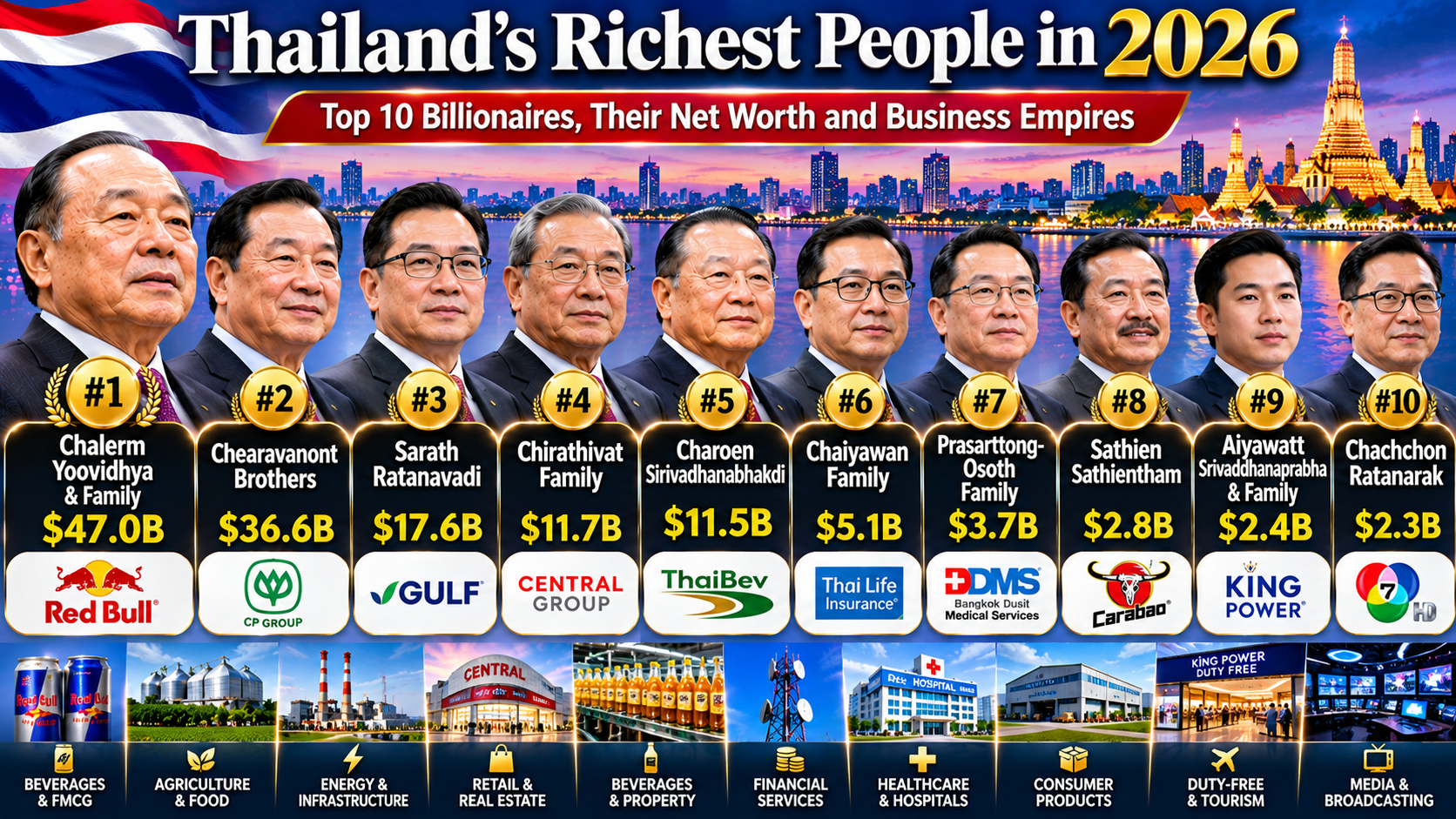
Thailand is home to some of Southeast Asia's most successful entrepreneurs, business families, and corporate leaders. Their fortunes have been built across industries including beverages, food production, telecommunications, energy, retail, real estate, healthcare, and manufacturing. Many of these business empires have expanded beyond Thailand, developing international operations and investments.
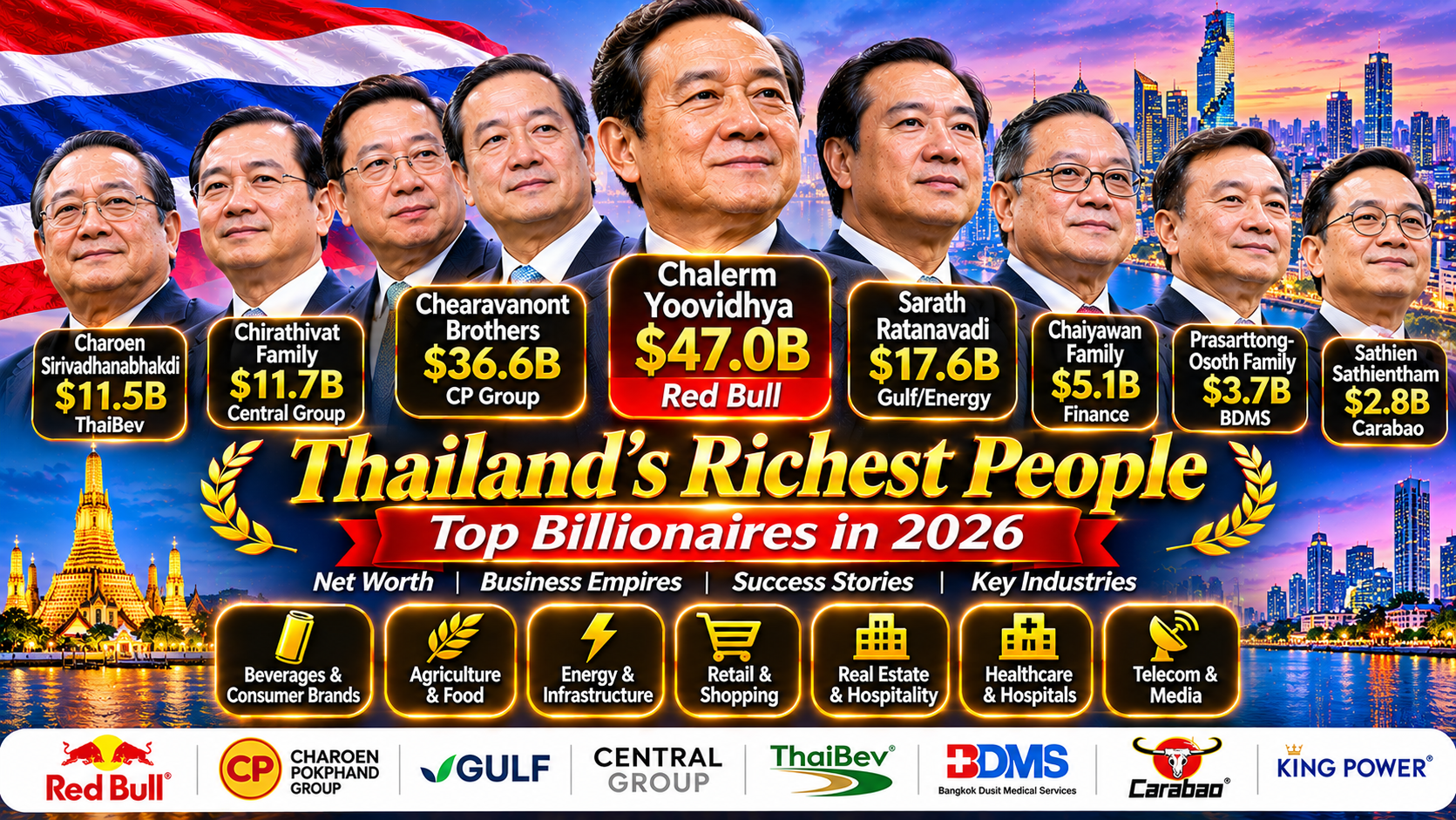
According to Forbes' 2026 ranking of Thailand's Richest, the combined wealth of the country's wealthiest tycoons reached approximately $187 billion, representing a 10% increase from the previous year's $170.5 billion. Chalerm Yoovidhya and his family retained the top position, supported by the global success of the Red Bull energy-drink business.
The 2026 ranking also highlights the growing importance of energy, digital infrastructure, retail, and AI-related investment. Sarath Ratanavadi recorded the largest increase in wealth in dollar terms, while industrial-estate developer Jareeporn Jarukornsakul benefited from growing demand for data centres.
This article explores Thailand's top 10 wealthiest individuals and families in 2026, their estimated fortunes, major businesses, and the industries behind their success.
Top 10 Richest People in Thailand in 2026
The following ranking is based on Forbes' 2026 Thailand's 50 Richest list, published in July 2026.
Rank | Person or family | Estimated net worth |
|---|---|---|
1 | Chalerm Yoovidhya and family | $47 billion |
2 | Chearavanont brothers | $36.6 billion |
3 | Sarath Ratanavadi | $17.6 billion |
4 | Chirathivat family | $11.7 billion |
5 | Charoen Sirivadhanabhakdi | $11.5 billion |
6 | Chaiyawan family | $5.1 billion |
7 | Prasarttong-Osoth family | $3.7 billion |
8 | Sathien Sathientham | $2.8 billion |
9 | Aiyawatt Srivaddhanaprabha and family | $2.4 billion |
10 | Chachchon Ratanarak | $2.3 billion |
Important: Forbes' Thailand rich list includes family fortunes and individuals with significant business, residential, or other ties to Thailand. These figures are estimates, not cash balances, and can change as company valuations and markets move.
1. Chalerm Yoovidhya and Family – $47 Billion
Chalerm Yoovidhya and his family rank first among Thailand's wealthiest business families in 2026, with an estimated fortune of $47 billion. Their wealth is closely connected to the international success of Red Bull, one of the world's most recognizable energy-drink brands.
The Red Bull story began in Thailand with an energy drink called Krating Daeng. The product was developed by Chaleo Yoovidhya, whose business partnership with Austrian entrepreneur Dietrich Mateschitz helped transform the drink into a global brand.
Red Bull became internationally famous through its distinctive marketing, sports sponsorships, and association with extreme sports, motorsports, and entertainment. Its presence in Formula One, football, music, and other sporting events helped establish a strong global identity.
The company reported 2025 revenue growth of more than 8%, reaching approximately €12.2 billion, with worldwide sales approaching 14 billion cans. This performance helped support the family's position at the top of Thailand's 2026 wealth ranking.
The Yoovidhya family's success demonstrates how a product developed in Thailand became a major international consumer brand.
Main source of wealth: Red Bull and beverage businesses
Industry: Food and beverages
2. Chearavanont Brothers – $36.6 Billion
The Chearavanont brothers hold second place with an estimated combined fortune of $36.6 billion. Their wealth is associated with Charoen Pokphand Group, commonly known as CP Group, one of Thailand's largest multinational business conglomerates.
CP Group began as a small agricultural business and gradually expanded into animal feed, food production, retail, telecommunications, and other industries. Its operations now reach markets across Asia and beyond.
The group's food business includes livestock, animal nutrition, food processing, and distribution. Its retail interests have also made it a major presence in Thailand's consumer economy.
Telecommunications and digital infrastructure have become increasingly important parts of the group's business strategy. Investments and transactions involving Thailand's telecom sector demonstrate how traditional conglomerates are adapting to a more connected economy.
The Chearavanont family's business model is based on diversification. Rather than depending on one product or market, CP Group operates across multiple sectors that serve consumers and businesses.
Main source of wealth: Charoen Pokphand Group
Industry: Agriculture, food, retail, telecommunications, and diversified investments
3. Sarath Ratanavadi – $17.6 Billion
Sarath Ratanavadi ranks third among Thailand's richest people in 2026, with an estimated fortune of $17.6 billion. He is best known for building a major business presence in the energy sector through Gulf Development.
His business interests have expanded beyond traditional electricity generation into infrastructure, telecommunications, and financial investments. This diversification has helped position him among Thailand's most influential business figures.
Energy remains an essential part of Thailand's economy. Electricity is required to support manufacturing, commercial buildings, transport, digital services, and households. Companies involved in power generation and infrastructure therefore play an important role in the country's development.
Sarath's growing interests in telecommunications and finance reflect a broader strategy of connecting energy infrastructure with other essential services. The expansion of digital businesses and data centres has also increased the importance of reliable electricity supplies.
Forbes identified Sarath as the largest dollar gainer on its 2026 Thailand rich list, with his estimated wealth increasing by $5.6 billion compared with the previous year.
Main source of wealth: Gulf Development and investments
Industry: Energy, infrastructure, telecommunications, and finance
4. Chirathivat Family – $11.7 Billion
The Chirathivat family ranks fourth with an estimated fortune of $11.7 billion. The family is widely associated with Central Group, a major retail and property business with a substantial presence in Thailand and international markets.
Central Group developed from a family retail business into a diversified enterprise operating department stores, shopping centres, hotels, and other consumer-facing businesses.
Its retail operations serve a wide range of customers, from everyday shoppers to luxury consumers. The group's shopping destinations and retail brands have become familiar parts of Thailand's commercial landscape.
The family has also expanded into international markets, particularly in Europe, where its investments include department-store and luxury retail businesses.
The Chirathivat family's wealth reflects the importance of consumer spending, tourism, shopping destinations, and commercial property. As Thailand attracts international visitors and domestic retail activity evolves, these sectors remain important to the country's economy.
Main source of wealth: Central Group
Industry: Retail, shopping centres, hospitality, and real estate
5. Charoen Sirivadhanabhakdi – $11.5 Billion
Charoen Sirivadhanabhakdi ranks fifth with an estimated fortune of $11.5 billion. He is a major Thai business figure whose wealth is connected to beverage production, property, and diversified investments.
His business empire includes interests associated with ThaiBev and Frasers Property. These companies operate in different sectors but contribute to a broad portfolio of consumer and real-estate businesses.
ThaiBev is known for its beverage operations, including alcoholic and non-alcoholic products. Its brands and distribution networks have established a significant presence in Thailand and several regional markets.
Real estate is another important part of Charoen's business interests. Frasers Property has operations involving commercial buildings, industrial and logistics facilities, and residential developments.
The combination of consumer products and property investments gives the business group exposure to different parts of the economy. Beverage businesses depend on consumer demand and distribution, while property companies are influenced by rents, asset values, and investment activity.
Main source of wealth: ThaiBev, Frasers Property, and investments
Industry: Beverages and real estate
6. Chaiyawan Family – $5.1 Billion
The Chaiyawan family ranks sixth in Forbes' 2026 Thailand rich list, with an estimated fortune of $5.1 billion.
The family is associated with Thai business interests in finance and insurance, particularly through companies connected with the country's financial services sector.
Financial services play an important role in Thailand's economy by providing insurance, investment products, lending, and other services to individuals and businesses. These activities can create substantial long-term business value when companies maintain strong customer networks and manage financial risks effectively.
The family's position among Thailand's richest reflects the importance of established financial businesses and the role of family ownership in the country's corporate landscape.
Main source of wealth: Financial services and investments
Industry: Finance and insurance
7. Prasarttong-Osoth Family – $3.7 Billion
The Prasarttong-Osoth family holds seventh place with an estimated fortune of $3.7 billion. The family's wealth is associated with Bangkok Dusit Medical Services, one of Thailand's major private healthcare groups.
The business was built by Dr. Prasert Prasarttong-Osoth, a physician and entrepreneur who helped develop a large network of private hospitals and healthcare facilities.
Bangkok Dusit Medical Services operates hospitals and related healthcare businesses. Thailand's private healthcare sector serves domestic patients as well as international visitors seeking medical treatment.
The country's reputation as a medical tourism destination has supported demand for private hospitals, specialist treatment, and healthcare services. Hospital groups also invest in medical equipment, technology, professional staff, and facilities to serve increasingly complex healthcare needs.
Following Dr. Prasert's death, Forbes listed the family's fortune under the Prasarttong-Osoth family in 2026.
Main source of wealth: Bangkok Dusit Medical Services
Industry: Healthcare and hospitals
8. Sathien Sathientham – $2.8 Billion
Sathien Sathientham ranks eighth with an estimated fortune of $2.8 billion. He is best known as the founder of Carabao Group, a Thai beverage company recognized for its energy-drink products.
Carabao has built its brand around energy drinks and has pursued growth in both domestic and international markets. Its products compete in a consumer category where distribution, pricing, brand recognition, and marketing are important.
The company has used sports sponsorships and international marketing to increase brand visibility. Its involvement in football sponsorships has helped introduce the Carabao name to audiences beyond Thailand.
The beverage industry is highly competitive, with companies seeking to develop new products and expand distribution networks. Carabao's growth illustrates how a Thai consumer brand can build an international presence.
Main source of wealth: Carabao Group
Industry: Beverages and consumer products
9. Aiyawatt Srivaddhanaprabha and Family – $2.4 Billion
Aiyawatt Srivaddhanaprabha and his family rank ninth with an estimated fortune of $2.4 billion.
The family is associated with King Power, a major duty-free retail business in Thailand. The company became well known through its airport retail operations, serving international travellers and tourists.
Duty-free retail offers products such as cosmetics, fragrances, fashion accessories, electronics, and luxury goods. Its performance is closely connected to international passenger traffic, tourism, and consumer spending.
Aiyawatt is also widely recognized for his involvement in football through Leicester City Football Club in England. The club attracted international attention after winning the Premier League title in the 2015–16 season.
The family's business interests demonstrate the connection between tourism, international retail, sports, and global brand recognition.
Main source of wealth: King Power and investments
Industry: Duty-free retail, tourism, and sports-related investments
10. Chachchon Ratanarak – $2.3 Billion
Chachchon Ratanarak ranks tenth in Thailand's 2026 rich list, with an estimated fortune of $2.3 billion.
His wealth is associated with the Ratanarak family's business interests, including media and broadcasting. The family has long been connected with Bangkok Broadcasting and Television, which operates Channel 7 in Thailand.
Television and media businesses have historically played an important role in Thailand's entertainment and advertising markets. Broadcasting companies generate revenue through advertising, content partnerships, and other commercial activities.
The Ratanarak family's appearance in the 2026 ranking also reflects a generational transition. Forbes reported that wealth previously associated with media businessman Krit Ratanarak passed to his son Chachchon following his death.
Main source of wealth: Family business interests and media
Industry: Broadcasting, media, and investments
Industries That Create Thailand's Billionaire Wealth
Thailand's wealthiest business figures have built their fortunes across several major industries. The 2026 ranking offers a useful picture of the sectors that continue to shape the country's corporate economy.
1. Food and Beverage Businesses
Food and beverages remain among Thailand's most important wealth-generating industries. Red Bull, Carabao, ThaiBev, and CP Group demonstrate the scale that consumer brands and food businesses can achieve.
Successful companies in this sector benefit from strong distribution networks, recognizable brands, international expansion, and changing consumer demand.
2. Energy and Infrastructure
Energy is another major source of wealth. Sarath Ratanavadi's position illustrates the financial importance of power generation, infrastructure development, and related investments.
As Thailand develops its digital economy, electricity demand from industrial facilities and data centres may create additional opportunities for energy companies.
3. Retail and Real Estate
The Chirathivat and Charoen families have major business interests in retail and property. Shopping centres, hotels, commercial buildings, and logistics facilities form an important part of Thailand's modern economy.
Tourism and consumer spending can influence these businesses, while international investment can create additional opportunities.
4. Telecommunications and Digital Infrastructure
Thailand's large conglomerates have increasingly expanded into telecommunications and digital services. Reliable connectivity and infrastructure are essential for businesses, consumers, and technology companies.
The growing demand for cloud computing and artificial intelligence is also creating opportunities in data centres, industrial estates, and electricity supply.
5. Healthcare
Private healthcare is another important business sector. Thailand attracts patients from other countries, and its hospital groups have invested in facilities, specialist services, and medical technology.
The Prasarttong-Osoth family's position highlights the scale of private healthcare businesses in the country.
How Thailand's Richest People Built Their Fortunes
The wealthiest people in Thailand have followed different business paths, but several common themes appear across their success stories.
Building businesses over generations: Several of Thailand's largest fortunes are connected to family-owned enterprises. These businesses often expand over decades, with later generations developing new markets and investments.
Expanding internationally: Red Bull, CP Group, Central Group, and other major companies have established operations or commercial relationships outside Thailand. International expansion can increase customer reach and diversify revenue.
Investing across industries: Many wealthy Thai entrepreneurs have built diversified portfolios. A business group may operate in food, retail, energy, property, and finance rather than relying on one industry.
Recognizing changing demand: Companies that respond to changing consumer habits, technology, tourism, and infrastructure needs can create new opportunities for growth.
Using strong brands and distribution: Consumer businesses such as Red Bull and Carabao demonstrate the importance of marketing, product recognition, and distribution networks.
Thailand's Economic Outlook and the Future of Billionaire Wealth
Thailand's richest business families operate in an economy shaped by tourism, manufacturing, exports, consumer spending, and investment. The country's established industries remain important, but new technology-related opportunities are attracting attention.
The 2026 Forbes ranking showed that the combined wealth of Thailand's 50 richest increased to $187 billion. A stronger stock market contributed to the rise, while energy, telecommunications, retail, and industrial investment also influenced individual fortunes.
Artificial intelligence is becoming an important theme. Data centres require suitable land, reliable electricity, connectivity, and supporting infrastructure. Companies involved in industrial estates and power generation may benefit as international technology firms consider new locations for digital infrastructure.
Jareeporn Jarukornsakul, co-founder and group CEO of WHA Corporation, was one of the notable gainers in the 2026 list. Her estimated fortune increased 69% to $1.25 billion, with demand for AI data-centre investment contributing to the company's growth prospects.
However, Thailand's business environment also faces challenges. Economic growth, household purchasing power, competition, interest rates, tourism trends, and global market conditions can affect company performance and asset values.
For the country's wealthiest families, maintaining long-term growth will depend on adapting to these changes while managing established businesses.
Frequently Asked Questions About Thailand's Richest People
Who is the richest person in Thailand in 2026?
According to Forbes' 2026 Thailand's 50 Richest ranking, Chalerm Yoovidhya and his family are the wealthiest, with an estimated fortune of $47 billion.
What is Chalerm Yoovidhya's net worth?
Forbes estimated Chalerm Yoovidhya and his family's combined wealth at approximately $47 billion in its July 2026 Thailand rich list.
Who is the second-richest person or family in Thailand?
The Chearavanont brothers rank second, with an estimated combined fortune of $36.6 billion, primarily associated with Charoen Pokphand Group.
How much are Thailand's 50 richest people worth collectively?
Forbes reported that the combined wealth of Thailand's 50 richest reached approximately $187 billion in 2026, up 10% from the previous year.
Who is the richest woman in Thailand?
Jareeporn Jarukornsakul is a prominent Thai businesswoman and one of the notable female billionaires on the 2026 list. Forbes estimated her fortune at $1.25 billion. However, the top 10 ranking above is based on the broader family-inclusive list, not a separate ranking of women.
Which industries produce the most billionaires in Thailand?
Major sources of wealth include beverages, food production, energy, telecommunications, retail, real estate, healthcare, and diversified investments.
Are the net worth figures exact?
No. Billionaire net worth figures are estimates based on available financial information, shareholdings, company valuations, and other assets. They can change as market prices and business valuations change.
Conclusion
Thailand's richest people in 2026 represent a wide range of industries, from internationally recognized beverage brands to energy companies, retail groups, telecommunications businesses, and private healthcare networks.
Chalerm Yoovidhya and his family lead the Forbes ranking with an estimated $47 billion, followed by the Chearavanont brothers and energy entrepreneur Sarath Ratanavadi. Their fortunes demonstrate the importance of global brands, diversified investments, infrastructure, and long-term business development.
The country's wealth landscape is also evolving. AI data centres, digital infrastructure, renewable energy, and international investment are creating new opportunities alongside traditional industries.
As Thailand's economy develops, its wealthiest entrepreneurs and families will continue to play an important role in shaping the country's business environment and international presence.