The Philippines has become home to some of Southeast Asia's most successful entrepreneurs, business families, investors, and industrial leaders. From international port operators and property developers to banking executives, retail entrepreneurs, and technology investors, the country's wealthiest individuals have built businesses that influence major industries both locally and internationally.
In 2026, the Philippine billionaire landscape experienced significant changes. Some established business families saw their fortunes decline, while other entrepreneurs benefited from expanding international operations, strong company performance, and rising stock valuations.
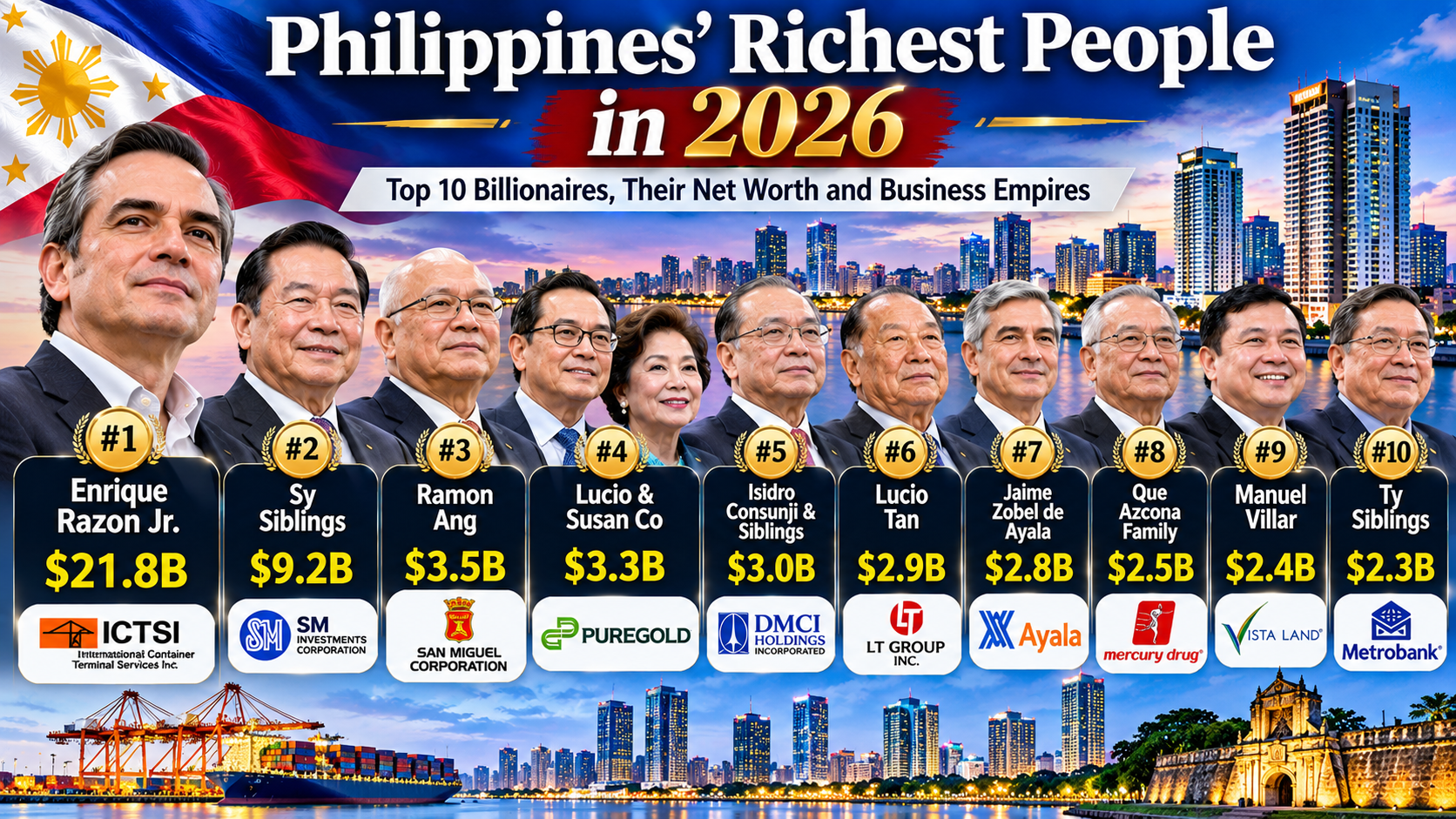
According to Forbes' August 2026 ranking of the Philippines' 50 Richest, Enrique Razon Jr. became the country's richest person for the first time, with an estimated net worth of $21.8 billion. His fortune increased substantially because of the international expansion and strong stock-market performance of International Container Terminal Services Inc. (ICTSI).
The Sy siblings, heirs to the business empire established by the late Henry Sy Sr., ranked second with a combined estimated fortune of $9.2 billion. Ramon Ang, the chairman of San Miguel Corporation, occupied third place with approximately $3.5 billion.
The collective wealth of the Philippines' 50 richest individuals and families declined by 8% in 2026, reaching approximately $79 billion compared with $86 billion in 2025. Economic uncertainty, inflation, currency depreciation, and weaker stock prices contributed to the decline.
Despite these challenges, the Philippines continues to produce successful business leaders across multiple industries. Their stories demonstrate the importance of entrepreneurship, strategic investment, international expansion, and long-term business development.
This article explores the Philippines' richest people in 2026, their estimated net worth, major companies, business achievements, and the industries behind their wealth.
Top 10 Richest People in the Philippines in 2026
According to Forbes' August 2026 annual ranking, the top 10 wealthiest individuals and families are:
Rank | Name | Estimated Net Worth |
|---|---|---|
1 | Enrique Razon Jr. | $21.8 billion |
2 | Sy Siblings | $9.2 billion |
3 | Ramon Ang | $3.5 billion |
4 | Lucio and Susan Co | $3.3 billion |
5 | Isidro Consunji and Siblings | $3 billion |
6 | Lucio Tan | $2.9 billion |
7 | Jaime Zobel de Ayala | $2.8 billion |
8 | Que Azcona Family | $2.5 billion |
9 | Manuel Villar | $2.4 billion |
10 | Ty Siblings | $2.3 billion |
Net worth figures are estimates in US dollars. Family fortunes are combined where applicable.
1. Enrique Razon Jr. – The Richest Person in the Philippines
Estimated Net Worth: $21.8 Billion
Main Source of Wealth: Ports, Infrastructure, Casinos, and Investments
Enrique Razon Jr. became the richest person in the Philippines in 2026, according to Forbes' annual ranking. He is a prominent businessman and the chairman and president of International Container Terminal Services Inc. (ICTSI), one of the world's leading independent port operators.
Razon's success is closely connected to international shipping, logistics, and infrastructure development. Ports play an essential role in global trade because they allow businesses to transport products, raw materials, machinery, and consumer goods between countries.
ICTSI operates container terminals across multiple international markets, providing services to shipping companies, importers, exporters, and logistics businesses.
The company has expanded its operations beyond the Philippines through investments and partnerships in different regions. Its international growth has helped strengthen its position in the global port-management industry.
In 2026, Razon's wealth increased dramatically as ICTSI shares more than doubled over the preceding year. The company's strong financial performance also supported the increase. Its 2025 net profit rose 23% to approximately $1.1 billion, while revenue increased 18% to $3.2 billion.
The company announced major expansion plans, including investments in South Africa and Brazil, alongside infrastructure improvements in the Philippines.
Razon also has business interests beyond port operations. These include casinos, energy, mining, and infrastructure investments through companies associated with his business group.
His success demonstrates how global trade and infrastructure investments can generate enormous wealth.
With an estimated fortune of $21.8 billion, Enrique Razon Jr. secured the number-one position in the Philippines' 2026 rich list for the first time.
2. The Sy Siblings – Owners of the SM Business Empire
Combined Estimated Net Worth: $9.2 Billion
Main Source of Wealth: Retail, Real Estate, and Banking
The Sy siblings are among the Philippines' most influential business families. They inherited significant business interests from their father, Henry Sy Sr., who established the SM business empire.
Henry Sy Sr. started his entrepreneurial journey with a small footwear business before expanding into retail and property development. Over several decades, he built one of the Philippines' most recognizable commercial groups.
Today, the SM Group has interests in shopping malls, retail operations, property development, banking, and other investments.
SM Investments Corporation serves as the group's major holding company, while SM Prime Holdings is one of the country's largest property developers and shopping mall operators.
The group's shopping malls have become important commercial destinations across the Philippines, providing retail stores, restaurants, entertainment facilities, and other services.
The Sy family's wealth is also connected to its interests in financial services through BDO Unibank, one of the country's major banking institutions.
However, the family's estimated fortune declined in 2026. Forbes reported a combined net worth of approximately $9.2 billion, down $2.6 billion from the previous year.
Weakness in the residential property market and a decline in SM Prime Holdings' share price contributed to the reduction.
Despite the decline, the Sy siblings remain one of the Philippines' wealthiest families.
Their story demonstrates how a small retail business can grow into a diversified corporate empire through strategic investment, customer relationships, and long-term expansion.
3. Ramon Ang – Chairman of San Miguel Corporation
Estimated Net Worth: $3.5 Billion
Main Source of Wealth: Food, Beverage, Energy, and Infrastructure
Ramon Ang is one of the Philippines' best-known business executives and the chairman and chief executive officer of San Miguel Corporation.
San Miguel is one of the country's oldest and largest conglomerates, with business interests across several industries.
The company initially became widely recognized through its food and beverage operations. Over time, it expanded into infrastructure, energy, fuel, packaging, and other industrial businesses.
San Miguel's diversified operations have made it an important participant in the Philippine economy.
Its food and beverage business includes well-known consumer products, while its energy and infrastructure investments support industrial activity and economic development.
Ramon Ang has played a significant role in expanding the company's business activities and pursuing major infrastructure projects.
His business interests include energy facilities, transportation infrastructure, and other large-scale developments.
In Forbes' 2026 ranking, Ang held third place with an estimated net worth of $3.5 billion.
His fortune declined slightly compared with the previous year, partly because investors expressed concerns about San Miguel's debt levels and company valuation.
Nevertheless, he remains one of the country's most influential industrial business leaders.
His career demonstrates the opportunities available through diversified business operations and investment in essential industries.
4. Lucio and Susan Co – Founders of Puregold
Combined Estimated Net Worth: $3.3 Billion
Main Source of Wealth: Retail and Supermarkets
Lucio and Susan Co are among the Philippines' most successful retail entrepreneurs.
They are best known as the founders of Puregold Price Club, one of the country's major supermarket and hypermarket chains.
Puregold operates retail stores that offer groceries, household products, personal care items, and other consumer goods.
The company's business model focuses on serving Filipino households, retailers, and small businesses through competitive pricing and extensive product availability.
The retail industry is important to the Philippine economy because it connects manufacturers, suppliers, distributors, and consumers.
Puregold has expanded its operations across the country, increasing its presence in both urban and developing communities.
The company has also invested in digital services and retail improvements to respond to changing customer preferences.
Lucio and Susan Co have benefited from the expansion of the supermarket business and the increasing demand for organized retail services.
Forbes estimated their combined fortune at approximately $3.3 billion in 2026, placing them fourth in the country's rich list.
Their achievement demonstrates how understanding consumer demand and building efficient retail networks can create substantial long-term business wealth.
5. Isidro Consunji and Siblings – Leaders of the DMCI Business Group
Combined Estimated Net Worth: $3 Billion
Main Source of Wealth: Construction, Mining, Energy, and Real Estate
Isidro Consunji and his siblings are associated with DMCI Holdings, a diversified Philippine business group with interests in construction, engineering, mining, power generation, and property development.
DMCI's history is connected to the construction industry, where it developed a reputation for delivering large engineering and infrastructure projects.
Over time, the company expanded into additional industries, creating a diversified business portfolio.
Its construction operations participate in major building and infrastructure projects, while its mining activities involve natural resources and industrial materials.
The group also has interests in energy production and property development.
These sectors are closely connected to the Philippines' economic development because they support transportation, housing, industrial production, and electricity supply.
Isidro Consunji has been an important figure in the family's business operations and corporate leadership.
According to Forbes' 2026 ranking, the Consunji family held fifth place with a combined estimated fortune of $3 billion.
Their business success illustrates the importance of industrial expertise, infrastructure investment, and diversification.
6. Lucio Tan – A Business Empire Across Multiple Industries
Estimated Net Worth: $2.9 Billion
Main Source of Wealth: Tobacco, Banking, Airlines, and Beverages
Lucio Tan is one of the Philippines' most recognizable business tycoons.
He built a diversified business empire with interests in tobacco, banking, airlines, beverages, real estate, and other industries.
Tan's business journey began with industrial and manufacturing activities before expanding into several major commercial sectors.
He is associated with LT Group, a holding company with investments in different industries.
One of the group's important businesses is Philippine National Bank, which provides financial services to individual and corporate customers.
Tan is also associated with Philippine Airlines, the country's flag carrier, which operates domestic and international flights.
Other business interests include beverage manufacturing and tobacco-related operations.
The diversification of his business interests has helped establish his position among the country's wealthiest entrepreneurs.
In Forbes' 2026 ranking, Lucio Tan held sixth place with an estimated fortune of $2.9 billion.
His business career demonstrates how diversification and long-term ownership can create significant wealth across multiple sectors.
7. Jaime Zobel de Ayala – Leader of the Ayala Business Family
Estimated Net Worth: $2.8 Billion
Main Source of Wealth: Real Estate, Banking, Telecommunications, and Infrastructure
Jaime Zobel de Ayala is one of the most prominent figures in the Philippines' corporate history.
He is associated with the Ayala Group, one of the country's oldest and most diversified business conglomerates.
The Ayala business group has interests in property development, banking, telecommunications, infrastructure, healthcare, and renewable energy.
Ayala Corporation serves as the group's principal holding company and has played an important role in the country's economic development.
Ayala Land is a major property developer responsible for residential communities, commercial buildings, shopping centers, and mixed-use developments.
The group also has interests in banking through Bank of the Philippine Islands (BPI), one of the country's established financial institutions.
Its telecommunications and infrastructure investments have contributed to the expansion of essential services.
Jaime Zobel de Ayala has played an important role in developing the group's corporate strategy and international business relationships.
Forbes estimated his fortune at approximately $2.8 billion in 2026.
His position among the Philippines' wealthiest people reflects the long-term value of diversified corporate investments.
8. The Que Azcona Family – Owners of Mercury Drug
Combined Estimated Net Worth: $2.5 Billion
Main Source of Wealth: Pharmaceutical Retail
The Que Azcona family is associated with Mercury Drug, one of the Philippines' most recognizable pharmacy chains.
Mercury Drug was established by Mariano Que and developed into a major retail pharmacy business serving customers across the country.
The company provides prescription medicines, over-the-counter products, health-related items, and personal care products.
Healthcare retail plays an important role in the Philippines because pharmacies help connect patients with essential medicines and healthcare supplies.
Mercury Drug has built an extensive store network and strong brand recognition over several decades.
Its business success is closely connected to consumer trust, product availability, and nationwide distribution.
The Que Azcona family's wealth reflects the value of establishing a successful retail business in an essential industry.
Forbes placed the family eighth in its 2026 ranking with an estimated combined fortune of $2.5 billion.
Their story demonstrates how a business focused on everyday healthcare needs can develop into a major national enterprise.
9. Manuel Villar – Real Estate and Property Development Magnate
Estimated Net Worth: $2.4 Billion
Main Source of Wealth: Real Estate and Property Development
Manuel Villar is a well-known Filipino businessman associated with large-scale property development.
He built his fortune through real estate businesses serving residential and commercial property markets.
His business interests include property development companies associated with the Villar Group.
These companies have developed residential communities, housing projects, commercial properties, and other real estate assets.
The Philippines has a large population and growing demand for housing, making residential property an important industry.
Villar's business model has focused on developing properties for different market segments, including middle-income households.
His business career also includes a period in public service, during which he held senior political positions in the Philippines.
In 2026, his estimated fortune declined significantly to approximately $2.4 billion.
Forbes reported that the decline was connected to the sharp fall in shares of Villar Land Holdings following concerns about the valuation of certain land assets and the company's financial reporting.
Despite the reduction, Villar remained among the Philippines' ten wealthiest individuals.
His career demonstrates the scale of opportunities in property development as well as the risks associated with real estate valuations and corporate financial performance.
10. The Ty Siblings – Wealth from Banking and Financial Services
Combined Estimated Net Worth: $2.3 Billion
Main Source of Wealth: Banking and Investments
The Ty siblings are associated with the Gokongwei-related banking and financial business landscape? No. The Ty family's wealth is primarily connected to the Metrobank group established by George S.K. Ty.
The Ty family has built a significant presence in Philippine banking and financial services through Metropolitan Bank & Trust Company, commonly known as Metrobank.
Metrobank is one of the country's major financial institutions and provides personal banking, corporate banking, lending, investment, and other financial services.
The banking industry plays a major role in supporting economic growth by providing loans, managing deposits, facilitating payments, and helping businesses access capital.
The Ty family's business interests have expanded beyond banking into other commercial activities and investments.
Their position in the 2026 Forbes ranking reflects the long-term importance of financial services in the Philippine economy.
Forbes estimated the Ty siblings' combined fortune at approximately $2.3 billion, placing them tenth.
Their business history illustrates how banking institutions can create substantial long-term value through financial services, investment management, and regional expansion.
Other Notable Wealthy Filipino Entrepreneurs
Beyond the top ten, the Philippines has many other successful business leaders who have built substantial fortunes.
Robert Coyiuto Jr.
Robert Coyiuto Jr. is a businessman with investments in insurance, energy, and infrastructure-related companies.
His fortune increased substantially in 2026, with Forbes reporting an estimated net worth of $925 million.
He was one of the biggest percentage gainers on the Philippines' rich list.
Jose Ma. Concepcion III
Jose Ma. Concepcion III is associated with RFM Corporation, a major Philippine food and beverage company.
His business interests include consumer food products and manufacturing.
He returned to the Forbes rich list in 2026 with an estimated fortune of approximately $200 million.
Eusebio Tanco
Eusebio Tanco is associated with DigiPlus Interactive, a company involved in online gaming and digital entertainment.
The company's expansion into digital platforms has contributed to its business growth.
His story reflects the emergence of technology-driven entertainment businesses in the Philippines.
How the Philippines' Wealthiest People Built Their Fortunes
The success of the Philippines' richest people is connected to several major industries.
1. Real Estate and Property Development
Real estate has been one of the most important sources of wealth in the Philippines.
Property developers have benefited from urban expansion, population growth, residential demand, commercial development, and infrastructure investment.
Companies associated with the Sy family, Ayala family, and Manuel Villar have built significant property portfolios.
The country's growing cities continue to create opportunities for residential communities, shopping centers, offices, and mixed-use developments.
2. Retail and Consumer Goods
Retail businesses serve millions of Filipino consumers and remain essential to the national economy.
Companies such as SM and Puregold have developed large retail networks.
Their success is connected to customer demand, distribution systems, purchasing power, and brand recognition.
3. Ports and International Trade
International shipping and logistics are essential to the Philippine economy.
The country depends on maritime transportation for imports, exports, and domestic trade between islands.
Enrique Razon's ICTSI demonstrates how port operations can create enormous business opportunities through international expansion.
4. Banking and Financial Services
Financial institutions support businesses and households by providing banking, insurance, credit, and investment services.
Major banking families have accumulated significant wealth through ownership and long-term participation in the financial industry.
5. Energy and Infrastructure
Economic development requires reliable electricity, transportation networks, industrial facilities, and other infrastructure.
Companies operating in energy and construction can benefit from long-term demand for these essential services.
Business leaders associated with San Miguel and DMCI have developed significant interests in these industries.
The Philippine Economy and Billionaire Wealth in 2026
The Philippines experienced a challenging economic environment in 2026.
According to Forbes' August 2026 coverage, economic growth reached 2.8% in the first quarter, the lowest quarterly growth rate since the pandemic.
Inflation, energy-related pressures, and a weaker Philippine peso contributed to economic uncertainty.
The combined wealth of the country's 50 richest individuals and families declined from $86 billion in 2025 to $79 billion in 2026.
Only 14 members of the ranking were wealthier than the previous year, while 33 experienced declines.
However, some entrepreneurs benefited from company expansion and stronger stock performance.
Enrique Razon Jr. was the largest gainer in dollar terms, adding approximately $10.3 billion to his fortune.
These developments demonstrate that billionaire wealth can change significantly because of stock prices, currency movements, corporate performance, and international economic conditions.
Challenges Facing the Philippines' Richest Business Leaders
Although the country's wealthiest entrepreneurs control major businesses, they also face significant challenges.
Economic Uncertainty
Inflation, interest rates, and changes in consumer spending can influence business performance.
Companies must adjust their operations to maintain profitability during uncertain economic conditions.
Currency Fluctuations
A weaker Philippine peso can reduce the value of locally denominated assets when converted into US dollars.
This is particularly important when international wealth rankings calculate fortunes in US currency.
International Competition
Businesses in retail, banking, property, and technology must compete with international companies.
Maintaining market share requires innovation, investment, and effective business management.
Infrastructure and Energy Costs
Industrial companies depend on reliable electricity, transportation, and logistics.
Higher operating costs can affect profit margins and long-term investment plans.
Financial Market Volatility
Many wealthy individuals hold significant ownership stakes in publicly traded companies.
Changes in stock prices can quickly influence their estimated net worth.
What Is the Future of the Philippines' Billionaire Economy?
The Philippines has opportunities to develop new business leaders across several industries.
Technology, digital finance, renewable energy, healthcare, logistics, manufacturing, and real estate may contribute to future wealth creation.
The country's young population and growing digital economy provide opportunities for entrepreneurs to develop new products and services.
Infrastructure investment could also support long-term business growth by improving transportation, energy supply, and international trade.
Retail and consumer businesses may continue expanding as customer demand evolves.
Meanwhile, established family businesses will likely remain important participants in the national economy.
Entrepreneurs who successfully combine innovation, financial discipline, and international expansion may become part of the Philippines' next generation of wealthy business leaders.
Conclusion
The Philippines' richest people in 2026 represent a diverse group of entrepreneurs, business families, investors, and industrial leaders.
Enrique Razon Jr. leads the Forbes ranking with an estimated fortune of $21.8 billion, followed by the Sy siblings with $9.2 billion and Ramon Ang with $3.5 billion.
Their businesses operate across ports, retail, real estate, banking, energy, construction, healthcare retail, and consumer products.
Although the collective wealth of the Philippines' 50 richest declined in 2026, the country's leading entrepreneurs continue to influence important industries and international markets.
Their achievements demonstrate the importance of long-term investment, strategic expansion, innovation, and business leadership.
As the Philippine economy continues to develop, emerging industries and established corporations will create new opportunities for entrepreneurs and investors.
The story of the Philippines' wealthiest people is ultimately a story of business growth, economic change, and the development of companies that help shape the country's future.