Philippines richest has developed a diverse group of wealthy entrepreneurs, business families, investors, property developers, industrialists, and consumer-business owners. Their fortunes are connected to some of the country's largest sectors, including ports, infrastructure, real estate, retail, banking, food and beverages, telecommunications, aviation, manufacturing, and consumer products.
The latest Forbes Philippines 50 Richest 2026 list provides a snapshot of this wealth landscape. Forbes reported that the combined net worth of the country's 50 richest people and families declined 8% to approximately US$79 billion, compared with US$86 billion the previous year. Enrique Razon Jr. moved into first place for the first time, with an estimated fortune of US$21.8 billion at the list's valuation date.
The list also demonstrates the importance of family businesses in the Philippines. Forbes' methodology includes family fortunes, including wealth shared among extended families, making the Philippine ranking different from an individual-only billionaire ranking. The 2026 figures were calculated using stock prices and exchange rates as of the close of markets on July 17, 2026.
Who Are the Philippines’ Richest People?
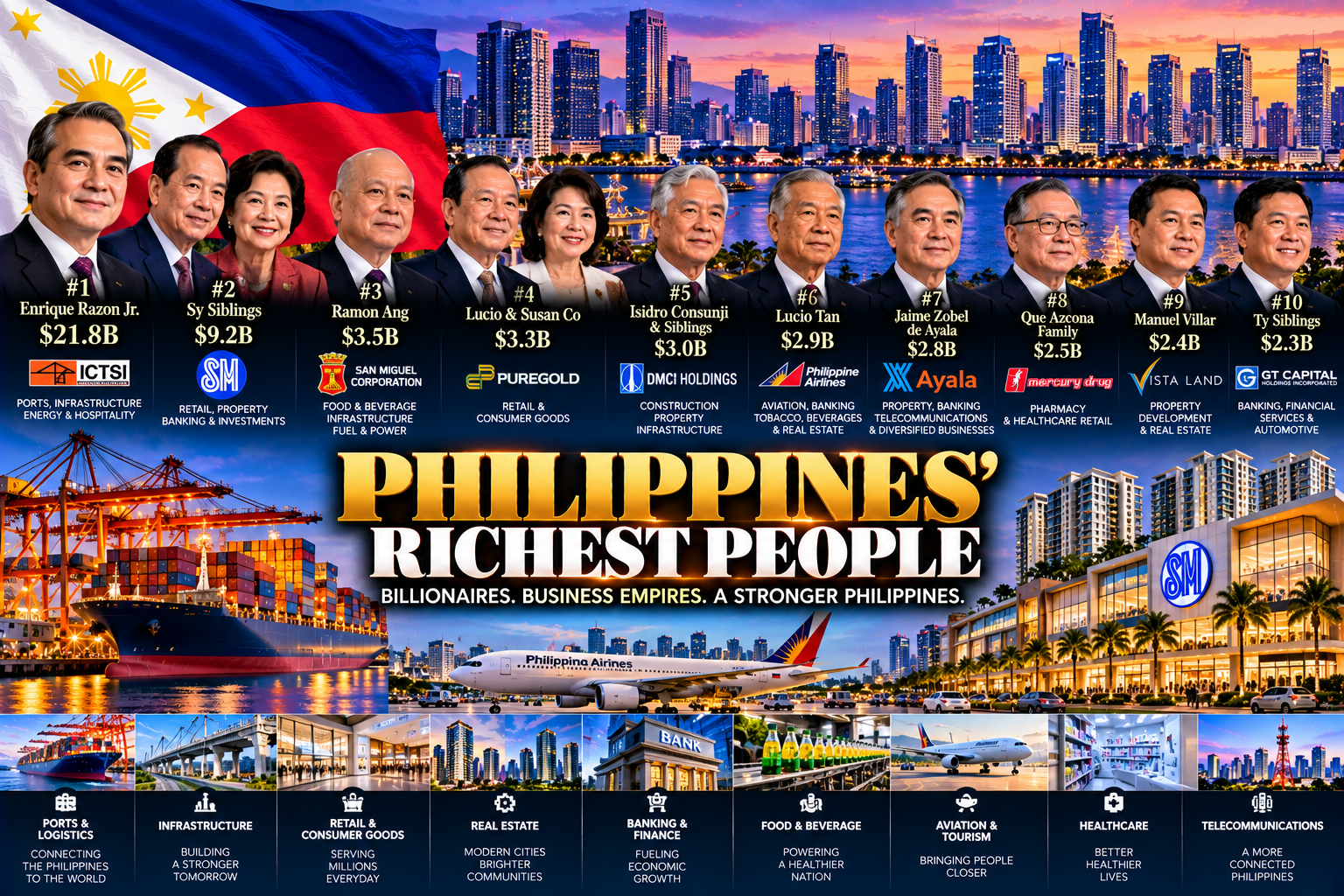
According to Forbes' 2026 Philippines 50 Richest list, the leading names include:
Enrique Razon Jr. — US$21.8 billion
Sy siblings — US$9.2 billion
Ramon Ang — US$3.5 billion
Lucio and Susan Co — US$3.3 billion
Isidro Consunji and siblings — US$3 billion
Lucio Tan — US$2.9 billion
Jaime Zobel de Ayala — US$2.8 billion
Que Azcona family — US$2.5 billion
Manuel Villar — US$2.4 billion
Ty siblings — US$2.3 billion
These figures represent Forbes' 2026 valuation methodology and can change as stock prices, exchange rates, and private-company valuations move.
1. Enrique Razon Jr.: Ports, Infrastructure, and Hospitality
Enrique Razon Jr. became the Philippines' richest person on the 2026 Forbes list, with an estimated fortune of US$21.8 billion.
Razon is chairman of International Container Terminal Services Inc. (ICTSI), the Philippines' largest ports operator by revenue. The company has expanded beyond the Philippines into markets across the Asia-Pacific, Eastern Europe, Africa, and the Americas.
The business has its roots in a port operation established by Razon's grandfather in Manila in 1916. Razon subsequently expanded the company internationally.
His business interests also include hospitality through Bloomberry Resorts, which operates Solaire resorts and casinos. Forbes has also reported growing infrastructure and energy investments, including interests connected to Manila Water and the Malampaya gas field.
Razon's rise to the top of the Philippine wealth list demonstrates the importance of infrastructure and international expansion in creating large business fortunes.
2. Sy Siblings: Retail and Real Estate
The Sy siblings rank second on Forbes' 2026 Philippines list, with a combined fortune of approximately US$9.2 billion.
The family fortune is connected to the business empire founded by the late Henry Sy Sr., whose enterprises helped create one of the Philippines' largest retail and property groups.
The family's business interests include SM Investments, with major exposure to retail, banking, and property.
Real estate is particularly important through SM Prime Holdings, which operates shopping malls, residential developments, commercial properties, and other real estate assets.
The Sy family's position illustrates the role of multigenerational businesses in the Philippine economy.
3. Ramon Ang: San Miguel and Diversified Business
Ramon Ang ranks third with an estimated fortune of approximately US$3.5 billion.
Ang is chairman and CEO of San Miguel Corporation, one of the Philippines' largest diversified companies.
San Miguel's business interests extend well beyond its famous food and beverage operations. The company has interests in infrastructure, power, fuel, packaging, and other industries.
Forbes reported that investor concerns over San Miguel's debt contributed to a decline in the company's share price during the year covered by the 2026 list.
Ang's career highlights how diversification can transform a traditional consumer company into a much broader industrial group.
4. Lucio and Susan Co: Retail and Consumer Businesses
Lucio and Susan Co entered the top five in 2026 with a combined fortune of approximately US$3.3 billion.
The couple is associated with Puregold Price Club, one of the Philippines' major supermarket and retail businesses.
The company's operations serve millions of consumers through supermarkets and related retail formats.
Their rise demonstrates the scale that can be achieved through consumer-focused businesses in a large and growing domestic market.
Retail wealth is particularly sensitive to consumer spending, inflation, food prices, competition, and changes in purchasing habits.
5. Isidro Consunji and Siblings: Property and Construction
Isidro Consunji and his siblings rank fifth with an estimated family fortune of around US$3 billion.
Their wealth is associated with DMCI Holdings, a diversified company involved in construction, property development, infrastructure, power, and related businesses.
Construction and property development are important parts of the Philippine economy because of continued urbanization and infrastructure requirements.
The Consunji family's business interests demonstrate how construction companies can evolve into diversified conglomerates.
6. Lucio Tan: Aviation, Banking, Tobacco, and Real Estate
Lucio Tan ranks sixth on Forbes' 2026 Philippines list with an estimated fortune of US$2.9 billion.
His business interests span several major industries, including aviation, banking, breweries, spirits, tobacco, and real estate.
One of the family's most visible businesses is Philippine Airlines.
In 2026, Philippine Airlines announced plans to acquire up to 34 new aircraft from Airbus and Boeing, with an estimated combined list price exceeding US$12 billion. The airline was also expanding its fleet following a period of financial restructuring.
Tan's diversified holdings demonstrate how a business empire can span consumer products, financial services, transportation, and property.
7. Jaime Zobel de Ayala: Ayala Business Legacy
Jaime Zobel de Ayala ranks seventh with approximately US$2.8 billion.
The Zobel de Ayala family is closely associated with Ayala Corporation, one of the Philippines' oldest and most diversified business groups.
The broader Ayala business ecosystem has interests across property development, banking, telecommunications, healthcare, infrastructure, and other sectors.
The family's wealth illustrates the importance of long-established business groups in the Philippine economy.
8. Que Azcona Family: Pharmacy and Consumer Retail
The Que Azcona family ranks eighth with approximately US$2.5 billion.
The family's fortune is associated with Mercury Drug, one of the Philippines' best-known pharmacy and healthcare retail businesses.
The company has developed a large nationwide presence serving consumers through pharmacies and health-related retail services.
Healthcare retail represents an important segment of the Philippine consumer economy, connecting business growth with everyday demand for medicines and health products.
9. Manuel Villar: Property Development and Retail
Manuel Villar ranks ninth with an estimated fortune of approximately US$2.4 billion.
Villar built his wealth primarily through property development and related businesses.
His business interests are connected with residential real estate, commercial developments, retail, and infrastructure.
Property remains an important source of wealth in the Philippines, particularly as cities expand and demand grows for housing, shopping centers, offices, and mixed-use developments.
Villar's career also demonstrates how entrepreneurs can build large fortunes by combining real estate development with consumer-facing businesses.
10. Ty Siblings: Banking and Financial Services
The Ty siblings rank tenth on Forbes' 2026 list with an estimated family fortune of approximately US$2.3 billion.
The family is associated with the GT Capital Holdings business group and has major interests in financial services and other industries.
Banking remains one of the Philippines' most important business sectors, supporting consumer lending, corporate finance, investment, insurance, and economic expansion.
The Ty family's position highlights the continuing importance of financial institutions to Philippine wealth creation.
The Industries Behind Philippine Billionaire Wealth
The Philippines' wealthiest people have built fortunes across a wide range of industries.
Real Estate
Property is one of the most important sources of billionaire wealth in the Philippines.
Major property businesses include:
Residential development
Shopping malls
Office buildings
Hotels
Industrial properties
Mixed-use developments
Land development
Infrastructure-linked property
The Sy, Villar, Consunji, and Ayala families all have important connections to property-related businesses.
Retail and Consumer Businesses
The country's large population creates significant opportunities for consumer businesses.
Supermarkets, pharmacies, shopping malls, food companies, and household products serve millions of consumers.
The Sy family's retail empire, Puregold, and Mercury Drug demonstrate different ways entrepreneurs and families have built substantial businesses around domestic consumption.
Infrastructure and Ports
Infrastructure has become an increasingly important source of business activity.
Enrique Razon's ICTSI is a major example. The company operates container terminals across multiple international markets, making the Philippines' wealth landscape increasingly connected to global logistics and trade.
Ports are strategically important because they connect manufacturers, retailers, exporters, importers, and consumers.
Food and Beverages
Food and beverage businesses have historically played an important role in Philippine business.
San Miguel Corporation is a major example of how a company can evolve from a traditional beverage business into a diversified conglomerate.
Other wealthy families have also built fortunes through food distribution, supermarkets, restaurants, and consumer products.
Banking and Finance
Banking is another major source of wealth.
The Philippines has several large financial institutions serving consumers and businesses.
Wealthy families connected to banking have benefited from long-term ownership of financial institutions, insurance businesses, and investment companies.
Financial services also provide connections to other parts of the economy, including real estate, infrastructure, consumer spending, and corporate investment.
Aviation and Tourism
The Philippines' geography makes aviation particularly important.
With thousands of islands and a large tourism sector, airlines connect major cities and tourist destinations.
The Lucio Tan family's involvement in Philippine Airlines illustrates how aviation can form part of a diversified business empire.
Tourism also creates opportunities in hotels, resorts, restaurants, transportation, and property development.
Family Businesses and Generational Wealth
A major characteristic of the Philippines' billionaire economy is the importance of family businesses.
The Forbes list includes several families rather than only individual entrepreneurs.
These family fortunes can involve:
Multiple generations
Public-company shares
Private companies
Real estate
Investment holdings
Banking assets
Consumer brands
Industrial businesses
Family ownership can provide continuity across generations, while professional management can allow businesses to expand into new industries.
Forbes specifically notes that its Philippines 50 Richest methodology includes family fortunes, including wealth shared among extended families.
Why Philippine Billionaire Rankings Change
Billionaire rankings are estimates rather than fixed measures of cash.
Publicly traded shares can rise or fall significantly, changing the estimated value of a family's or individual's holdings.
For the 2026 Forbes Philippines 50 Richest list, wealth calculations were based on stock prices and exchange rates as of July 17, 2026.
This explains why a person's ranking can change even if they have not sold any major assets.
Private companies also require valuation estimates based on financial information and comparable businesses.
The Role of the Philippine Stock Market
The performance of publicly traded Philippine companies has an important effect on billionaire wealth.
Many of the country's richest families own significant stakes in listed companies.
When share prices increase, the estimated value of their holdings can rise. When markets decline, estimated wealth can fall.
For this reason, billionaire rankings can change even when the underlying businesses continue operating normally.
Infrastructure and Economic Development
Infrastructure is another major area of opportunity in the Philippines.
The country continues to require investment in:
Roads
Airports
Ports
Railways
Water systems
Power infrastructure
Telecommunications
Urban developments
Businesses involved in these sectors can benefit from long-term infrastructure demand.
Razon's expansion in ports and infrastructure is an example of how private companies can become major participants in nationally important sectors.
Technology and the Digital Economy
Technology has not historically dominated the Philippine billionaire list to the same extent as some other Asian economies, but the digital economy continues to expand.
Important areas include:
E-commerce
Fintech
Digital payments
Telecommunications
Online services
Software
Business technology
Digital banking
The Philippines' large population and young consumer base provide a substantial potential market for digital services.
Technology may therefore become increasingly important to future business wealth.
The Future of Philippine Wealth
The future of the country's wealth landscape is likely to combine established industries with emerging opportunities.
Real estate, retail, banking, food and beverages, infrastructure, and consumer businesses are likely to remain important.
At the same time, technology, renewable energy, logistics, healthcare, digital finance, and telecommunications could create new sources of wealth.
Global trade will also remain important because the Philippines is integrated into international supply chains and overseas markets.
Final Thoughts
The Philippines' richest people represent a broad cross-section of the country's business economy.
Enrique Razon Jr. represents ports, infrastructure, energy, and hospitality. The Sy family represents retail, property, and financial services. Ramon Ang represents diversified industrial businesses, while the Co family has built its fortune around retail. The Consunji, Tan, Ayala, Que Azcona, Villar, and Ty families demonstrate the importance of property, aviation, healthcare retail, finance, and other consumer businesses.
Forbes' 2026 Philippines 50 Richest list puts the combined wealth of the country's 50 richest at approximately US$79 billion, down from US$86 billion the previous year.
The ranking also shows how closely Philippine wealth is connected to the country's largest economic sectors. From ports and infrastructure to supermarkets, property, banking, aviation, and consumer products, the businesses behind these fortunes play significant roles in the country's economy.
FAQs
Who is the richest person in the Philippines in 2026?
Enrique Razon Jr. ranked first on Forbes' 2026 Philippines 50 Richest list with an estimated fortune of US$21.8 billion.
How much are the Philippines' 50 richest worth?
Forbes estimated the combined wealth of the Philippines' 50 richest people and families at approximately US$79 billion in 2026.
What is Enrique Razon Jr.'s main business?
Razon is chairman of International Container Terminal Services Inc. (ICTSI), a major international ports operator. He also has interests in hospitality, infrastructure, and energy.
Who are the Sy siblings?
The Sy siblings are heirs to the business empire established by Henry Sy Sr., with major interests connected to retail, property, banking, and investments.
What industries create the most wealth in the Philippines?
Major sources include real estate, retail, banking, infrastructure, ports, food and beverages, aviation, healthcare, manufacturing, and consumer businesses.
Why do Philippine billionaire rankings change?
Rankings change because the value of publicly traded shares, private businesses, exchange rates, and other assets changes over time. Forbes' 2026 figures use a specific valuation date of July 17, 2026.
Does the Forbes Philippines list include families?
Yes. Forbes' Philippines 50 Richest list includes family fortunes, including wealth shared among extended families.