The Philippines is home to some of Southeast Asia’s most powerful business families and entrepreneurs. Their fortunes have been built across ports, infrastructure, property, food and beverages, retail, banking, telecommunications and entertainment.
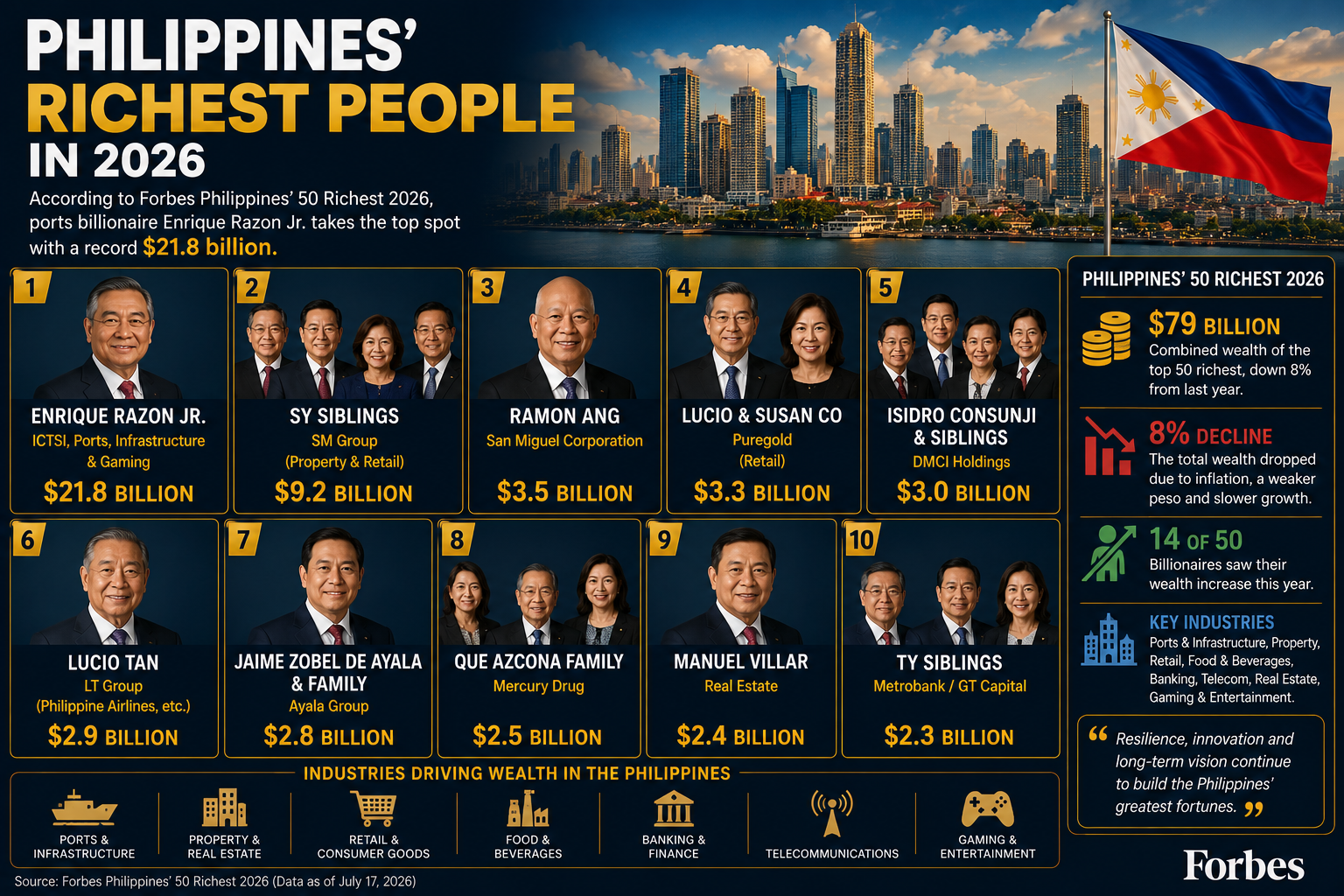
The country’s billionaire landscape experienced a major shake-up in 2026. According to Forbes’ Philippines’ 50 Richest 2026, ports billionaire Enrique Razon Jr. moved into first place with a record estimated fortune of $21.8 billion.
However, the overall wealth of the Philippines’ 50 richest people declined. Their combined fortune fell to approximately $79 billion, down from $86 billion the previous year. Forbes attributed the decline partly to inflation, a weaker Philippine peso and challenging economic conditions.
Only 14 people on the list became wealthier compared with the previous year, while 33 saw their fortunes decline.
Top 10 Richest People in the Philippines in 2026
Rank | Billionaire / Family | Main Business | Net Worth |
|---|---|---|---|
1 | Enrique Razon Jr. | Ports, Infrastructure & Gaming | $21.8B |
2 | Sy Siblings | SM Group / Property & Retail | $9.2B |
3 | Ramon Ang | San Miguel Corporation | $3.5B |
4 | Lucio & Susan Co | Puregold / Retail | $3.3B |
5 | Isidro Consunji & Siblings | DMCI Holdings | $3.0B |
6 | Lucio Tan | LT Group / Philippine Airlines | $2.9B |
7 | Jaime Zobel de Ayala & Family | Ayala Group | $2.8B |
8 | Que Azcona Family | Mercury Drug | $2.5B |
9 | Manuel Villar | Real Estate | $2.4B |
10 | Ty Siblings | Metrobank / GT Capital | $2.3B |
The figures are from Forbes’ 2026 annual ranking, with fortunes calculated using stock prices and exchange rates as of July 17, 2026. Forbes’ country rankings can include family fortunes and certain foreign citizens with significant business or other ties to the Philippines.
1. Enrique Razon Jr. — $21.8 Billion
Enrique Razon Jr. is the richest person in the Philippines in 2026.
Forbes estimates his fortune at approximately $21.8 billion, nearly double his wealth from the previous year. He added approximately $10.3 billion to his fortune, making him the biggest dollar gainer on the list.
Razon built his fortune primarily through International Container Terminal Services Inc. (ICTSI), one of the world's major independent port operators.
ICTSI operates container terminals in multiple countries, giving Razon a truly global infrastructure business.
His business empire also extends into:
Ports
Infrastructure
Energy
Mining
Gaming
Real estate
Razon's rise to the No. 1 position was driven largely by strong performance at ICTSI and its continued international expansion.
His story demonstrates how infrastructure and global logistics can create enormous fortunes in an increasingly interconnected world.
Global expansion
Razon has continued expanding ICTSI internationally rather than relying only on the Philippine market.
The company's global port operations have helped make him one of the most internationally connected billionaires in Southeast Asia.
His rise is particularly notable because the Philippines' overall billionaire wealth declined in 2026 while his personal fortune surged.
2. Sy Siblings — $9.2 Billion
The Sy siblings, heirs to the late retail tycoon Henry Sy Sr., rank second.
Their combined fortune was estimated at $9.2 billion in 2026, down from $11.8 billion the previous year.
The Sy family controls interests associated with the SM Group, one of the Philippines' largest business empires.
SM's businesses include:
Shopping malls
Real estate
Retail
Banking
Property development
Investments
The family's flagship property company, SM Prime Holdings, experienced pressure during the year, with its shares falling significantly amid weakness in the residential property market.
Despite the decline in wealth, the Sy family remains one of the Philippines' most influential business dynasties.
The legacy of Henry Sy Sr.
Henry Sy Sr. started with a small shoe store and gradually built what became one of the largest conglomerates in the Philippines.
His family's story remains one of the country's best-known examples of entrepreneurial success.
3. Ramon Ang — $3.5 Billion
Ramon Ang, chairman and CEO of San Miguel Corporation, ranks third with approximately $3.5 billion.
San Miguel is one of the Philippines' oldest and largest conglomerates.
The company has interests across:
Food and beverages
Infrastructure
Power
Fuel
Packaging
Transportation
Telecommunications
Ang climbed one position in the 2026 ranking despite his fortune declining slightly.
Investor concerns about San Miguel's debt levels contributed to a decline in the company's share price.
Nevertheless, Ang remains one of the most powerful corporate figures in the Philippines.
His business strategy has transformed San Miguel from a traditional food-and-beverage company into a highly diversified conglomerate.
4. Lucio & Susan Co — $3.3 Billion
Lucio and Susan Co rank fourth with a combined fortune of approximately $3.3 billion.
They are the cofounders of Puregold Price Club, one of the Philippines' largest supermarket and hypermarket chains.
Their rise in the 2026 ranking was supported by strong sales growth at Puregold.
The company has benefited from the Philippines' large consumer market and continued demand for affordable food and household products.
The Co family's businesses demonstrate how retail can generate substantial wealth in a rapidly growing consumer economy.
Puregold's business model
Puregold focuses heavily on:
Supermarkets
Hypermarkets
Wholesale retail
Consumer goods
Food distribution
The company's growth has helped the Co family become one of the Philippines' wealthiest business families.
5. Isidro Consunji & Siblings — $3 Billion
Isidro Consunji and his siblings rank fifth with an estimated combined fortune of $3 billion.
Their wealth comes primarily from DMCI Holdings, a major Philippine construction, infrastructure and property company.
DMCI has interests in:
Construction
Engineering
Real estate
Mining
Power
Infrastructure
The Consunji family has been one of the Philippines' most prominent business families for decades.
Their fortune illustrates the importance of construction and infrastructure development to the country's economy.
As the Philippines continues to invest in transportation, energy and urban development, companies such as DMCI remain important players.
6. Lucio Tan — $2.9 Billion
Lucio Tan ranks sixth with an estimated fortune of $2.9 billion.
Tan is one of the Philippines' best-known business magnates and has built a diversified empire through LT Group.
His business interests include:
Tobacco
Banking
Airlines
Beverages
Property
Investments
One of his most recognizable businesses is Philippine Airlines.
The airline has been recovering following its restructuring and bankruptcy proceedings in the United States, while benefiting from the broader recovery in international travel.
Tan's fortune has been built over decades and represents one of the Philippines' classic business success stories.
7. Jaime Zobel de Ayala & Family — $2.8 Billion
Jaime Zobel de Ayala and his family rank seventh with approximately $2.8 billion.
The Zobel de Ayala family is associated with Ayala Corporation, one of the Philippines' oldest and most diversified business groups.
The family's business empire stretches across:
Real estate
Banking
Telecommunications
Healthcare
Infrastructure
Renewable energy
Hotels
Education
The Ayala Group has played a major role in shaping modern Manila and the broader Philippine economy.
According to Forbes, members of the next generation own more than 40% of the conglomerate, highlighting the continued importance of family ownership.
The family's renewable-energy investments are also becoming increasingly important as the Philippines expands solar and wind capacity.
8. Que Azcona Family — $2.5 Billion
The Que Azcona family ranks eighth with an estimated fortune of $2.5 billion.
Their wealth is associated with Mercury Drug, one of the Philippines' best-known pharmacy chains.
Mercury Drug has developed an enormous nationwide retail network, making it an important part of the country's healthcare and consumer landscape.
The family fortune reflects the strength of businesses serving essential consumer needs.
Pharmacies and healthcare retail can remain resilient even during periods when other parts of the economy face pressure.
9. Manuel Villar — $2.4 Billion
Property magnate Manuel Villar ranks ninth with approximately $2.4 billion.
Villar was one of the biggest stories on the 2026 Forbes list—not because his fortune increased, but because it fell dramatically.
His fortune dropped by approximately $8.6 billion, pushing him from third place in 2025 to ninth in 2026.
Villar's business empire is primarily focused on real estate.
His companies have developed residential communities, commercial properties and large mixed-use developments.
One of his most ambitious projects is Villar City, a massive mixed-use development in Metro Manila.
However, shares of Villar Land Holdings came under significant pressure after the company agreed to a major markdown in the value of certain Metro Manila land parcels.
Trading in the company's shares was also suspended by the market regulator amid delays involving audited financial statements.
Villar's dramatic decline demonstrates how quickly billionaire fortunes can change when they are heavily connected to publicly traded companies.
10. Ty Siblings — $2.3 Billion
The Ty siblings round out the top 10 with approximately $2.3 billion.
Their family fortune is associated with GT Capital Holdings and Metropolitan Bank & Trust Company, commonly known as Metrobank.
The Ty family has been one of the Philippines' major banking dynasties.
Their interests extend across:
Banking
Finance
Insurance
Automotive
Real estate
Investments
Financial services remain one of the country's most important sources of family wealth.
Why the Philippines' Richest People Became Less Wealthy in 2026
Unlike many countries where billionaire wealth increased in 2026, the combined fortune of the Philippines' 50 richest people fell.
Forbes reported that total wealth declined 8% to $79 billion, from $86 billion in 2025.
Several factors contributed to the decline.
Inflation
Higher prices put pressure on households and businesses.
Inflation also reduced purchasing power and created challenges for companies operating in consumer-focused industries.
A Weaker Philippine Peso
Currency movements are particularly important in Forbes' global rankings because billionaire fortunes are measured in U.S. dollars.
A weaker peso can reduce the U.S.-dollar value of assets and businesses based in the Philippines.
Slower Economic Growth
The Philippine economy expanded by 2.8% in the first quarter of 2026, its weakest quarterly growth rate since the pandemic period.
The slowdown affected investor sentiment and contributed to weaker valuations for several major Philippine companies.
Enrique Razon's Extraordinary Rise
The biggest story in the 2026 ranking is undoubtedly Enrique Razon.
His wealth increased by approximately $10.3 billion in just one year.
While the rest of the country's billionaire class collectively lost wealth, Razon nearly doubled his fortune.
The primary driver was his ports business.
ICTSI continued expanding internationally, helping push its shares higher and increasing Razon's stake value.
His rise also demonstrates the value of businesses with global revenue streams.
Rather than relying entirely on Philippine economic conditions, ICTSI operates ports across multiple international markets.
The Philippines' Wealth Gap Is Widening
The difference between the richest person and everyone else on the list became particularly striking in 2026.
Razon's $21.8 billion fortune was more than twice the combined fortune of the No. 2 Sy siblings.
This represents a major change from previous years, when the top positions were more closely contested.
The sharp decline in Manuel Villar's fortune also demonstrates how quickly the ranking can change.
Infrastructure Remains a Major Source of Wealth
Infrastructure continues to play a major role in the Philippines' billionaire economy.
Razon's ports business and Ramon Ang's infrastructure investments are two major examples.
The country needs continued investment in:
Roads
Ports
Airports
Energy
Transportation
Telecommunications
Urban development
Entrepreneurs capable of building businesses around these needs can potentially create enormous long-term fortunes.
Property Remains Important—but Risky
Real estate has produced some of the Philippines' biggest fortunes.
The Sy family, Manuel Villar, the Consunji family and the Ayala family all have major property interests.
However, Villar's dramatic decline shows that property-related wealth can also be highly vulnerable to market conditions.
Property valuations, financing costs, regulatory decisions and investor confidence can all have a major impact on billionaire fortunes.
Retail and Consumer Businesses Continue to Grow
The fortunes of the Sy siblings and the Co family demonstrate the importance of consumer businesses.
The Philippines has a large and growing population, creating strong demand for:
Food
Groceries
Shopping malls
Household products
Healthcare
Consumer services
Puregold and SM have built enormous businesses by serving this domestic demand.
Banking and Finance Remain Powerful
The Ty family and Ayala family represent the continuing importance of financial services.
Banking remains one of the Philippines' most important economic sectors.
Large financial institutions benefit from the country's growing middle class, business activity and expanding demand for loans, investments and financial services.
The Next Generation of Filipino Billionaires
The Philippines' future billionaire rankings could become more diversified.
Technology, digital commerce, renewable energy, online gaming, fintech and data infrastructure are creating new opportunities.
Forbes highlighted Eusebio Tanco, chairman of DigiPlus Interactive, as an entrepreneur whose online gaming business has expanded rapidly.
The technology sector could become increasingly important as more Filipinos use digital payments, e-commerce platforms and online services.
Gaming and Digital Entertainment
Online gaming has become a significant emerging industry.
DigiPlus Interactive has expanded its online bingo and gaming operations, while other Philippine companies are exploring international opportunities.
The sector combines technology, entertainment and digital payments, making it a potential source of new wealth.
However, it also faces regulatory and competitive challenges.
Renewable Energy and the Future Economy
Renewable energy is another industry worth watching.
The Philippines has significant potential for:
Solar power
Wind energy
Hydroelectricity
Geothermal energy
Established conglomerates such as Ayala are investing heavily in renewable energy, while infrastructure-focused billionaires are also exploring opportunities in the energy sector.
As the country attempts to meet rising electricity demand while reducing dependence on fossil fuels, renewable energy could produce major new businesses.
Who Is the Richest Person in the Philippines?
According to Forbes' 2026 Philippines 50 Richest ranking, Enrique Razon Jr. is the richest person in the Philippines with an estimated fortune of $21.8 billion.
His fortune is primarily connected to ports and infrastructure through International Container Terminal Services.
The ranking is based on wealth estimates as of July 17, 2026, meaning individual fortunes can change as stock prices and exchange rates move.
Final Thoughts
The Philippines' richest people in 2026 reflect a rapidly changing business environment.
Enrique Razon Jr. dominates the ranking with $21.8 billion, powered by the global expansion of his ports business. The Sy siblings remain second with $9.2 billion, while Ramon Ang, Lucio and Susan Co, the Consunji family and Lucio Tan occupy the next positions.
The overall picture, however, is more challenging than the success of the top-ranked billionaire suggests.
The combined wealth of the Philippines' 50 richest people fell to $79 billion, down 8% from the previous year.
Inflation, slower economic growth, a weaker peso and declining share prices affected many fortunes.
At the same time, new opportunities are emerging in infrastructure, digital technology, gaming, renewable energy and e-commerce.
The Philippines therefore enters the next phase of its economic development with a billionaire class that is still dominated by traditional industries—but increasingly influenced by technology and global investment.
As the economy evolves, the next major Philippine fortune could come not from a shopping mall, port or property development, but from the country's rapidly expanding digital and technology economy.
Source and Methodology
This article is based primarily on Forbes’ Philippines’ 50 Richest 2026 ranking, published in August 2026. Forbes calculated the fortunes using shareholding and financial information from individuals, families, stock exchanges, analysts and other sources. Public-company valuations were based on stock prices and exchange rates as of the close of markets on July 17, 2026. Private companies were valued using comparisons with similar publicly traded businesses. Forbes' country ranking can include family fortunes and individuals with significant business, residential or other ties to the Philippines.