
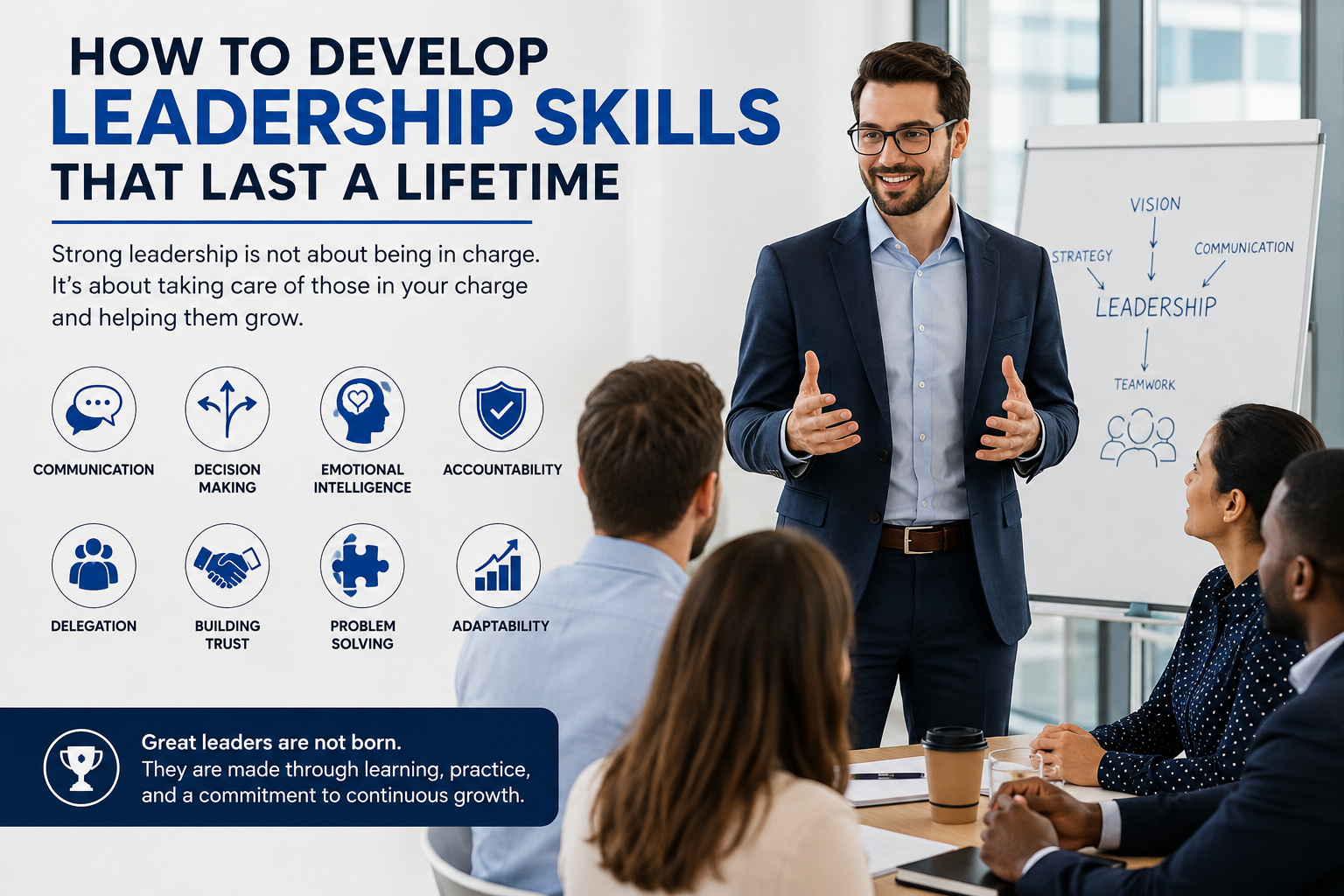
Leadership is one of the most valuable skills a person can develop, regardless of their job title, industry, or level of experience. A strong leader does more than give instructions. Effective leadership involves communicating clearly, making thoughtful decisions, building trust, supporting others, handling challenges, and taking responsibility for results.
The good news is that leadership is not a skill reserved for a select group of naturally confident people. Leadership abilities can be developed through practice, experience, feedback, self-awareness, and continuous learning.
Whether you are a student preparing for your career, a professional hoping to move into management, an experienced manager, or someone simply looking to become more effective in everyday situations, improving your leadership skills can have lasting benefits.
The most important part is understanding that leadership development is a long-term process. There is no single course, book, or position that automatically turns someone into a great leader. Instead, effective leadership grows through repeated actions and a willingness to learn.
What Are Leadership Skills?
Leadership skills are the abilities that help a person guide, influence, support, and motivate others toward a shared objective.
These skills can include communication, decision-making, problem-solving, emotional intelligence, accountability, delegation, adaptability, strategic thinking, relationship building, and conflict management.
Leadership can look different depending on the situation. A business executive may lead an organization through major decisions, while a project leader may coordinate a small team. A teacher can demonstrate leadership in a classroom, and an employee can demonstrate leadership by taking initiative and helping colleagues solve problems.
This means leadership is not simply about having authority. It is about how effectively you influence outcomes and work with other people.
Research and leadership frameworks consistently emphasize skills such as building relationships, developing people, communicating clearly, thinking critically, leading change, inspiring others, and creating accountability.
Why Leadership Skills Matter
Strong leadership can affect how teams communicate, make decisions, handle challenges, and work toward common goals.
When expectations are unclear, employees may struggle to understand priorities or determine what successful performance looks like. When leaders communicate clearly and create accountability, people have a better understanding of their responsibilities.
Leadership skills are also valuable outside the workplace. The ability to listen, make decisions, manage disagreements, and take responsibility can improve relationships and everyday interactions.
Developing leadership skills can help you:
Communicate ideas more effectively
Make better decisions
Build stronger professional relationships
Handle difficult situations with greater confidence
Support and motivate other people
Manage responsibilities more effectively
Adapt to changing circumstances
Resolve disagreements constructively
Develop other people's abilities
Build trust over time
Because these abilities remain useful across different jobs and industries, leadership development can be a long-term investment in personal and professional growth.
1. Start With Self-Awareness
One of the first steps toward becoming a better leader is understanding yourself.
Effective leadership begins with knowing your strengths, weaknesses, habits, values, and typical reactions to difficult situations. Without self-awareness, it can be difficult to understand how your behavior affects other people.
For example, someone may consider themselves highly efficient because they prefer completing tasks alone. However, if they rarely delegate responsibilities, they may unintentionally prevent team members from developing their own skills.
Another person may believe they are a direct communicator while colleagues experience their communication as unnecessarily harsh.
Self-awareness creates an opportunity to identify these differences.
Ask yourself questions such as:
What are my strongest leadership qualities?
What situations make me uncomfortable?
How do I react when someone disagrees with me?
Do I listen carefully before responding?
How do other people experience my communication style?
Which leadership skills do I need to improve?
Honest answers can help you create a practical development plan.
2. Improve Your Communication Skills
Communication is at the heart of effective leadership.
Leaders need to explain expectations, communicate priorities, share information, provide feedback, and discuss problems. However, good communication is not simply about speaking clearly. It also involves listening.
Active listening means giving someone your attention, understanding what they are saying, asking appropriate questions, and avoiding the temptation to immediately formulate a response while they are speaking.
Clear communication can prevent misunderstandings before they become larger problems.
When assigning a responsibility, for example, a leader should make sure the other person understands what needs to be done, why it matters, what the expected outcome is, and when it should be completed.
Strong leaders also adapt their communication style to different situations. A complex strategic discussion may require detailed information, while a short operational update may need to be simple and direct.
3. Learn to Make Thoughtful Decisions
Decision-making is an unavoidable part of leadership.
Some decisions are small and routine, while others can affect an entire team or organization. Developing a structured approach can make decision-making more effective.
Before making an important decision, consider:
What problem needs to be solved?
What information is available?
What information is missing?
What options are realistic?
What are the potential risks?
Who could be affected?
What are the likely short-term and long-term consequences?
Good leaders do not necessarily have every answer. They know when to seek additional information or ask other people for their perspectives.
It is also important to learn from decisions that do not produce the desired result. A poor outcome does not automatically mean the decision-making process was careless. Leaders should review what happened, identify what they could have controlled, and apply the lesson to future decisions.
4. Develop Emotional Intelligence
Leadership involves people, and people bring emotions, expectations, personalities, and different perspectives into every situation.
Emotional intelligence can help leaders recognize their own emotions and respond appropriately to the emotions of others.
For example, imagine a team member makes a mistake on an important project. A leader who immediately reacts with anger may create fear and discourage honest communication. A leader with stronger emotional awareness can pause, understand the situation, discuss what happened, and focus on solving the problem.
Emotional intelligence includes several useful abilities:
Recognizing your emotions
Managing reactions under pressure
Understanding other people's perspectives
Showing empathy
Building healthy relationships
Responding thoughtfully to criticism
These skills become particularly important during stressful situations, disagreements, and periods of change.
5. Build Trust Through Consistency
Trust is not created by a single impressive speech or decision. It develops through consistent behavior.
People are more likely to trust leaders who communicate honestly, keep reasonable commitments, treat people fairly, and follow through on what they say.
Consistency is particularly important when circumstances become difficult. If a leader applies one standard to one person and a completely different standard to another without a legitimate reason, trust can quickly decline.
Building trust can involve simple behaviors:
Keep your commitments.
Admit when you do not know something.
Give credit to others.
Avoid taking credit for someone else's work.
Communicate changes honestly.
Treat people respectfully.
Apply expectations fairly.
Follow up on important issues.
Over time, these small actions can create a reputation for reliability.
6. Learn to Delegate Effectively
Many new leaders struggle with delegation because they believe they can complete tasks faster themselves.
While taking control may sometimes seem efficient in the short term, doing everything personally can create unnecessary pressure and limit opportunities for other people to develop.
Delegation is not simply handing unwanted tasks to someone else. Effective delegation involves selecting an appropriate person, explaining the desired outcome, providing necessary resources, and establishing reasonable follow-up.
Good delegation can help team members develop responsibility and ownership while allowing leaders to focus on higher-priority work. Leadership training resources also emphasize delegation as a way to develop others while maintaining clear expectations and accountability.
A useful delegation process is:
Choose the right responsibility
Consider which tasks can reasonably be handled by someone else.
Choose the right person
Look at experience, skills, workload, and development opportunities.
Explain the expected outcome
Make sure the person understands what success looks like.
Provide support
Give access to the information, tools, and guidance they need.
Follow up
Check progress without unnecessarily controlling every step.
Delegation should create ownership rather than simply transferring workload.
7. Become Comfortable With Feedback
Feedback is an important tool for leadership development.
A leader who never receives or seeks feedback may develop blind spots. Other people may notice communication habits, behaviors, or decision-making patterns that the leader does not recognize.
Ask trusted colleagues or mentors questions such as:
What is one thing I do well as a leader?
What could I improve?
Do I communicate clearly?
Do I listen effectively?
How do I respond when people disagree with me?
Constructive feedback can sometimes feel uncomfortable, but discomfort does not necessarily mean the feedback is unhelpful.
Leaders should also learn how to give useful feedback to others. Effective feedback should focus on specific behavior, performance, or outcomes rather than personal attacks.
Instead of saying, "You are careless," it is more constructive to explain what happened, why it caused a problem, and what could be done differently in the future.
8. Develop Strong Problem-Solving Skills
Leaders regularly encounter problems that do not have immediate solutions.
Instead of reacting emotionally, break the problem into smaller parts.
First, identify the actual problem. Sometimes the issue that appears obvious is only a symptom of a deeper problem.
Next, gather relevant information and consider different explanations. Then identify possible solutions and evaluate their potential consequences.
A simple problem-solving framework is:
Identify → Understand → Evaluate → Act → Review
After taking action, review the outcome. Did the solution work? What changed? What still needs attention?
This approach encourages leaders to focus on learning rather than simply reacting to problems.
9. Learn to Handle Conflict Constructively
Disagreements are normal in professional environments. Different people have different experiences, priorities, communication styles, and opinions.
Avoiding every disagreement may allow small problems to become larger ones.
Effective leaders approach conflict with the goal of understanding and resolving the underlying issue.
When handling a disagreement:
Listen to each person's perspective.
Avoid interrupting.
Separate facts from assumptions.
Focus on the issue rather than personal criticism.
Look for areas of agreement.
Discuss possible solutions.
Establish clear next steps.
The objective is not necessarily to make everyone agree on everything. The objective is to find a workable path forward while maintaining professional respect.
10. Learn to Adapt to Change
Change is a normal part of professional and organizational life.
Companies introduce new technologies, processes change, responsibilities evolve, and customer expectations shift. Leaders who refuse to adapt can make it harder for their teams to respond effectively.
Adaptability does not mean accepting every change without question. It means being willing to understand new circumstances, evaluate options, and adjust when necessary.
Strong leaders can help others navigate change by explaining why it is happening, acknowledging reasonable concerns, and providing clear direction.
Leading change effectively requires both communication and flexibility.
11. Develop Strategic Thinking
Strategic thinking means looking beyond immediate tasks and considering the bigger picture.
A leader should understand how individual decisions connect to broader goals.
For example, completing a task quickly may seem productive, but if it does not contribute to the organization's priorities, the effort may not create meaningful value.
Strategic leaders regularly ask:
What are we trying to achieve?
Why does this matter?
What should we prioritize?
What could prevent us from reaching the goal?
What resources do we have?
What might happen next?
This broader perspective helps leaders balance short-term responsibilities with long-term objectives.
12. Learn to Motivate and Develop Others
Leadership is not only about achieving your own goals. It is also about helping other people succeed.
Effective leaders understand that team members have different strengths, experiences, interests, and development needs.
One person may want more responsibility, while another may need additional training before taking on a larger role.
Instead of using exactly the same approach with everyone, leaders can learn what helps different people perform at their best.
Developing others may include:
Providing useful feedback
Sharing learning opportunities
Giving people appropriate responsibilities
Recognizing good work
Encouraging new ideas
Supporting professional development
Offering guidance when challenges arise
Leadership research also places strong emphasis on developing people rather than simply directing their tasks.
13. Practice Accountability
Accountability means taking responsibility for commitments, actions, and outcomes.
Good leaders do not use accountability only when something goes wrong. It should be part of everyday work.
Clear expectations make accountability easier. People need to understand what they are responsible for and what successful performance looks like.
Leaders should also hold themselves to the same standards they expect from others.
If a leader expects employees to communicate problems early but hides problems themselves, the message becomes inconsistent.
Accountability works best when it is clear, fair, and consistent. Current leadership research continues to identify accountability as a core leadership competency.
14. Lead by Example
People often pay attention to what leaders do, not only what they say.
If you want your team to communicate respectfully, demonstrate respectful communication. If you expect people to take responsibility, show accountability yourself.
Leading by example can be especially powerful because it turns abstract expectations into visible behavior.
This does not mean leaders must appear perfect. In fact, acknowledging mistakes can demonstrate an important leadership quality.
A leader who can say, "I made a mistake, and here is what I learned from it," can create a healthier environment than someone who always attempts to appear flawless.
15. Keep Learning Throughout Your Career
Leadership development should not stop after someone receives a management position.
Industries change, technology evolves, workplaces develop new expectations, and people encounter new challenges.
Continuous learning can involve reading, professional courses, mentoring, workshops, conversations with experienced leaders, or simply reflecting on everyday experiences.
You can also learn by observing effective leaders.
Pay attention to how experienced leaders:
Handle difficult conversations
Communicate during uncertainty
Make decisions
Respond to criticism
Manage disagreements
Support team members
Deal with mistakes
Then consider which behaviors could be adapted to your own leadership style.
16. Create a Personal Leadership Development Plan
Knowing what you want to improve is useful, but turning that knowledge into action is even more important.
Create a simple leadership development plan with three parts:
Identify your strengths
Write down three leadership qualities you already demonstrate well.
Identify improvement areas
Choose two or three skills that could make the biggest difference.
Create practical actions
Instead of writing "become a better communicator," create a measurable action such as:
Practice active listening during meetings.
Ask for feedback after an important presentation.
Read one leadership book each month.
Volunteer to lead a project.
Schedule regular conversations with a mentor.
Reflect on one difficult leadership situation each week.
Small, repeated actions can eventually become stronger habits.
17. Measure Your Progress
Leadership improvement can be difficult to notice because it usually happens gradually.
Regular reflection can help you identify progress.
At the end of each month, ask yourself:
What leadership situation did I handle well?
What was difficult?
What feedback did I receive?
What mistake taught me something useful?
Did I communicate clearly?
Did I give others enough ownership?
What is one skill I should focus on next month?
Keeping brief notes can make your development easier to track.
Common Leadership Mistakes to Avoid
Even experienced leaders can make mistakes. Some common problems include:
Trying to control everything
Micromanagement can prevent people from developing confidence and ownership.
Avoiding difficult conversations
Uncomfortable conversations do not usually become easier when they are ignored.
Failing to listen
Leaders who speak without listening can miss valuable information and create unnecessary misunderstandings.
Taking all the credit
Recognizing other people's contributions builds stronger relationships and encourages future collaboration.
Changing expectations constantly
People need reasonable clarity about priorities and responsibilities.
Refusing to admit mistakes
Trying to appear perfect can damage credibility. Acknowledging mistakes can demonstrate accountability.
Focusing only on short-term results
Strong leadership requires attention to both immediate responsibilities and long-term development.
How to Practice Leadership Every Day
You do not need to wait for a promotion before practicing leadership.
You can develop leadership skills in ordinary situations.
At work, volunteer to organize a project, help a colleague, or take responsibility for solving a problem.
During meetings, practice listening carefully and summarizing other people's ideas before presenting your own.
When disagreements occur, focus on understanding the issue rather than winning the argument.
When you make a mistake, acknowledge it and consider what you can learn.
When someone does good work, recognize their contribution.
These small actions can help turn leadership concepts into practical habits.
Final Thoughts
Leadership is not a destination that you reach after receiving a particular job title. It is an ongoing process of learning, practicing, adapting, and helping others succeed.
The strongest leadership skills are often built through ordinary experiences: listening to someone carefully, making a difficult decision, accepting feedback, solving a problem, delegating responsibility, handling disagreement, or admitting a mistake.
You do not need to develop every leadership skill at once. Choose one area that needs improvement and work on it consistently. Once that behavior becomes more natural, move to another area.
Over time, these small improvements can create a stronger leadership foundation that remains useful throughout your career.
The goal is not to become a perfect leader. The goal is to become a more thoughtful, reliable, adaptable, and effective one.
Frequently Asked Questions
1. Can anyone develop leadership skills?
Yes. Leadership skills can be developed through practice, experience, feedback, learning, and self-reflection. You do not need to be naturally outgoing or confident to become an effective leader.
2. What is the most important leadership skill?
There is no single skill that works in every situation. Communication, accountability, relationship building, decision-making, emotional intelligence, adaptability, and problem-solving are all important parts of effective leadership.
3. How can I improve my leadership skills at work?
Start by taking initiative, communicating clearly, listening to colleagues, accepting responsibility, asking for feedback, helping others, and volunteering for appropriate projects or responsibilities.
4. Can leadership skills help someone who is not a manager?
Absolutely. Leadership is not limited to management positions. Employees can demonstrate leadership by taking initiative, solving problems, supporting colleagues, and helping a team work toward a shared goal.
5. How does communication affect leadership?
Clear communication helps people understand goals, responsibilities, priorities, and expectations. Strong communication also involves listening, asking questions, and adapting information to different audiences.
6. Why is emotional intelligence important for leaders?
Emotional intelligence can help leaders understand their own reactions and recognize the perspectives and emotions of other people. This can be particularly useful when dealing with stress, feedback, disagreements, and change.
7. What is effective delegation?
Effective delegation involves assigning appropriate responsibilities to capable people, explaining expected outcomes, providing necessary support, and following up on progress without unnecessarily controlling every detail.
8. How can a leader build trust?
Trust can be developed through consistent behavior, honest communication, accountability, fairness, reliability, and keeping reasonable commitments. Trust usually develops over time rather than through a single action.
9. How can I become a better decision-maker?
Gather relevant information, consider different options, evaluate potential consequences, seek useful perspectives, and avoid allowing temporary emotions to control important decisions. Review the outcome afterward and learn from the experience.
10. How long does it take to develop leadership skills?
There is no fixed timeline. Leadership development is an ongoing process. Some improvements may become noticeable within weeks or months, while deeper skills continue developing through years of experience.
11. What should I do if I receive negative feedback?
Listen carefully before responding defensively. Ask questions if the feedback is unclear, identify what is useful, and decide what action you can take. Not every piece of feedback will be equally valid, but constructive criticism can reveal areas worth improving.
12. Why is accountability important in leadership?
Accountability creates clarity around responsibilities and expectations. Leaders who take responsibility for their own actions and establish fair expectations for others can create a stronger foundation for trust and performance.
13. Can leadership skills improve career opportunities?
Strong leadership skills can be valuable across many roles because employers often need people who can communicate, solve problems, collaborate, make decisions, and take responsibility. Developing these abilities can support long-term professional growth.
14. How can I practice leadership if I have little experience?
Start with small responsibilities. Lead a project, organize a group activity, mentor someone, volunteer for a task, or take initiative when you identify a problem. Practical experience is one of the best ways to develop leadership abilities.
15. What is the best way to continue developing as a leader?
Keep learning, seek feedback, reflect on your experiences, study effective leadership practices, and regularly challenge yourself with appropriate responsibilities. Consistent improvement is more valuable than trying to become an effective leader overnight.