Money and politics have always been closely connected. Political campaigns require funding, governments make decisions that affect businesses, and wealthy individuals and corporations often have strong interests in taxation, regulation, trade, technology, energy and financial policy.
But in 2026, the relationship between money and politics has become more visible than ever.
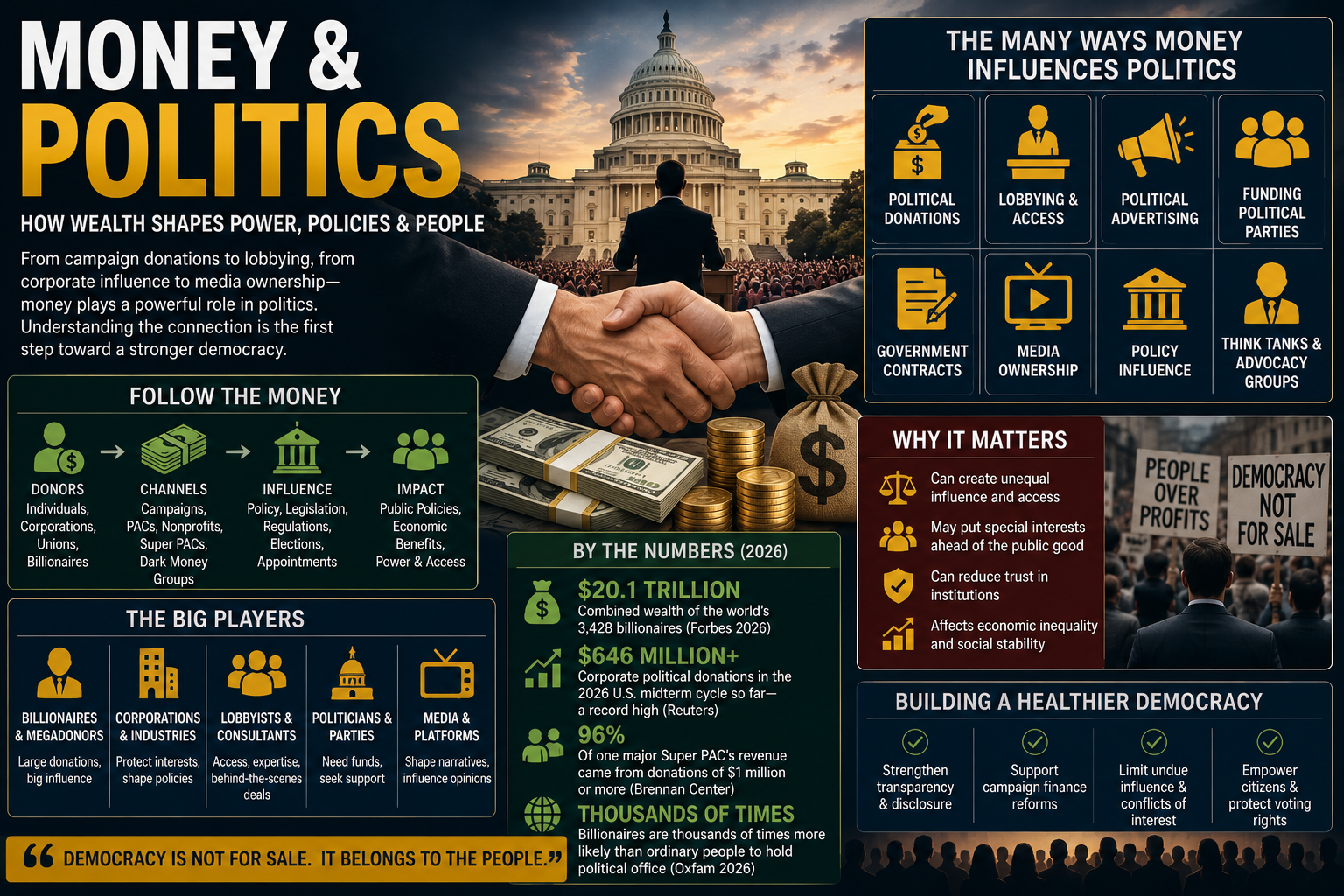
The global billionaire class has reached unprecedented levels of wealth. Forbes' 2026 World’s Billionaires list counted a record 3,428 billionaires with combined wealth of approximately $20.1 trillion. Forbes also described billionaires as increasingly influential in politics, policy, financial markets and the rapidly expanding artificial-intelligence economy.
At the same time, political campaigns are becoming increasingly expensive. In the United States, corporate political donations for the 2026 midterm cycle had already reached a record $646 million by late August, according to Reuters, with cryptocurrency companies, AI firms and other industries playing increasingly important roles.
This raises a fundamental question:
How much political influence can money buy?
The answer is complicated. Wealth can provide access, visibility and resources, but it does not automatically guarantee political success. Nevertheless, the growing scale of political spending has created an intense debate over whether democratic systems are giving wealthy individuals and corporations too much influence.
What Does “Money & Politics” Mean?
The term money and politics describes the relationship between financial resources and political power.
It includes many different activities, including:
Political donations
Campaign financing
Super PACs
Lobbying
Corporate political spending
Political advertising
Donations to political parties
Funding of advocacy organizations
Think tanks and policy groups
Political consulting
Media ownership
Government contracts
Business relationships with political leaders
Money can influence politics in both direct and indirect ways.
A billionaire may donate millions of dollars to a political campaign.
A corporation may spend heavily on lobbying.
A business owner may purchase media companies that influence public debate.
An investor may support candidates who favor policies beneficial to their industry.
And politicians may depend on wealthy donors to finance increasingly expensive campaigns.
The result is a complex ecosystem in which economic power and political power frequently overlap.
Billionaires Are Becoming More Politically Powerful
The enormous growth of billionaire wealth is one of the defining economic stories of the 2020s.
According to Forbes, the world's billionaires collectively held approximately $20.1 trillion in wealth in 2026. The number of billionaires also reached a record 3,428.
This concentration of wealth matters politically because wealthy individuals can deploy enormous resources toward causes, candidates, companies and political organizations.
A normal voter may contribute $50 or $100 to a campaign.
A billionaire can potentially contribute millions—or help fund organizations capable of spending tens or hundreds of millions of dollars.
That creates a significant difference in political resources.
However, wealth does not automatically translate into votes.
Political candidates still need voters, organizations, public support and effective campaigns.
The real issue is often access and agenda-setting, rather than simply buying an election.
The Rise of Megadonors
One of the biggest changes in modern politics has been the emergence of extremely wealthy political donors.
Instead of relying only on thousands or millions of small contributions, political campaigns can receive enormous financial support from a relatively small number of wealthy individuals.
This is particularly visible in the United States.
Reuters reported in August 2026 that new sources of political money—including billionaires and industries such as cryptocurrency, artificial intelligence and sports betting—were helping fuel record spending in the 2026 midterm elections.
These industries are relatively young compared with traditional sectors such as banking, oil and manufacturing.
Their increasing political spending reflects the growing importance of government policy to emerging industries.
Crypto Money Enters Politics
Cryptocurrency has become one of the most politically active sectors in the United States.
The reason is straightforward.
Government regulation can dramatically affect the crypto industry.
Rules concerning:
Digital assets
Stablecoins
Cryptocurrency exchanges
Taxation
Securities regulation
Banking access
Consumer protection
can influence the future profitability and growth of crypto companies.
As a result, crypto companies and wealthy crypto entrepreneurs have increasingly invested in political campaigns and advocacy.
Reuters reported that the cryptocurrency sector had become the largest corporate contributor among industries examined for the 2026 U.S. midterm cycle, with approximately $344 million in contributions.
This illustrates a broader principle:
Industries often become politically active when government policy can significantly affect their economic future.
Artificial Intelligence and Political Influence
Artificial intelligence is another emerging area where money and politics are increasingly connected.
AI companies are facing major policy questions involving:
Regulation
Copyright
Data privacy
National security
Semiconductor supply chains
Energy consumption
Employment
Competition policy
Government contracts
AI companies therefore have strong incentives to influence policymakers.
At the same time, AI companies have become some of the world's most valuable businesses.
The enormous financial stakes mean that decisions made in Washington, Brussels, Beijing and other political centers could have major consequences for the industry.
Reuters reported that AI firms were among the new corporate political players contributing to the 2026 U.S. election cycle.
The political influence of AI may therefore become one of the defining money-and-politics stories of the next decade.
Super PACs and Political Spending
Super PACs are another important part of the modern political-finance system in the United States.
Unlike traditional candidate committees, super PACs can raise and spend unlimited amounts of money to advocate for or against candidates, provided they operate independently of candidates' campaigns.
This has created a system in which extremely wealthy individuals can spend enormous amounts of money supporting political causes.
In February 2026, the Brennan Center reported that MAGA Inc., a pro-Trump super PAC, had raised a record $305 million after Donald Trump returned to office. The organization received 96% of its revenue from donations of at least $1 million.
Such fundraising illustrates how political influence can become concentrated among a relatively small group of major donors.
Does Money Buy Elections?
This is one of the most debated questions in political science.
The simple answer is:
Not necessarily.
Money can pay for advertising, staff, polling, travel, organizing, digital campaigns and political messaging.
But money alone cannot guarantee:
Voter support
Good candidates
Strong grassroots organizations
Effective political messaging
Public trust
Electoral victory
A wealthy donor can spend millions supporting a candidate who ultimately loses.
However, money can influence which candidates can compete, how much information voters receive and which issues receive political attention.
This distinction is important.
Money may not literally “buy votes,” but it can significantly influence the political environment in which voters make decisions.
Lobbying: The Less Visible Side of Money and Politics
Campaign donations are highly visible.
Lobbying is often less visible to the general public.
Companies and industry groups hire professional lobbyists to communicate with lawmakers and government officials.
Lobbyists may provide:
Policy research
Industry data
Legal analysis
Draft legislative language
Economic studies
Meetings with policymakers
Information about proposed regulations
Lobbying itself is not necessarily corruption.
Governments need information from businesses, workers, scientists, consumer organizations and other groups.
The concern arises when wealthy interests have substantially greater access than ordinary citizens or poorly funded organizations.
This creates a potential imbalance in political representation.
Corporate Money and Government Policy
Corporations have enormous economic interests in government decisions.
A change in tax policy can affect billions of dollars in profits.
A new environmental regulation can increase costs.
A tariff can change international supply chains.
A technology regulation can determine whether a business model succeeds.
A government contract can be worth billions.
Because the financial stakes are so high, corporations have strong incentives to participate in politics.
Reuters reported that U.S. corporate political contributions reached a record $646 million during the period leading into the 2026 midterms, a figure already exceeding total corporate contributions during the 2024 presidential election cycle.
The Politics of Government Contracts
Money and politics can also intersect through government procurement.
Governments spend enormous amounts of money on:
Defense
Infrastructure
Technology
Healthcare
Energy
Transportation
Construction
Telecommunications
Companies that receive major government contracts have strong economic incentives to maintain relationships with policymakers.
This does not mean every government contract is politically motivated.
Competitive bidding, procurement rules and oversight can provide safeguards.
But the enormous value of government spending means that political relationships can become extremely important to large corporations.
Billionaires Who Enter Politics
There is another way wealth and politics can intersect:
Billionaires can become politicians themselves.
Instead of donating money to candidates, wealthy individuals can use their personal fortunes to finance their own political campaigns.
This provides several advantages.
A self-funded candidate may:
Depend less on donors
Control campaign strategy
Spend quickly
Avoid traditional fundraising
Build a campaign around personal wealth
But wealth also creates criticism.
Opponents may argue that political office should not become easier to access simply because someone has enormous financial resources.
The broader global trend is striking: Oxfam reported in 2026 that billionaires were estimated to be thousands of times more likely than ordinary people to hold political office.
Wealth and Media Ownership
Money can influence politics without being donated directly to a political campaign.
One of the most powerful examples is media ownership.
Wealthy individuals can own:
Newspapers
Television networks
Online publications
Social media platforms
Entertainment companies
Digital advertising businesses
Owning media does not automatically determine what people believe.
Journalists, editors, audiences and competing sources all matter.
But media ownership can influence:
Which stories receive attention
Which political issues become prominent
How political candidates are portrayed
Which opinions reach large audiences
This is why media concentration is frequently discussed alongside political power.
Social Media and Political Influence
The internet has transformed the relationship between money and politics.
Traditional campaigns relied heavily on:
Television
Newspapers
Radio
Billboards
Direct mail
Modern campaigns increasingly rely on:
Social media
Influencers
Digital advertising
Online fundraising
Targeted messaging
Video platforms
Political podcasts
This has lowered some barriers to political communication.
A small campaign can potentially reach millions of people online.
But wealthy campaigns also have the ability to spend enormous amounts on digital advertising and sophisticated targeting.
This creates a new competition:
Who can capture attention most effectively?
Dark Money and Political Transparency
Another major issue is dark money.
The term generally refers to political spending where the original source of the funding is difficult or impossible for the public to identify.
Dark-money structures can involve nonprofit organizations and other entities that may not have to publicly disclose all donors.
Supporters of political privacy argue that donors should be protected from harassment and retaliation.
Critics argue that voters have a right to know who is financially supporting political campaigns and advocacy efforts.
This creates a fundamental tension between:
Political privacy vs. political transparency.
Why Transparency Matters
Transparency is one of the main tools used to reduce concerns about hidden political influence.
Disclosure requirements can help voters understand:
Who funded a campaign
How much was donated
Which industries are spending money
Which organizations are supporting candidates
Where political advertising comes from
The Campaign Legal Center and other campaign-finance organizations have argued that voters need information about wealthy special interests attempting to influence government.
Transparency does not eliminate political influence.
But it can make that influence easier to identify.
Money, Politics and Inequality
The relationship between wealth and political power becomes especially controversial when economic inequality increases.
If a small number of people control enormous amounts of wealth, they may have significantly greater resources to participate in political activity.
Oxfam reported in January 2026 that billionaire wealth had reached approximately $18.3 trillion at the end of 2025, while warning about the growing political influence of extremely wealthy individuals.
The concern is not simply that rich people participate in politics.
Rich people, like everyone else, have political rights.
The deeper concern is whether economic inequality can become political inequality.
If wealthy citizens have dramatically greater ability to influence policy than ordinary citizens, democratic representation can become less balanced.
Can Government Control the Influence of Money?
Governments have several tools available.
Campaign contribution limits
Governments can place limits on how much individuals can contribute directly to candidates or political parties.
Disclosure requirements
Political organizations can be required to disclose donors and spending.
Public campaign financing
Governments can provide public funds to qualifying candidates.
Lobbying regulations
Governments can require lobbyists to register and disclose their activities.
Independent oversight
Election commissions and ethics bodies can investigate violations.
Stronger enforcement
Campaign-finance rules are meaningful only when violations have consequences.
However, campaign-finance regulation is often legally and politically controversial.
The U.S. Supreme Court and Campaign Finance
The United States has particularly complex campaign-finance laws because political spending intersects with constitutional protections involving freedom of speech.
The Supreme Court's Citizens United decision in 2010 became a landmark moment in the debate over corporate and independent political spending.
In 2026, campaign-finance law remains under significant legal pressure.
The Brennan Center reported that the Supreme Court had considered a case involving limits on how much national political parties can spend in coordination with candidates.
The outcome of such cases can significantly change the balance between campaign-finance regulation and political spending.
Money and Politics Around the World
The relationship between wealth and politics is not limited to the United States.
Different countries have different systems.
In some countries:
Campaign donations are tightly regulated.
Political parties receive public funding.
Corporate donations are restricted.
Individual donation limits are relatively low.
In others:
Private donations play a major role.
Wealthy families dominate business and politics.
Political parties depend heavily on private fundraising.
Business leaders themselves enter politics.
The exact relationship varies, but the fundamental question remains similar:
Who has the resources to influence political decisions?
Asia's Growing Billionaire Influence
Asia has become home to a growing number of billionaires.
China, India, Hong Kong, Singapore, Indonesia, Japan, South Korea, Taiwan and other Asian economies contain enormous concentrations of private wealth.
Many of the region's richest families control businesses in:
Property
Banking
Manufacturing
Technology
Energy
Telecommunications
Retail
Infrastructure
Their economic importance can give them significant access to political and regulatory decision-makers.
However, the nature of political influence differs dramatically between Asian countries.
Some systems have highly regulated campaign finance.
Others have stronger connections between business and government.
Therefore, wealth does not translate into political power in exactly the same way everywhere.
The Trump Era and Money & Politics
The relationship between money and politics has become particularly visible in U.S. politics surrounding Donald Trump.
Trump entered politics as a wealthy businessman and maintained extensive private business interests while holding political office.
The intersection between his political activities and business interests has generated significant debate.
The Brennan Center reported in February 2026 that Trump's wealth had increased substantially since returning to office, with much of the increase attributed to cryptocurrency ventures and other business interests. The organization argued that the overlap between public office and private financial interests raised serious ethical concerns.
These claims are contested political and legal issues, but they illustrate the broader challenge:
What happens when political power and private wealth become deeply intertwined?
The Economic Cost of Political Influence
Money in politics can have both positive and negative effects.
Potential benefits
Political spending can:
Increase voter information
Support political participation
Fund policy research
Help new candidates compete
Give organizations a voice
Promote debate over public policy
Potential risks
Large concentrations of political money can:
Increase inequality of political influence
Create conflicts of interest
Encourage regulatory favoritism
Reduce public trust
Make campaigns more expensive
Give wealthy donors disproportionate access
The challenge for democratic systems is finding a balance.
Political participation requires resources.
But excessive financial concentration can undermine public confidence.
Why Ordinary Voters Are Concerned
For many voters, the central concern is simple:
Does my political voice matter as much as the voice of a billionaire?
A democratic system gives citizens equal voting rights.
But citizens do not have equal financial resources.
A billionaire may have access to politicians, media platforms, lobbyists and political organizations that an ordinary citizen cannot afford.
This creates a distinction between political equality at the ballot box and political influence outside the ballot box.
The first may be formally equal.
The second can be highly unequal.
The Future of Money and Politics
The relationship between money and politics is likely to become even more complicated over the next decade.
Several trends deserve attention.
Artificial intelligence
AI companies are becoming economically powerful and will increasingly interact with governments over regulation, national security and competition.
Cryptocurrency
Crypto businesses are becoming major political donors and advocates.
Social media
Political communication is increasingly digital, making online influence more important.
Billionaire wealth
The number and wealth of billionaires continue to grow.
Data
Political campaigns increasingly rely on sophisticated data and targeting.
Government technology spending
Governments are becoming major customers for AI, cybersecurity and digital infrastructure companies.
Climate and energy
Energy policy will create enormous economic opportunities and political conflicts.
Could AI Change Political Campaigns?
Artificial intelligence may fundamentally change how political campaigns operate.
Campaigns could use AI to:
Analyze voter data
Create advertisements
Translate political messages
Generate campaign content
Identify important issues
Automate communications
Produce videos
Personalize messages
But AI also creates risks involving:
Deepfakes
Misinformation
Automated propaganda
Political manipulation
Privacy
Election security
As AI becomes more powerful, governments will have to determine how much political AI-generated content should be regulated.
That means the companies developing AI technology may become increasingly important participants in political debates.
Will Billionaires Become More Politically Powerful?
There is no guaranteed answer.
Billionaire wealth could continue increasing, giving wealthy individuals more resources to participate in politics.
But political systems can also respond with:
Stronger disclosure laws
Campaign-finance reforms
Public financing
Lobbying restrictions
Antitrust policies
Tax reforms
Public opinion can also influence the relationship between wealth and politics.
If voters become increasingly concerned about billionaire influence, political candidates may campaign specifically against concentrated wealth.
Interestingly, some candidates who criticize billionaire influence have still received financial support from wealthy donors.
This contradiction illustrates just how difficult it is to separate modern politics from money.
Money & Politics: The Central Debate
At its heart, the debate over money and politics is not simply about whether wealthy people should participate in democracy.
They should have political rights like other citizens.
The deeper question is whether one person's economic power should translate into dramatically greater political influence.
Supporters of unlimited political spending argue that restricting political spending can restrict freedom of expression.
Critics argue that unlimited spending allows a tiny number of wealthy interests to dominate political conversations.
Both arguments involve important democratic principles.
The challenge is finding a system that protects political expression while preventing extreme concentrations of economic power from overwhelming democratic institutions.
Final Thoughts
Money and politics have always been connected, but the scale of that relationship is changing rapidly.
The world now has thousands of billionaires controlling trillions of dollars in wealth. At the same time, elections are becoming more expensive, political advertising is increasingly digital, and emerging industries such as AI and cryptocurrency are becoming major political forces.
The United States provides one of the clearest examples, with record corporate political spending ahead of the 2026 midterms and new industries becoming major participants in political finance.
But this is a global issue.
From technology and finance to energy, property and infrastructure, businesses have enormous economic interests in government policy.
The future of money and politics will therefore depend on how governments balance three competing forces:
Political freedom.
Economic power.
Democratic accountability.
As billionaire fortunes continue to grow and new technologies reshape the economy, the debate over who gets access to political power—and how much influence money should have—will likely become one of the defining political and economic questions of the 2020s and beyond.
Sources and Methodology
This article draws on recent reporting and research from Forbes, Reuters, the Brennan Center for Justice and other sources covering billionaire wealth, campaign finance, corporate political spending and political influence. Political-finance figures can change as new campaign filings and disclosures become available, so individual spending totals should be treated as snapshots rather than permanent figures.