
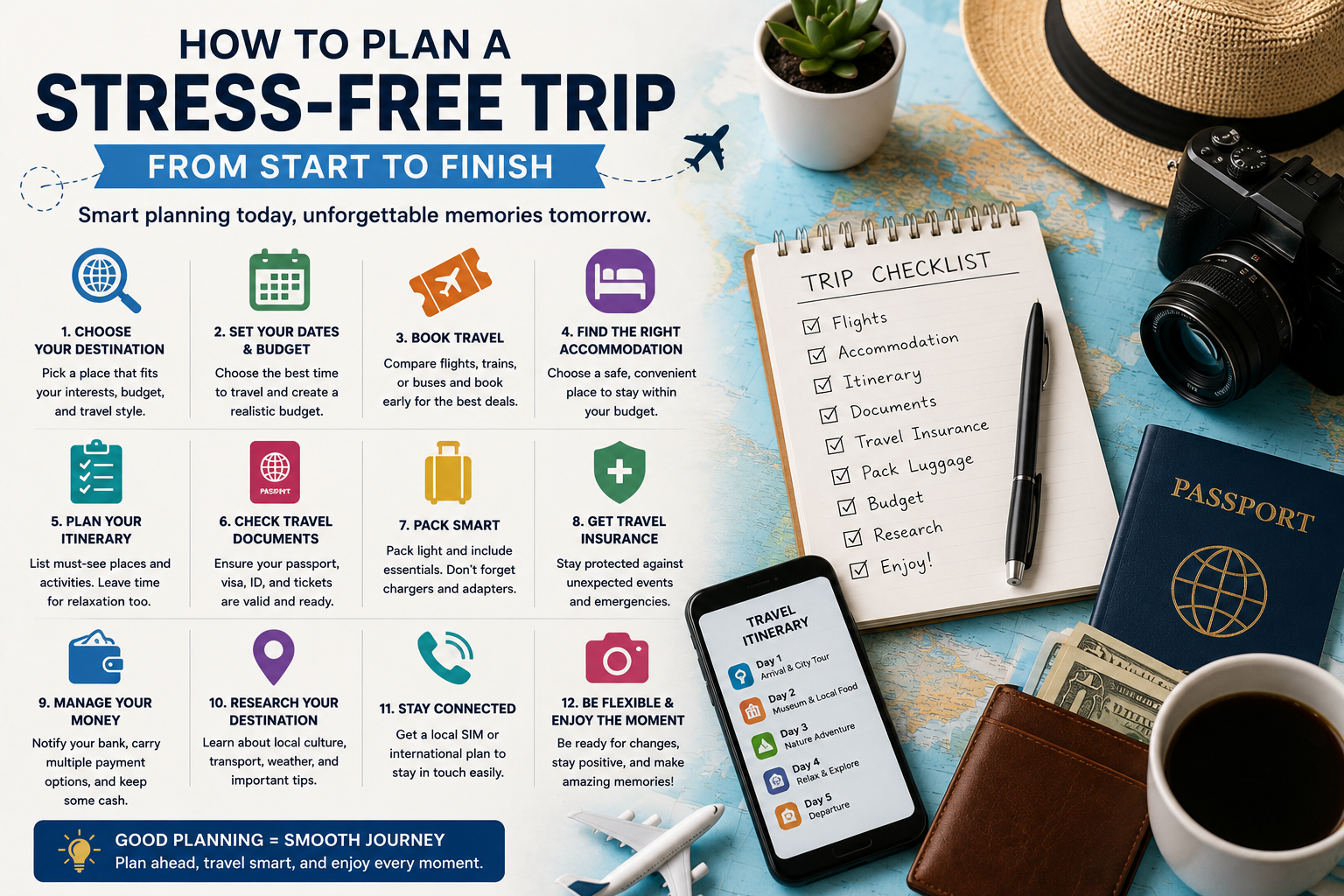
Travel can be exciting, refreshing, and memorable, but poor planning can turn even a promising trip into a stressful experience.
Missed connections, unexpected expenses, forgotten documents, overpacked luggage, unclear schedules, and last-minute decisions can make traveling more difficult than it needs to be.
The good news is that many common travel problems can be reduced with simple preparation.
A stress-free trip does not require planning every minute of your journey. In fact, an overly detailed itinerary can sometimes make travel feel more exhausting. The goal is to create enough structure to handle important arrangements while leaving room for flexibility.
Whether you are planning a short weekend getaway, a family vacation, a business trip, or a longer international journey, a thoughtful planning process can help you travel with greater confidence.
Why Travel Planning Matters
Travel involves multiple moving parts.
You may need to coordinate transportation, accommodation, documents, activities, meals, money, communication, and personal belongings.
If these details are handled at the last minute, small problems can quickly become stressful.
Planning ahead gives you time to:
Compare transportation options
Choose suitable accommodation
Check travel documents
Estimate expenses
Research the destination
Organize luggage
Create a flexible itinerary
Prepare for unexpected situations
Good planning does not guarantee that everything will go perfectly. Flights can be delayed, weather can change, and plans may need to be adjusted.
However, preparation can make it easier to deal with unexpected situations.
1. Decide What You Want From the Trip
Before booking anything, think about the purpose of your trip.
Are you traveling for:
Relaxation?
Adventure?
Family time?
Business?
Cultural experiences?
Nature?
Food?
Shopping?
Events?
A combination of several interests?
Your priorities should influence your destination, accommodation, budget, and itinerary.
For example, someone looking for a relaxing vacation may prefer fewer activities and more free time. Someone interested in sightseeing may want to stay closer to major attractions.
Defining your priorities early can prevent you from creating an itinerary that looks impressive but does not actually match what you want from the trip.
2. Choose the Right Destination
Choosing a destination involves more than looking at attractive photographs online.
Consider practical factors such as:
Weather
Travel time
Transportation
Accommodation costs
Local prices
Activities
Safety considerations
Entry requirements
Language
Local customs
Your available time
Think about whether the destination realistically fits your schedule.
If you only have a few days, spending most of that time traveling between locations may leave little time for enjoying the destination itself.
For shorter trips, convenience can sometimes be more valuable than trying to visit as many places as possible.
3. Choose the Right Time to Travel
The timing of your trip can affect prices, crowds, weather, and availability.
Before choosing dates, research the destination's typical conditions during that period.
Consider:
Weather patterns
Holiday periods
Peak travel seasons
Local events
School holidays
Transportation availability
Accommodation demand
Traveling during a quieter period may offer a different experience from visiting during the busiest season.
However, the best time depends on what you want to do.
If your trip depends on outdoor activities, weather may be particularly important. If you are primarily interested in museums, restaurants, or cultural attractions, seasonal considerations may be different.
4. Set a Realistic Travel Budget
One of the best ways to reduce travel stress is to understand your likely expenses before booking.
Create a rough budget for:
Transportation
Accommodation
Food
Local transportation
Activities
Entry fees
Shopping
Travel insurance
Visas or permits where applicable
Emergency expenses
Do not plan your budget around the cheapest possible scenario.
Unexpected costs can happen.
A small financial buffer can provide flexibility if transportation changes, prices increase, or an unplanned expense appears.
The exact budget will depend on the destination, travel style, length of stay, and number of travelers.
5. Research Transportation Options
Transportation can be one of the most important parts of a trip.
Compare different options based on more than price.
Consider:
Travel time
Number of connections
Departure and arrival times
Baggage policies
Cancellation or change conditions
Transportation between stations or airports
Convenience
The cheapest option is not always the best option.
A slightly more expensive route may be worthwhile if it reduces long connections or makes your arrival time more convenient.
When traveling internationally, also consider the time required for immigration, baggage collection, security procedures, and transportation to your accommodation.
6. Book Accommodation Carefully
Where you stay can have a major effect on your overall travel experience.
Before booking accommodation, consider:
Location
Price
Reviews
Transportation access
Check-in and check-out times
Room facilities
Cancellation conditions
Additional fees
Safety considerations
Distance from important places
A cheaper hotel far from the areas you plan to visit may not actually save money if you spend significant time and money traveling back and forth.
Read recent reviews carefully and look for recurring comments rather than relying only on the overall rating.
7. Check Your Travel Documents Early
Documents should be checked well before departure.
Depending on your trip, you may need:
Passport
Visa
Identification
Tickets
Accommodation confirmation
Travel insurance documents
Driving permit
Health-related travel documents where applicable
Copies of important documents
Check the entry requirements for your destination using official sources.
Do not assume that requirements are the same for every traveler.
If a passport needs to meet a minimum validity period, or a visa is required, discovering the issue shortly before departure can create significant stress.
8. Make Copies of Important Documents
Keep secure copies of important travel documents.
You can maintain digital copies in a secure location and carry appropriate physical copies when useful.
Important documents may include:
Passport
Visa
Insurance information
Booking confirmations
Emergency contacts
Identification
Transportation details
If your phone is lost or your luggage is delayed, having access to important information can make the situation easier to manage.
Avoid storing sensitive information carelessly or sharing it unnecessarily.
9. Create a Flexible Itinerary
A travel itinerary should provide structure without making every minute of your trip mandatory.
Start by listing the experiences that matter most.
Then organize them by:
Location
Opening hours
Travel time
Reservations
Priority
Avoid scheduling attractions on opposite sides of a city back-to-back if transportation between them will be difficult.
Also leave some free time.
You may discover an interesting neighborhood, find a restaurant you want to try, or simply want to rest.
Flexibility can make a trip feel less like a checklist and more like an experience.
10. Prioritize Activities
You do not need to see everything.
Before your trip, divide activities into three groups:
Must do
Experiences that are especially important to you.
Would like to do
Activities you would enjoy if time allows.
Optional
Things you can skip without feeling disappointed.
This simple system makes it easier to adjust your plans when something unexpected happens.
If you have limited time, focus on your highest priorities rather than trying to complete an exhausting list.
11. Make Reservations When Necessary
Some activities, restaurants, tours, transportation services, or attractions may require advance reservations.
Research which parts of your trip need to be booked ahead.
At the same time, avoid reserving every moment of every day.
Too many fixed reservations can make your schedule difficult to change.
Reserve the experiences that genuinely require advance planning and leave other parts flexible when possible.
12. Research Local Transportation
Understanding how you will move around after arrival can prevent unnecessary confusion.
Research:
Public transportation
Taxis
Ride services
Rental cars
Walking routes
Airport transfers
Train or bus connections
Find out how you will travel from the airport, station, or terminal to your accommodation.
Knowing this before arrival is particularly useful if you arrive late at night or in an unfamiliar place.
13. Download Useful Maps and Information
Internet access may not always be reliable.
Consider preparing offline access to important information when available.
Useful resources may include:
Maps
Hotel address
Transportation information
Booking confirmations
Emergency contacts
Important reservations
Write down or save the exact address of your accommodation.
If your phone loses connectivity, having the information available offline can be extremely useful.
14. Learn Basic Local Customs
Every destination has its own social norms and cultural expectations.
Research basic customs before traveling.
This may include:
Appropriate clothing
Greeting practices
Dining etiquette
Photography rules
Religious or cultural practices
Tipping expectations
Public behavior
Local laws
You do not need to become an expert before visiting another country.
Learning a few basic expectations can help you show respect and avoid uncomfortable misunderstandings.
15. Learn a Few Useful Local Phrases
If you are traveling somewhere where you do not speak the local language, learning a few basic phrases can be helpful.
Useful phrases may include:
Hello
Thank you
Please
Excuse me
Where is...?
How much does this cost?
I need help
I do not understand
Even when communication is possible through translation tools, making an effort to use simple local expressions can make interactions more pleasant.
16. Pack According to the Trip
Packing too much can make travel unnecessarily difficult.
Instead of packing for every possible situation, think about your actual itinerary.
Consider:
Weather
Length of stay
Activities
Dress requirements
Laundry availability
Luggage limits
Special equipment
Choose versatile clothing that can be used in multiple situations.
Before packing, check the baggage allowance for your transportation provider.
Avoid assuming that every airline, train operator, or transportation company has the same luggage rules.
17. Create a Packing Checklist
A checklist can prevent last-minute mistakes.
Divide your packing list into categories.
Documents
Passport
Identification
Tickets
Visa documents if applicable
Insurance information
Clothing
Everyday clothing
Appropriate footwear
Weather-appropriate layers
Sleepwear
Necessary personal items
Electronics
Phone
Chargers
Power adapter if needed
Portable battery where permitted
Personal items
Toiletries
Medications or necessary personal supplies
Glasses or contact-lens supplies if applicable
Travel essentials
Wallet
Keys
Important addresses
Emergency contact information
Check the list again before leaving home.
18. Prepare for the Weather
Weather can influence what you pack and what activities are practical.
Check a reliable forecast before departure, but also understand the destination's typical conditions for the season.
Bring appropriate clothing and footwear.
If the weather is unpredictable, layering can provide flexibility.
Do not build an itinerary that depends entirely on perfect weather unless you have backup options.
For outdoor activities, identify indoor alternatives where practical.
19. Plan for Communication
If you are traveling internationally, think about how you will stay connected.
Depending on the destination, options may include:
International roaming
Local SIM cards
eSIM services
Wi-Fi
Offline maps
Check your mobile provider's international policies before leaving.
Unexpected roaming charges can become an unpleasant surprise.
Also make sure you have access to important contact information if your internet connection becomes unavailable.
20. Think About Money
Travelers should plan how they will access money during their trip.
Depending on the destination, you may use:
Cards
Cash
Mobile payment systems
Local banking services
Before traveling, check whether your payment cards are suitable for international use and understand any applicable fees.
It can also be useful to have more than one payment method rather than relying entirely on a single card or device.
Keep financial information secure and avoid carrying more cash than necessary.
21. Consider Travel Insurance
Travel insurance may provide protection against certain unexpected events, depending on the policy.
Coverage can vary significantly.
Policies may address areas such as:
Trip cancellation
Travel interruption
Lost or delayed baggage
Medical emergencies
Transportation disruptions
Before purchasing a policy, read the terms carefully.
Understand exclusions, coverage limits, deductibles, and claim requirements.
Insurance is not a substitute for good planning, but appropriate coverage may provide additional protection against certain risks.
22. Prepare for Unexpected Delays
Travel rarely goes exactly according to plan.
Flights may be delayed. Roads may become congested. A reservation may be changed.
Build reasonable flexibility into your schedule.
Avoid scheduling an important event immediately after a tight connection if missing it would create major problems.
If you have a long journey, allow some recovery time after arrival rather than immediately planning an exhausting schedule.
23. Keep Important Items Accessible
Do not bury your passport, phone charger, wallet, medications, or other important items deep inside checked luggage.
Keep essential items accessible during transportation.
A small travel bag can hold the things you are most likely to need.
This can be particularly helpful during long journeys or when changing transportation.
24. Arrive Early for Important Departures
Give yourself enough time for airports, train stations, bus terminals, or other transportation hubs.
The appropriate arrival time depends on the type of transportation, location, and operator's instructions.
Follow the official guidance for your journey and consider additional time if you expect unfamiliar procedures or heavy crowds.
Rushing through a terminal can add unnecessary stress before the trip has even started.
25. Avoid Overplanning Your First Day
The first day of travel can be tiring.
After a long journey, you may need time to check in, eat, rest, and adjust to the new environment.
Instead of scheduling several major activities immediately after arrival, consider keeping the first day relatively light.
This can be especially helpful after overnight or long-distance travel.
26. Keep Emergency Information Available
Before traveling, prepare a list of important contacts.
This might include:
Family members
Travel companions
Accommodation
Insurance provider
Transportation provider
Local emergency services
Relevant embassy or consular information for international travelers
Save this information digitally and, where appropriate, keep an accessible backup.
27. Research Health and Safety Considerations
Different destinations can involve different practical health and safety considerations.
Before traveling, research reliable guidance relevant to your destination.
Depending on the trip, this may include:
Local healthcare access
Food and water considerations
Weather risks
Transportation safety
Recommended precautions
Entry requirements
For international travel, official government and health authorities can provide destination-specific information.
If you have personal medical needs, plan appropriately and carry necessary supplies according to applicable travel rules.
28. Do Not Share Too Much Information Publicly
Travelers should also consider personal privacy.
Avoid publicly sharing sensitive information such as:
Passport details
Booking confirmation numbers
Financial information
Home address
Security information
Be thoughtful about posting real-time information that reveals that your home is unoccupied.
Travel should be enjoyable, but basic digital and personal security should not be overlooked.
29. Leave Room for Spontaneity
Planning should make your trip easier, not remove all freedom.
Leave some unplanned time.
You might discover:
A local market
A quiet park
A neighborhood café
A cultural event
A scenic walking route
An interesting shop
Some of the best travel experiences happen when there is enough flexibility to explore.
30. Review Everything Before Departure
A few days before leaving, conduct a final review.
Check:
Documents
Passport, visa, identification, tickets, and necessary confirmations.
Money
Payment methods, cash where appropriate, and access to financial accounts.
Accommodation
Address, check-in instructions, and reservation details.
Transportation
Departure time, terminal or station, baggage requirements, and connections.
Packing
Clothing, chargers, personal items, and important documents.
Communication
Roaming, SIM or eSIM arrangements, and offline information.
Itinerary
Important reservations and priority activities.
This final review can catch small problems while there is still time to fix them.
A Simple Trip Planning Timeline
A practical planning timeline can make preparation easier.
Several Weeks Before
Choose the destination
Set a budget
Check travel documents
Research entry requirements
Book transportation
Reserve accommodation
One to Two Weeks Before
Plan major activities
Research local transportation
Check weather
Review travel insurance
Organize important documents
Make a packing list
A Few Days Before
Confirm bookings
Check transportation schedules
Prepare luggage
Arrange communication
Organize money
Download useful offline information
The Day Before
Complete your final packing
Check important documents
Confirm departure details
Charge necessary devices
Set alarms
Get adequate rest
On Travel Day
Leave with enough time
Keep important items accessible
Follow official transportation instructions
Stay flexible if delays occur
Common Travel Planning Mistakes to Avoid
Trying to Do Too Much
An itinerary packed with activities can become exhausting.
Ignoring Travel Time
Attractions may look close on a map but take significant time to reach.
Booking Without Checking Conditions
Review cancellation, baggage, and payment terms before confirming important bookings.
Forgetting Important Documents
Check requirements early rather than at the last minute.
Underestimating Expenses
Include transportation, food, activities, fees, and a reasonable emergency buffer.
Relying Entirely on Your Phone
Keep important information accessible offline or in another appropriate format.
Leaving Everything Until the Last Minute
Last-minute preparation increases the chance of forgetting something important.
How to Make Travel Less Stressful While You Are Away
Planning does not stop when you leave home.
During the trip:
Give yourself enough time between activities.
Check transportation information before leaving.
Keep your belongings organized.
Confirm important bookings.
Stay hydrated and take reasonable breaks.
Do not feel obligated to follow the itinerary perfectly.
Adjust your plans when circumstances change.
Keep important documents secure.
Remember that the purpose of travel is to experience the destination, not simply complete a checklist.
Final Thoughts
A stress-free trip does not require perfect planning.
It requires thoughtful preparation for the things that matter most.
Start by deciding what you want from the trip, choose a destination that fits your goals, establish a realistic budget, arrange transportation and accommodation, check travel documents, and create a flexible itinerary.
Prepare for practical details such as local transportation, weather, communication, money, and unexpected delays.
At the same time, leave room for rest and spontaneity.
The best travel plans provide enough structure to prevent avoidable problems while remaining flexible enough to accommodate real life.
With a little preparation, you can spend less time worrying about logistics and more time enjoying the journey.
Frequently Asked Questions
1. How do I plan a stress-free trip?
Start by choosing a suitable destination, setting a realistic budget, checking travel documents, booking transportation and accommodation, researching the destination, creating a flexible itinerary, and preparing for unexpected situations.
2. How far in advance should I plan a trip?
The ideal timeframe depends on the destination, travel season, trip length, and transportation. International trips and travel during busy periods generally benefit from earlier planning.
3. What should I consider when choosing a destination?
Consider your budget, available time, weather, transportation, activities, accommodation costs, entry requirements, local customs, and the type of experience you want.
4. How can I create a realistic travel budget?
Estimate transportation, accommodation, food, local transportation, activities, fees, insurance, and other expected expenses. Include some additional money for unexpected costs.
5. Should I plan every day of my trip?
Not necessarily. Plan important activities and reservations, but leave free time for rest, unexpected discoveries, and schedule changes.
6. What documents should I check before international travel?
Depending on the destination and your circumstances, you may need a valid passport, visa, identification, tickets, accommodation information, insurance documents, and other required documentation. Always check current requirements through appropriate official sources.
7. How can I avoid overpacking?
Pack according to your itinerary, weather, activities, and luggage allowance. Choose versatile clothing and create a checklist so you can avoid bringing unnecessary items.
8. Should I buy travel insurance?
Travel insurance can provide coverage for certain unexpected events, but coverage varies between policies. Read the policy carefully and consider whether the coverage fits your trip and circumstances.
9. How can I prepare for travel delays?
Leave reasonable time between connections, avoid overly tight schedules, keep important information accessible, and understand the change or cancellation policies associated with your transportation and bookings.
10. What should I do on the first day of a trip?
Consider keeping your first day relatively flexible, especially after a long journey. Allow time for transportation, check-in, meals, rest, and adjusting to your surroundings.
11. How can I save money while traveling?
Set a budget, compare transportation and accommodation options, research local prices, avoid unnecessary fees, plan major expenses, and prioritize activities that matter most to you.
12. How can I stay organized while traveling?
Keep important documents together, use a packing checklist, save booking information in an accessible location, organize your luggage, and review your schedule regularly.
13. Should I use cash or cards when traveling?
The best option depends on the destination. Research local payment practices and consider having more than one payment method available rather than relying entirely on a single option.
14. How can I stay connected during international travel?
Depending on your destination and mobile provider, options may include roaming, local SIM cards, eSIM services, or Wi-Fi. Check costs and availability before departure.
15. How can I make a family trip less stressful?
Plan around everyone's needs, allow extra time, choose suitable accommodation, avoid overly packed schedules, prepare necessary items in advance, and involve family members in age-appropriate planning decisions.
16. How can I handle unexpected changes to my itinerary?
Focus on the most important priorities first. Check available alternatives, communicate with transportation or accommodation providers when necessary, and adjust less important activities rather than trying to preserve the original schedule at all costs.
17. Is it better to travel with a detailed itinerary or a flexible one?
A combination is often useful. Book essential transportation and reservations in advance while leaving some time open for flexibility.
18. What is the biggest travel planning mistake?
One common mistake is trying to schedule too much without considering travel time, rest, unexpected delays, or changing circumstances.
19. How can I make sure I do not forget anything?
Use a checklist covering documents, money, clothing, electronics, personal items, medications or necessary supplies, and travel confirmations. Review it again shortly before departure.
20. What is the key to a stress-free trip?
Prepare for important details without trying to control everything. A realistic budget, organized documents, sensible scheduling, appropriate research, and flexibility can make travel much easier and more enjoyable.