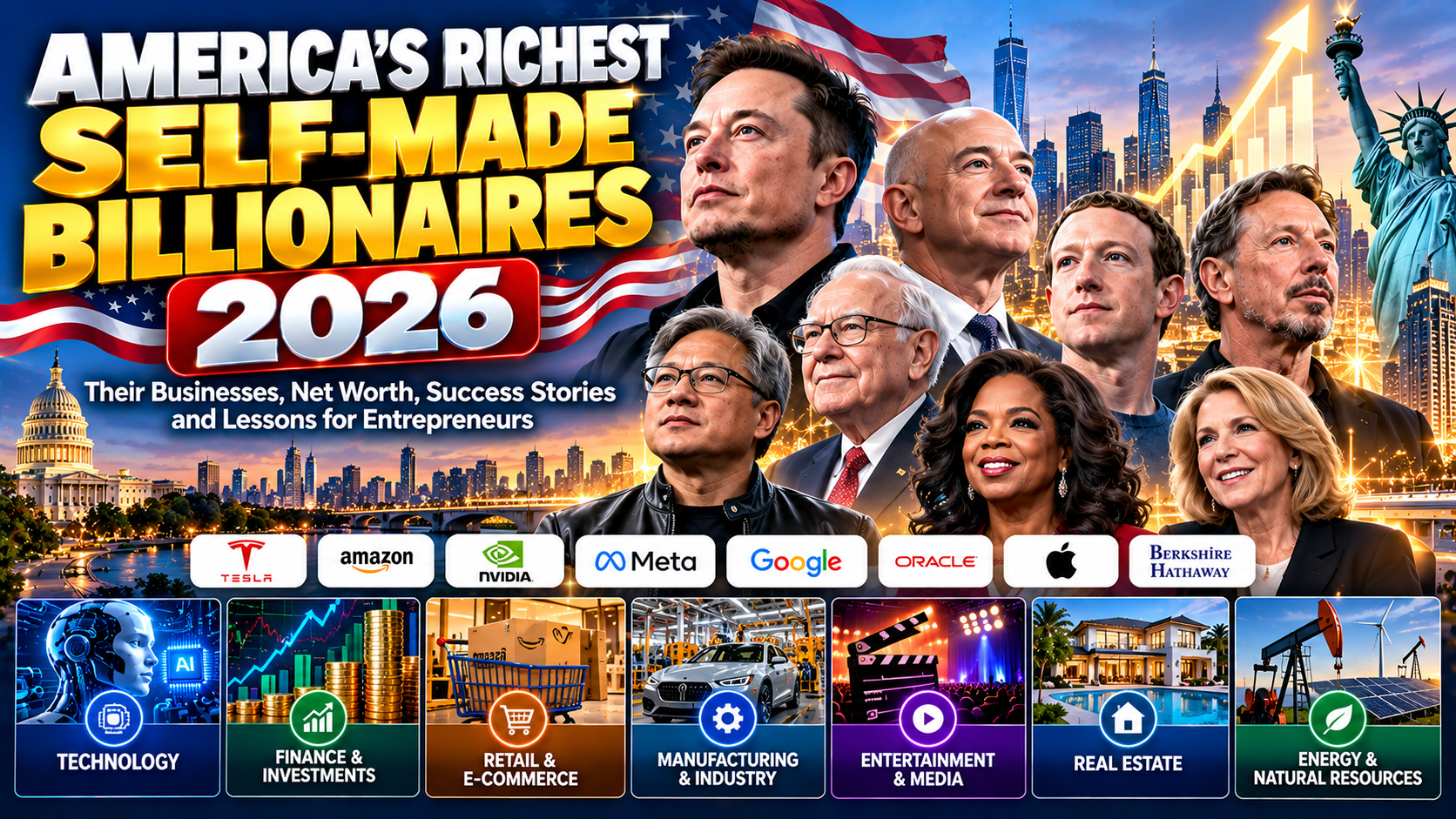
America has produced some of the world's most influential entrepreneurs, investors, technology founders, entertainers, and business leaders. Many of these individuals transformed relatively modest beginnings into extraordinary fortunes by identifying opportunities, developing innovative products, building companies, and taking calculated financial risks.
In 2026, self-made wealth continues to attract attention as artificial intelligence, financial markets, digital businesses, entertainment, manufacturing, and energy create new opportunities for entrepreneurs. While some wealthy Americans inherited established businesses or family fortunes, others built their wealth primarily through their own professional achievements and business ventures.
According to Forbes' 2026 reporting, America's wealthiest individuals collectively hold enormous fortunes, with technology and finance playing particularly important roles. Its Self-Made 250 also recognizes Americans who built successful careers and businesses despite significant obstacles. These lists illustrate that self-made success can take many forms, although it is important to recognize that access to education, capital, networks, and opportunity differs considerably from person to person. (Forbes Self-Made 250; Forbes 400 reporting)
This guide explores notable self-made American billionaires, the businesses behind their wealth, the industries creating new fortunes, and the lessons entrepreneurs can learn from their journeys.
What Does Self-Made Billionaire Mean?
A self-made billionaire is generally someone who accumulated a substantial personal fortune through business ownership, investments, professional achievements, or other activities rather than inheriting most of their wealth.
However, the term does not mean every successful entrepreneur started with absolutely nothing. Some founders had access to university education, early investors, professional connections, or financial support. Others overcame poverty, discrimination, unstable housing, or limited opportunities.
Forbes uses a self-made score ranging from 1 to 10 in its billionaire profiles. The scale distinguishes people who largely inherited their fortunes from those who built wealth through their own efforts and ventures. (Forbes Real-Time Billionaires)
Understanding this distinction is essential when examining America's wealthiest people. A billionaire's net worth tells us how much wealth they hold, but it does not independently explain their starting point, the risks they took, the support they received, or the wider economic circumstances that contributed to their success.
1. Elon Musk: Building Wealth Through Technology and Innovation
Elon Musk is among the most prominent self-made entrepreneurs in the United States. His businesses operate across electric vehicles, space technology, artificial intelligence, and digital communication.
Musk was born in South Africa and later moved to North America to pursue educational and business opportunities. His early ventures included Zip2, a software company that provided online business directories and maps, and X.com, an online financial services company that became part of PayPal.
After the sale of PayPal, Musk directed significant resources toward new ventures. He became a central figure in Tesla's growth and founded SpaceX in 2002. Tesla helped bring electric vehicles into mainstream consumer markets, while SpaceX developed reusable rockets and commercial space-launch services.
His business interests subsequently expanded into artificial intelligence and other technology projects. These companies operate in capital-intensive industries where research, engineering, infrastructure, and manufacturing require substantial investment.
How Did Musk Build His Fortune?
Musk's wealth is primarily connected to ownership stakes in companies rather than a conventional salary. When the market valuation of a company increases, the estimated value of an owner's shares can increase as well. The opposite is also true: falling valuations can reduce an owner's net worth significantly.
His business journey illustrates several important characteristics of technology entrepreneurship:
Investing in products that require long-term research and development.
Building businesses around major technological changes.
Reinvesting resources to expand production and infrastructure.
Accepting substantial financial and operational risks.
Using ownership stakes to participate in potential company growth.
Musk's experience also demonstrates that a high company valuation does not necessarily mean an entrepreneur has an equivalent amount of cash available to spend.
2. Jeff Bezos: From an Online Bookstore to a Global Business
Jeff Bezos founded Amazon in 1994. The business began as an online bookstore and gradually expanded into a vast e-commerce platform serving customers across numerous product categories.
Amazon's development extended beyond retail. The company built logistics networks, fulfillment centers, subscription services, advertising operations, and cloud computing infrastructure. Amazon Web Services, commonly known as AWS, became an important part of the company's technology business.
Bezos stepped down as Amazon's chief executive in 2021 and became executive chairman. He also founded Blue Origin, a company focused on space technology, and acquired The Washington Post.
What Made Amazon Different?
Amazon's growth was supported by several interconnected strategies:
Customer convenience: The company invested in making online shopping easier through product selection, delivery services, and digital purchasing tools.
Infrastructure: Warehouses, transportation networks, software systems, and cloud computing facilities allowed Amazon to serve a growing customer base.
Long-term investment: Rather than concentrating exclusively on immediate profits, Amazon invested heavily in expanding its operations and developing new services.
Multiple revenue streams: Retail, cloud computing, advertising, and subscriptions gave the company different sources of revenue.
Bezos's story demonstrates how a business can grow when its original product becomes part of a broader ecosystem. It also shows the importance of execution: a large market opportunity alone does not guarantee that a company will succeed.
3. Larry Ellison: The Software Entrepreneur Behind Oracle
Larry Ellison built much of his fortune through Oracle, the enterprise software company he co-founded in 1977.
Oracle became a major provider of database technology and business software. Its products help organizations store, manage, analyze, and protect information. Over time, the company expanded into cloud infrastructure, enterprise applications, and services for large organizations.
Ellison's success reflects the importance of solving complex problems for businesses. Companies depend on reliable databases and software systems to manage customers, payments, inventory, operations, and other critical information.
The Business Model Behind Oracle
Enterprise software often differs from consumer technology. Instead of selling a single product to millions of individual buyers, enterprise companies may provide complex systems and ongoing services to businesses that need long-term technical support.
Oracle's business model includes software licenses, subscriptions, cloud services, and enterprise technology solutions. These offerings can create continuing customer relationships, although competition, technology changes, and customer migration remain important business risks.
Ellison's career illustrates how specialized technology can become the foundation of a large company when it addresses essential business needs.
4. Mark Zuckerberg: Turning a Social Network Into a Technology Empire
Mark Zuckerberg co-founded Facebook in 2004 while studying at Harvard University. The platform expanded from a university-focused social network into a global service used for communication, content sharing, communities, and advertising.
Facebook's parent company, Meta Platforms, operates Facebook, Instagram, WhatsApp, and other technology products. Advertising has historically been a major source of revenue, supported by systems that help businesses reach audiences across its platforms.
Meta has also invested in artificial intelligence, virtual and augmented reality, and other emerging technologies.
How Social Media Created Billionaire Wealth
Social media businesses benefit from network effects. As more people join a platform, it can become more useful to users, creators, and advertisers. However, maintaining that network requires ongoing investment in technology, safety, content moderation, and product development.
Zuckerberg's wealth is closely tied to his ownership of Meta. Its share price can influence his estimated net worth even when his personal cash holdings do not change by the same amount.
His story demonstrates the commercial value of digital platforms, while also highlighting challenges such as privacy concerns, regulatory scrutiny, changing user preferences, and competition for advertising budgets.
5. Larry Page and Sergey Brin: Creating Google
Larry Page and Sergey Brin met while studying at Stanford University and developed the search technology that became Google. The company was founded in 1998 and eventually became one of the most influential businesses in digital technology.
Google transformed how people find information online. Its business expanded into advertising, email, maps, mobile operating systems, video platforms, cloud computing, and artificial intelligence.
The company is now part of Alphabet, a holding company that oversees Google's major businesses and other technology ventures.
The Power of Solving a Large Problem
Search engines address a basic but enormous challenge: helping people find relevant information among billions of web pages.
Google's search business grew by connecting user intent with advertising opportunities. Businesses could reach people searching for particular products, services, or information, creating a commercial model that supported continued product development.
Page and Brin demonstrate how a technical idea can grow into a major enterprise when paired with effective distribution, infrastructure, product improvement, and a sustainable revenue model.
The broader lesson for entrepreneurs is that a business does not always need to invent an entirely new human need. It can create substantial value by solving an existing problem more effectively.
6. Jensen Huang: The Artificial Intelligence Chip Pioneer
Jensen Huang co-founded Nvidia in 1993 and serves as its chief executive. Nvidia originally became widely known for graphics processing units, or GPUs, used in computer graphics and gaming.
Over time, GPUs became increasingly important for parallel computing, scientific research, data centers, and artificial intelligence. Modern AI systems require substantial computing power for model training and deployment, making advanced chips and supporting software strategically important.
Why AI Has Changed Nvidia's Business
Artificial intelligence has created demand for specialized computing infrastructure. This includes chips, networking equipment, software tools, and complete systems designed to run demanding workloads.
Nvidia has built an ecosystem around its hardware and software, helping developers and organizations create and operate AI applications.
Huang's career illustrates how a company can benefit when technology developed for one purpose becomes useful in a much larger market. It also demonstrates the importance of building an ecosystem rather than relying exclusively on selling a single product.
Nevertheless, the AI industry remains competitive. Future demand, export restrictions, supply chains, rival chipmakers, and the economics of AI infrastructure can all influence business performance.
7. Michael Dell: Growing a Computer Company From a Small Operation
Michael Dell founded Dell Technologies in 1984 while attending the University of Texas at Austin. His original business focused on building and selling personal computers directly to customers.
The direct-sales model helped the company connect with buyers while managing inventory and responding to customer needs. Dell later expanded into enterprise servers, storage systems, IT services, and infrastructure used by businesses.
The Importance of Operations
Dell's story highlights a side of entrepreneurship that receives less attention than flashy product launches: operational efficiency.
Successful businesses must coordinate manufacturing, procurement, inventory, logistics, pricing, customer support, and distribution. Even a good product can fail commercially if these processes are poorly managed.
Dell also shows how entrepreneurs can begin with a focused business model and expand into related markets as customer needs change.
The broader lesson is that operational excellence can be a source of competitive advantage, especially in industries where cost, reliability, and delivery times matter.
8. Warren Buffett: Building Wealth Through Investing
Warren Buffett is one of America's most recognized investors. Through Berkshire Hathaway, he built a large investment and operating business with interests across insurance, energy, rail transportation, manufacturing, and consumer products.
Buffett became known for studying companies, evaluating their financial strength, and seeking businesses that could create value over long periods.
His wealth-building approach differs from that of entrepreneurs whose fortunes come primarily from founding technology companies. Buffett's fortune grew through investment ownership, business acquisitions, and the long-term compounding of capital.
What Is Compounding?
Compounding occurs when investment gains remain invested and can generate additional returns over time. For example, when an investment earns a return, future gains may be calculated on both the original capital and previous gains.
Compounding can be powerful over long periods, but investment returns are not guaranteed. Businesses can lose value, markets can decline, and investors can make poor decisions.
Buffett's career highlights several widely discussed investment principles:
Understand the business before investing.
Evaluate financial performance and competitive advantages.
Consider the price paid for an investment.
Avoid relying on short-term market predictions.
Recognize the importance of patience and risk management.
His journey shows that building wealth does not always require inventing a product. Capital allocation and business evaluation can also create substantial long-term value.
9. Oprah Winfrey: Building a Media and Entertainment Empire
Oprah Winfrey is one of America's best-known self-made media entrepreneurs. She grew up in poverty in rural Mississippi and later built a career in broadcasting that developed into a broader media business.
Her national success accelerated when she took over a Chicago morning talk show in 1984. The program became highly influential, helping establish her as a major television personality.
Winfrey expanded beyond presenting into production, publishing, film, and other media ventures. Her business activities included the creation of Harpo Productions and the development of a recognizable personal brand.
Turning Audience Trust Into a Business
Media businesses depend on audience attention, but sustained success also requires credibility, content quality, distribution, and commercial partnerships.
Winfrey's career demonstrates how a professional skill can become the foundation for a wider enterprise. Her communication ability helped her develop an audience, while ownership and production opportunities allowed her to participate in projects beyond her work as a presenter.
Her experience is also a reminder that a successful brand can create opportunities across several industries. However, personal branding must be supported by consistent quality and a clear connection with the audience.
10. Diane Hendricks: Building a Fortune in Building Materials
Diane Hendricks is a prominent American businesswoman and the co-founder of ABC Supply, a major distributor of roofing, siding, windows, and other exterior building products.
Her career offers a different perspective on self-made wealth. Unlike technology founders who build digital platforms, Hendricks developed a business serving contractors and construction professionals.
ABC Supply operates in a market where dependable distribution, product availability, supplier relationships, and customer service can make a significant difference.
Why Traditional Industries Still Create Wealth
Entrepreneurs sometimes assume that the largest opportunities exist only in software or artificial intelligence. In reality, essential industries can also produce large businesses.
Construction-related markets require materials, equipment, transportation, warehousing, and specialized distribution. A company that consistently serves these needs can establish durable customer relationships.
Hendricks's success demonstrates that business opportunities can exist in established markets, especially when a company improves the way products are sourced and delivered.
According to Forbes' 2026 coverage of the Forbes 400, Hendricks remained America's richest self-made woman on that year's list. Net worth estimates depend on the valuation date and the assets included in the calculation. (Forbes 400 reporting)
11. Jan Koum: From Public Assistance to a Major Technology Exit
Jan Koum immigrated to the United States from Ukraine with his family and experienced financial hardship while growing up. He later developed technical skills and worked in the technology industry before co-founding WhatsApp with Brian Acton in 2009.
WhatsApp focused on simple messaging that allowed people to communicate over the internet. Its growth reflected the increasing global demand for mobile communication, especially as smartphones became more common.
In 2014, Facebook announced its agreement to acquire WhatsApp in a transaction valued at approximately $19 billion at the time of the announcement. The final value of such deals can differ from the headline amount because of stock-price movements, cash components, and other transaction terms.
The Value of a Simple Product
WhatsApp's early appeal came from making messaging straightforward and accessible. It addressed a familiar need while benefiting from smartphone adoption and international communication trends.
Koum's journey illustrates how software can reach a large market without requiring a complicated product interface. A focused product, strong user experience, and reliable technical infrastructure can help a business grow rapidly.
However, user growth alone is not sufficient. Technology businesses must also address security, reliability, monetization, competition, and regulatory requirements.
12. Shahid Khan: From an Immigrant Student to an Industrial Entrepreneur
Shahid Khan immigrated to the United States from Pakistan as a young man. He studied industrial engineering at the University of Illinois and began his professional career in manufacturing.
Khan later purchased Flex-N-Gate, an automotive supplier that produces components for vehicle manufacturers. Under his ownership, the business expanded substantially.
He also became a prominent sports owner, including ownership of the Jacksonville Jaguars in the National Football League and Fulham Football Club in England.
Building Wealth in Manufacturing
Manufacturing businesses often require expertise in engineering, quality control, supply chains, capital investment, and relationships with major customers.
Automotive suppliers must meet demanding production schedules and technical specifications. They also operate in an industry affected by vehicle sales, production costs, changing technology, and the transition toward electric vehicles.
Khan's career illustrates how technical knowledge and business ownership can combine to create a large enterprise. It also demonstrates that entrepreneurship can lead to opportunities in adjacent industries, including professional sports.
13. LeBron James: An Athlete Who Built a Business Portfolio
LeBron James is widely known for his basketball career, but his business activities have also made him an important example of modern athlete entrepreneurship.
Growing up in difficult circumstances, James became a professional basketball player after being selected first overall in the 2003 NBA Draft. His athletic achievements created commercial opportunities through contracts, endorsements, media projects, and investments.
Over time, his business interests expanded beyond traditional sponsorships. His activities have included entertainment production and partnerships involving consumer brands.
How Athletes Build Wealth Beyond Their Salaries
Professional athletes can earn significant income, but their careers are often relatively short compared with a conventional working life. Financial planning and business ownership can therefore play important roles in long-term wealth creation.
Athletes may diversify their income through:
Endorsement agreements and licensing.
Investments in companies.
Media and entertainment production.
Ownership interests in businesses.
Brand partnerships and other commercial ventures.
James's experience shows how professional success can create a platform for entrepreneurship. It also highlights the difference between earning a high income and building lasting wealth: the latter often depends on managing expenses, evaluating investments, and developing income sources beyond an active sporting career.
14. Tyler Perry: Turning Creative Work Into a Business
Tyler Perry built a successful career as a writer, actor, director, and producer. His early years included financial hardship and periods of housing instability.
Perry initially developed an audience through stage plays and characters that resonated with specific communities. He later expanded into films and television projects.
A defining part of his business success has been ownership and production infrastructure, including Tyler Perry Studios in Atlanta.
Why Ownership Matters in Entertainment
Entertainment professionals may earn money from acting fees, production agreements, licensing, distribution, and intellectual property. The financial outcome can differ significantly depending on whether a creator merely works on a project or also owns rights to it.
Ownership can provide opportunities to benefit from a successful project over time. However, it can also involve production expenses, distribution risks, and substantial upfront investment.
Perry's career illustrates how creative skills can become the foundation of a broader company when paired with production capacity, audience knowledge, and business management.
15. Howard Schultz: Expanding Starbucks Into a Global Brand
Howard Schultz grew up in public housing in Brooklyn, New York, and later became associated with the growth of Starbucks into a global coffee business.
After joining Starbucks in the early 1980s, Schultz became interested in the Italian coffeehouse experience and envisioned a business built around more than selling coffee beans. He later helped expand the company's retail coffeehouse model.
Starbucks developed a recognizable customer experience through store design, product consistency, brand identity, and convenience.
Creating a Repeat-Customer Business
A company that depends on repeat customers must deliver a reliable experience. Product quality, service, location, pricing, and brand recognition all influence whether customers return.
Starbucks' growth demonstrates how a business can expand a familiar product category through positioning and customer experience. It also shows that scaling a retail brand requires operational systems, employee training, supply chains, and consistent standards across locations.
Schultz's story is useful for entrepreneurs because it emphasizes the importance of understanding what customers value beyond the core product itself.
Which Industries Produce America's Self-Made Billionaires?
America's largest fortunes are spread across multiple sectors. Technology and finance are particularly prominent, but manufacturing, retail, construction, entertainment, and energy also create substantial business opportunities. Recent analysis of the 2026 Forbes 400 highlights the range of industries represented among wealthy Americans. (Business Insider's industry analysis)
Technology and Artificial Intelligence
Technology companies can scale products to millions of users, and some software businesses generate recurring revenue through subscriptions or enterprise contracts.
AI has increased interest in chips, cloud computing, data centers, cybersecurity, and automation. Entrepreneurs entering these markets still need to solve real customer problems and build commercially sustainable products.
Finance and Investment
Investors, fund managers, and financial entrepreneurs can build wealth by managing capital, acquiring businesses, or creating financial services.
Success depends on factors such as investment discipline, risk management, market conditions, and the ability to evaluate opportunities accurately. Financial losses are possible, and historical performance does not guarantee future results.
Retail and E-Commerce
Retail entrepreneurs can build businesses by offering desirable products, effective distribution, recognizable brands, and convenient purchasing experiences.
E-commerce has lowered some barriers to reaching customers, but competition, advertising costs, returns, inventory, and shipping can make profitability difficult.
Manufacturing and Industrial Services
Manufacturers and distributors supply essential products to other businesses and consumers. Their competitive advantages may come from technical knowledge, production efficiency, reliable delivery, and strong customer relationships.
These businesses may require substantial capital, but they can also build long-term relationships with customers.
Entertainment, Sports, and Media
Athletes, performers, producers, and media entrepreneurs can build wealth through contracts, intellectual property, brand partnerships, production businesses, and investments.
The strongest long-term business opportunities often involve converting temporary attention into durable assets, although entertainment income can be unpredictable.
Energy and Natural Resources
Energy companies can generate significant wealth through exploration, production, infrastructure, and services. However, they face commodity-price volatility, regulatory changes, environmental requirements, and major capital needs.
Harold Hamm, for example, built his fortune in the oil industry after starting a trucking business serving oilfields. His journey is featured in Forbes' 2026 Self-Made 250. (Forbes Self-Made 250)
What Can Entrepreneurs Learn From Self-Made Billionaires?
The stories of wealthy American entrepreneurs reveal several recurring business principles. These principles are useful for understanding business growth, but they should not be interpreted as a guaranteed formula for becoming rich.
1. Solve a Real Problem
Many successful businesses began by addressing a practical need. Amazon made online shopping more accessible, Google improved information discovery, and WhatsApp simplified digital communication.
A business idea becomes more valuable when customers are willing to pay for the solution or when a sustainable business model can be built around it.
2. Build Skills Before Scaling
Technical knowledge, sales, financial management, product design, and leadership can all help entrepreneurs make better decisions.
Founders do not need to master every skill themselves, but they need to understand the key parts of their businesses and recruit people who can fill important gaps.
3. Understand the Numbers
Revenue is not the same as profit, and profit is not the same as cash flow. Businesses must account for operating expenses, taxes, debt, inventory, marketing, and other costs.
A growing company can still struggle financially if customers pay late or expenses rise faster than sales.
4. Focus on Customers
Businesses need to understand who their customers are, what those customers value, and why they would choose one product over another.
Customer feedback, repeat purchases, product quality, and reliable service can provide useful signals about whether a business is solving the right problem.
5. Reinvest Carefully
Many entrepreneurs invest in product development, infrastructure, employees, marketing, and distribution to expand their businesses.
However, reinvestment should be based on evidence and financial capacity. Spending more does not automatically produce growth, and excessive borrowing can put a business at risk.
6. Think Beyond One Source of Income
Some wealthy entrepreneurs build a company and later invest in other businesses or assets. Diversification can reduce dependence on a single source of income, although it cannot eliminate all financial risk.
For a new entrepreneur, the priority is often to establish a sustainable core business before taking on complex investments.
7. Recognize the Role of Opportunity and Timing
Hard work matters, but success also depends on market conditions, access to resources, competition, timing, and luck.
A business may succeed because its product meets demand at the right moment. Another business with a strong idea may struggle because of insufficient funding, a shrinking market, or unexpected external events.
Understanding these factors gives a more realistic view of entrepreneurship than attributing every success to individual effort alone.
Are America's Richest Self-Made Billionaires All Entrepreneurs?
No. Entrepreneurs are an important group among self-made billionaires, but they are not the only people who can accumulate substantial wealth.
Investors can build fortunes by allocating capital effectively. Entertainers can become wealthy through ownership of production companies and intellectual property. Athletes can expand their earnings through business ventures, while industrial leaders can build large companies by improving manufacturing and distribution.
The common factor is not one particular career. It is the accumulation of valuable assets or ownership interests over time.
Some individuals create companies from the beginning. Others acquire existing businesses, develop a professional brand, or invest in enterprises founded by other people.
Is Becoming a Billionaire Realistic for an Average Entrepreneur?
Becoming a billionaire is an exceptionally rare outcome. Most businesses do not reach that scale, and many entrepreneurs never become wealthy even when they work hard.
However, the underlying principles of entrepreneurship can still be useful for people pursuing more attainable goals, such as starting a profitable small business, increasing household income, building savings, or creating a company that supports employees.
A practical starting point is to identify a specific customer problem, test demand at a manageable cost, track the financial results, and expand only when there is evidence that the business model works.
For example, an entrepreneur might begin with a specialized online service, develop a small customer base, and improve the offer based on feedback. Growth could then come through referrals, partnerships, repeat business, or new products.
This approach does not guarantee success, but it allows a person to learn and make decisions without assuming that a billion-dollar outcome is necessary for a business to be worthwhile.
Frequently Asked Questions
Who is America's richest self-made billionaire in 2026?
Elon Musk was at the top of major 2026 billionaire rankings for much of the year. Exact rankings and net worth estimates can change with market prices and valuation updates. Check the Forbes Real-Time Billionaires list for its latest figures.
Who is the richest self-made woman in America?
Forbes' 2026 Forbes 400 reporting identified Diane Hendricks as the richest self-made woman on that list. Her wealth is associated with ABC Supply, the building-products distribution business she co-founded. Rankings depend on the publication's methodology and valuation date.
How do self-made billionaires make their money?
They commonly build wealth through ownership stakes in companies, investments, business acquisitions, intellectual property, or other assets. Their net worth generally reflects the estimated value of those assets minus liabilities, rather than cash held in a bank account.
Which industry creates the most self-made billionaires?
Technology and finance are among the most important sources of large American fortunes. Other industries—including retail, manufacturing, energy, construction, and entertainment—also produce wealthy business owners.
Can a small business owner become a billionaire?
It is possible, but extremely uncommon. Reaching that level generally requires ownership of assets or a business with enormous value. Most small businesses aim for profitability, stability, and sustainable growth rather than billionaire-scale valuations.
Are self-made billionaires completely self-made?
The term describes how a person's wealth was primarily accumulated, not whether they received any help. Entrepreneurs may benefit from education, family support, professional networks, investors, employees, and favorable market conditions. Their achievements can be significant while still being influenced by these factors.
Why do billionaire net worth figures change?
Many billionaires own shares in publicly traded companies or private businesses. Their estimated fortunes can change as share prices, company valuations, exchange rates, debt, and other asset values change.
Conclusion
America's richest self-made billionaires have accumulated wealth through different paths. Elon Musk and Jensen Huang built businesses associated with major technological changes, Jeff Bezos expanded online retail into a global ecosystem, and Larry Page and Sergey Brin helped transform internet search. Warren Buffett built a fortune through investing, while Oprah Winfrey, Tyler Perry, LeBron James, Diane Hendricks, and Shahid Khan demonstrate how wealth can also emerge from media, sports, construction distribution, and manufacturing.
Their stories reveal that large fortunes rarely come from one decision alone. Building a successful business often requires a valuable idea, effective execution, financial discipline, customer understanding, and the ability to adapt as markets change.
For aspiring entrepreneurs, the most useful lesson is not to copy a billionaire's exact career path. It is to identify a meaningful problem, develop valuable skills, understand the economics of a business, and make decisions based on evidence.
Self-made success is possible, but it is neither easy nor guaranteed. Studying how wealthy entrepreneurs built their companies can provide practical insights into innovation, ownership, risk, and long-term business growth.