
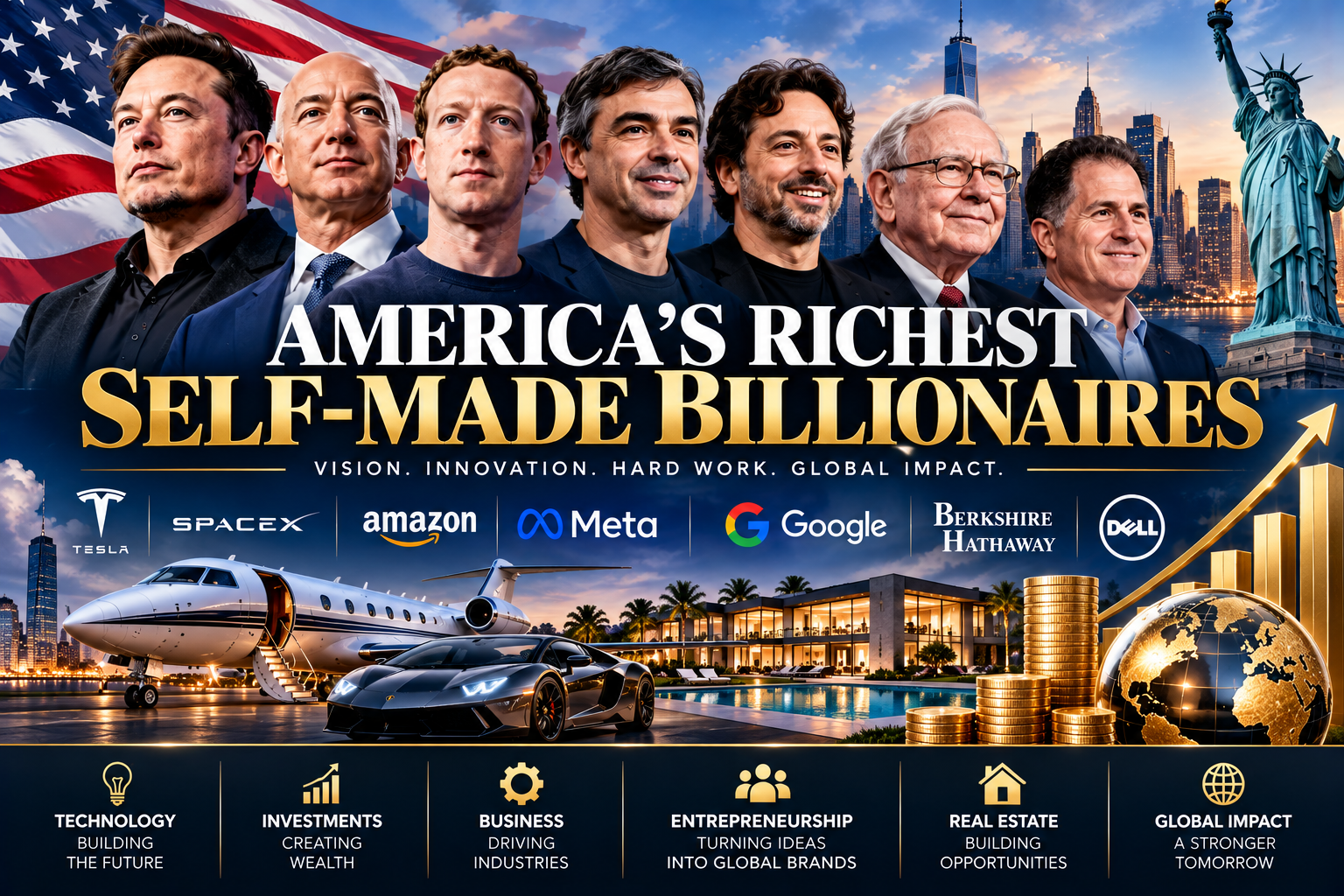
America has produced some of the most successful entrepreneurs, technology founders, investors, and business leaders in the world. Many of the country’s wealthiest individuals built their fortunes through companies they founded or helped develop rather than inheriting the majority of their wealth.
The 2026 Forbes 400 highlights the scale of self-made wealth in the United States. According to Forbes, 71% of people on the 2026 Forbes 400 are considered self-made, meaning they built their fortunes rather than primarily inheriting them. The combined wealth of the Forbes 400 reached approximately $8 trillion in 2026.
Among the most prominent self-made American billionaires are entrepreneurs such as Elon Musk, Larry Page, Michael Dell, Sergey Brin, Warren Buffett, and other founders and investors whose fortunes were created through technology, finance, manufacturing, retail, and other industries.
What Does “Self-Made” Mean?
The term “self-made” generally refers to individuals who built substantial fortunes through their own businesses, investments, careers, or entrepreneurial activities rather than receiving most of their wealth through inheritance.
Forbes uses a self-made classification as part of its billionaire research. Its methodology distinguishes between inherited fortunes and wealth generated through business ownership, entrepreneurship, investments, and other activities.
Being self-made does not necessarily mean starting with no advantages. Some entrepreneurs had access to education, family support, professional networks, or early opportunities. The term primarily describes the origin of their wealth rather than suggesting that every individual began with identical circumstances.
Elon Musk: Technology, Space and Electric Vehicles
Elon Musk is currently one of the most prominent examples of self-made wealth in America.
His fortune is closely connected to companies including Tesla and SpaceX, as well as other technology ventures. Forbes lists Musk as self-made and identifies Tesla and SpaceX as major sources of his wealth.
Musk became involved with Tesla in its early development and has served as its CEO since 2008. SpaceX, founded in 2002, became another major part of his business empire.
His companies operate across several high-growth industries, including electric vehicles, aerospace, artificial intelligence, and advanced technology.
Musk's story demonstrates how ownership in rapidly growing companies can create enormous personal wealth when the value of those businesses increases.
Larry Page: Building Google
Larry Page is another major example of self-made American wealth.
Page co-founded Google with Sergey Brin while they were students at Stanford University. Google eventually became one of the world's largest technology companies and later became part of Alphabet.
Forbes estimated Page's wealth at approximately $278 billion for the 2026 Forbes 400, placing him among America's wealthiest individuals. Forbes attributed much of the increase in his fortune to the rise in Alphabet's share price and strong performance in areas including Google Cloud and artificial intelligence.
Page's journey illustrates how creating technology infrastructure used by billions of people can generate extraordinary economic value.
Michael Dell: From College Dorm Room to Global Technology Company
Michael Dell built his fortune through Dell Technologies.
Dell started selling computers while attending the University of Texas and founded Dell Computer in 1984. The company became one of the world's best-known computer businesses and later expanded into enterprise technology and infrastructure.
In the 2026 Forbes 400, Dell ranked among America's wealthiest individuals, with Forbes estimating his fortune at approximately $278 billion at the time of its September 4 wealth calculations.
Dell's business demonstrates another important route to self-made wealth: identifying an existing market and developing a more efficient way to sell and deliver products.
Today, Dell Technologies operates across personal computing, enterprise infrastructure, servers, storage, and other technology markets.
Sergey Brin: Another Google Success Story
Sergey Brin co-founded Google alongside Larry Page.
The two founders developed Google's search technology while at Stanford, eventually transforming their project into a global technology company.
Forbes estimated Brin's fortune at approximately $256 billion in its 2026 Forbes 400 calculations.
Brin's wealth, like Page's, is primarily connected to his ownership of Alphabet.
The Google story is particularly significant because it demonstrates how intellectual property, software, advertising technology, and global digital platforms can create enormous businesses.
Warren Buffett: Building Wealth Through Investing
Warren Buffett represents a different path to self-made wealth.
Rather than building a major technology company, Buffett accumulated his fortune through investing and the growth of Berkshire Hathaway.
Forbes describes Buffett as self-made and identifies Berkshire Hathaway as his primary source of wealth. He began investing at a young age and eventually transformed Berkshire Hathaway into a diversified holding company with businesses across insurance, consumer products, energy, transportation, and other industries.
Buffett's story shows that self-made wealth can develop through long-term ownership and capital allocation rather than only through startup creation.
His approach has centered on acquiring or investing in businesses and allowing capital to compound over long periods.
Technology Remains a Major Source of Self-Made Wealth
Technology has become one of the most powerful engines of billionaire wealth in the United States.
Software companies can scale to millions or billions of users without requiring the same physical infrastructure needed by traditional businesses.
Companies involved in search, social media, cloud computing, artificial intelligence, semiconductors, cybersecurity, software, and digital commerce have created enormous fortunes for founders and early shareholders.
The 2026 Forbes 400 also reflects the increasing importance of artificial intelligence. Forbes reported that more than a dozen AI entrepreneurs were among the newcomers to the list, including several founders of AI companies.
Artificial Intelligence Is Creating New Fortunes
Artificial intelligence has emerged as one of the newest major sources of entrepreneurial wealth.
The development of large language models, AI infrastructure, data centers, specialized chips, enterprise AI software, and autonomous systems has attracted enormous investment.
Forbes reported that several AI entrepreneurs joined the 2026 Forbes 400, including OpenAI cofounder Greg Brockman and founders connected to Anthropic.
This illustrates how technological shifts can create new industries and dramatically change the distribution of business wealth.
Finance and Investment
Finance has also produced generations of self-made billionaires.
Investment managers, private-equity executives, hedge-fund founders, and financial entrepreneurs can build substantial fortunes by managing capital and owning stakes in successful businesses.
Unlike entrepreneurs who depend primarily on one operating company, investors may build wealth through diversified portfolios.
The compounding of investment returns can become particularly powerful over decades.
Retail and Consumer Businesses
Self-made fortunes are not limited to Silicon Valley.
Retail, consumer products, restaurants, apparel, manufacturing, and other traditional industries have also created billionaires.
Entrepreneurs can build enormous companies by identifying consumer demand, developing recognizable brands, improving distribution, or creating efficient supply chains.
This is important because billionaire wealth often comes from ownership rather than salary. When a founder owns a significant portion of a company, the value of that ownership can increase dramatically as the company grows.
The Importance of Company Ownership
One of the most important characteristics shared by many self-made billionaires is equity ownership.
A highly paid executive can earn millions of dollars over a career, but an entrepreneur who owns a large percentage of a rapidly growing company can potentially accumulate far greater wealth.
For example, if a founder owns 20% of a company valued at $10 billion, that ownership stake would theoretically represent $2 billion before considering taxes, debt, liquidity restrictions, and other factors.
As the company's value increases, the founder's net worth can rise even without receiving an equivalent amount of cash.
Stock Markets and Billionaire Wealth
Publicly traded companies play an important role in billionaire wealth calculations.
When a billionaire owns shares of a publicly traded company, the estimated value of those shares changes as the stock price moves.
This means billionaire rankings can change quickly.
Forbes' real-time billionaire methodology updates public holdings frequently while private-company valuations may be adjusted using different methods.
As a result, a billionaire's reported net worth is generally an estimate of the value of assets rather than the amount of cash sitting in a bank account.
Why Billionaire Rankings Change
Billionaire rankings can change for several reasons:
Stock-market movements
Private-company valuations
Business acquisitions
Initial public offerings
Currency movements
Changes in ownership stakes
Debt and liabilities
Asset sales
Market conditions
For example, Forbes reported major changes in the fortunes of several members of the 2026 Forbes 400 because of movements in technology stocks and private-company valuations.
Therefore, a billionaire ranking should always be understood as a snapshot based on a particular date.
Self-Made Women in America
Self-made wealth is also represented by women entrepreneurs.
Forbes identifies Diane Hendricks as the richest self-made woman in America in its 2026 Forbes 400 coverage, with an estimated fortune of $23.6 billion. She cofounded ABC Supply, a major roofing and siding distributor.
Forbes also maintains a separate annual list dedicated to America's richest self-made women, covering entrepreneurs and executives across industries.
These businesses demonstrate that self-made wealth is not restricted to technology or finance.
What Industries Create Self-Made Billionaires?
America's self-made billionaires come from a wide variety of industries.
Technology
Software, artificial intelligence, cloud computing, social media, cybersecurity, and hardware have created enormous fortunes.
Finance
Investment firms, hedge funds, private equity, and financial services continue to produce wealthy entrepreneurs.
Retail
Consumer brands and large-scale retail businesses can generate substantial wealth through massive sales volumes.
Manufacturing
Industrial companies and specialized manufacturing businesses can create significant long-term value.
Real Estate
Property development, commercial real estate, and investment can generate wealth through ownership, appreciation, rental income, and development.
Energy
Oil, gas, renewable energy, and energy infrastructure have historically created major fortunes.
Healthcare
Pharmaceuticals, medical technology, healthcare services, and biotechnology have also produced wealthy entrepreneurs.
The Role of Innovation
Innovation is a recurring feature of many self-made fortunes.
Innovation does not always mean inventing something completely new. It can involve improving an existing product, changing distribution, reducing costs, reaching underserved customers, or combining existing technologies in a new way.
Michael Dell's early direct-sales model, Google's search technology, and the development of large technology platforms demonstrate different forms of business innovation.
The Role of Timing
Timing can also influence entrepreneurial outcomes.
Entering a growing market before it becomes mainstream can provide a company with significant opportunities.
Technology investors and founders who entered areas such as personal computing, internet search, e-commerce, cloud computing, social media, electric vehicles, or artificial intelligence at important stages of their development could benefit from long-term market expansion.
However, timing alone does not guarantee success. Businesses still face competition, regulatory requirements, technological changes, financing challenges, and market risks.
Self-Made Wealth and Risk
Building a major fortune generally involves financial and business risk.
Entrepreneurs may invest personal savings, raise outside capital, leave stable employment, launch products without guaranteed demand, or compete against established companies.
Some businesses fail completely.
The billionaire stories that receive the most attention are usually the successful outcomes, while the much larger number of unsuccessful businesses receive considerably less attention.
Understanding this distinction is important when studying entrepreneurial success.
Lessons From America's Self-Made Billionaires
Although every billionaire's journey is different, several recurring business themes appear across these stories:
1. Build or Own Valuable Assets
Ownership can create wealth more rapidly than relying solely on salary.
2. Focus on Scalable Markets
Technology and other scalable industries can reach enormous numbers of customers.
3. Think Long Term
Many fortunes developed over decades rather than overnight.
4. Reinvest
Reinvesting profits into businesses, technology, employees, or acquisitions can support long-term growth.
5. Adapt to Change
Companies must respond to new technologies, consumer behavior, competitors, and economic conditions.
6. Understand Capital
Knowing how to raise, invest, manage, and allocate capital can be crucial for building large businesses.
The Future of Self-Made Wealth in America
The next generation of self-made billionaires may emerge from industries that are still developing.
Artificial intelligence is currently one of the most visible areas of wealth creation. Data centers, robotics, advanced computing, biotechnology, energy infrastructure, cybersecurity, and new financial technologies may also generate major companies.
The 2026 Forbes 400 already provides evidence of this shift, with AI entrepreneurs appearing among new entrants to the list.
At the same time, traditional industries will continue to create opportunities. Manufacturing, logistics, healthcare, construction, consumer products, and financial services remain important parts of the American economy.
Final Thoughts
America's richest self-made billionaires represent a wide range of business models and industries.
Elon Musk built wealth through major stakes in technology and aerospace companies. Larry Page and Sergey Brin created Google. Michael Dell built a global technology business from a computer-selling operation. Warren Buffett developed extraordinary wealth through investing and Berkshire Hathaway. Diane Hendricks built a major distribution business and became America's richest self-made woman according to Forbes' 2026 Forbes 400 coverage.
Their stories show that self-made wealth can emerge through entrepreneurship, technology, investment, innovation, ownership, and long-term business development.
At the same time, billionaire net worth should be viewed as an estimated value of assets rather than simply cash wealth. Market movements can cause these figures to change substantially from one day to another.
As technology and entrepreneurship continue to reshape the American economy, new industries are likely to create new generations of extremely wealthy business owners.
FAQs
Who is America's richest self-made billionaire in 2026?
Elon Musk is identified by Forbes as America's wealthiest person and is classified as self-made. Forbes estimated his Forbes 400 fortune at about $908 billion using September 4, 2026 valuations.
What percentage of the Forbes 400 is self-made?
Forbes reported that 71% of the 2026 Forbes 400 are self-made.
Who is America's richest self-made woman?
Forbes identified Diane Hendricks as America's richest self-made woman in its 2026 Forbes 400 coverage, with an estimated net worth of $23.6 billion.
How do self-made billionaires build wealth?
They commonly build wealth through ownership of companies, entrepreneurship, investments, technology, finance, real estate, manufacturing, retail, and other businesses.
Is billionaire net worth the same as cash?
No. Net worth generally represents the estimated value of assets such as company shares, private businesses, real estate, and other investments, minus liabilities.
Why does billionaire wealth change so quickly?
Public stock prices, private-company valuations, acquisitions, asset sales, and other market factors can significantly change estimated net worth.
Is technology the only path to becoming a billionaire?
No. Technology is an important source of modern billionaire wealth, but self-made fortunes have also been created in finance, retail, manufacturing, real estate, energy, healthcare, logistics, and consumer businesses.
What is the Forbes 400?
The Forbes 400 is an annual ranking of the wealthiest people in the United States. Forbes calculates estimated net worth using information about assets, company ownership, market prices, and other financial data.
Will the list of America's richest self-made billionaires stay the same?
Not necessarily. Rankings can change as stock prices, private-company valuations, business ownership, and economic conditions change.