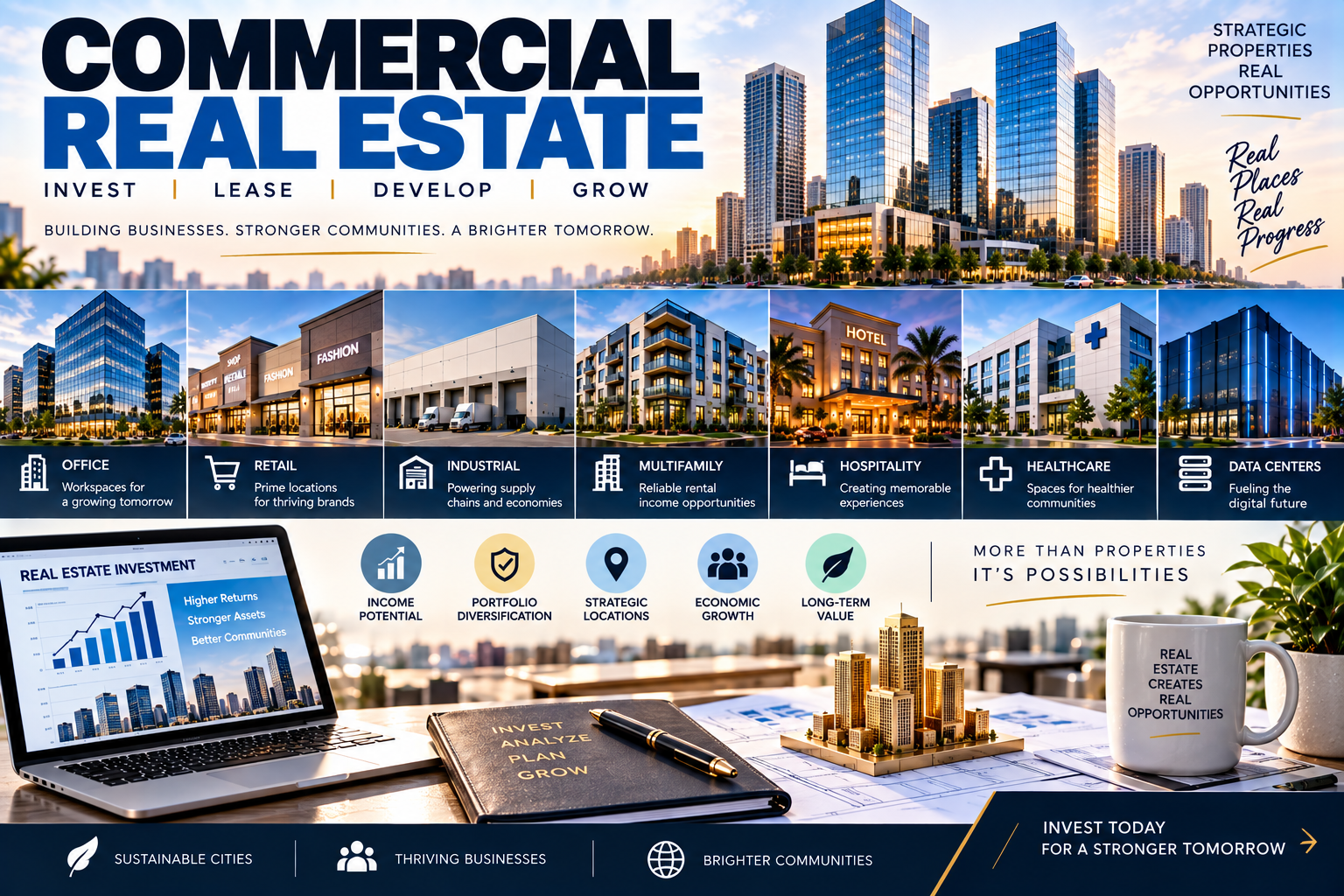
Commercial real estate is one of the largest and most diverse segments of the property market. It includes buildings and land used for business activities, rental income, investment, and specialized commercial purposes. Office buildings, shopping centers, warehouses, apartment communities, hotels, healthcare facilities, and data centers are all examples of commercial real estate.
For investors, commercial property can provide rental income, potential appreciation, and portfolio diversification. For businesses, it provides the physical locations needed to operate, manufacture, store products, serve customers, and deliver services.
However, commercial real estate transactions are often more complicated than residential property transactions. Investors must consider property income, operating expenses, leases, tenants, financing, location, vacancy, maintenance, taxes, and market conditions.
This guide explains the major types of commercial real estate, how commercial properties generate income, important investment metrics, financing options, leasing structures, risks, due diligence, and major U.S. commercial real estate trends in 2026.
What Is Commercial Real Estate?
Commercial real estate, often abbreviated as CRE, refers to property primarily used for business, commercial activities, or income generation.
Major examples include:
Office buildings
Retail centers
Shopping malls
Industrial buildings
Warehouses
Distribution centers
Multifamily apartment properties
Hotels and resorts
Healthcare facilities
Data centers
Life sciences facilities
Mixed-use properties
Commercial development land
Unlike a typical single-family home, commercial properties are often evaluated based on their ability to generate income.
For example, an investor purchasing an office building may analyze current rents, tenant leases, occupancy, operating expenses, and expected future income before deciding what the property is worth.
Major Types of Commercial Real Estate
Commercial real estate includes several property categories, each with different characteristics and sources of demand.
Office Real Estate
Office buildings provide space for companies, professional services, government organizations, and other businesses.
Office properties range from small suburban buildings to large downtown towers.
Important factors include:
Location
Building quality
Parking
Transportation access
Amenities
Tenant mix
Lease terms
Vacancy
Renovation requirements
The U.S. office market has been experiencing a gradual recovery, but conditions differ significantly between high-quality properties and older buildings. CBRE's 2026 outlook highlights continued demand for prime office space and a widening distinction between higher-quality and less competitive properties.
Retail Real Estate
Retail real estate includes properties where businesses sell products or services to consumers.
Examples include:
Shopping centers
Grocery-anchored centers
Open-air retail
High-street stores
Restaurants
Service businesses
Standalone retail buildings
Retail properties depend heavily on consumer demand, demographics, visibility, accessibility, tenant quality, and local competition.
Limited new construction has also contributed to relatively tight retail availability in several U.S. markets.
Industrial Real Estate
Industrial real estate includes properties used for manufacturing, warehousing, logistics, distribution, and other industrial activities.
Examples include:
Distribution centers
Warehouses
Manufacturing facilities
Fulfillment centers
Cold-storage facilities
Specialized industrial buildings
Industrial real estate continues to be influenced by supply-chain restructuring, manufacturing investment, third-party logistics, and demand for modern facilities.
CBRE's 2026 midyear outlook increased its forecast for U.S. industrial leasing growth to 10%, with annual leasing activity expected to approach 1 billion square feet.
Multifamily Real Estate
Multifamily properties contain multiple residential units and are commonly included within commercial real estate investment markets.
Examples include:
Apartment communities
Student housing
Senior housing
Large rental developments
Revenue generally comes from rent, while additional income may come from parking, storage, laundry, amenities, and other services.
Multifamily remained a major focus for U.S. commercial real estate investors in CBRE's 2026 investor survey.
Hospitality Real Estate
Hospitality properties include:
Hotels
Resorts
Extended-stay properties
Boutique hotels
Limited-service hotels
Hotel revenue is influenced by occupancy, room rates, tourism, business travel, local events, and economic conditions.
Healthcare Real Estate
Healthcare real estate includes:
Medical office buildings
Clinics
Outpatient centers
Specialized healthcare facilities
Healthcare campuses
Demand can be influenced by population growth, demographics, healthcare access, and changes in healthcare delivery.
Data Centers
Data centers are specialized facilities that house servers and other technology infrastructure.
The expansion of cloud computing, artificial intelligence, digital services, and data-intensive applications has increased demand for data-center capacity.
CBRE's 2026 midyear outlook expects data centers under construction to reach an approximately 80% preleasing rate, reflecting strong demand, while power availability remains an important development constraint.
How Does Commercial Real Estate Generate Income?
Commercial property typically generates revenue through rent.
A simplified calculation is:
Rental Income + Other Income − Operating Expenses = Net Operating Income
Other income can include:
Parking fees
Storage
Advertising
Service fees
Amenity fees
Percentage rent
Other tenant-related income
The resulting Net Operating Income (NOI) is an important metric used to evaluate property performance.
NOI does not normally include financing costs such as mortgage principal and interest.
What Is Net Operating Income?
Net Operating Income represents the income a property generates after normal operating expenses.
For example:
Annual rental income: $1,000,000
Other income: $50,000
Operating expenses: $350,000
Estimated NOI:
$1,000,000 + $50,000 − $350,000 = $700,000
Investors can use NOI to compare properties and evaluate how changes in rent, occupancy, and expenses affect the property's financial performance.
Understanding Cap Rates
The capitalization rate, or cap rate, is another important commercial real estate metric.
A simplified formula is:
Cap Rate = NOI ÷ Property Value
For example, if a property produces $500,000 of NOI and is valued at $10 million:
$500,000 ÷ $10,000,000 = 5%
Cap rates can help investors compare properties, but they should not be used by themselves.
A property with a higher cap rate may have different characteristics or risks from one with a lower cap rate. Location, tenant quality, lease duration, property condition, growth prospects, and financing conditions can all affect valuation.
Commercial Real Estate Financing
Commercial properties often require substantial capital, so financing is an important part of the transaction.
Potential financing sources include:
Banks
Credit unions
Commercial mortgage lenders
Insurance companies
Private lenders
Real estate investment funds
Private equity
Joint ventures
Commercial mortgage-backed securities
Lenders may evaluate:
Property income
Borrower finances
Credit history
Loan-to-value ratio
Debt-service coverage
Tenant leases
Property condition
Market conditions
Borrower's experience
Commercial loans may also have different terms, underwriting standards, repayment structures, and maturity periods from traditional residential mortgages.
Commercial Real Estate Leases
Leases determine how tenants use commercial properties and how income and expenses are allocated between landlords and tenants.
Gross Lease
Under a gross lease, the tenant generally pays an agreed rent while the landlord pays many property operating expenses, depending on the contract.
Net Lease
A net lease generally requires the tenant to pay rent plus some specified property expenses.
Triple-Net Lease
A triple-net or NNN lease commonly requires the tenant to pay rent along with specified expenses such as property taxes, insurance, and maintenance.
The exact responsibilities depend on the lease agreement.
Why Location Matters
Location can have a major effect on commercial property demand and value.
Investors may examine:
Population growth
Employment
Household income
Transportation
Highway access
Public transit
Customer traffic
Nearby businesses
Competition
Zoning
Development plans
Utility availability
Different property types have different location requirements.
A retail center may benefit from high consumer traffic, while an industrial warehouse may depend more heavily on highway access, logistics infrastructure, labor availability, and power.
Tenant Quality and Lease Structure
Commercial real estate investors should look beyond occupancy rates.
A property with 95% occupancy may appear attractive, but investors should also ask:
Who are the tenants?
When do leases expire?
Are rents below or above market levels?
Are tenants financially stable?
How concentrated is the rental income?
Are tenants likely to renew?
What expenses are paid by tenants?
A property dependent on one major tenant can have a different risk profile from a property with dozens of independent tenants.
Commercial Property Due Diligence
Due diligence is an important part of purchasing commercial real estate.
Financial Review
Investors may examine:
Income statements
Rent rolls
Operating expenses
Tax records
Utility expenses
Maintenance costs
Capital expenditures
Lease Review
Review:
Current rents
Lease expiration dates
Renewal options
Rent increases
Tenant responsibilities
Expense reimbursements
Special provisions
Physical Inspection
A professional inspection can identify potential problems involving:
Roofing
HVAC systems
Plumbing
Electrical systems
Structure
Parking areas
Building envelope
Environmental conditions
Legal Review
The transaction may also require examination of:
Property title
Surveys
Zoning
Permits
Easements
Property taxes
Environmental regulations
Insurance
Development restrictions
Thorough due diligence can help buyers identify potential costs and risks before completing a purchase.
Commercial Real Estate Development
Commercial development involves creating new properties or significantly improving existing ones.
A typical project can involve:
Identifying a development site
Conducting market research
Performing a feasibility study
Reviewing zoning
Obtaining financing
Securing permits
Designing the property
Construction
Marketing and leasing
Property management
Development can create value, but it also involves construction costs, permitting risks, financing risk, delays, and uncertainty about future demand.
Commercial Real Estate Investment Strategies
Investors use different approaches depending on their objectives.
Income-Focused Investing
This approach emphasizes recurring rental income from occupied properties.
Investors may focus on properties with established tenants, predictable leases, and stable operating performance.
Value-Add Investing
A value-add strategy involves purchasing a property where improvements may increase income or value.
Improvements might include:
Renovation
Better management
Tenant improvements
New amenities
Energy efficiency
Leasing vacant space
Development
Development involves constructing new commercial properties or substantially redeveloping existing buildings.
This can offer opportunities for value creation but generally involves greater development and execution risk.
Diversification
Some investors diversify across:
Property types
Geographic markets
Tenant categories
Lease structures
Diversification can reduce dependence on one property or market, although it does not eliminate investment risk.
Commercial Real Estate Market Trends in 2026
The U.S. commercial real estate market in 2026 is showing different conditions across property types and markets.
CBRE's January 2026 investor survey found that 74% of surveyed commercial real estate investors planned to buy more assets in 2026 than in the previous year. CBRE also expected U.S. commercial real estate investment volume to increase by 16% during the year.
Office Market
The office market continues to show a strong distinction between high-quality and older properties.
Prime buildings can attract tenants seeking better amenities, locations, technology, and workplace environments, while some older properties continue to face greater challenges.
Industrial Market
Industrial demand remains connected to logistics, manufacturing, reshoring, and third-party logistics providers.
CBRE expects modern, functional industrial properties to attract stronger demand, while older facilities can face pressure as occupiers consolidate into newer buildings.
Retail Market
Retail availability remains relatively limited in many markets because new construction has been restrained.
Demand continues to vary by location and tenant category, with grocery, discount, service, food, and other consumer-oriented businesses contributing to leasing activity.
Multifamily Market
Multifamily remains a significant commercial real estate investment category.
Rental demand, construction levels, financing conditions, local employment, and population trends can all influence apartment property performance.
Data Center Market
Data centers remain closely connected to the expansion of artificial intelligence and digital infrastructure.
Power availability, energy infrastructure, construction timelines, and connectivity are increasingly important considerations for data-center development.
Risks of Commercial Real Estate
Commercial property can generate income, but investors should understand the potential risks.
Common risks include:
Vacancy
Tenant default
Lease expiration
Interest-rate changes
Refinancing risk
Economic downturns
Property damage
Unexpected repairs
Construction costs
Regulatory changes
Environmental problems
Local market weakness
Interest rates can be particularly important because higher borrowing costs can affect property cash flow, financing availability, and valuations.
How to Evaluate a Commercial Property
A structured analysis can help investors understand a potential purchase.
1. Research the Market
Study employment, population, development, competition, rents, vacancy, and demand.
2. Analyze the Property
Review the property's condition, age, location, amenities, and future capital requirements.
3. Examine Income
Analyze rent, occupancy, tenant concentration, and other revenue sources.
4. Calculate NOI
Determine operating income after property-level expenses.
5. Review the Cap Rate
Compare the cap rate with relevant properties while accounting for differences in quality and risk.
6. Examine Financing
Review interest rates, loan terms, equity requirements, debt service, and maturity dates.
7. Review Leases
Analyze tenant obligations, expiration dates, rent increases, and renewal options.
8. Consider the Exit
Think about potential future buyers, market liquidity, property improvements, and changes in income.
Commercial Real Estate vs. Residential Real Estate
Feature | Commercial Real Estate | Residential Real Estate |
|---|---|---|
Primary purpose | Business or income generation | Housing |
Typical tenants | Businesses | Individuals or families |
Lease structure | Often more complex | Generally simpler |
Financing | Commercial loans | Residential mortgages |
Income analysis | NOI and cap rate | Rent and property value |
Transaction size | Often larger | Varies |
Management | Often specialized | Generally simpler |
Due diligence | Usually extensive | Varies by property |
The distinction can vary depending on the specific property and legal or financing classification.
Role of Commercial Real Estate Professionals
Commercial transactions can involve many professionals, including:
Commercial brokers
Property managers
Real estate attorneys
Accountants
Lenders
Appraisers
Inspectors
Environmental consultants
Architects
Contractors
The professionals required depend on the property's size, complexity, and transaction structure.
Commercial Real Estate Checklist
Before purchasing or investing in commercial property, consider:
Property location
Property type
Purchase price
Current rental income
NOI
Cap rate
Occupancy
Tenant quality
Lease expiration dates
Operating expenses
Property taxes
Insurance
Maintenance
Capital expenditures
Financing terms
Interest rate
Local market conditions
Zoning
Environmental conditions
Exit strategy
Final Thoughts
Commercial real estate encompasses a wide range of properties, from office buildings and shopping centers to warehouses, apartment communities, healthcare facilities, and data centers.
Understanding commercial real estate requires more than looking at a property's purchase price. Investors should examine rental income, operating expenses, NOI, cap rates, leases, tenants, financing, property condition, location, and market conditions.
The U.S. commercial real estate market in 2026 is showing sector-specific recovery and changing investment preferences. CBRE's current outlook points to continued investment activity, strong industrial and data-center demand, improving conditions in selected office markets, and continued interest in multifamily and retail properties.
Because commercial properties differ significantly from one another, investors should evaluate each opportunity based on its own financial characteristics, location, tenant base, financing structure, and risks.
Frequently Asked Questions
What is commercial real estate?
Commercial real estate includes properties primarily used for business activities or income generation, including offices, retail centers, warehouses, multifamily buildings, hotels, healthcare facilities, and data centers.
What are the main types of commercial real estate?
The main categories include office, retail, industrial, multifamily, hospitality, healthcare, and data centers.
How does commercial real estate make money?
Commercial properties generally generate income through rent and may also produce revenue from parking, storage, services, advertising, and other sources.
What is NOI?
NOI stands for Net Operating Income. It represents property income after operating expenses and before financing costs and certain other expenses.
What is a cap rate?
A cap rate is commonly calculated by dividing a property's NOI by its value or purchase price. It is one metric used to evaluate commercial property investments.
What is a triple-net lease?
A triple-net lease, commonly called an NNN lease, generally requires the tenant to pay rent plus specified expenses such as property taxes, insurance, and maintenance, depending on the lease agreement.
Is commercial real estate risky?
Yes. Commercial real estate can involve vacancy risk, tenant default, financing risk, interest-rate risk, maintenance expenses, economic changes, and local market risks.
What should I check before buying commercial property?
Review the property's income, expenses, rent roll, leases, tenants, physical condition, title, zoning, taxes, insurance, environmental conditions, financing, and local market.
What are the major commercial real estate trends in 2026?
Major themes include recovering investment activity, continued demand for high-quality properties, industrial and logistics activity, selective office and retail recovery, multifamily investment interest, and strong data-center demand. Conditions vary by market and property type.