Indonesia is one of Southeast Asia’s largest economies, with major industries spanning natural resources, banking, energy, telecommunications, technology, manufacturing, consumer goods, and infrastructure. These sectors have helped create some of the region’s most prominent billionaires and business families.
The country’s wealthiest individuals have built fortunes through different paths. Some became wealthy through coal and energy, while others built large banking, tobacco, petrochemical, technology, property, and consumer businesses. Because billionaire wealth is often connected to publicly traded shares, rankings can change frequently as stock prices and company valuations move.
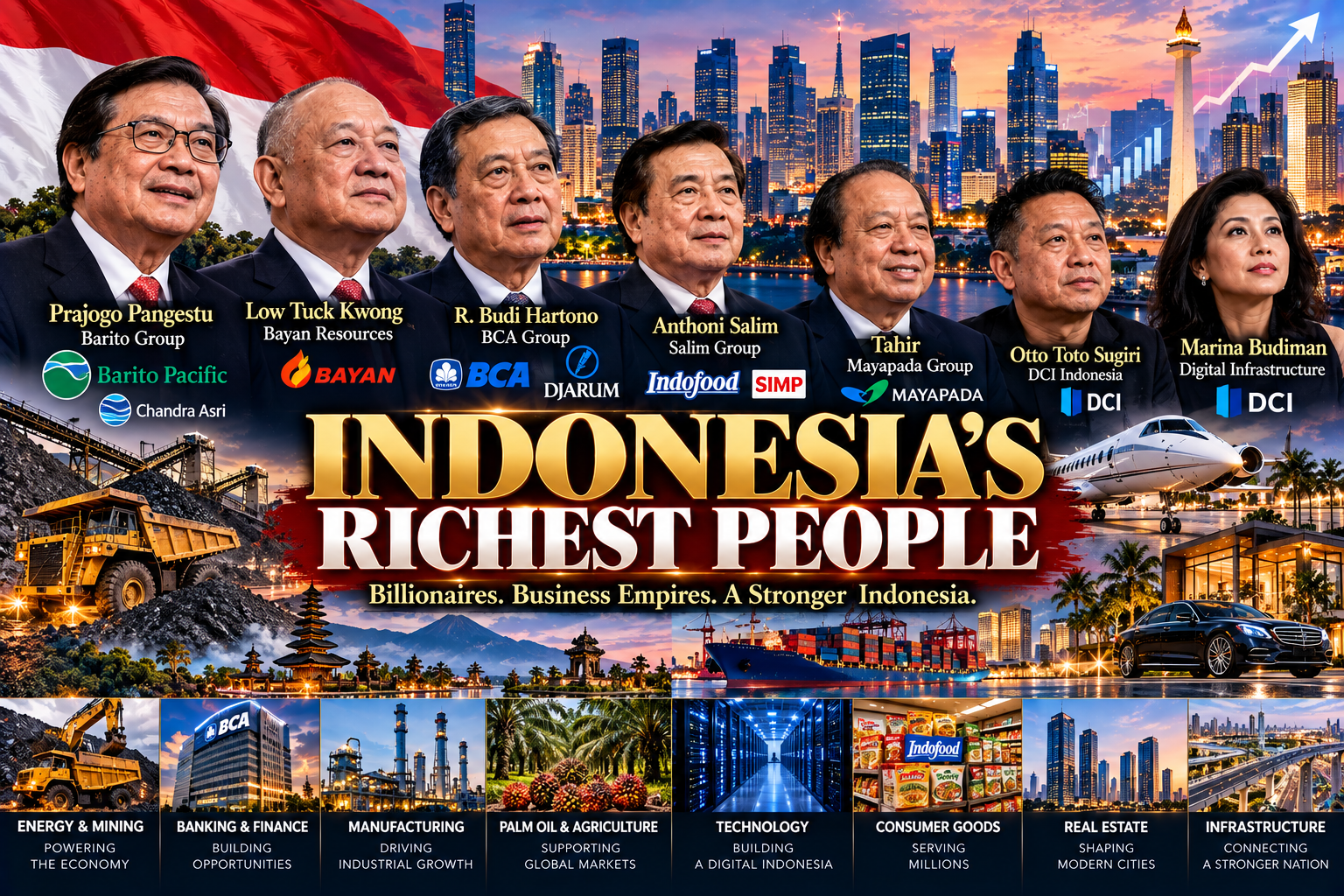
According to Forbes-related data reported in August 2026, Prajogo Pangestu ranked first among Indonesia’s richest people at that time, followed by Low Tuck Kwong and R. Budi Hartono. Forbes’ real-time profiles also show how valuations can change from day to day.
Who Are Indonesia’s Richest People?
Indonesia’s billionaire landscape includes entrepreneurs, family-business owners, investors, and industrial leaders. Their fortunes are concentrated across several major industries, particularly energy, mining, banking, tobacco, petrochemicals, telecommunications, technology, healthcare, and real estate.
Among the most prominent names are:
Prajogo Pangestu
Low Tuck Kwong
R. Budi Hartono
Anthoni Salim
Tahir and family
Otto Toto Sugiri
Sri Prakash Lohia
Marina Budiman
Lim Hariyanto Wijaya Sarwono
Theodore Rachmat
These names illustrate how diversified Indonesia’s billionaire economy has become.
1. Prajogo Pangestu: Energy and Petrochemicals
Prajogo Pangestu is one of Indonesia’s most prominent business figures, with wealth connected to petrochemicals, energy, and natural resources.
Forbes reported that Pangestu began his business career in the timber industry in the late 1970s. His business interests later expanded significantly, including Barito Pacific, Chandra Asri, Petrindo Jaya Kreasi, and Barito Renewables Energy.
His business empire demonstrates how Indonesia’s natural-resource economy can develop into a diversified industrial group.
Chandra Asri became one of Indonesia’s major integrated petrochemical producers, while Pangestu also expanded into coal mining and renewable energy.
This combination of traditional energy and newer renewable-energy investments reflects the changing structure of Indonesia’s resource economy.
2. Low Tuck Kwong: Indonesia’s Coal Billionaire
Low Tuck Kwong is closely associated with Indonesia’s coal-mining industry. He is the founder of Bayan Resources, one of the country's major coal producers.
Forbes identifies coal as his primary source of wealth and notes that he moved from Singapore to Indonesia in 1972. He eventually built his fortune after acquiring his first mine in 1997.
His business interests have also expanded beyond coal. Forbes reports that he controls Singapore-based renewable-energy company Metis Energy and has interests connected to infrastructure and internet connectivity.
Low's story highlights the importance of Indonesia's natural resources in creating large private fortunes.
At the same time, resource-based wealth can be sensitive to commodity prices, production levels, regulation, and global energy demand.
3. R. Budi Hartono: Banking, Tobacco, and Technology
R. Budi Hartono is one of Indonesia's best-known business figures and a member of the Hartono family.
According to Forbes, much of his fortune comes from the family's investment in Bank Central Asia, commonly known as BCA. The family also became wealthy through the tobacco industry and continues to have major interests in cigarette manufacturing.
The Hartono family's business interests extend beyond banking and tobacco. They also have investments in electronics, real estate, e-commerce, and other businesses.
Their ownership of Polytron, for example, connects the family to Indonesia's electronics industry, while their investment in Global Digital Niaga provides exposure to digital commerce through Blibli.
The Hartono example shows how a family business can evolve from a traditional consumer industry into banking, technology, digital commerce, and other sectors.
4. Anthoni Salim: Consumer Businesses and Investments
Anthoni Salim is another major name in Indonesia's business community.
The Salim family has historically been associated with consumer goods, food, financial services, and other businesses. Its business interests have also extended into resources and investment holdings.
Indonesia's large population and growing consumer market provide significant opportunities for companies operating in food, retail, financial services, and consumer products.
The Salim business story demonstrates how consumer demand can become the foundation for a diversified business empire.
5. Tahir and Family: Banking, Healthcare, Media, and Property
Tahir is the founder of Mayapada Group, a diversified Indonesian conglomerate.
Forbes reports that Mayapada has interests in banking, healthcare, media, and real estate, while the family also holds stakes in Bank Mayapada and Maha Properti Indonesia.
Tahir's business journey is notable because his wealth did not come from one single industry.
Forbes says he started with car dealerships in the late 1980s and later moved into the garment business after that venture failed. He subsequently developed a much broader business group.
His story demonstrates how diversification can become an important feature of Indonesia's private business sector.
6. Otto Toto Sugiri: Data Centers and Digital Infrastructure
Indonesia's billionaire landscape is increasingly connected to technology and digital infrastructure.
Otto Toto Sugiri is an important example. He is cofounder and CEO of DCI Indonesia, a major data-center operator.
According to Forbes, Sugiri founded DCI in 2011 and helped build it into one of Indonesia's largest data-center companies. DCI was listed publicly in 2021.
Before DCI, Sugiri founded Sigma Cipta Caraka and cofounded Indonet, which Forbes describes as Indonesia's first internet service provider.
His career illustrates the shift from traditional industries toward digital infrastructure.
As businesses, financial institutions, governments, and consumers increasingly rely on cloud computing and online services, data centers have become an important part of the modern economy.
7. Sri Prakash Lohia: Manufacturing and Industry
Sri Prakash Lohia is another major Indonesian business figure whose wealth is connected to manufacturing.
His business interests have historically included petrochemicals, textiles, and manufacturing.
Indonesia's industrial base has expanded alongside urbanization, exports, infrastructure development, and consumer demand. Manufacturing businesses can therefore play an important role in the country's wealth creation.
Industrial companies also provide connections to global supply chains, making Indonesia an important manufacturing location within Southeast Asia.
8. Marina Budiman: Digital Infrastructure
Marina Budiman is associated with Indonesia's rapidly expanding digital infrastructure sector.
Her business interests are connected to data centers and technology infrastructure, an area that has become increasingly important as Indonesia's digital economy expands.
The rise of data centers represents a broader change in Indonesia's billionaire economy. Wealth creation is no longer concentrated only in commodities, property, banking, or consumer goods.
Digital infrastructure is becoming another important source of business growth.
9. Lim Hariyanto Wijaya Sarwono: Palm Oil and Nickel
Lim Hariyanto Wijaya Sarwono built significant wealth through palm oil and natural resources.
Forbes reports that Lim and his family own a majority stake in Singapore-listed palm oil producer Bumitama Agri, whose plantations are located in Indonesia. The family also has interests in bauxite and nickel processing.
Indonesia is one of the world's major producers of commodities such as palm oil and nickel.
Nickel has become especially important because of its connection to stainless steel and battery supply chains.
This makes resource companies an important part of Indonesia's position in the global economy.
10. Theodore Rachmat: Diversified Business Interests
Theodore Rachmat is another prominent Indonesian entrepreneur with extensive business interests.
His career has included major involvement in manufacturing, mining, energy, and investment activities.
Like several other Indonesian billionaires, his wealth reflects the country's development from a resource-based economy toward a more diversified business environment.
Indonesia’s Billionaire Economy Is Highly Diverse
One of the most interesting characteristics of Indonesia's richest people is the diversity of their industries.
Energy and Coal
Energy and coal remain important sources of wealth. Indonesia's natural resources have supported large mining and energy companies and created significant private fortunes.
Prajogo Pangestu and Low Tuck Kwong are prominent examples of wealth connected to energy and natural resources.
Banking
Banking is another major source of wealth.
The Hartono family's investment in Bank Central Asia demonstrates how financial institutions can become major components of long-term family wealth.
Consumer Goods
Indonesia's large domestic population creates a substantial consumer market.
Food, beverages, tobacco, retail, and other consumer industries have helped build several major Indonesian business groups.
Technology
Technology is becoming increasingly important.
Data centers, e-commerce, digital payments, telecommunications, and online services are creating new business opportunities.
Otto Toto Sugiri's DCI Indonesia is one example of wealth connected to this transformation.
Manufacturing
Manufacturing remains an important pillar of Indonesia's economy.
Industrial companies produce everything from petrochemicals and construction materials to consumer products and other manufactured goods.
Why Indonesia’s Richest People Keep Changing
Billionaire rankings should not be viewed as permanent.
Forbes' real-time billionaire methodology updates public-company holdings as stock markets move, while fortunes connected to private companies are generally updated on a different schedule.
This means that two rankings published on different dates can show different results.
For example, Katadata's report based on Forbes Real Time Billionaires data placed Prajogo Pangestu first in Indonesia on August 13, 2026, with an estimated $17.5 billion, followed by Low Tuck Kwong at $16.8 billion and R. Budi Hartono at $15.9 billion.
Later Forbes profile data showed different values, illustrating how quickly billionaire wealth can move with market prices.
How Billionaire Wealth Is Measured
A billionaire's net worth is generally an estimate of the value of assets minus liabilities.
For public companies, the calculation can be influenced heavily by share prices.
For private businesses, analysts may use company valuations, comparable businesses, industry multiples, and other financial information.
As a result, billionaire net worth should be treated as an estimate rather than cash sitting in a bank account.
A person with a $15 billion estimated fortune does not necessarily have $15 billion available to spend. Much of the wealth may be tied to company shares and other assets.
Indonesia’s Growing Digital Economy
Indonesia's digital transformation is creating new opportunities for entrepreneurs.
E-commerce, fintech, cloud computing, data centers, online entertainment, artificial intelligence, and digital payments are becoming increasingly important.
The country's large population provides a substantial market for digital services.
This creates opportunities for both established business groups and newer technology companies.
Natural Resources Remain Important
Despite the growth of technology, natural resources continue to play an important role.
Coal, nickel, palm oil, petrochemicals, and other commodities remain significant to Indonesia's economy.
However, commodity businesses also face challenges related to global prices, environmental requirements, regulation, transportation, and international demand.
The country's billionaire landscape therefore reflects both the opportunities and risks of resource-driven wealth.
The Role of Family Businesses
Family businesses are a major feature of Indonesia's private-sector economy.
Some wealthy families have built businesses across multiple generations, expanding from one industry into banking, property, technology, manufacturing, or consumer goods.
The Hartono family provides an example of this model, with interests extending from tobacco into banking, electronics, digital commerce, and property.
Family ownership can provide long-term control, but succession planning, governance, and diversification can become important issues as businesses grow.
Indonesia’s Wealth and Global Markets
Indonesia's richest people are increasingly connected to international markets.
Their companies may have operations, investments, suppliers, customers, or listings outside Indonesia.
Palm oil, nickel, coal, petrochemicals, banking, technology, and manufacturing all have international connections.
This means changes in global commodity prices, interest rates, currencies, trade policies, and investor sentiment can influence Indonesian business fortunes.
Future of Indonesia’s Richest People
The next generation of Indonesian wealth may come from a combination of established industries and emerging sectors.
Several areas could remain important:
Renewable energy
Data centers
Artificial intelligence
Digital banking
E-commerce
Electric vehicles
Nickel and battery supply chains
Healthcare
Manufacturing
Infrastructure
Real estate
Consumer businesses
The country's economic scale and expanding digital infrastructure create opportunities for entrepreneurs across both traditional and emerging industries.
Final Thoughts
Indonesia's richest people represent a broad cross-section of the country's economy.
Prajogo Pangestu illustrates the importance of petrochemicals and energy. Low Tuck Kwong represents the influence of coal and mining. R. Budi Hartono demonstrates the strength of banking, tobacco, technology, and family businesses. Tahir represents diversification across banking, healthcare, media, and property, while Otto Toto Sugiri highlights the growing importance of digital infrastructure.
Rather than coming from a single industry, Indonesia's billionaire wealth reflects the country's diverse economy.
As Indonesia continues to develop its infrastructure, digital economy, manufacturing base, energy sector, and consumer market, the businesses behind its largest fortunes are likely to continue evolving.
FAQs
Who is the richest person in Indonesia?
Rankings change with market values. Forbes-related data placed Prajogo Pangestu at the top of Indonesia's billionaire list in August 2026, while subsequent real-time valuations can change the order.
Who is Low Tuck Kwong?
Low Tuck Kwong is the founder of Bayan Resources and is primarily known for his wealth from Indonesia's coal industry.
What is R. Budi Hartono's main source of wealth?
Forbes identifies banking and tobacco as major sources of his fortune, particularly his family's investment in Bank Central Asia.
Which industries create the most billionaire wealth in Indonesia?
Major sources include energy, mining, banking, tobacco, consumer goods, manufacturing, property, technology, and digital infrastructure.
Are Indonesia's richest people all self-made?
No. Indonesia's billionaire population includes both entrepreneurs who built businesses and individuals whose wealth is connected to established family businesses and inherited assets.
Why do billionaire rankings change?
Public-company share prices, private-company valuations, currency movements, transactions, and other asset values can change estimated net worth.
Is billionaire net worth the same as cash?
No. Most billionaire wealth is generally tied to ownership stakes in businesses and other assets rather than cash.
Why is technology becoming important to Indonesia's wealthy?
Indonesia's expanding digital economy has increased demand for e-commerce, data centers, financial technology, telecommunications, and other digital services.