China is home to one of the world's largest populations of billionaires, with enormous fortunes spread across technology, beverages, e-commerce, telecommunications, batteries, automobiles, healthcare, consumer products, and manufacturing.
The country's billionaire landscape changes frequently because many wealthy Chinese entrepreneurs own substantial stakes in publicly traded companies. Changes in stock prices, private-company valuations, business performance, and currency markets can therefore cause major shifts in individual net worth.
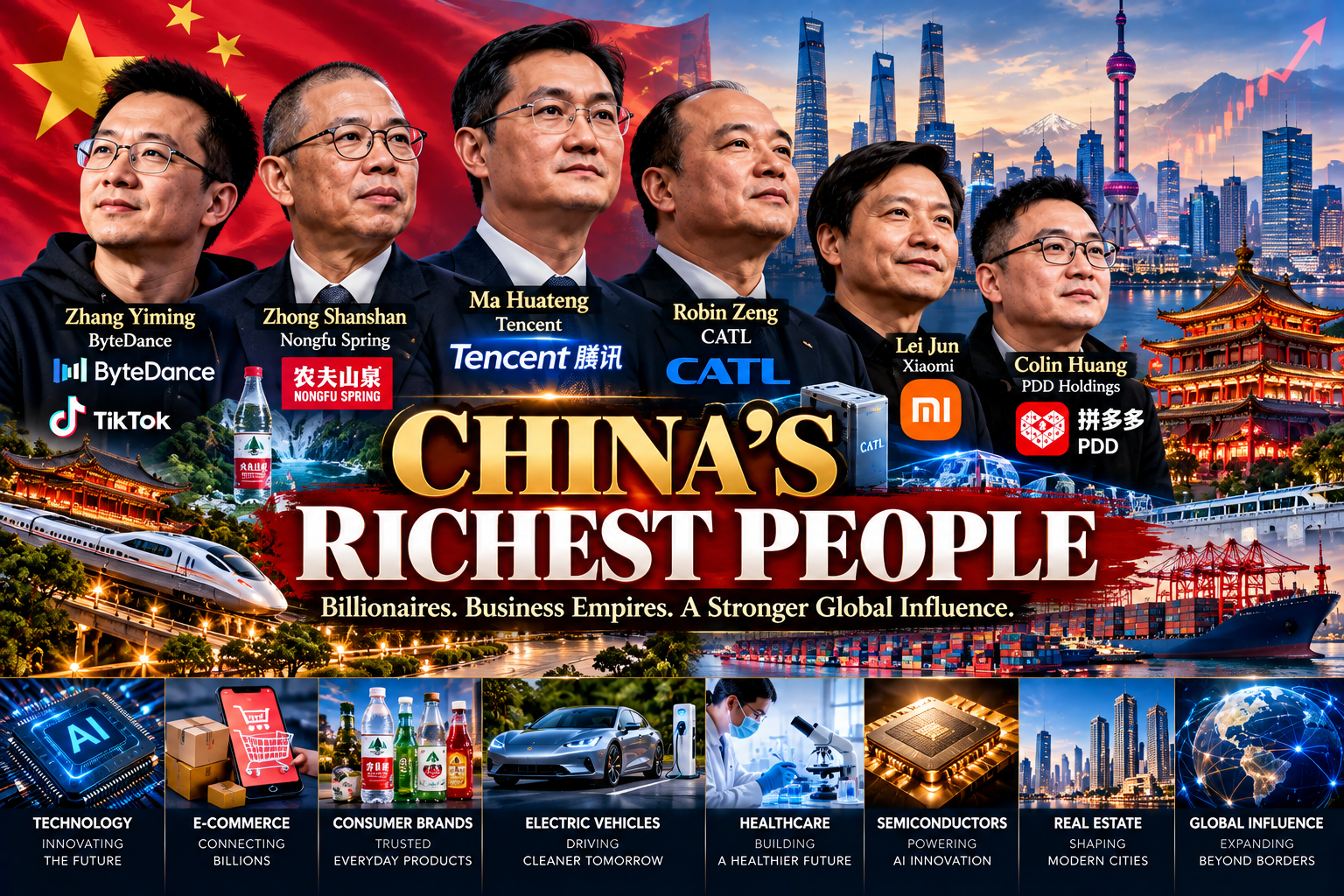
Recent Forbes and Hurun rankings show how China's wealthiest entrepreneurs are connected to some of the country's most important businesses. Among the names appearing near the top are Zhang Yiming, founder of ByteDance; Zhong Shanshan, founder of Nongfu Spring; Ma Huateng, cofounder of Tencent; Robin Zeng, founder of CATL; Lei Jun, founder of Xiaomi; and Huang Shilin and other major business owners across technology and manufacturing.
Who Is the Richest Person in China?
The answer depends on the ranking and valuation date being used.
Hurun's China Rich List 2025, based on wealth calculations around September 2025, placed Zhong Shanshan at No. 1 with an estimated fortune of $74.3 billion. Zhang Yiming was second at $65.9 billion, while Tencent cofounder Ma Huateng was third at $65.2 billion.
However, real-time estimates can produce different results. Forbes' profile for Zhang Yiming showed an estimated real-time net worth of approximately $84 billion in September 2026, while Zhong Shanshan's Forbes real-time estimate was approximately $58.3 billion at the time of its September 2026 update.
This difference highlights an important point: there is no permanent billionaire ranking. The person at the top can change as company valuations and stock prices move.
Zhang Yiming: The ByteDance Founder
Zhang Yiming is one of China's most successful technology entrepreneurs.
He cofounded ByteDance in 2012 after beginning the company in a four-bedroom apartment in Beijing. ByteDance later developed TikTok, one of the world's most widely used short-video platforms.
Forbes identifies Zhang as a self-made billionaire whose primary source of wealth is TikTok and ByteDance. The company has also expanded into areas including e-commerce, gaming, education, news, and artificial intelligence.
Zhang stepped down from ByteDance's leadership roles in 2021, but his ownership stake continued to connect him to the company's enormous valuation.
The company's growing AI operations have also become an important part of its technology strategy. Forbes reported that ByteDance's Doubao AI assistant had hundreds of millions of monthly active users in early 2026.
Zhong Shanshan: From Construction Worker to Billionaire
Zhong Shanshan represents a very different path to extreme wealth.
He is the founder and chairman of Nongfu Spring, one of China's best-known bottled-water and beverage companies.
Before becoming a billionaire, Zhong had worked as a construction worker, newspaper reporter, and beverage sales agent. He eventually started his own businesses and built Nongfu Spring into a major consumer brand.
He also controls Wantai Biological, a pharmaceutical and diagnostic company.
Forbes classifies Zhong as self-made, with beverages and pharmaceuticals as his primary sources of wealth.
His story demonstrates that China's billionaire economy is not limited to technology. Consumer products, healthcare, manufacturing, and traditional industries can also create enormous fortunes.
Ma Huateng: The Tencent Billionaire
Ma Huateng, commonly known as Pony Ma, is the cofounder and chairman of Tencent.
Tencent has become one of China's largest technology companies, with major businesses in gaming, social media, advertising, digital payments, cloud services, and online entertainment.
Hurun ranked Ma Huateng third on its 2025 China Rich List with estimated wealth of $65.2 billion. Hurun also reported strong growth in Tencent's advertising business, gaming operations, WeChat Mini Stores, and annual profits.
Tencent's success demonstrates the economic power of digital ecosystems.
Instead of relying on a single product, the company operates across multiple interconnected services, allowing it to reach hundreds of millions of consumers and businesses.
Robin Zeng: Building a Battery Empire
Robin Zeng Yuqun is the founder and chairman of CATL, one of the world's most important battery manufacturers.
CATL supplies batteries used in electric vehicles and energy-storage systems.
The rise of electric vehicles has transformed the battery industry into a strategically important part of the global economy. As automakers invest heavily in electrification, battery manufacturers have become increasingly valuable.
Hurun ranked Zeng fourth on its 2025 China Rich List with estimated wealth of $46.3 billion. The organization attributed a significant increase in his fortune to rising demand for batteries and energy storage.
Lei Jun: Xiaomi and Consumer Technology
Lei Jun is the founder of Xiaomi, a technology company known for smartphones, consumer electronics, smart-home products, and electric vehicles.
Xiaomi's growth illustrates how Chinese entrepreneurs can compete in global consumer markets.
The company began with smartphones and expanded into a broader technology ecosystem. Its move into electric vehicles has also connected Lei Jun's wealth to another rapidly developing industry.
Hurun ranked Lei Jun fifth on its 2025 China Rich List, with estimated wealth of $45.7 billion.
Huang Zheng and the Rise of E-Commerce
Huang Zheng, also known as Colin Huang, founded PDD Holdings, the parent company associated with Pinduoduo and Temu.
PDD developed an e-commerce model focused on value-conscious consumers, social commerce, and technology-driven shopping experiences.
The company's international expansion has increased its visibility beyond China.
Hurun placed Huang among the top Chinese billionaires in its 2025 ranking, estimating his fortune at $44 billion.
His story demonstrates how China's enormous consumer market can provide a foundation for technology-driven businesses with international ambitions.
Ding Lei and the Gaming Industry
Ding Lei is the founder of NetEase, a major Chinese internet and gaming company.
Online gaming has become one of China's most important entertainment industries, creating large businesses around game development, publishing, advertising, and digital communities.
Hurun ranked Ding Lei sixth on its 2025 China Rich List with estimated wealth of $44.9 billion.
NetEase's business illustrates another important source of Chinese billionaire wealth: digital entertainment.
Chen Tianshi and China's AI Chip Industry
Artificial intelligence is creating a new generation of wealthy technology entrepreneurs in China.
Chen Tianshi, chairman and CEO of Cambricon Technologies, is one example.
Before cofounding Cambricon in 2016, Chen worked as a researcher at the Chinese Academy of Sciences' Institute of Computing Technology. Cambricon develops semiconductor technologies designed for artificial intelligence applications.
Forbes classifies Chen as self-made, with semiconductors as his primary source of wealth. Its September 2026 real-time estimate placed his fortune at approximately $30.4 billion.
His rapid rise demonstrates how AI infrastructure and semiconductor technology are becoming major sources of entrepreneurial wealth.
China's Billionaire Wealth Is Becoming More Technology-Driven
Technology has become one of the most important sources of billionaire wealth in China.
Major areas include:
Internet platforms
E-commerce
Artificial intelligence
Semiconductors
Gaming
Smartphones
Cloud computing
Electric vehicles
Battery technology
Digital payments
The expansion of AI is particularly significant.
Hurun's 2026 Global Rich List reported that some of the biggest increases in Chinese billionaire wealth were connected to artificial intelligence and related technology. Zhang Yiming's wealth increased substantially, while semiconductor entrepreneur Chen Tianshi also experienced major gains.
Consumer Products Still Matter
Although technology receives significant attention, consumer businesses remain an important part of China's billionaire economy.
Zhong Shanshan's Nongfu Spring is a major example.
Other wealthy entrepreneurs have built companies around:
Food and beverages
Household appliances
Luxury goods
Jewelry
Consumer electronics
Fashion
Toys
Retail
Hurun's 2025 ranking highlighted strong wealth growth among entrepreneurs connected to consumer brands, including the founders of Pop Mart and Laopu Gold.
Electric Vehicles and Batteries
China has become a major force in the electric-vehicle industry.
Companies involved in electric vehicles, batteries, charging infrastructure, and related technologies have created significant wealth.
Lei Jun's Xiaomi and Robin Zeng's CATL represent two different parts of this ecosystem.
The industry is also connected to China's manufacturing infrastructure, supply chains, battery materials, software, and export markets.
As global automobile companies continue investing in electrification, Chinese companies are positioned across several stages of the EV supply chain.
Healthcare and Pharmaceuticals
Healthcare is another important source of billionaire wealth.
Zhong Shanshan's Wantai Biological is one example of a business operating in pharmaceuticals and diagnostic products.
Other Chinese billionaires have built fortunes through biotechnology, pharmaceutical companies, medical technology, and healthcare services.
Hurun reported significant growth among several Chinese pharmaceutical entrepreneurs in its 2025 and 2026 research.
The healthcare sector can create substantial value because successful products may serve very large populations and potentially reach international markets.
Real Estate and Traditional Industries
China's billionaire economy also includes property, manufacturing, household appliances, logistics, energy, and other traditional sectors.
The wealthiest entrepreneurs are therefore not all technology founders.
Some fortunes are connected to companies that manufacture physical products, operate factories, develop property, distribute goods, or provide essential services.
This diversity is important when understanding China's wealth landscape.
Why Chinese Billionaire Rankings Change
Chinese billionaire rankings can change rapidly for several reasons.
Stock Prices
Many wealthy individuals own large stakes in publicly traded companies. When share prices move, their estimated net worth can change substantially.
Private Valuations
Private businesses may be valued using funding rounds, comparable companies, financial performance, and other indicators.
Currency Movements
Because international rankings often convert Chinese yuan into U.S. dollars, exchange-rate movements can influence reported wealth.
Business Performance
Revenue, profits, market share, product launches, and international expansion can influence company valuations.
Regulation
Regulatory developments can affect entire industries, particularly technology, finance, education, property, and healthcare.
China's Self-Made Billionaires
A significant feature of China's billionaire population is the large number of entrepreneurs who built businesses rather than receiving their wealth entirely through inheritance.
Zhong Shanshan, Zhang Yiming, Ma Huateng, Lei Jun, and Chen Tianshi are examples of entrepreneurs whose fortunes are connected to companies they founded or helped build.
Their businesses span very different industries, showing that there is no single formula for building extreme wealth.
Some developed consumer brands, while others created software platforms, e-commerce businesses, semiconductor companies, or technology ecosystems.
The Global Reach of Chinese Billionaires
Chinese billionaire-owned companies increasingly operate beyond China's domestic market.
ByteDance's TikTok became a global platform.
PDD Holdings expanded international e-commerce through Temu.
Chinese electric-vehicle and battery companies have developed international operations and partnerships.
Consumer brands and manufacturing companies also participate in global supply chains.
This international expansion means that the fortunes of Chinese entrepreneurs can increasingly be influenced by consumer demand, regulation, competition, and investment conditions around the world.
Artificial Intelligence and the Next Generation of Wealth
AI may become one of the most important sources of new billionaire wealth in China.
Companies are investing in:
AI models
AI chips
Data centers
Cloud computing
Robotics
Autonomous vehicles
AI-powered applications
Enterprise software
Semiconductor manufacturing
China's AI ecosystem includes both established technology companies and newer startups.
The growth of Cambricon and ByteDance's AI operations illustrates how AI is already connected to some of China's largest private fortunes.
What Can We Learn From China's Wealthiest Entrepreneurs?
The stories of China's richest people reveal several recurring themes.
Innovation
Many successful companies introduced new products, technologies, or business models.
Large Markets
China's huge domestic consumer market has allowed companies to achieve significant scale.
Ownership
Large ownership stakes in successful businesses are a major source of billionaire wealth.
Technology
Digital platforms, AI, semiconductors, e-commerce, and mobile technology have created enormous opportunities.
Global Expansion
Companies that successfully enter international markets can significantly expand their potential customer base.
Long-Term Growth
Many billionaire fortunes were created over decades rather than overnight.
The Future of China's Billionaire Economy
China's billionaire landscape is likely to continue evolving as technology, consumer behavior, manufacturing, and global trade change.
Artificial intelligence and semiconductors are becoming increasingly important.
Electric vehicles and energy storage remain significant industries.
Healthcare and biotechnology may also create new opportunities.
At the same time, established industries such as consumer products, manufacturing, retail, food and beverages, and financial services will continue to play important roles.
The country's billionaire rankings will therefore remain dynamic.
Final Thoughts
China's richest people represent a broad range of industries and entrepreneurial stories.
Zhang Yiming built ByteDance into a global technology company. Zhong Shanshan created enormous businesses in beverages and healthcare. Ma Huateng helped transform Tencent into a technology ecosystem. Robin Zeng built one of the world's major battery companies. Lei Jun expanded Xiaomi from smartphones into a broader technology and electric-vehicle business. Chen Tianshi represents the growing importance of artificial intelligence and semiconductor technology.
The exact ranking of China's richest people can change quickly because billionaire wealth is closely tied to company valuations and financial markets.
What remains consistent is the diversity of industries producing enormous fortunes in China, from technology and AI to beverages, healthcare, e-commerce, batteries, automobiles, gaming, and consumer products.
As China's economy continues to evolve, new entrepreneurs and industries are likely to reshape the country's billionaire landscape.
FAQs
Who is the richest person in China?
The answer varies according to the ranking and valuation date. Hurun's 2025 China Rich List placed Zhong Shanshan first, while Forbes' September 2026 real-time profile showed Zhang Yiming with a higher estimated net worth at that point.
Who is Zhang Yiming?
Zhang Yiming is the founder of ByteDance, the Chinese technology company behind TikTok. Forbes classifies him as self-made.
Who is Zhong Shanshan?
Zhong Shanshan is the founder of Nongfu Spring and controls Wantai Biological. Forbes identifies beverages and pharmaceuticals as his primary sources of wealth.
Who is Ma Huateng?
Ma Huateng, also known as Pony Ma, is the cofounder and chairman of Tencent, a major Chinese technology company involved in gaming, social media, advertising, and digital services.
Who is China's richest technology entrepreneur?
Rankings change over time. Zhang Yiming is among China's wealthiest technology entrepreneurs, with his fortune primarily connected to ByteDance.
How do Chinese billionaires make their money?
Chinese billionaires have built fortunes through technology, e-commerce, consumer products, manufacturing, finance, healthcare, automobiles, batteries, real estate, and other industries.
Why does China's billionaire ranking change?
Changes in stock prices, private-company valuations, currency exchange rates, business performance, and ownership stakes can all affect estimated net worth.
How many billionaires are there in China?
The number varies by methodology and date. Hurun's 2025 China Rich List identified 1,021 dollar billionaires among its qualifying population, while different international rankings use different definitions and cutoff dates.
Is China's billionaire wealth mostly from technology?
Technology is a major source of wealth, but China's richest entrepreneurs also come from beverages, pharmaceuticals, batteries, automobiles, manufacturing, retail, gaming, and other industries.