Japan richest's is home to some of Asia’s most influential entrepreneurs, investors, industrialists, retailers, and family business owners. From technology and artificial intelligence to fashion, manufacturing, food and beverages, telecommunications, real estate, and finance, Japan’s wealthiest people have built fortunes through businesses that operate both domestically and internationally.
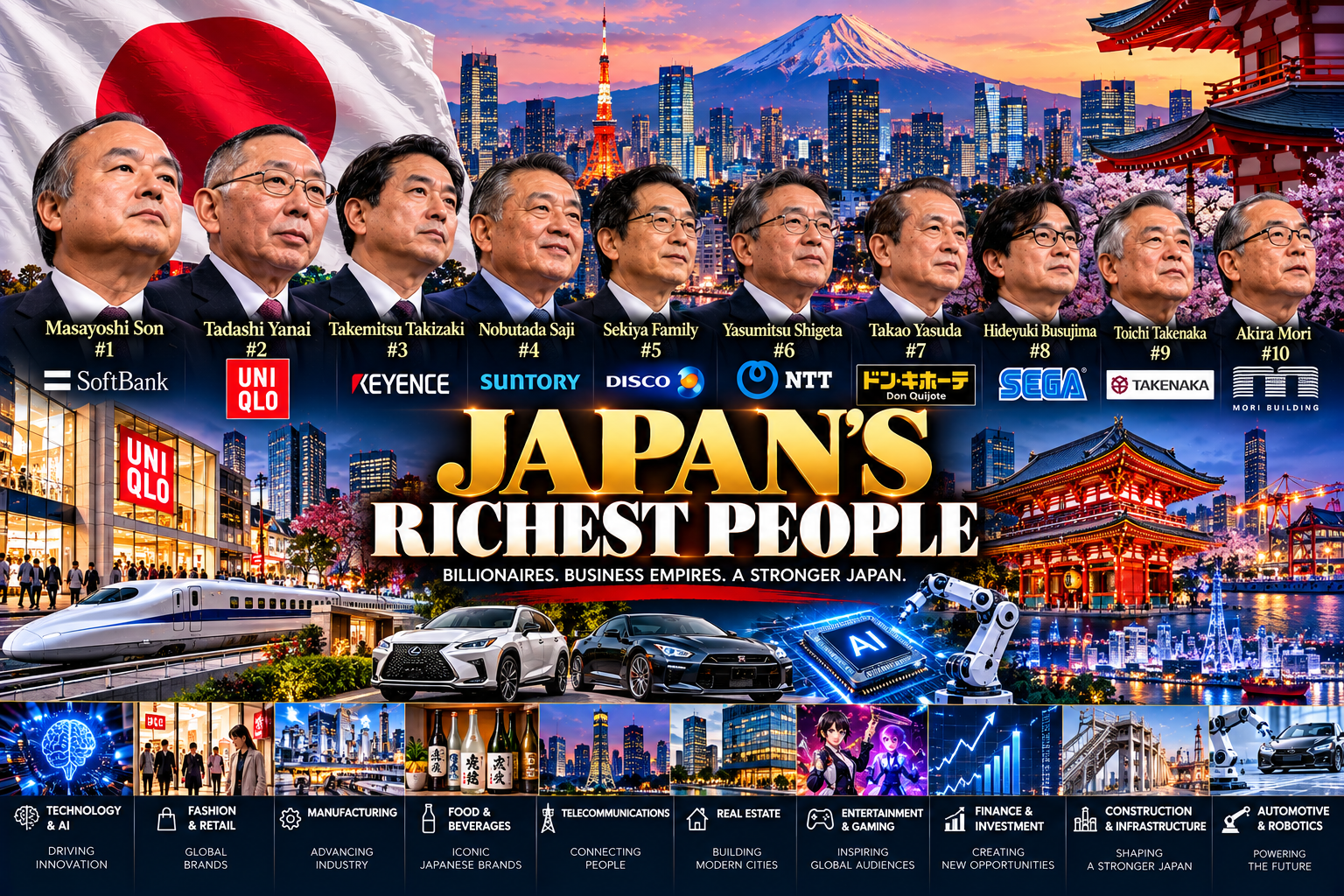
The country’s billionaire landscape has also changed significantly as technology and artificial intelligence have influenced financial markets and corporate valuations. According to Forbes’ 2026 Japan’s 50 Richest list, the combined wealth of the country’s 50 richest people reached approximately $294 billion, up 29% from the previous year. Masayoshi Son returned to the No. 1 position with an estimated fortune of $80 billion, followed by Tadashi Yanai and family at $65 billion and Takemitsu Takizaki at $23.6 billion.
Who Are Japan’s Richest People?
Japan’s richest people come from a wide range of industries. Some built their fortunes by founding companies, while others inherited or expanded family businesses.
The 2026 Forbes Japan list included major fortunes connected to:
Technology and artificial intelligence
Finance and investment
Fashion and retail
Manufacturing
Food and beverages
Telecommunications
Real estate
Construction
Entertainment and gaming
Forbes calculates these fortunes using information from shareholdings, financial reports, stock exchanges, analysts, and other sources. The 2026 Japan list used market data and exchange rates from May 22, 2026.
1. Masayoshi Son: Technology, Investment, and SoftBank
Masayoshi Son is one of Japan’s most internationally recognized business leaders and the founder of SoftBank Group.
Forbes placed Son at the top of its 2026 Japan rich list with an estimated fortune of $80 billion. His wealth increased substantially during the year as SoftBank benefited from rising technology valuations and investor interest in artificial intelligence.
SoftBank has evolved from a telecommunications company into a global technology investment group. The company has made major investments across technology, internet businesses, artificial intelligence, and emerging technologies.
AI has become particularly important to Son’s investment strategy. SoftBank reported record net profit for the fiscal year ended March 2026, while the company's technology investments attracted increased attention as the AI industry expanded.
Son’s fortune demonstrates how ownership in technology and investment companies can change rapidly as public markets reassess the value of technology businesses.
2. Tadashi Yanai: The Uniqlo Retail Empire
Tadashi Yanai built one of Japan’s most successful international retail businesses through Fast Retailing, the parent company of Uniqlo.
Forbes’ 2026 Japan list valued Yanai and his family’s fortune at approximately $65 billion, placing them second.
Uniqlo has become a global clothing brand with thousands of stores and operations across multiple international markets. Fast Retailing also owns brands including GU, Theory, and other fashion businesses.
According to Forbes, Fast Retailing reported approximately $22 billion in revenue and $2.8 billion in net profit for the fiscal year ended August 2025. Uniqlo had nearly 2,500 stores across 25 countries at the time of Forbes' profile update.
Yanai’s story illustrates the international potential of Japanese consumer brands. Rather than relying solely on the domestic market, Fast Retailing developed a global retail strategy based on standardized products, supply-chain management, branding, and international expansion.
3. Takemitsu Takizaki: Manufacturing and Automation
Takemitsu Takizaki is associated with Keyence, one of Japan’s most prominent industrial technology companies.
Forbes ranked Takizaki third on its 2026 Japan rich list with an estimated fortune of $23.6 billion.
Keyence develops factory automation and measurement technologies used by manufacturers around the world.
The company's business reflects one of Japan's strongest economic characteristics: advanced manufacturing.
Japan has developed global expertise in areas such as robotics, precision equipment, sensors, industrial machinery, electronics, and automotive technologies.
Companies serving industrial customers can generate significant economic value because their equipment and technologies are integrated into manufacturing processes across many countries.
4. Nobutada Saji: Food and Beverage
Nobutada Saji and his family are associated with Suntory Holdings, one of Japan's major beverage companies.
Forbes placed Saji and his family fourth on the 2026 Japan list with an estimated fortune of $9.3 billion.
Suntory has built a diversified global beverage business covering alcoholic drinks, soft drinks, spirits, and other consumer products.
The company represents another important path to wealth creation in Japan: building a consumer brand that can expand beyond the domestic market.
Japanese beverage and food companies have increasingly developed international operations, allowing established brands to reach consumers around the world.
5. The Sekiya Family: Semiconductor and Technology Demand
The Sekiya family ranked fifth on Forbes’ 2026 Japan rich list with an estimated fortune of approximately $9.1 billion.
Their wealth is linked to Disco, a Japanese company involved in semiconductor manufacturing equipment.
The semiconductor industry has become increasingly important because of artificial intelligence, data centers, advanced computing, smartphones, automobiles, and other technologies.
Forbes reported that Disco shares more than doubled during the period covered by the 2026 list, helped by demand associated with AI-related products.
This highlights how Japan's industrial technology companies can benefit indirectly from global technology trends.
6. Yasumitsu Shigeta: Telecommunications
Yasumitsu Shigeta ranked sixth with an estimated fortune of approximately $6 billion.
His wealth is connected to Japan's telecommunications industry.
Telecommunications remains a major economic sector because mobile networks, broadband infrastructure, digital services, and communications platforms support nearly every part of the modern economy.
Japan's telecommunications industry has also become increasingly connected to cloud computing, digital services, data centers, and other technology infrastructure.
7. Takao Yasuda: Fashion and Retail
Takao Yasuda ranked seventh on the 2026 Japan rich list with an estimated fortune of approximately $4.7 billion.
Yasuda is associated with Don Quijote, a major Japanese discount retail chain.
The company demonstrates the importance of retail innovation in Japan. Discount retailers compete through product variety, pricing, convenience, store locations, and distinctive shopping experiences.
Retail remains an important source of private wealth because successful chains can develop extensive networks and strong customer recognition.
8. Hideyuki Busujima: Entertainment and Gaming
Hideyuki Busujima and his family ranked eighth with an estimated fortune of approximately $4.6 billion.
Their wealth is connected to Japan's gaming and entertainment industry.
Gaming is an important part of Japan's global cultural and economic influence. Japanese entertainment companies have created internationally recognized games, characters, animation, and digital entertainment businesses.
The sector also demonstrates how intellectual property can become a valuable economic asset when successful franchises expand into multiple markets and formats.
9. Toichi Takenaka: Construction and Engineering
Toichi Takenaka and his family ranked ninth with an estimated fortune of around $4 billion.
Their wealth is associated with construction and engineering.
Construction companies play a central role in Japan's economy by developing commercial buildings, residential properties, infrastructure, factories, transportation facilities, and other physical assets.
Japan's highly developed urban environment creates continuing demand for construction, redevelopment, renovation, and infrastructure projects.
10. Akira Mori: Real Estate
Akira Mori and his family ranked tenth on the 2026 Forbes Japan list, with an estimated fortune of approximately $3.95 billion.
Mori is associated with Mori Building, one of Japan's prominent real estate developers.
Real estate remains an important component of Japan's wealth landscape, particularly in major metropolitan areas such as Tokyo.
Large-scale developments can combine offices, residential buildings, retail, hotels, entertainment, transportation connections, and public spaces into integrated urban projects.
Technology Is Reshaping Japan’s Billionaire Economy
One of the clearest themes in Japan's 2026 wealth landscape is the growing importance of technology.
Artificial intelligence has influenced technology stocks, semiconductor companies, investment firms, and infrastructure businesses.
Masayoshi Son's SoftBank is one of the clearest examples. The company's investment strategy has increasingly focused on artificial intelligence and emerging technology.
At the same time, companies such as Keyence and Disco benefit from demand for industrial automation and semiconductor manufacturing technologies.
This creates several layers of wealth creation:
AI companies → semiconductor demand → manufacturing equipment → industrial automation → investment opportunities.
As AI infrastructure expands, businesses operating at different stages of this technology ecosystem can potentially benefit from increased demand.
Japan’s Manufacturing Strength
Manufacturing remains one of the foundations of Japanese corporate wealth.
Japan is internationally known for advanced production capabilities involving:
Automobiles
Robotics
Electronics
Semiconductors
Industrial machinery
Precision instruments
Factory automation
Chemicals
Consumer electronics
Manufacturing businesses often generate wealth through long-term relationships with customers, specialized technologies, patents, global supply chains, and high barriers to entry.
Takemitsu Takizaki's connection to Keyence illustrates how specialized industrial technology can become a major source of personal wealth.
Fashion and Retail
Retail is another major contributor to Japanese billionaire wealth.
Tadashi Yanai's Fast Retailing is one of the strongest examples. Uniqlo expanded from Japan into a global clothing business with thousands of stores and a significant international presence.
Other Japanese fortunes have also been created through discount retail, department stores, convenience stores, specialty shops, and consumer brands.
The sector's success depends on factors such as brand recognition, supply chains, pricing, store networks, digital commerce, and consumer demand.
Finance and Investment
Japan's financial sector has produced major fortunes, but modern investment wealth increasingly overlaps with technology.
Masayoshi Son's SoftBank demonstrates this combination particularly well.
Investment companies can generate wealth through ownership stakes in public companies, private businesses, technology startups, and strategic investments.
However, this type of wealth can also fluctuate considerably because valuations depend on financial markets and the performance of underlying investments.
Real Estate and Urban Development
Real estate continues to play an important role among Japan's wealthiest families.
Tokyo is one of the world's major metropolitan economies, creating demand for offices, apartments, hotels, retail centers, and mixed-use developments.
Large developers can generate value by assembling land, financing projects, developing buildings, managing properties, and creating integrated urban districts.
Real estate fortunes can therefore be connected to both property values and the long-term development of cities.
Japan’s Billionaires and Global Markets
Japan's richest people increasingly operate businesses with international exposure.
Uniqlo sells clothing across numerous countries. Japanese industrial companies supply manufacturers worldwide. Technology investors participate in global markets. Beverage companies have expanded international brands.
Globalization allows Japanese companies to diversify revenue sources and access larger consumer and industrial markets.
However, international businesses are also exposed to currency movements, trade conditions, geopolitical developments, interest rates, and changes in consumer demand.
Why Japan’s Richest People Rankings Change
Billionaire rankings are not fixed.
A person's estimated wealth can change because of:
Stock market movements
Currency exchange rates
Company earnings
Private-company valuations
Acquisitions
Dividends
Changes in ownership
Business performance
Technology-sector valuations
Forbes' 2026 Japan ranking illustrates this clearly. The fortunes of the 50 richest Japanese increased collectively by 29%, reaching about $294 billion. Forbes attributed much of the increase to strong equity markets and the technology and AI investment environment.
Forbes also notes that its billionaire calculations can change as public stock prices move, while significant private-company holdings may be updated using valuation estimates and market indicators.
Japan’s Richest People and Self-Made Wealth
Japan's billionaire landscape includes both self-made entrepreneurs and family fortunes.
Tadashi Yanai, for example, is identified by Forbes as self-made and built Fast Retailing into an international fashion business.
Other fortunes are connected to families that have owned businesses for generations.
This distinction is important when studying billionaire wealth because personal net worth does not always represent cash holdings. Much of a billionaire's wealth can consist of shares in companies, private business ownership, real estate, or other assets.
The Future of Wealth in Japan
Several industries could remain important to Japan's wealth creation in the coming years.
Artificial Intelligence
AI is already influencing investment decisions, semiconductor demand, cloud infrastructure, robotics, and software.
Semiconductors
Japan has important capabilities in semiconductor materials, manufacturing equipment, and industrial technologies.
Robotics
Japan's aging population and advanced manufacturing sector create opportunities for automation and robotics.
Digital Infrastructure
Data centers, telecommunications networks, cloud computing, and digital platforms are becoming increasingly important.
Global Consumer Brands
Japanese fashion, food, beverages, automobiles, entertainment, and consumer products continue to have international audiences.
Real Estate
Tokyo and other major cities remain important centers for commercial, residential, hospitality, and mixed-use development.
Final Thoughts
Japan's richest people represent a diverse collection of industries rather than a single path to wealth.
Masayoshi Son built his fortune through technology and investment. Tadashi Yanai expanded Japanese fashion retail into a global business. Takemitsu Takizaki represents advanced manufacturing and automation, while other leading fortunes come from beverages, telecommunications, entertainment, construction, and real estate.
The 2026 Forbes Japan list also shows how quickly wealth can change when financial markets, artificial intelligence, and global business conditions shift.
Japan's billionaire economy is therefore closely connected to the country's broader strengths: advanced manufacturing, global brands, technology, investment, infrastructure, and consumer businesses.
As AI, robotics, semiconductors, digital infrastructure, and international consumer markets continue developing, these sectors may remain important parts of Japan's corporate and wealth landscape.
FAQs
Who is the richest person in Japan in 2026?
According to Forbes' 2026 Japan's 50 Richest list, Masayoshi Son ranked first with an estimated fortune of $80 billion as measured for the list.
Who is Tadashi Yanai?
Tadashi Yanai is the founder and leader of Fast Retailing, the parent company of Uniqlo. Forbes ranked Yanai and his family second on the 2026 Japan rich list.
What industries create the most billionaire wealth in Japan?
Major industries include technology, finance, fashion, retail, manufacturing, food and beverages, telecommunications, construction, entertainment, and real estate.
Why does Masayoshi Son's wealth change?
A significant portion of Son's wealth is connected to his ownership and investments related to SoftBank. Changes in SoftBank's share price and valuations of technology investments can therefore affect his estimated net worth.
Is Tadashi Yanai self-made?
Forbes identifies Tadashi Yanai as a self-made billionaire. He built Fast Retailing and expanded Uniqlo into a major international clothing brand.
How is billionaire net worth calculated?
Billionaire net worth generally includes estimated values of publicly traded shares, private businesses, real estate, and other assets, minus relevant liabilities where data is available. Forbes updates its real-time billionaire estimates as market values change.
Does Japan have many technology billionaires?
Yes. Technology and industrial technology are significant sources of Japanese billionaire wealth, including businesses connected to investment, semiconductors, automation, telecommunications, and digital infrastructure.
Why can Japan's richest-person rankings change?
Rankings can change because stock prices, exchange rates, company valuations, earnings, ownership stakes, and private-company estimates change over time. Forbes' 2026 methodology used market information as of May 22, 2026 for its Japan 50 list.