South Korea has transformed from a war-damaged economy into one of the world's leading technology, manufacturing, automotive, entertainment, healthcare, and financial markets. Behind this economic transformation are powerful companies and entrepreneurs whose businesses have created some of Asia's most significant fortunes.
South Korea's billionaire landscape is closely connected to its famous conglomerates, technology companies, automobile manufacturers, financial institutions, biotechnology firms, gaming companies, and investment groups.
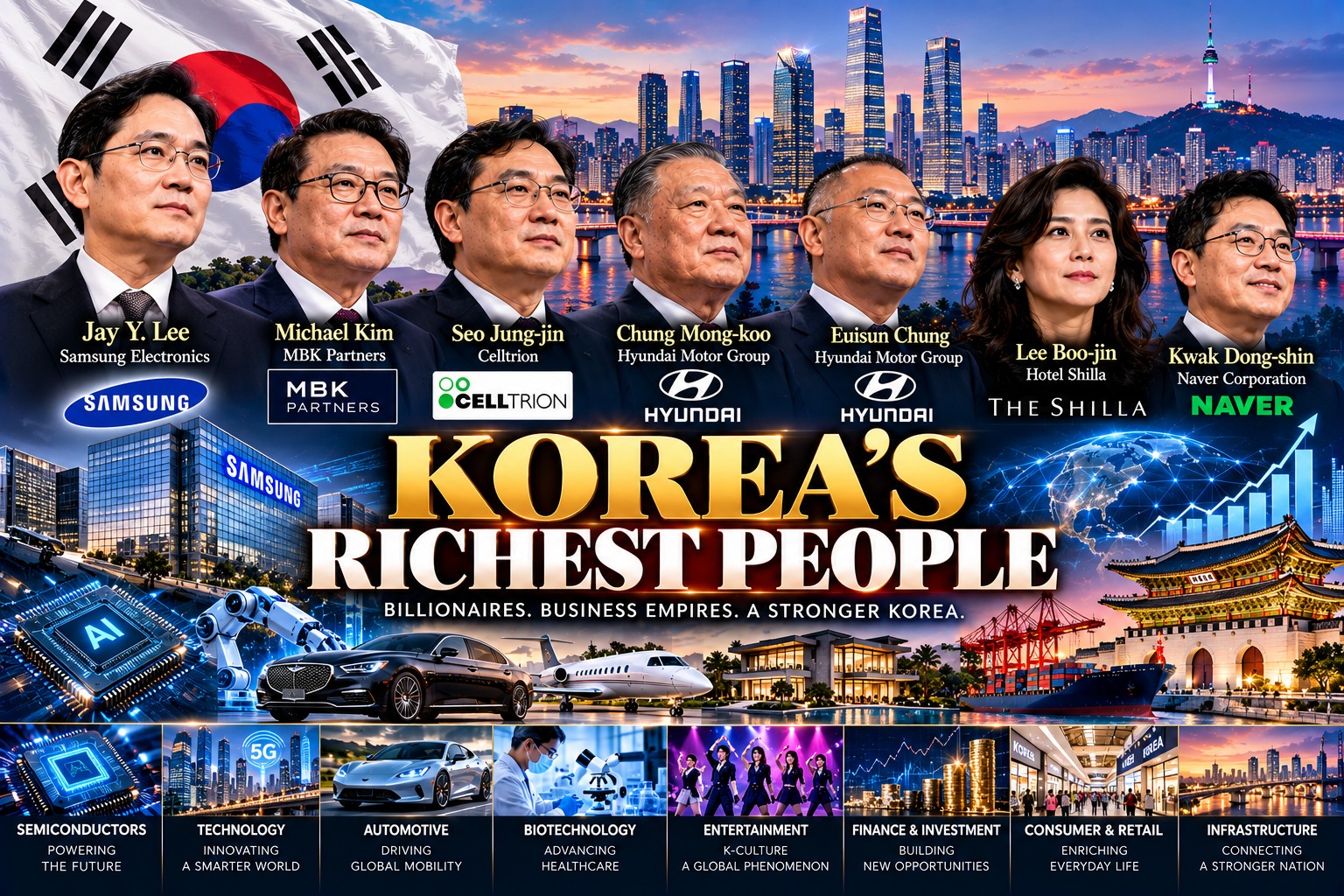
According to Forbes' 2026 Korea's 50 Richest ranking, Jay Y. Lee, executive chairman of Samsung Electronics, reclaimed the No. 1 position. Michael Kim of MBK Partners ranked second, while Celltrion cofounder Seo Jung-jin ranked third. Forbes reported that the combined fortune of Korea's 50 richest reached approximately $175 billion, a 77% increase from the previous year's $99 billion.
The rise in Korean billionaire wealth was strongly connected to the country's technology and semiconductor industries, particularly the global boom in artificial intelligence and demand for advanced chips.
Who Are Korea's Richest People?
South Korea's wealthiest individuals come from a wide range of industries. Some built their fortunes through family-controlled conglomerates, while others created companies from scratch.
Among the most prominent names in the 2026 Forbes ranking are:
Jay Y. Lee
Michael Kim
Seo Jung-jin
Cho Jung-ho
Lee Boo-jin
Lee Seo-hyun
Chung Mong-koo
Hong Ra-hee
Euisun Chung
Yoon Dae-in
Kwak Dong-shin
Park Hyeon-joo
Kim Beom-su
Bom Kim
Kwon Hyuk-bin
Forbes' 2026 ranking shows that technology, finance and investment, healthcare, automotive, entertainment, and diversified businesses are major sources of billionaire wealth in South Korea.
1. Jay Y. Lee: Samsung and South Korea's Technology Empire
Jay Y. Lee is one of South Korea's most recognizable business leaders and the executive chairman of Samsung Electronics.
Forbes ranked Lee No. 1 on its 2026 Korea's 50 Richest list. His wealth is primarily connected to Samsung, one of the world's largest technology companies.
Samsung operates across areas including semiconductors, smartphones, displays, consumer electronics, and other technology businesses.
The semiconductor business has become especially important as artificial intelligence has increased demand for high-performance computing and memory chips.
Lee's position also reflects the importance of South Korea's chaebol system, in which large family-controlled business groups have played a major role in the country's industrial development.
Forbes reported that Lee and his family were also dealing with a substantial inheritance-tax obligation following the 2020 death of Samsung patriarch Lee Kun-hee.
2. Michael Kim: Finance and Investment
Michael Kim, also known as Kim Byung-ju, ranked second in Forbes' 2026 Korea's 50 Richest list.
His fortune is associated with MBK Partners, a major private-equity investment firm.
Unlike fortunes primarily based on manufacturing or consumer brands, investment fortunes are often connected to ownership stakes in multiple companies.
Private-equity firms raise capital, acquire businesses, improve or restructure them, and eventually seek returns through sales or other transactions.
Michael Kim's position demonstrates the growing importance of financial markets and private investment in South Korea's billionaire economy.
3. Seo Jung-jin: Biotechnology and Healthcare
Seo Jung-jin is the cofounder of Celltrion, a South Korean biopharmaceutical company.
Forbes ranked Seo third in its 2026 Korea list. Forbes describes Celltrion as a biotechnology company producing medicines used in areas including cancer, influenza, and rheumatoid arthritis.
Seo founded Celltrion in 2002 and took the company public in 2008.
The company became particularly notable for its work in biosimilars, which are biological medicines designed to be highly similar to existing approved biological products.
Healthcare and biotechnology have become increasingly important sources of wealth as South Korea develops its pharmaceutical and medical technology industries.
4. Cho Jung-ho: Financial Services
Cho Jung-ho is chairman of Meritz Financial Group, one of South Korea's major financial businesses.
Forbes placed him fourth in its 2026 Korea ranking, with financial and investment activities identified as his primary industry.
Financial institutions play an important role in South Korea's economy by providing banking, insurance, investment, and capital-market services.
The growth of Korean financial companies has created significant fortunes outside the country's better-known technology and manufacturing sectors.
5. Lee Boo-jin: Samsung and Hospitality
Lee Boo-jin is a member of the Samsung family and president of Hotel Shilla.
Forbes ranked her fifth among Korea's richest people in 2026.
Hotel Shilla operates in the hospitality and duty-free sectors, connecting Lee's wealth to both tourism and consumer businesses.
Her position also illustrates the continuing role of family ownership in South Korea's largest corporate groups.
6. Lee Seo-hyun: Samsung and Creative Industries
Lee Seo-hyun is another member of the Samsung family and ranked among South Korea's wealthiest people in Forbes' 2026 list.
Her wealth is primarily connected to Samsung-related holdings, while her career has also included involvement in creative and design-related activities.
Her position alongside other members of the Samsung family demonstrates how ownership stakes in major conglomerates can remain an important component of Korean family wealth.
7. Chung Mong-koo: Hyundai Motor Group
Chung Mong-koo is the former chairman of Hyundai Motor Group and one of the most important figures in South Korea's automotive history.
Forbes ranked him seventh among Korea's richest people in 2026.
Hyundai Motor Group includes major automotive businesses and has developed a substantial international presence.
The Korean automotive sector has evolved from producing relatively inexpensive vehicles into a global competitor in automobiles, electric vehicles, batteries, and advanced mobility technologies.
Chung Mong-koo's wealth reflects the scale of the Hyundai business empire and the global importance of South Korea's automotive industry.
8. Hong Ra-hee: Samsung Family Wealth
Hong Ra-hee is another major Samsung shareholder and ranked eighth on Forbes' 2026 Korea list.
She is also known for her leadership of the Leeum Museum of Art, reflecting the Samsung family's long-standing involvement in art and culture.
Her wealth illustrates how ownership in a major public conglomerate can create significant personal fortunes even when the individual is not running the company's day-to-day operations.
9. Euisun Chung: Hyundai Motor Group
Euisun Chung is chairman of Hyundai Motor Group and represents the next generation of leadership in the Hyundai business family.
Forbes ranked him ninth among Korea's richest people in 2026.
Under the broader Hyundai group, the automotive industry has expanded beyond traditional gasoline-powered vehicles.
Electric vehicles, autonomous driving, robotics, hydrogen technologies, and smart mobility are becoming increasingly important areas of development.
This transition could influence the future direction of one of South Korea's largest industrial groups.
10. Yoon Dae-in: Pharmaceuticals
Yoon Dae-in ranked tenth on Forbes' 2026 Korea list and is associated with Samchundang Pharm.
His position reflects the increasing importance of healthcare and pharmaceuticals within South Korea's wealth economy.
South Korea has invested heavily in biotechnology, pharmaceutical research, medical technology, and advanced healthcare manufacturing.
The country's established technology infrastructure also provides a foundation for innovation in healthcare.
Technology Is Driving Korean Billionaire Wealth
Technology is one of the most important themes in South Korea's billionaire economy.
Samsung Electronics is the most obvious example, but the country's technology sector extends far beyond one company.
South Korea has major companies involved in:
Semiconductors
Memory chips
Displays
Smartphones
Batteries
Consumer electronics
Artificial intelligence
Telecommunications
Online platforms
Gaming
Data infrastructure
Forbes reported that the 2026 increase in Korean billionaire wealth was significantly connected to the AI-driven semiconductor boom.
South Korea's Semiconductor Industry
Semiconductors are central to the Korean economy.
Samsung Electronics and SK Hynix are among the world's best-known memory-chip manufacturers.
The artificial intelligence boom has increased demand for advanced computing infrastructure and high-performance memory.
This creates opportunities for chip manufacturers, equipment suppliers, materials companies, and related technology businesses.
The semiconductor industry also demonstrates why changes in global technology demand can have a direct impact on Korean billionaire fortunes.
Automotive Billionaires
South Korea's automotive industry is another important source of wealth.
Hyundai Motor Group has developed a significant global footprint, selling vehicles across North America, Europe, Asia, and other markets.
The industry is also undergoing a major technological transition.
Electric vehicles, batteries, software, autonomous-driving technology, and connected vehicles are changing the competitive landscape.
This means that South Korea's automotive fortunes may increasingly depend on technology as well as traditional vehicle manufacturing.
Healthcare and Biotechnology
Healthcare has become another major area of Korean business growth.
Celltrion is one of the country's most prominent biotechnology companies, while other pharmaceutical companies are expanding research and international operations.
The growth of biosimilars has helped Korean companies compete in global pharmaceutical markets.
As populations age and demand for advanced medical treatments grows, biotechnology may become increasingly important to South Korea's economy.
Gaming and Entertainment
South Korea is also a global leader in gaming and entertainment.
Companies involved in online games, mobile gaming, music, television, and film have developed international audiences.
Korean entertainment has expanded significantly through K-pop, Korean dramas, films, and digital content.
The sector creates another path for entrepreneurs to build valuable intellectual-property businesses.
Finance and Private Equity
Finance is another major source of billionaire wealth.
Michael Kim's MBK Partners and Cho Jung-ho's Meritz Financial Group demonstrate how investment and financial services have created major fortunes in South Korea.
As South Korea's capital markets continue to develop, investment firms, financial institutions, and asset managers can play an increasingly important role in wealth creation.
The Role of Chaebols
One unique characteristic of South Korea's corporate economy is the importance of chaebols.
Chaebols are large business groups with extensive family ownership and control.
Samsung, Hyundai, SK, and LG are among the most internationally recognized Korean conglomerates.
These groups played an important role in South Korea's rapid economic development.
They have also created large family fortunes through ownership stakes in affiliated companies.
The Samsung family provides one of the clearest examples of how wealth can be connected to a major conglomerate across multiple generations.
Why Korea's Richest Rankings Change
Billionaire rankings are not permanent.
Many of the wealthiest individuals own significant stakes in publicly traded companies. When share prices rise or fall, their estimated net worth can change accordingly.
Forbes' 2026 Korea ranking was based on valuations measured around March 27, 2026.
Real-time Forbes profiles can show different values later in the year.
For example, Forbes' Jay Y. Lee profile displayed a real-time net worth of $33.8 billion as of May 25, 2026, while the Korea ranking used an earlier valuation date.
This is why rankings should always be accompanied by a date.
How Korean Billionaire Wealth Is Measured
Billionaire net worth is an estimate rather than a bank balance.
For publicly traded companies, analysts can calculate the value of an individual's shares based on current market prices.
For private companies, valuations may rely on recent transactions, comparable companies, ownership stakes, and other financial information.
Currency exchange rates can also affect wealth estimates when values are converted into U.S. dollars.
Therefore, two publications can report somewhat different net worth figures even when they are analyzing the same person.
South Korea's New Generation of Wealth
South Korea's next generation of billionaires may emerge from industries that were much smaller several decades ago.
Potential areas include:
Artificial intelligence
Semiconductors
Biotechnology
Electric vehicles
Battery technology
Gaming
Digital finance
Renewable energy
Robotics
Entertainment
Software
Data centers
These industries are increasingly connected to global markets.
South Korean companies therefore have opportunities to build businesses that serve customers far beyond the domestic market.
The Global Reach of Korean Businesses
South Korea's largest companies are no longer purely domestic businesses.
Samsung sells technology around the world. Hyundai and Kia operate across international automotive markets. Korean pharmaceutical companies are expanding globally, while entertainment companies have developed worldwide audiences.
This international reach gives Korean businesses access to larger markets but also exposes them to global competition, currency movements, trade policies, and changing consumer demand.
Future of Korea's Richest People
The future of South Korea's billionaire economy will likely be influenced by the country's ability to maintain its leadership in technology and manufacturing while expanding into emerging industries.
Artificial intelligence could continue to support semiconductor demand.
Electric vehicles and batteries could reshape automotive manufacturing.
Biotechnology could strengthen Korea's healthcare industry.
Digital entertainment could continue expanding internationally.
Meanwhile, established conglomerates such as Samsung and Hyundai will continue to play an important role in the country's economy.
Final Thoughts
South Korea's richest people reflect the country's transformation into a global economic and technological power.
Jay Y. Lee represents Samsung and the semiconductor-driven technology economy. Michael Kim represents private equity and investment. Seo Jung-jin represents biotechnology and healthcare. Chung Mong-koo and Euisun Chung represent the automotive industry, while other billionaires have built fortunes through finance, pharmaceuticals, gaming, technology, and diversified businesses.
The country's billionaire economy is therefore much broader than Samsung or Hyundai alone.
From semiconductors and artificial intelligence to biotechnology, automobiles, finance, gaming, and entertainment, South Korea has developed businesses with global influence.
As these industries continue to evolve, the companies behind Korea's largest fortunes will also change, potentially creating new generations of entrepreneurs and business leaders.
FAQs
Who is the richest person in South Korea?
According to Forbes' 2026 Korea's 50 Richest ranking, Jay Y. Lee of Samsung ranked first.
Who is Jay Y. Lee?
Jay Y. Lee is the executive chairman of Samsung Electronics and the leader of South Korea's largest conglomerate.
Who is the second-richest person in Korea?
Forbes' 2026 Korea ranking placed Michael Kim, chairman of MBK Partners, second.
Who is Seo Jung-jin?
Seo Jung-jin is the cofounder and chairman of Celltrion, a South Korean biotechnology and pharmaceutical company.
Which industries create the most billionaire wealth in South Korea?
Major industries include technology, semiconductors, finance, healthcare, automobiles, entertainment, gaming, manufacturing, and diversified conglomerates.
Why is Samsung important to Korea's billionaire wealth?
Samsung is one of South Korea's largest corporate groups, with major businesses in semiconductors, electronics, smartphones, displays, and other technologies.
Why do Korean billionaire rankings change?
Stock prices, company valuations, currency movements, ownership changes, and other asset values can cause estimated billionaire wealth to change.
What is a chaebol?
A chaebol is a large South Korean business group typically associated with extensive family ownership and control across multiple affiliated companies.