Hong Kong is one of the world's most influential financial and commercial centers. Known for its international banking industry, luxury real estate market, global trade connections, and major business conglomerates, the city has produced some of Asia's wealthiest entrepreneurs and business families.
Over the decades, Hong Kong has become home to successful property developers, investors, industrialists, technology entrepreneurs, shipping magnates, and retail business leaders. Many of these individuals have built international business empires that extend far beyond the city's borders.
In 2026, Hong Kong's billionaire community experienced a significant increase in wealth. According to Forbes' February 2026 ranking of Hong Kong's 50 Richest, business magnate Li Ka-shing retained his position as the city's richest individual, with an estimated fortune of $45.1 billion.
The second position went to brothers Peter and Martin Lee and their family, with a combined fortune of $34.9 billion. Henry Cheng and his family secured third place with an estimated net worth of $26.1 billion.
The collective wealth of Hong Kong's 50 richest individuals and families reached approximately $366 billion in 2026, representing a 22% increase compared with $301 billion in 2025.
A recovering property market, strong stock-market performance, and a series of initial public offerings (IPOs) contributed to this growth. The Hang Seng Index also gained nearly 30% between the previous wealth measurement periods.
Hong Kong's wealthiest people have built their fortunes through industries such as property development, banking, infrastructure, jewelry, technology, shipping, and investment management.
This article explores Hong Kong's richest people in 2026, their estimated net worth, business backgrounds, major companies, and the industries contributing to their extraordinary fortunes.
Top 10 Richest People in Hong Kong in 2026
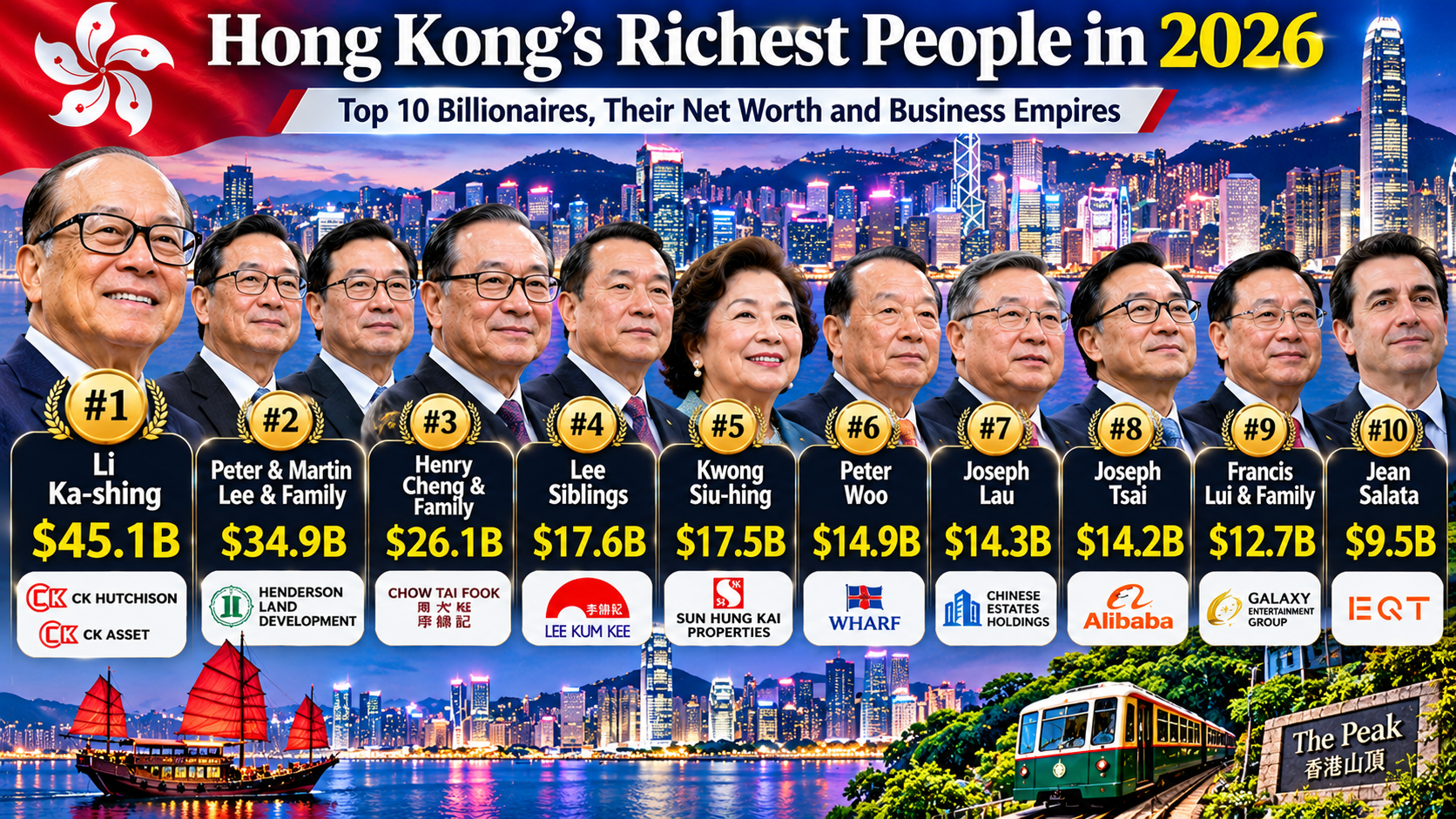
According to Forbes' February 2026 annual ranking, the top 10 wealthiest individuals and families are:
Rank | Name | Estimated Net Worth |
|---|---|---|
1 | Li Ka-shing | $45.1 billion |
2 | Peter and Martin Lee and Family | $34.9 billion |
3 | Henry Cheng and Family | $26.1 billion |
4 | Lee Siblings | $17.6 billion |
5 | Kwong Siu-hing | $17.5 billion |
6 | Peter Woo | $14.9 billion |
7 | Joseph Lau | $14.3 billion |
8 | Joseph Tsai | $14.2 billion |
9 | Francis Lui and Family | $12.7 billion |
10 | Jean Salata | $9.5 billion |
Net worth figures are estimated in US dollars. Family fortunes are combined where applicable.
1. Li Ka-shing – Hong Kong's Richest Person
Estimated Net Worth: $45.1 Billion
Main Sources of Wealth: Real Estate, Infrastructure, Retail, and Investments
Li Ka-shing is Hong Kong's richest person in 2026 and one of the most internationally recognized business magnates in Asia.
Born in Guangdong, China, in 1928, Li moved to Hong Kong with his family during his childhood. His early life was challenging, and he began working at a young age to support his family.
His entrepreneurial journey started in manufacturing. In 1950, he established a plastics manufacturing business that later became famous for producing plastic flowers.
His early success provided the foundation for his expansion into property development, infrastructure, telecommunications, retail, and international investments.
Li eventually established a major business empire through companies associated with CK Hutchison Holdings and CK Asset Holdings.
CK Hutchison has interests in several industries, including ports, retail, telecommunications, infrastructure, and energy.
CK Asset focuses primarily on property development and investment activities.
Li's companies operate internationally, with business interests across Europe, Asia, and other regions.
His investment strategy has focused on diversification, long-term ownership, and identifying opportunities in industries with strong commercial potential.
According to Forbes, Li added approximately $7.8 billion to his fortune during the 2026 ranking period, reaching an estimated net worth of $45.1 billion.
The rise was supported by strong CK Hutchison share performance, with its stock increasing by more than 60% compared with the previous year.
Li handed over the leadership of much of his business empire to his eldest son, Victor Li, in 2018, although his legacy remains central to Hong Kong's business history.
His career demonstrates how manufacturing, strategic investment, and international expansion can transform a small business into a global corporate empire.
2. Peter and Martin Lee – The Henderson Land Family Empire
Combined Estimated Net Worth: $34.9 Billion
Main Source of Wealth: Real Estate and Property Development
Peter Lee Ka-kit and Martin Lee Ka-shing are among Hong Kong's wealthiest business figures.
The brothers are the sons of the late Lee Shau Kee, the founder of Henderson Land Development and one of Hong Kong's most influential property tycoons.
After their father's death in March 2025, the brothers and their family inherited significant business interests and wealth.
Henderson Land Development is one of Hong Kong's major property companies, with investments in residential developments, commercial buildings, hotels, and other real estate assets.
The company has played an important role in shaping Hong Kong's urban landscape.
Its developments include residential communities, office buildings, retail spaces, and large mixed-use projects.
One of its major projects is Central Yards, an approximately $8.1 billion office-to-retail development overlooking Victoria Harbour.
The project is planned to open in two phases beginning in 2027.
Peter and Martin Lee serve as co-chairmen of Henderson Land Development and continue the family's involvement in the property industry.
Their combined estimated fortune reached $34.9 billion in Forbes' 2026 ranking, placing them second.
Their business interests demonstrate the importance of property ownership, development expertise, and long-term investment in Hong Kong's real estate market.
3. Henry Cheng and Family – The Chow Tai Fook Business Empire
Combined Estimated Net Worth: $26.1 Billion
Main Sources of Wealth: Jewelry, Real Estate, and Investments
Henry Cheng is one of Hong Kong's most prominent business leaders and the chairman of Chow Tai Fook Enterprises.
He is the son of the late Cheng Yu-tung, who helped develop the family's business interests into a major international commercial empire.
The family's wealth is closely associated with Chow Tai Fook Jewellery Group, one of the world's best-known jewelry retailers.
The company specializes in gold jewelry, diamonds, gemstones, luxury accessories, and other precious products.
Chow Tai Fook has developed an extensive retail presence across Hong Kong, mainland China, and other international markets.
Its brand recognition and large store network have helped establish it as a major participant in the global jewelry industry.
The Cheng family's business interests also extend into property development, hospitality, and investments.
New World Development is another important company associated with the family's business empire.
The company has developed residential, commercial, and mixed-use properties in Hong Kong and other markets.
In 2026, Henry Cheng and his family maintained third place in Forbes' Hong Kong rich list with an estimated fortune of $26.1 billion.
Their wealth increased by approximately $6.6 billion compared with the previous year.
The performance of Chow Tai Fook Jewellery Group, supported by higher gold prices and stronger share performance, contributed to the increase.
The family's business history demonstrates how luxury retail and real estate investments can create substantial long-term wealth.
4. The Lee Siblings – The Lee Kum Kee Family Fortune
Combined Estimated Net Worth: $17.6 Billion
Main Source of Wealth: Food Manufacturing and Consumer Products
The Lee siblings are heirs to the business empire associated with Lee Kum Kee Group, one of the world's most recognizable Chinese sauce and condiment manufacturers.
The company was founded in 1888 by Lee Kum Sheung, who is credited with creating oyster sauce.
Over the decades, the business expanded from a small food operation into an internationally recognized food manufacturing company.
Lee Kum Kee produces a broad range of sauces, condiments, cooking ingredients, and other food products.
Its products are distributed across numerous international markets and are widely used in Asian and international cooking.
The company has built a strong reputation through its product quality, traditional recipes, brand recognition, and international distribution network.
The Lee family has maintained ownership interests in the business across generations.
The five children of the late Lee Man-tat, who led the company for many years, share the family's estimated fortune.
Forbes valued their combined wealth at approximately $17.6 billion in 2026.
Their position demonstrates how a family-owned food manufacturing company can grow into an international business empire.
5. Kwong Siu-hing – The Sun Hung Kai Properties Family Fortune
Estimated Net Worth: $17.5 Billion
Main Source of Wealth: Real Estate
Kwong Siu-hing is one of Hong Kong's wealthiest women and an important figure associated with Sun Hung Kai Properties.
She is the widow of Kwok Tak-seng, who co-founded the company with his brothers.
Sun Hung Kai Properties is one of Hong Kong's largest property developers.
Its business activities include residential development, commercial property investment, shopping malls, office buildings, hotels, and other real estate projects.
The company has contributed significantly to Hong Kong's modern skyline through major developments in different parts of the city.
Its portfolio includes residential communities, commercial centers, and large mixed-use properties.
Real estate has historically been one of Hong Kong's most important wealth-generating industries.
Limited land availability, strong commercial demand, and the city's international financial position have contributed to the long-term value of property assets.
Kwong Siu-hing's wealth is associated with her family's ownership interests in Sun Hung Kai Properties.
Forbes estimated her fortune at approximately $17.5 billion in 2026, placing her fifth in the ranking.
Her position demonstrates the continuing importance of family ownership in Hong Kong's property industry.
6. Peter Woo – Property and Business Investment Magnate
Estimated Net Worth: $14.9 Billion
Main Source of Wealth: Real Estate and Investments
Peter Woo Kwong-ching is a prominent Hong Kong businessman and investor.
He is best known for his former leadership of the Wharf Group and his involvement in major property and commercial investments.
Wharf Holdings has historically been associated with property development, shopping malls, hotels, logistics, and other commercial assets.
Peter Woo played an important role in developing the group's business operations and expanding its commercial interests.
He has also been involved in other business ventures, investments, and corporate leadership activities.
Hong Kong's property market has been an important source of wealth for generations of entrepreneurs, and Woo's business career reflects this economic history.
Forbes estimated his net worth at $14.9 billion in 2026, placing him sixth among Hong Kong's wealthiest individuals.
His success illustrates how property investment, commercial development, and strategic asset management can generate substantial fortunes.
7. Joseph Lau – Real Estate Investor and Businessman
Estimated Net Worth: $14.3 Billion
Main Source of Wealth: Real Estate and Investments
Joseph Lau Luen-hung is one of Hong Kong's well-known property investors and entrepreneurs.
He is associated with Chinese Estates Holdings, a company with interests in property investment, development, and commercial real estate.
Lau built much of his fortune through property acquisitions and investments in valuable commercial and residential assets.
His business strategy has involved identifying investment opportunities in real estate markets and managing substantial property portfolios.
Hong Kong's international financial position and property market have historically created opportunities for investors with access to significant capital.
Lau's business interests also include investments in other financial assets.
His estimated fortune reached approximately $14.3 billion in Forbes' 2026 ranking.
He secured seventh place among Hong Kong's wealthiest people.
His career demonstrates the role of investment strategy, asset management, and property ownership in creating billionaire-level wealth.
8. Joseph Tsai – Alibaba Co-Founder and Technology Billionaire
Estimated Net Worth: $14.2 Billion
Main Sources of Wealth: Technology, E-commerce, and Investments
Joseph Tsai is a Taiwanese-born Canadian businessman who has become one of Hong Kong's most influential technology entrepreneurs.
He is best known as a co-founder of Alibaba Group, one of the world's largest e-commerce and technology companies.
Tsai joined Jack Ma and other founding members in building Alibaba into an international business empire.
Alibaba initially focused on connecting Chinese businesses with international buyers through online marketplaces.
Over time, the company expanded into e-commerce, cloud computing, digital payments, logistics, and technology services.
Alibaba became one of the most important companies in China's digital economy.
Joseph Tsai played a significant role in the company's corporate development, financial strategy, and international expansion.
He later became chairman of Alibaba Group.
He is also involved in sports investments and is the owner of the Brooklyn Nets basketball franchise.
His business interests demonstrate the growing relationship between technology, international investment, and global entertainment.
Forbes estimated his net worth at approximately $14.2 billion in 2026, placing him eighth in Hong Kong's wealth ranking.
His career highlights the opportunities created by digital commerce and technology entrepreneurship.
9. Francis Lui and Family – Galaxy Entertainment Business Empire
Combined Estimated Net Worth: $12.7 Billion
Main Source of Wealth: Hospitality, Resorts, and Gaming
Francis Lui Yiu-tung is a prominent Hong Kong businessman associated with Galaxy Entertainment Group.
The company operates in the hospitality, resort, and gaming industries, with a major presence in Macau.
Macau is internationally recognized as a major destination for tourism and casino entertainment.
Galaxy Entertainment operates large integrated resorts that combine hotels, restaurants, shopping, entertainment, and gaming facilities.
Its business model focuses on attracting international visitors and providing a wide range of hospitality services.
Francis Lui became an important figure in the family business and succeeded his father, Lui Che-woo, in leading the company.
Lui Che-woo founded Galaxy Entertainment and was one of the most influential entrepreneurs in Macau's hospitality industry.
After his father's death in 2024, Francis Lui continued to oversee the company's business operations.
Forbes estimated the family's fortune at approximately $12.7 billion in 2026.
Its position reflects the importance of tourism, hospitality, and entertainment in the Greater Bay Area economy.
10. Jean Salata – Private Equity and Investment Management Billionaire
Estimated Net Worth: $9.5 Billion
Main Source of Wealth: Private Equity and Investments
Jean Salata is a prominent investment professional and the chairman of EQT Asia.
He built his wealth through private equity and investment management.
Private equity firms invest in businesses with the objective of improving their operations, expanding their markets, and increasing their long-term value.
These firms typically work with companies across multiple industries, including technology, healthcare, manufacturing, consumer products, and financial services.
Jean Salata became known for his work in the Asian private equity market through Baring Private Equity Asia.
The business later became part of EQT, a major international investment organization.
His career has been closely connected to identifying investment opportunities, managing business portfolios, and helping companies expand across regional markets.
Hong Kong's position as an international financial center has helped support the growth of investment management businesses.
Forbes estimated Jean Salata's fortune at $9.5 billion in 2026, placing him tenth.
His success demonstrates how private equity and international investment management can generate significant wealth.
Other Notable Billionaires and Wealthy Business Families in Hong Kong
Beyond the top 10, Hong Kong is home to several other influential business leaders and wealthy families.
Richard Li
Richard Li is the younger son of Li Ka-shing and a successful entrepreneur in telecommunications, finance, and insurance.
He is associated with Pacific Century Group and has investments in several financial and technology businesses.
His business interests demonstrate the opportunities available in digital services, insurance, and international finance.
Michael Kadoorie
Michael Kadoorie is a prominent businessman associated with the Kadoorie family.
The family has major interests in hospitality, electricity, and investments.
Hongkong and Shanghai Hotels, which operates the Peninsula Hotels brand, is among its best-known business interests.
The Keswick Family
The Keswick family is associated with Jardine Matheson, a diversified international business group with interests in property, retail, engineering, and other commercial activities.
Its long business history demonstrates the importance of international trade and corporate investment in Hong Kong.
The Sohmen-Pao Family
The Sohmen-Pao family is associated with the global shipping industry.
Its wealth is connected to the business legacy of shipping entrepreneur Helmut Sohmen and the family's involvement in international maritime transportation.
The family entered Forbes' 2026 Hong Kong rich list with an estimated fortune of $5.7 billion.
How Hong Kong Became Home to So Many Billionaires
Hong Kong's economic development has created opportunities for entrepreneurs and business families across several industries.
Its international financial system, developed infrastructure, and position as a major trade center have helped businesses expand across Asia and the rest of the world.
1. Real Estate and Property Development
Real estate has historically been one of the most important sources of wealth in Hong Kong.
The city has limited land availability and substantial demand for residential, commercial, and retail properties.
Major property developers have built extensive portfolios of apartments, office towers, hotels, and shopping centers.
Companies such as Henderson Land Development and Sun Hung Kai Properties have played important roles in shaping the city's skyline.
2. International Finance and Banking
Hong Kong is one of Asia's leading financial centers.
Its financial industry includes commercial banking, investment banking, insurance, wealth management, and private equity.
International investors use Hong Kong as a gateway to financial markets across Asia.
This environment has created opportunities for business owners and investment professionals.
3. International Trade and Shipping
Hong Kong has long been an important center for international trade.
Its port infrastructure, logistics networks, and commercial connections have helped establish the city as a major participant in global supply chains.
Shipping and infrastructure businesses have created substantial wealth for entrepreneurs such as Li Ka-shing and families associated with international maritime operations.
4. Luxury Retail and Jewelry
Hong Kong is an important luxury retail market, particularly for jewelry, watches, fashion, and premium consumer goods.
Companies such as Chow Tai Fook have developed strong international brands through retail expansion and product innovation.
Rising demand for precious metals and luxury products can also influence the performance of businesses in this sector.
5. Technology and Digital Commerce
Technology has created new opportunities for Hong Kong-based entrepreneurs and investors.
E-commerce, financial technology, cloud computing, digital services, and international investment have become important areas of business activity.
Joseph Tsai's success with Alibaba demonstrates how technology entrepreneurship can create enormous international wealth.
Hong Kong's Economy and the Billionaire Wealth Boom in 2026
Hong Kong experienced a strong stock-market recovery during the period covered by Forbes' 2026 wealth ranking.
The Hang Seng Index increased by nearly 30% between the previous wealth measurement periods.
A series of initial public offerings and a gradual recovery in the property market also supported economic activity.
According to Forbes, the combined wealth of Hong Kong's 50 richest people increased by 22%, reaching a record $366 billion in 2026.
This was significantly higher than the $301 billion recorded in 2025.
A total of 36 people and families on the list experienced increases in their estimated fortunes.
Li Ka-shing was the largest dollar gainer, adding approximately $7.8 billion to his wealth.
The minimum net worth required to enter the 2026 list also increased to $1.6 billion, compared with $1.4 billion in 2025.
These figures demonstrate the importance of financial markets, property valuations, and corporate performance in determining billionaire wealth.
Forbes based its 2026 estimates on stock prices and exchange rates as of January 23, 2026. Real-time fortunes may differ.
Challenges Facing Hong Kong's Richest Business Leaders
Despite their enormous wealth, Hong Kong's leading entrepreneurs face several business challenges.
Property Market Uncertainty
Real estate has traditionally been a major source of wealth in Hong Kong.
However, property developers must manage financing costs, market demand, construction expenses, and changing economic conditions.
International Competition
Businesses operating in Hong Kong compete with companies from mainland China, Singapore, Japan, Europe, and other international markets.
Maintaining a competitive advantage requires innovation and strategic investment.
Global Financial Volatility
Changes in interest rates, currency values, and international investment conditions can influence business performance.
Companies with international operations must manage risks across multiple financial markets.
Regulatory and Geopolitical Factors
International businesses must consider changing regulations, trade policies, and geopolitical developments.
These factors can influence corporate investment decisions and international expansion plans.
Technology Transformation
Traditional businesses must adapt to digital commerce, artificial intelligence, automation, and changing consumer preferences.
Companies that fail to modernize may face increasing competitive pressure.
What Is the Future of Hong Kong's Billionaire Economy?
Hong Kong is likely to remain an important center for international business, finance, trade, and investment.
Several industries could contribute to future wealth creation, including artificial intelligence, biotechnology, financial technology, healthcare, logistics, renewable energy, and advanced manufacturing.
The city's connection with mainland China and international markets creates opportunities for companies seeking to expand across Asia.
Real estate and property development will also remain important parts of its business environment.
Meanwhile, international investment firms may continue attracting capital and developing opportunities in emerging industries.
The next generation of Hong Kong billionaires may come from technology, healthcare, digital finance, and businesses that successfully combine traditional industries with modern innovation.
Long-term economic success will depend on investment, entrepreneurship, financial stability, and the ability of companies to respond to changing global conditions.
Conclusion
Hong Kong's richest people in 2026 represent a diverse group of entrepreneurs, property developers, investors, industrialists, and wealthy business families.
Li Ka-shing retained the top position with an estimated net worth of $45.1 billion, followed by Peter and Martin Lee and their family with $34.9 billion, and Henry Cheng and his family with $26.1 billion.
Their businesses operate across real estate, infrastructure, jewelry, food manufacturing, technology, hospitality, and international finance.
The collective wealth of Hong Kong's 50 richest reached a record $366 billion in 2026, reflecting stronger stock-market performance, new public listings, and a gradual recovery in the property sector.
Although billionaire fortunes can change with market conditions, Hong Kong remains an important center for international investment and entrepreneurship.
The success of its wealthiest people demonstrates the power of strategic investment, business innovation, international expansion, and long-term corporate ownership.
Hong Kong's billionaire economy is more than a collection of individual fortunes. It reflects the city's history as a global commercial center and its continuing influence on the international business landscape.