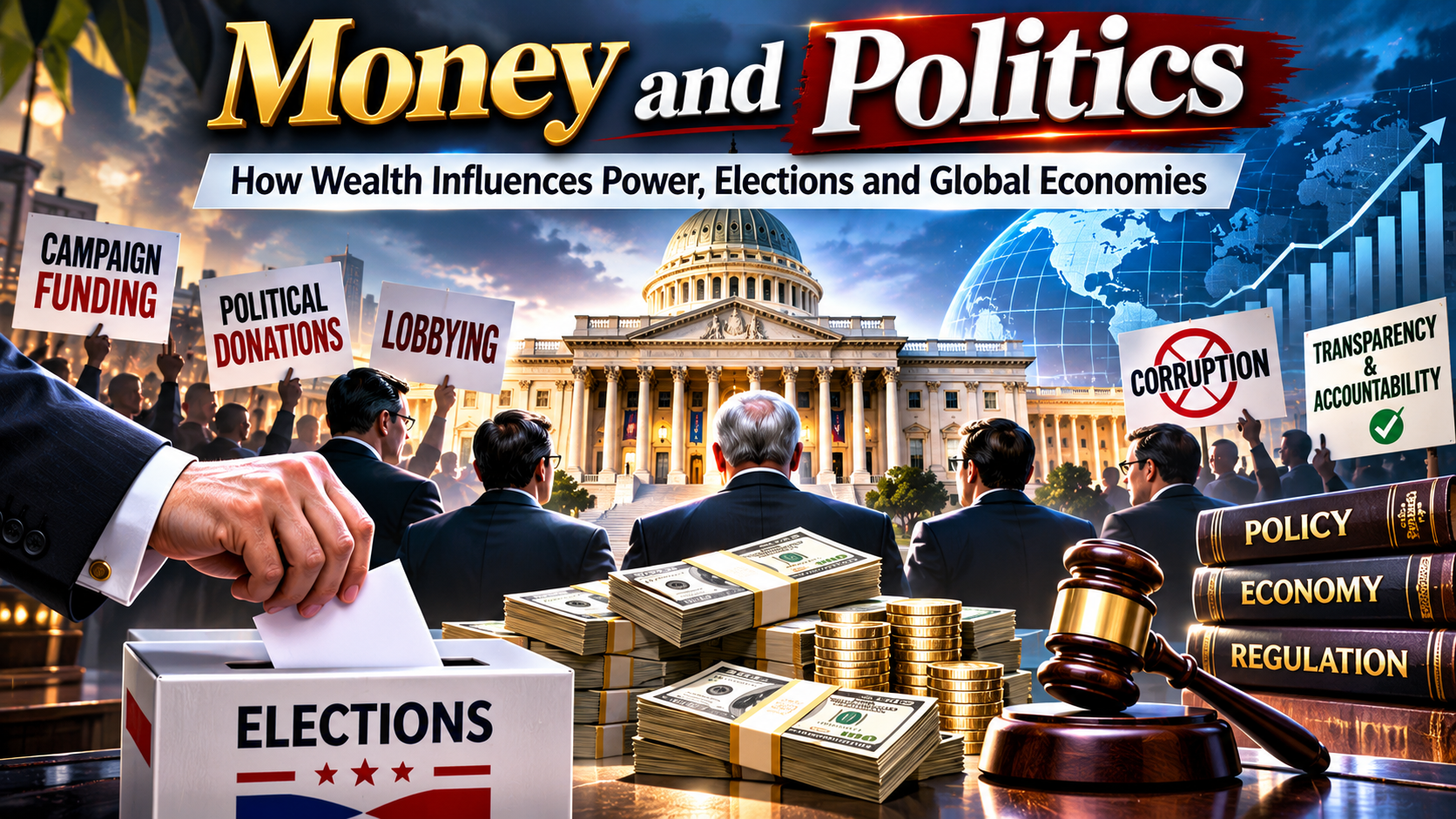
Money and politics have always shared a complicated relationship. Financial resources are essential for political parties, election campaigns, government operations, and public policy development. However, when money becomes concentrated in the hands of a small number of powerful individuals or organizations, it can influence political decisions and create inequalities within democratic systems.
Across the world, wealthy business leaders, corporations, financial institutions, political donors, and influential organizations participate in political activities. Some support candidates whose policies reflect their interests, while others invest in lobbying, advocacy, research, and political campaigns to influence public discussions.
The relationship between money and political power is not limited to wealthy countries. It affects developing economies, emerging democracies, and established political systems. Financial resources can help political candidates reach millions of voters, organize campaigns, communicate their policies, and build political networks.
At the same time, excessive political spending, hidden donations, corruption, and conflicts of interest can weaken public trust.
In modern society, understanding the connection between money and politics is important because political decisions influence taxation, employment, international trade, education, healthcare, business regulations, and economic development.
This article explores how money influences politics, why wealthy individuals invest in political activities, how campaign financing works, the role of lobbying, the risks of corruption, and what governments can do to protect political transparency and accountability.
1. Understanding the Relationship Between Money and Politics
Money plays an important role in almost every political system.
Political parties need financial resources to organize activities, communicate with voters, maintain offices, employ staff, conduct research, and participate in elections.
Candidates also require funding to promote their campaigns, travel between communities, organize public events, and communicate their political programs.
Without sufficient financial resources, candidates may struggle to compete with established political organizations.
However, financial support can also create relationships between political representatives and wealthy donors.
For example, a business owner may financially support a candidate because they agree with the candidate's economic policies. A corporation may support industry-related research or advocacy because it believes proposed regulations could affect its operations.
These activities are not automatically illegal or corrupt. Political participation can be legitimate when funding is lawful, transparent, and properly regulated.
Problems arise when financial contributions are exchanged for special treatment, hidden political influence, or decisions that benefit a narrow group at the expense of the public.
According to International IDEA, money is necessary for democratic participation, but inadequate regulation can undermine political integrity and accountability.
2. How Wealthy Individuals Influence Political Decisions
Wealthy individuals can participate in politics through several different channels.
Political Donations
One of the most direct ways to participate in political activities is through financial donations.
Individuals may donate to political parties, candidates, election campaigns, or organizations supporting particular policy positions.
These contributions can help political campaigns operate effectively.
However, large donations can create concerns about unequal political influence, especially when a small number of donors provide a substantial share of campaign funding.
Transparent donation records and contribution limits can help reduce these risks.
Business Networks
Successful entrepreneurs and business leaders often have relationships with policymakers, government institutions, industry associations, and professional organizations.
These networks can provide opportunities to communicate business concerns and participate in discussions about economic policy.
Such relationships can be beneficial when they provide useful expertise and encourage informed policymaking.
However, they require appropriate safeguards to prevent conflicts of interest and preferential treatment.
Political Lobbying
Lobbying involves communicating with government officials to influence public policy, legislation, or regulatory decisions.
Businesses, professional associations, nonprofit organizations, and civil society groups may all engage in lobbying.
For example, a technology company may advocate for updated digital regulations, while an environmental organization may campaign for stronger pollution standards.
Lobbying can provide governments with technical information and industry expertise.
Nevertheless, unequal access and secretive influence can allow wealthy organizations to dominate political discussions.
The OECD emphasizes the importance of transparency and integrity in lobbying to ensure that public decisions serve broader interests.
3. The Role of Money in Election Campaigns
Modern election campaigns require considerable financial resources.
Political parties compete to attract voters, communicate their policies, organize supporters, and build public recognition.
Campaign funding can be used for:
Television and radio advertisements.
Digital marketing and social media campaigns.
Political rallies and public events.
Campaign offices and staff.
Research and opinion polling.
Printed promotional materials.
Transportation and logistics.
Voter outreach programs.
Digital platforms have transformed political campaigning.
Candidates can now reach large audiences through online advertisements, social media accounts, video platforms, websites, and digital communication tools.
These technologies can reduce certain campaign costs while creating new challenges related to transparency, political advertising, misinformation, and foreign influence.
A candidate with significant financial support may have more opportunities to communicate with voters than a candidate with limited resources.
This does not automatically guarantee electoral success, but financial resources can provide important campaign advantages.
4. Why Businesses Care About Politics
Businesses operate within legal and economic systems shaped by government decisions.
Tax policies, trade agreements, labor regulations, environmental standards, import duties, interest rates, and infrastructure spending can directly affect company performance.
As a result, businesses have legitimate reasons to follow political developments and participate in public policy discussions.
Tax Policies
Changes in corporate taxes, investment incentives, and business deductions can influence profitability.
Companies may support policies that encourage investment, employment, and economic growth.
Trade Regulations
International businesses depend on trade agreements, customs procedures, tariffs, and international relationships.
Political decisions can determine how easily companies access foreign markets.
Government Contracts
Public infrastructure projects, transportation systems, energy facilities, and technology services often involve government procurement.
Transparent procurement processes are important because government contracts involve public money.
Employment Regulations
Labor laws, minimum wages, workplace protections, and employment taxes affect business operations.
Companies and workers may have different perspectives on proposed employment policies.
The challenge for governments is to balance legitimate business interests with the wider needs of society.
5. Money, Political Power, and Economic Inequality
One of the major concerns surrounding money and politics is the possibility that wealth can translate into disproportionate political influence.
In an unequal society, wealthy individuals may have more opportunities to participate in political activities than ordinary citizens.
They may have access to professional lobbying services, extensive networks, research organizations, and major communication platforms.
Meanwhile, lower-income communities may struggle to make their concerns heard.
This imbalance can influence policy priorities.
For example, political discussions may focus heavily on corporate taxation or investment incentives while issues such as affordable housing, healthcare access, education, and employment receive less attention.
However, financial wealth does not automatically determine political outcomes. Public opinion, elections, institutions, courts, journalism, and civil society also influence political decisions.
Strong democratic institutions can help ensure that political participation remains open to different groups.
6. Corruption: When Money Controls Political Decisions
Political corruption occurs when public authority is misused for private or personal benefit.
It can take several forms, including bribery, illegal political donations, embezzlement, favoritism, and misuse of public resources.
Corruption can damage economic development and reduce public confidence in government institutions.
Bribery
Bribery occurs when money, gifts, or other benefits are offered or accepted to influence an official decision improperly.
For example, a company may attempt to secure a government contract by offering an illegal payment to a public official.
Favoritism and Nepotism
Political favoritism occurs when individuals or organizations receive advantages because of personal connections rather than fair procedures.
This can affect recruitment, government contracts, business licenses, and public services.
Misuse of Public Funds
Public money is collected through taxation and other government revenues.
When these resources are diverted for private benefit, communities may lose funding for essential services.
Hidden Political Donations
Undisclosed contributions can make it difficult for voters to understand who financially supports political parties and candidates.
Transparency International has identified opaque political financing as an important risk to democratic accountability.
Preventing corruption requires effective laws, independent investigations, financial transparency, and meaningful penalties for violations.
7. The Influence of Corporations on Government Policies
Large corporations can have substantial economic influence because they provide employment, invest capital, produce goods, and contribute to national economies.
Governments often consult businesses when developing policies affecting important industries.
For example, energy companies may participate in discussions about electricity regulations, while financial institutions may provide expertise on banking reforms.
Technology companies may contribute information about artificial intelligence, cybersecurity, and digital privacy.
These discussions can help governments understand complicated economic issues.
However, problems arise when corporate influence becomes excessive or when government policies consistently favor powerful companies over consumers, workers, or smaller competitors.
A fair political system should provide opportunities for different stakeholders to participate in policymaking.
8. Political Financing Around the World
Different countries have different systems for financing political parties and election campaigns.
Some countries rely heavily on private donations, while others provide public funding to eligible political parties.
Many countries use a combination of public and private financing.
Common political financing methods include:
Private donations: Individuals and organizations contribute money to political parties or candidates under applicable laws.
Public funding: Governments provide financial support to political parties or candidates that meet specific eligibility requirements.
Membership contributions: Political parties collect money from their registered members and supporters.
Campaign fundraising: Candidates organize fundraising events and online campaigns to support election activities.
Political advertising: Parties spend money promoting their candidates and policies through traditional and digital media.
Effective regulation generally requires accurate financial reporting, clear donation rules, independent supervision, and appropriate enforcement.
According to the OECD's 2026 Anti-Corruption and Integrity Outlook, many countries have political financing regulations, but significant gaps remain in implementation and compliance.
9. Social Media and the New Politics of Money
Social media has transformed the relationship between money and politics.
Political candidates can now communicate directly with voters through platforms such as Facebook, Instagram, YouTube, TikTok, and X.
These platforms allow political organizations to publish campaign messages, organize supporters, and respond to public discussions.
Digital advertising can also target audiences according to demographic and behavioral information, subject to applicable platform rules and laws.
However, online political communication creates several challenges.
Paid Political Advertising
Political organizations may spend significant amounts promoting their messages through online advertisements.
Voters should be able to identify who paid for political advertising.
Misinformation
False or misleading information can spread rapidly through social media.
This can influence public debate and make it harder for voters to evaluate political claims.
Hidden Campaign Funding
Third-party organizations may support political messaging without making their financial relationships sufficiently clear.
Transparent reporting can help voters understand the sources of campaign funding.
Artificial Intelligence
Artificial intelligence is creating new opportunities for political communication, including automated content production and audience analysis.
At the same time, synthetic images, manipulated videos, and misleading AI-generated content create additional risks for election integrity.
Governments and technology companies need effective transparency and accountability measures to address these challenges.
10. Money and Politics in Developing Countries
The relationship between money and politics can be particularly important in developing economies.
Countries experiencing rapid economic development often face challenges involving political financing, institutional capacity, public procurement, and corruption prevention.
Financial resources can help political parties develop stronger organizations and communicate with citizens.
However, weak financial oversight may allow wealthy individuals or powerful organizations to gain disproportionate influence.
Developing countries can strengthen political accountability through:
Transparent campaign finance reporting.
Independent election oversight.
Clear rules on political donations.
Public access to government spending information.
Strong anti-corruption institutions.
Fair government procurement systems.
Protection for investigative journalists.
Effective conflict-of-interest regulations.
These measures can help improve public confidence and encourage fairer political competition.
11. The Relationship Between Money and Politics in Pakistan
Pakistan provides an important example of the relationship between financial resources, political institutions, and economic development.
The country's political environment involves federal and provincial governments, political parties, business organizations, financial institutions, and influential economic groups.
Government decisions can affect major sectors, including agriculture, energy, telecommunications, manufacturing, banking, infrastructure, and international trade.
Election campaigns require financial resources for public meetings, advertising, transportation, communication, and party organization.
Political financing and accountability are therefore important issues for Pakistan's democratic development.
Several areas deserve particular attention.
Political Campaign Financing
Transparent records of political donations and campaign expenditures can help voters understand how political parties and candidates receive financial support.
Government Spending
Public expenditure influences infrastructure, education, healthcare, transportation, and social development.
Transparent budgets and independent audits can improve accountability.
Business and Government Relations
Businesses need predictable regulations and fair economic policies.
At the same time, government decisions should protect competition and avoid providing unfair advantages to selected companies.
Taxation and Economic Policy
Tax collection and government spending influence economic growth, employment, investment, and public services.
Fair and transparent taxation can help strengthen public finances.
Accountability and Institutional Independence
Independent oversight institutions, courts, election authorities, and investigative bodies play important roles in protecting public resources.
Improving institutional accountability can help create a more predictable environment for citizens and businesses.
12. How Governments Can Prevent the Misuse of Political Money
Regulating political finance is essential for protecting democratic institutions.
Governments can introduce several measures to reduce the risks associated with political funding.
Greater Financial Transparency
Political parties and candidates should disclose relevant donations and campaign expenditures according to clear reporting requirements.
Public disclosure allows voters and independent organizations to examine political financing.
Donation Limits
Appropriate donation limits can help prevent political funding from becoming excessively concentrated among a small number of wealthy contributors.
Independent Audits
Independent financial audits can help identify inaccurate reporting, prohibited contributions, and misuse of campaign resources.
Strong Anti-Corruption Laws
Governments need clear laws addressing bribery, illegal payments, conflicts of interest, and misuse of public funds.
Transparent Government Contracts
Public procurement systems should use fair competition, clear evaluation standards, and accessible records.
Digital Reporting Systems
Online reporting platforms can make political finance information easier to publish, access, analyze, and verify.
International IDEA and Transparency International emphasize that effective oversight and public access to political finance information are essential parts of political integrity.
13. Can Money Ever Have a Positive Role in Politics?
Money is not inherently harmful to political systems.
In fact, political parties need financial resources to function effectively.
Without campaign funding, candidates may struggle to communicate their ideas, organize public meetings, or reach voters in different communities.
Financial support can also encourage broader participation when donations come from diverse groups and are subject to fair regulations.
Public funding can provide additional opportunities for candidates and parties that lack access to wealthy donors.
Businesses and professional organizations can contribute valuable technical information during policy discussions.
For example, medical organizations can provide expertise on healthcare policy, while technology companies can explain the economic and technical implications of digital regulations.
The key issue is not whether money should exist in politics, but how it is collected, reported, spent, and regulated.
A transparent political financing system can support democratic participation while reducing the risk of corruption and undue influence.
14. The Future of Money and Politics
The relationship between financial resources and political power will continue evolving.
Digital technologies, international investment, social media, artificial intelligence, and global financial networks are changing how political campaigns operate.
Future political financing systems will need to address several important developments.
Digital campaign transparency: Voters will increasingly need accessible information about the organizations and individuals paying for online political advertisements.
Artificial intelligence regulation: Governments may introduce stronger disclosure requirements for AI-generated political content and automated campaign activities.
International financial oversight: Cross-border financial flows may require stronger cooperation between regulators and election authorities.
Corporate accountability: Businesses may face growing expectations to disclose political spending, lobbying activities, and conflicts of interest.
Public participation: Digital platforms may make it easier for ordinary citizens to participate in political discussions and fundraising.
Independent oversight: Election authorities and anti-corruption institutions will need stronger tools to monitor increasingly complex financial activities.
The future of political integrity will depend on whether institutions can adapt to these changes while protecting freedom of expression and democratic participation.
Conclusion
Money and politics are closely connected because financial resources help political parties operate, candidates communicate with voters, and governments develop economic policies.
Wealthy individuals, businesses, political organizations, and civil society groups all participate in political processes. Their contributions can provide valuable expertise and support democratic participation when they operate within transparent and fair rules.
However, hidden donations, bribery, excessive political influence, and conflicts of interest can undermine public trust and weaken democratic institutions.
The challenge for governments is to create political financing systems that allow legitimate participation while preventing corruption and unfair advantages.
Transparent donations, independent audits, effective election oversight, fair lobbying rules, and public access to financial information can help protect political integrity.
Ultimately, money should support political participation rather than determine who controls political power. Strong institutions, accountable leadership, informed citizens, and transparent financial systems are essential for ensuring that government decisions serve the public interest.