Japan is home to some of the world's most successful entrepreneurs, technology investors, industrialists, and business families. From global fashion brands and artificial intelligence investments to advanced manufacturing, retail, entertainment, and real estate, Japan's wealthiest individuals have built companies with influence across international markets.
In 2026, Japan's billionaire landscape experienced a major shift. Masayoshi Son, founder of SoftBank Group, reclaimed the number one position after a significant increase in his estimated wealth, supported by the global artificial intelligence boom and SoftBank's investment activities.
Other leading Japanese billionaires include Tadashi Yanai, the founder of Uniqlo's parent company Fast Retailing, and Takemitsu Takizaki, the founder of industrial automation and sensor manufacturer Keyence.
According to Forbes' 2026 Japan's 50 Richest ranking, the combined wealth of the country's 50 richest individuals and families reached approximately $294 billion, representing a 29% increase compared with the previous year's $228 billion.
This article explores Japan's richest people in 2026, their estimated net worth, the companies behind their fortunes, and the industries shaping Japan's economic future.
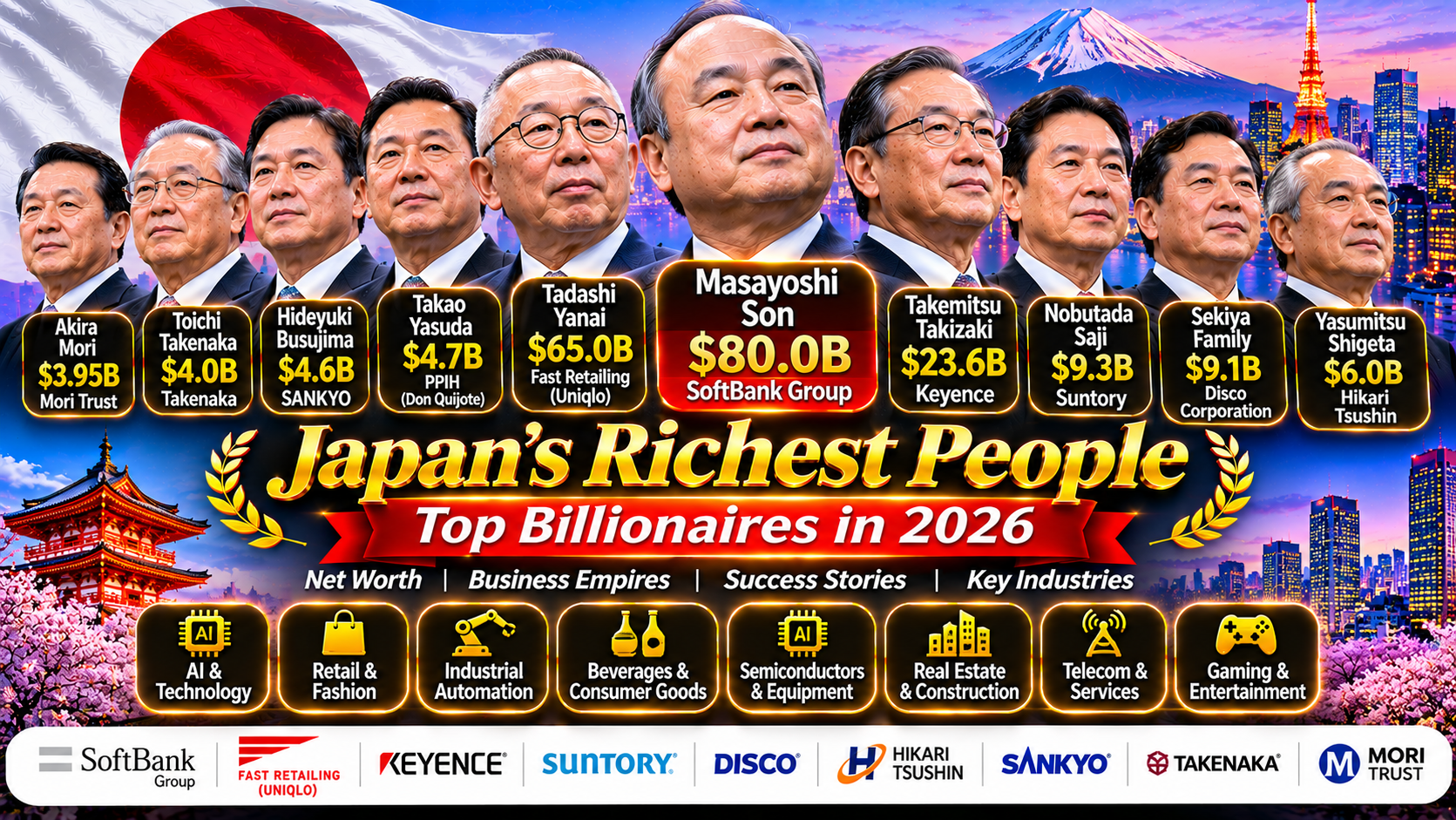
Top 10 Richest People in Japan in 2026
The following ranking is based on Forbes' Japan's 50 Richest 2026 list, published in June 2026. The figures are estimates in US dollars and reflect the methodology and market conditions used by Forbes.
Rank | Person or family | Estimated net worth | Main business |
|---|---|---|---|
1 | Masayoshi Son | $80 billion | SoftBank Group |
2 | Tadashi Yanai | $65 billion | Fast Retailing / Uniqlo |
3 | Takemitsu Takizaki | $23.6 billion | Keyence |
4 | Nobutada Saji | $9.3 billion | Suntory |
5 | Sekiya family | $9.1 billion | Disco Corporation |
6 | Yasumitsu Shigeta | $6 billion | Hikari Tsushin |
7 | Takao Yasuda | $4.7 billion | Pan Pacific International Holdings |
8 | Hideyuki Busujima | $4.6 billion | SANKYO |
9 | Toichi Takenaka | $4 billion | Takenaka Corporation |
10 | Akira Mori | $3.95 billion | Mori Trust |
Source: Forbes Japan's 50 Richest 2026. Net worth estimates are based on market prices and exchange rates as of May 22, 2026. Some entries represent family fortunes rather than the wealth of one individual.
Forbes+1
1. Masayoshi Son – $80 Billion
Industry: Technology, artificial intelligence, and investment
Company: SoftBank Group
Masayoshi Son is Japan's richest person in 2026 and one of the most influential technology investors in the world.
He founded SoftBank in 1981, initially building a business around software distribution and technology-related activities. Over the following decades, SoftBank developed into a major international investment and technology group.
Son is widely recognized for his willingness to invest in ambitious technology companies and emerging industries. His investment strategy has included telecommunications, internet businesses, artificial intelligence, robotics, and advanced technology infrastructure.
How did Masayoshi Son build his fortune?
SoftBank's growth has been supported by several important developments:
Expansion into telecommunications.
International technology investments.
Ownership interests in major technology businesses.
Investments through the Vision Fund.
Exposure to artificial intelligence and semiconductor technology.
One of the most important developments behind Son's 2026 wealth increase was SoftBank's multibillion-dollar investment in OpenAI.
According to Forbes, his estimated net worth increased by $51.8 billion, or 184%, reaching approximately $80 billion. SoftBank also reported record annual net profit of ¥5 trillion for the financial year ended March 31, 2026.
Masayoshi Son's return to the top position demonstrates how strongly artificial intelligence and technology investments can influence billionaire wealth rankings.
Forbes+1
2. Tadashi Yanai – $65 Billion
Industry: Fashion, apparel, and global retail
Company: Fast Retailing / Uniqlo
Tadashi Yanai is the founder of Fast Retailing, the Japanese company behind Uniqlo, one of the world's most recognized clothing retailers.
Yanai transformed a relatively small clothing business into a global retail brand known for practical, affordable, and comfortable apparel.
Uniqlo's business model focuses on everyday clothing, functional materials, simple designs, and large-scale international distribution.
What makes Uniqlo successful?
Uniqlo has developed a distinctive position in the global fashion market by focusing on:
Everyday clothing and basic fashion.
Functional fabric technology.
Affordable product pricing.
Efficient supply chains.
International retail expansion.
Strong brand recognition.
The company has expanded across Asia, Europe, North America, and other international markets.
Although Yanai slipped to second place in 2026, his estimated fortune increased to $65 billion. Forbes attributed the improvement partly to Fast Retailing's revenue and profit growth.
His business journey demonstrates how a company focused on everyday consumer needs can develop into an international retail empire.
Forbes+1
3. Takemitsu Takizaki – $23.6 Billion
Industry: Industrial automation and technology
Company: Keyence
Takemitsu Takizaki is the founder of Keyence, a Japanese company specializing in sensors, measurement instruments, machine vision systems, and industrial automation technology.
Unlike consumer-facing businesses, Keyence operates primarily in the industrial technology market.
Its products help manufacturers improve production efficiency, inspect products, measure components, and automate industrial processes.
Why is Keyence important?
Modern manufacturing increasingly depends on accurate measurement, automation, and real-time quality control.
Keyence provides technologies that support:
Factory automation.
Industrial sensors.
Machine vision.
Measurement systems.
Quality inspection.
Manufacturing efficiency.
These technologies are used across multiple industries, including automotive production, electronics, machinery, and pharmaceuticals.
Takizaki's estimated fortune reached $23.6 billion in 2026, making him Japan's third-richest person.
His success illustrates the enormous business potential of specialized industrial technology.
Forbes+1
4. Nobutada Saji – $9.3 Billion
Industry: Beverages, food, and consumer products
Company: Suntory Holdings
Nobutada Saji is associated with the Suntory business empire, one of Japan's best-known beverage companies.
Suntory has built an international reputation through alcoholic and non-alcoholic beverages, including whisky, soft drinks, bottled water, and other consumer products.
The company has expanded beyond Japan and developed a substantial international business presence.
Suntory's global business
Its commercial interests include:
Japanese whisky.
International spirits.
Soft drinks.
Bottled water.
Beverage distribution.
Consumer products.
Suntory's success reflects the value of strong consumer brands, product quality, and international distribution.
Nobutada Saji's estimated wealth was approximately $9.3 billion in the 2026 Forbes ranking.
Forbes+1
5. Sekiya Family – $9.1 Billion
Industry: Semiconductor manufacturing equipment
Company: Disco Corporation
The Sekiya family is associated with Disco Corporation, a Japanese company specializing in semiconductor manufacturing equipment.
Semiconductors are essential components in modern electronic devices, including smartphones, computers, automobiles, data centers, and artificial intelligence systems.
Disco manufactures equipment used in processes such as cutting, grinding, and polishing semiconductor materials.
Why did the family's wealth increase?
The global expansion of artificial intelligence has increased demand for advanced semiconductor products.
As chip manufacturers develop more sophisticated processors and electronic components, specialized manufacturing equipment becomes increasingly important.
Disco has benefited from investor interest in the semiconductor supply chain and AI-related manufacturing demand.
The Sekiya family's estimated fortune reached approximately $9.1 billion in 2026, moving up three positions compared with the previous ranking.
Forbes+1
6. Yasumitsu Shigeta – $6 Billion
Industry: Telecommunications and technology services
Company: Hikari Tsushin
Yasumitsu Shigeta is the founder of Hikari Tsushin, a Japanese company with business interests in telecommunications, business services, and related distribution activities.
Hikari Tsushin has developed a business model that connects companies and customers through technology-related products and services.
Its activities have included telecommunications services, insurance-related products, office equipment, and business solutions.
Business strategy
The company's operations demonstrate the importance of distribution networks and recurring business relationships.
Its commercial activities are connected to:
Telecommunications services.
Business technology products.
Insurance distribution.
Office equipment.
Corporate services.
Shigeta's estimated wealth reached $6 billion in 2026, placing him sixth among Japan's richest people.
Forbes+1
7. Takao Yasuda – $4.7 Billion
Industry: Retail and discount shopping
Company: Pan Pacific International Holdings
Takao Yasuda is known for building the business behind Don Quijote, one of Japan's most recognizable discount retail chains.
Don Quijote stores are famous for their extensive product selection, competitive pricing, and distinctive shopping experience.
The company has developed a strong presence in Japan and expanded internationally through different retail formats.
How did the business grow?
Its retail strategy focuses on:
Competitive pricing.
Wide product selection.
Convenient shopping locations.
Long operating hours at many stores.
International retail expansion.
The business also benefits from consumer demand for affordable products and convenient shopping experiences.
Yasuda's estimated net worth reached approximately $4.7 billion in the 2026 ranking.
Forbes+1
8. Hideyuki Busujima – $4.6 Billion
Industry: Gaming and entertainment equipment
Company: SANKYO
Hideyuki Busujima is associated with SANKYO, a Japanese company known for its pachinko and gaming-related entertainment equipment.
Pachinko is a popular form of entertainment in Japan, and the industry has developed a specialized manufacturing ecosystem.
SANKYO produces gaming machines and related equipment for entertainment venues.
Business opportunities in entertainment
The company operates in a sector influenced by:
Consumer entertainment demand.
Gaming machine technology.
Product design.
Licensing and regulations.
Competition among manufacturers.
Busujima's estimated fortune reached $4.6 billion in 2026, placing him eighth on the list.
Forbes+1
9. Toichi Takenaka – $4 Billion
Industry: Construction and infrastructure
Company: Takenaka Corporation
Toichi Takenaka is associated with Takenaka Corporation, a major Japanese construction company with a long history in architecture and building development.
Japan's construction sector plays an important role in developing commercial buildings, offices, residential properties, industrial facilities, and public infrastructure.
Takenaka has been involved in major architectural and construction projects, contributing to Japan's built environment.
Why is the construction industry important?
Large construction businesses support economic development through:
Commercial property development.
Industrial facilities.
Infrastructure projects.
Office buildings.
Hotels and public buildings.
Advanced construction technology.
Toichi Takenaka's estimated fortune reached approximately $4 billion in the 2026 Forbes ranking.
Forbes+1
10. Akira Mori – $3.95 Billion
Industry: Real estate and property development
Company: Mori Trust
Akira Mori is a leading Japanese businessman associated with Mori Trust, a major real estate investment and development company.
Japan's property market offers opportunities in commercial buildings, hotels, offices, and large-scale urban developments.
Mori Trust has developed a portfolio of commercial and hospitality properties, particularly in major Japanese cities.
Mori Trust's business interests
The company's activities include:
Office buildings.
Hotel developments.
Commercial real estate.
Urban redevelopment.
Property investments.
Hospitality projects.
Akira Mori's estimated fortune was approximately $3.95 billion in 2026.
His position highlights the continuing importance of property ownership and commercial real estate in Japan's billionaire economy.
Forbes+1
Industries Creating Japan's Biggest Fortunes
Japan's wealthiest people have built their fortunes across several industries. These sectors demonstrate the country's strengths in technology, manufacturing, consumer products, and international business.
1. Artificial Intelligence and Technology
Artificial intelligence has become one of the most important forces influencing Japan's business environment.
Masayoshi Son's SoftBank investments demonstrate how AI development can create major opportunities for technology investors.
AI-related businesses are attracting investment in:
Semiconductor technology.
Cloud computing.
Robotics.
Data centers.
AI software.
Advanced computing infrastructure.
As businesses adopt artificial intelligence, demand for specialized hardware and digital infrastructure is expected to remain an important economic theme.
2. Fashion and Global Retail
Japan has created internationally recognized retail brands, with Uniqlo being one of the strongest examples.
Fast Retailing demonstrates how a company can expand internationally by combining practical product design, efficient operations, and consistent brand positioning.
The global fashion industry continues to create opportunities through e-commerce, international expansion, and changing consumer preferences.
3. Semiconductor and Industrial Technology
Japan has a long history of manufacturing advanced industrial equipment.
Companies such as Keyence and Disco are examples of businesses operating in specialized technology markets.
Their products support manufacturing automation, semiconductor processing, measurement, and quality control.
The global demand for advanced chips has made this sector particularly important.
4. Beverages and Consumer Products
Suntory illustrates how a Japanese consumer-products company can develop international brand recognition.
Beverage businesses benefit from brand loyalty, distribution networks, product innovation, and international consumer demand.
5. Real Estate and Construction
Japan's major cities continue to require commercial offices, hotels, residential developments, and modern infrastructure.
Large real estate and construction companies benefit from long-term property development and investment opportunities.
6. Retail and Entertainment
Discount retailers and entertainment equipment manufacturers represent two different but important parts of Japan's consumer economy.
Businesses must adapt to changing customer preferences, digital shopping, and new forms of entertainment.
How Japan's Richest People Built Their Wealth
Although Japan's richest individuals operate in different sectors, several common business strategies appear across their success stories.
1. Innovation and technological investment
Masayoshi Son and Takemitsu Takizaki demonstrate the importance of investing in technology and developing products that solve business problems.
Companies that create useful technology can establish strong positions in international markets.
2. Building internationally recognized brands
Tadashi Yanai's Uniqlo and Suntory demonstrate the commercial value of recognizable consumer brands.
Strong brands can build customer loyalty and support expansion into new markets.
3. Specializing in profitable industries
Some of Japan's richest entrepreneurs built their fortunes by focusing on specialized industries rather than competing directly with every major global company.
Keyence and Disco illustrate how industrial technology businesses can become highly valuable.
4. Long-term business planning
Japan's major business groups have often developed through decades of investment, operational improvements, and strategic expansion.
Long-term planning can help businesses establish stable market positions.
5. Understanding global economic trends
The growth of artificial intelligence, semiconductor demand, digital services, and international retail has created new opportunities for Japanese businesses.
Entrepreneurs who understand global trends can identify markets with significant growth potential.
What Could Shape Japan's Billionaire Economy in the Future?
Japan's economy is changing as businesses adapt to technological innovation, demographic challenges, international competition, and changing consumer demand.
Several industries may influence future wealth creation.
Artificial intelligence: AI infrastructure, software, robotics, and advanced computing may create new investment opportunities.
Semiconductors: Global demand for advanced chips and manufacturing equipment could support Japanese industrial technology companies.
Robotics and automation: Japan's manufacturing expertise creates opportunities in industrial automation, service robots, and precision engineering.
Renewable energy: Solar, wind, battery storage, and energy infrastructure may attract investment as businesses respond to changing energy requirements.
Healthcare technology: Medical equipment, healthcare services, and technology supporting an aging population could become increasingly important.
International retail: Japanese consumer brands may continue expanding into international markets through physical stores and e-commerce.
These industries offer potential opportunities, but their future performance will depend on market demand, competition, regulation, investment, and technological development.
Challenges Facing Japan's Wealthiest Business Leaders
Even Japan's largest companies face challenges that can affect profitability and long-term growth.
1. Currency fluctuations
Changes in the Japanese yen can affect international earnings, overseas investments, and the value of assets when converted into US dollars.
2. Global competition
Japanese businesses face strong competition from companies in the United States, China, South Korea, and Europe.
3. Demographic changes
Japan's aging population and low birth rate create challenges for the labor market, healthcare system, and domestic consumer demand.
4. Technological disruption
Companies must continuously adapt to artificial intelligence, automation, digital commerce, and changing consumer expectations.
5. International economic uncertainty
Trade tensions, supply chain disruptions, inflation, and global financial conditions can influence Japanese companies operating internationally.
The ability to respond to these challenges will be important for Japan's largest business groups.
Conclusion: Who Is the Richest Person in Japan in 2026?
According to Forbes' Japan's 50 Richest 2026 ranking, Masayoshi Son is Japan's richest person, with an estimated net worth of $80 billion.
Tadashi Yanai ranks second with $65 billion, while Takemitsu Takizaki occupies third place with approximately $23.6 billion.
Their success stories represent different areas of Japan's economy, including technology investment, global fashion, industrial automation, beverages, semiconductors, retail, construction, and real estate.
Japan's wealthiest entrepreneurs demonstrate how innovation, international expansion, specialized manufacturing, and long-term business development can create powerful commercial organizations.
As artificial intelligence, robotics, semiconductor technology, and global consumer markets continue to evolve, Japan's business leaders may find new opportunities to expand their influence.
The country's richest people are not simply individuals with large fortunes. They are connected to companies and industries that play an important role in Japan's position within the global economy.
Frequently Asked Questions (FAQs)
1. Who is the richest person in Japan in 2026?
Masayoshi Son is Japan's richest person in Forbes' 2026 Japan's 50 Richest ranking, with an estimated net worth of $80 billion.
2. Who are the top three richest people in Japan?
The top three are Masayoshi Son, Tadashi Yanai, and Takemitsu Takizaki.
3. How much is Masayoshi Son worth in 2026?
Forbes estimated Masayoshi Son's fortune at approximately $80 billion in its June 2026 ranking.
4. Who owns Uniqlo?
Uniqlo is operated by Fast Retailing, the Japanese retail group founded by Tadashi Yanai.
5. Who is the richest businessman in Japan?
Masayoshi Son ranks first in Forbes' 2026 Japan's 50 Richest list.
6. What company made Masayoshi Son rich?
SoftBank Group is the primary company associated with Masayoshi Son's wealth. His fortune has been influenced by technology investments and telecommunications businesses.
7. Who is the richest Japanese technology entrepreneur?
Masayoshi Son is one of Japan's wealthiest technology entrepreneurs, while Takemitsu Takizaki is another major technology fortune holder through Keyence.
8. How rich is Tadashi Yanai?
Tadashi Yanai's estimated net worth was $65 billion in Forbes' 2026 Japan ranking.
9. Who is the richest family in Japan?
The Sekiya family ranked fifth in Forbes' 2026 Japan's 50 Richest list, with an estimated family fortune of $9.1 billion. The top positions are held by individual fortunes.
10. What industries create the most billionaires in Japan?
Major industries include technology, retail, industrial manufacturing, semiconductors, beverages, real estate, and entertainment.
11. Why is Japan important in the semiconductor industry?
Japan has significant expertise in semiconductor materials, manufacturing equipment, precision engineering, and industrial technology.
12. How did Uniqlo become a global brand?
Uniqlo expanded through practical clothing designs, functional fabrics, affordable products, efficient supply chains, and international retail operations.
13. Is Japan one of the world's wealthiest countries?
Japan is one of the world's major advanced economies, with substantial industrial, technological, financial, and international commercial activity.
14. How are billionaire net worth estimates calculated?
Net worth estimates generally include ownership in publicly traded companies, private business valuations, investments, and other assets. Market prices and currency exchange rates can change the estimates.
15. Will Japan produce more billionaires in the future?
Japan may produce additional billionaires through growth in artificial intelligence, robotics, advanced manufacturing, healthcare, clean energy, and global technology businesses. However, future rankings cannot be predicted with certainty.
Editorial Note: This article uses Forbes' Japan's 50 Richest 2026 ranking, published in June 2026. Forbes calculated wealth using financial and shareholding information, with public-market prices and exchange rates measured at the close of markets on May 22, 2026. The list includes some family fortunes, and private-company valuations are estimates. Net worth figures should not be interpreted as live values.
Primary research source.