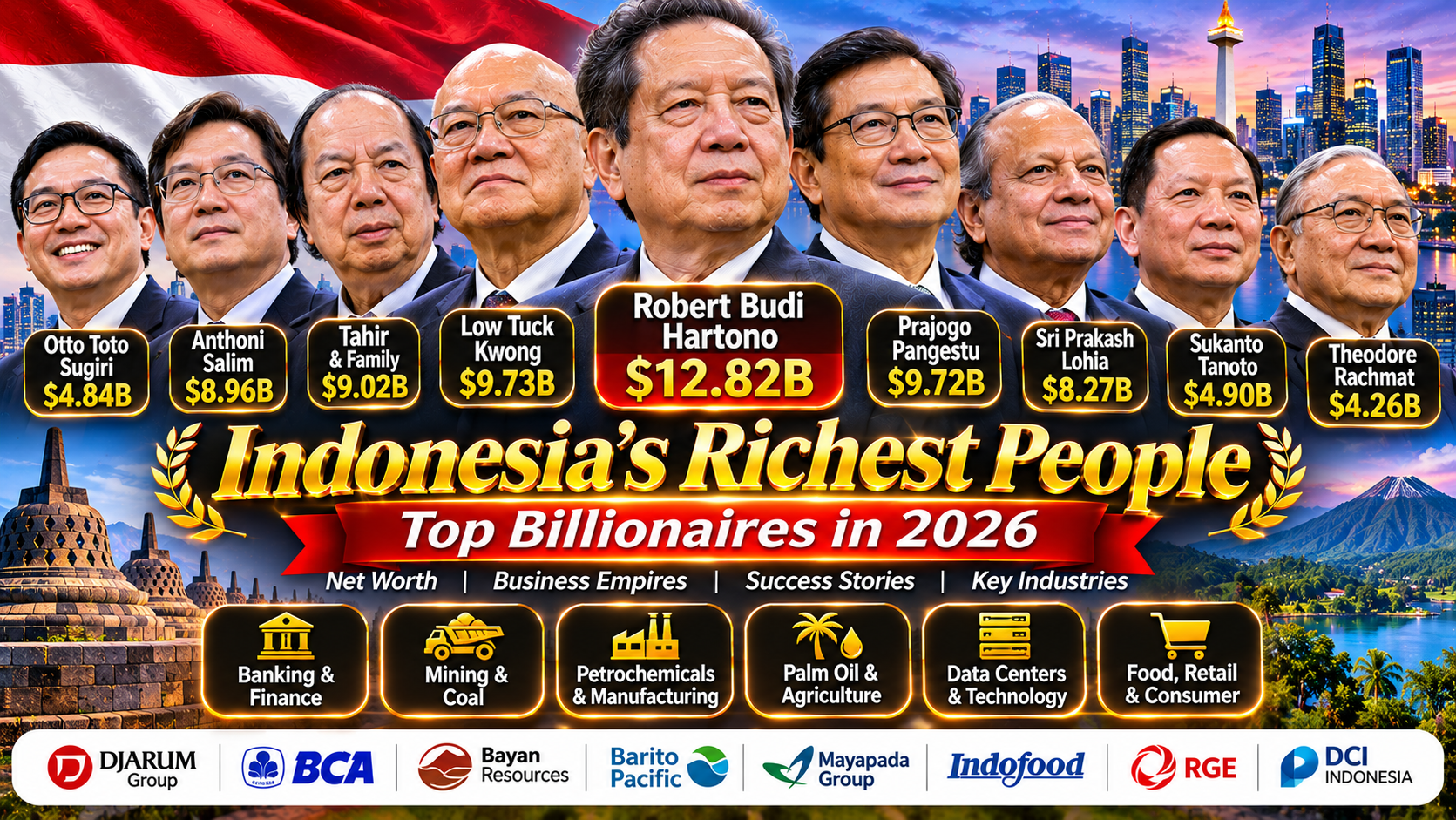
The following ranking uses available Forbes Real-Time Billionaires estimates reported on November 11, 2026. Net worth figures are estimates, not cash balances, and can change with company valuations and stock-market movements.
Rank | Billionaire | Estimated net worth | Main source of wealth |
|---|---|---|---|
1 | Robert Budi Hartono | $12.82 billion | Banking and tobacco |
2 | Low Tuck Kwong | $9.73 billion | Coal and energy |
3 | Prajogo Pangestu | $9.72 billion | Petrochemicals and energy |
4 | Tahir and family | $9.02 billion | Diversified businesses |
5 | Anthoni Salim | $8.96 billion | Food, retail and investments |
6 | Sri Prakash Lohia | $8.27 billion | Manufacturing and petrochemicals |
7 | Sukanto Tanoto | $4.90 billion | Pulp, paper and energy |
8 | Otto Toto Sugiri | $4.84 billion | Data centers and technology |
9 | Theodore Rachmat | $4.26 billion | Manufacturing and investments |
10 | Lim Hariyanto Wijaya Sarwono | $4.05 billion | Palm oil and mining |
Ranking snapshot: November 11, 2026. Individual rankings and estimates may differ between publications and update times.
1. Robert Budi Hartono – Indonesia's Richest Person
Estimated net worth: $12.82 billion
Robert Budi Hartono is one of Indonesia's most successful business figures and a leading member of the Hartono family, which controls major interests in the Djarum Group and Bank Central Asia (BCA).
The Hartono family's business journey began in the tobacco industry. Over time, its commercial interests expanded into banking and other investments, creating one of Indonesia's most influential business groups.
How Budi Hartono built his fortune
The Djarum Group is widely recognized for its cigarette manufacturing business. The family also holds a major stake in BCA, one of Indonesia's leading private banks.
BCA has developed a strong position in consumer banking, corporate banking, digital financial services, and payments.
Important sources of the family's wealth include:
Banking and financial services
Tobacco manufacturing
Investment holdings
Other diversified business interests
Budi Hartono's position at the top of the billionaire rankings demonstrates the financial influence of established family-owned businesses.
2. Low Tuck Kwong – The Coal and Energy Billionaire
Estimated net worth: $9.73 billion
Low Tuck Kwong is the founder of Bayan Resources, one of Indonesia's major coal mining companies.
His fortune is closely connected to the mining and energy industries. Coal has historically played an important role in electricity generation and industrial production across Asia.
Bayan Resources and its business operations
Bayan Resources operates in the coal mining industry and supplies energy resources to domestic and international customers.
The company's business activities involve:
Coal extraction
Mining operations
Transportation and logistics
Energy supply
Resource development
Low Tuck Kwong's entrepreneurial journey highlights how natural resources can create substantial business wealth.
However, the long-term future of coal businesses also depends on energy policies, environmental regulations, global demand, and the transition toward renewable energy.
3. Prajogo Pangestu – The Petrochemical and Energy Entrepreneur
Estimated net worth: $9.72 billion
Prajogo Pangestu is the founder of Barito Pacific Group and one of Indonesia's most recognized industrial entrepreneurs.
He began his business career in the timber industry before expanding into petrochemicals, energy, and other industrial sectors.
How Prajogo Pangestu developed his business empire
Prajogo's business interests include companies involved in petrochemical production, power generation, mining, and renewable energy.
His business ecosystem includes:
Barito Pacific
Chandra Asri
Petrindo Jaya Kreasi
Barito Renewables Energy
The petrochemical industry produces materials used in packaging, plastics, chemicals, manufacturing, and numerous consumer products.
His business expansion demonstrates the opportunities available through industrial investment and diversification.
Prajogo's fortune has experienced significant changes as the share prices of his associated companies have moved. This is an important reminder that billionaire wealth estimates are not fixed.
4. Tahir and Family – The Mayapada Group Business Empire
Estimated net worth: $9.02 billion
Tahir is an Indonesian entrepreneur and philanthropist associated with the Mayapada Group.
The group has business interests across banking, healthcare, property, and other commercial sectors.
Business interests behind the Mayapada Group
Tahir developed a diversified business organization rather than concentrating on a single industry.
Its business interests include:
Banking and financial services
Hospitals and healthcare
Property development
Investments
Other commercial activities
Diversification can help businesses participate in different markets and customer segments.
Tahir's success reflects the role of financial services, healthcare, and property in Indonesia's business economy.
5. Anthoni Salim – The Salim Group Billionaire
Estimated net worth: $8.96 billion
Anthoni Salim leads the Salim Group, one of Indonesia's major diversified business organizations.
The group has interests in food production, consumer products, retail, telecommunications, and infrastructure-related businesses.
The success of the Salim Group
One of the best-known businesses associated with the Salim family is Indofood, a major food manufacturer.
Indofood produces a wide range of consumer products, including instant noodles, packaged foods, and other food-related goods.
The group's business activities also extend into:
Agriculture
Food manufacturing
Retail distribution
Telecommunications
Infrastructure
Investment activities
The Salim Group demonstrates how a company can build a large business ecosystem by connecting production, distribution, and consumer markets.
Its position in the food industry is particularly important because food products are part of everyday consumer demand.
6. Sri Prakash Lohia – The Indorama Group Founder
Estimated net worth: $8.27 billion
Sri Prakash Lohia is the co-founder of Indorama Corporation, an international industrial group with major operations in manufacturing and petrochemicals.
His business journey reflects the growth of large-scale industrial production in emerging markets.
Indorama's international business
Indorama operates across several manufacturing industries, including:
Polyester
Textiles
Petrochemicals
Industrial materials
Fertilizers
The company serves customers in different countries and participates in international supply chains.
Manufacturing businesses can build significant value through production efficiency, technological development, exports, and long-term customer relationships.
Lohia's wealth highlights the international opportunities available to entrepreneurs who develop competitive industrial operations.
7. Sukanto Tanoto – The Royal Golden Eagle Founder
Estimated net worth: $4.90 billion
Sukanto Tanoto is the founder of Royal Golden Eagle (RGE), a global business group with operations in natural resources, pulp and paper, palm oil, and energy.
His entrepreneurial journey began with trading and expanded into large-scale industrial businesses.
The Royal Golden Eagle business portfolio
RGE operates across several industries, including:
Pulp and paper
Tissue manufacturing
Palm oil
Natural resources
Energy
Industrial manufacturing
The group's businesses participate in international markets and supply products used by consumers and manufacturers.
Tanoto's success demonstrates how natural resources and industrial processing can support the growth of a multinational business organization.
8. Otto Toto Sugiri – Indonesia's Data Center Billionaire
Estimated net worth: $4.84 billion
Otto Toto Sugiri is a technology entrepreneur associated with DCI Indonesia, a major data center company.
His position among Indonesia's wealthiest people highlights an important change in the country's billionaire economy: technology infrastructure is becoming a major source of business wealth.
Why data centers are important
Data centers provide the physical infrastructure required to store, process, and manage digital information.
They support services such as:
Cloud computing
Artificial intelligence
Online banking
E-commerce
Digital payments
Enterprise software
Internet services
As more companies adopt cloud technology and AI applications, demand for reliable data center infrastructure continues to grow.
DCI Indonesia operates in a sector that is increasingly important to Southeast Asia's digital economy.
Sugiri's business journey demonstrates that technology wealth does not always come from developing consumer applications. Building the infrastructure behind digital services can also create substantial value.
9. Theodore Rachmat – The Triputra Group Entrepreneur
Estimated net worth: $4.26 billion
Theodore Rachmat is the founder of Triputra Group, an Indonesian business organization with interests in agriculture, manufacturing, mining, and other industries.
He is also known for his background in the automotive and industrial sectors.
Building a diversified business organization
Triputra Group operates across several business areas:
Agribusiness
Manufacturing
Mining
Trading
Industrial investments
The group has developed its business activities through partnerships, investments, and operational expansion.
Rachmat's career demonstrates the importance of management experience, industry knowledge, and long-term business development.
His fortune also reflects the role of industrial and agricultural businesses in Indonesia's economy.
10. Lim Hariyanto Wijaya Sarwono – The Palm Oil and Mining Billionaire
Estimated net worth: $4.05 billion
Lim Hariyanto Wijaya Sarwono is associated with business interests in palm oil, mining, and natural resources.
His family's business operations include investments connected to Bumitama Agri and Harita Group.
The role of natural resources in his wealth
Indonesia is an important global producer of palm oil and a significant participant in the nickel industry.
These industries support international supply chains for food products, consumer goods, batteries, and manufacturing.
Lim's business interests reflect the opportunities created by resource development and agricultural production.
However, both industries face environmental, regulatory, and international market challenges.
Industries Creating Billionaire Wealth in Indonesia
Indonesia's richest entrepreneurs have built their fortunes in several industries. Understanding these sectors helps explain the structure of the country's business economy.
1. Banking and financial services
Banking remains a major source of business wealth in Indonesia.
Large financial institutions provide consumer banking, corporate lending, investment services, payments, and digital financial products.
The Hartono family's association with BCA demonstrates the importance of financial services in creating long-term business value.
2. Coal mining and energy
Indonesia has a significant mining industry, including coal production.
Mining businesses can generate substantial revenue through resource extraction, transportation, and international sales.
However, energy transitions and environmental regulations are influencing the industry's long-term outlook.
3. Petrochemicals and manufacturing
Petrochemical companies produce materials used in packaging, construction, textiles, and consumer goods.
Manufacturing businesses can expand internationally by developing efficient production systems and competitive products.
Prajogo Pangestu and Sri Prakash Lohia represent major examples of entrepreneurs who built wealth through industrial businesses.
4. Palm oil and agriculture
Palm oil is an important Indonesian export and is used in food products, cosmetics, cleaning products, and industrial applications.
Agricultural businesses create opportunities through plantation operations, processing, logistics, and international distribution.
5. Digital infrastructure and data centers
The expansion of cloud computing, AI, online payments, and digital businesses has increased the importance of data centers.
Indonesia's growing digital economy may create further opportunities for technology infrastructure providers.
Otto Toto Sugiri's business success demonstrates the commercial potential of this sector.
Indonesia's New Billionaire Economy: AI, Data Centers and Digital Transformation
Indonesia's business environment is gradually changing as digital technology becomes more important.
Traditional sectors such as banking, mining, manufacturing, and agriculture continue to generate wealth. However, new opportunities are emerging in technology infrastructure and digital services.
Artificial intelligence
AI is being introduced into banking, retail, logistics, manufacturing, customer support, and business operations.
Companies that develop useful AI applications may benefit from growing demand for automation and intelligent software.
Data center infrastructure
Digital services require reliable computing infrastructure.
Data centers support cloud platforms, business applications, financial systems, and AI workloads.
As digital adoption grows, infrastructure providers may become increasingly important to Indonesia's economy.
Digital financial services
Mobile banking, digital wallets, electronic payments, and financial technology are changing how consumers and businesses manage money.
These services create opportunities for banks, payment companies, and technology providers.
Renewable energy
Indonesia has significant potential in geothermal, solar, hydroelectric, and other renewable energy sources.
The transition toward cleaner energy could create opportunities for businesses involved in power generation, energy storage, and infrastructure.
Challenges Facing Indonesia's Richest Business Leaders
Even major business groups face challenges that can influence their growth and financial performance.
Economic uncertainty
Changes in consumer demand, inflation, interest rates, and currency values can affect business operations and investment decisions.
Environmental regulations
Mining, forestry, palm oil, and energy companies face increasing attention regarding environmental protection and sustainable production.
International competition
Indonesian companies compete with international businesses across manufacturing, technology, energy, and consumer markets.
Commodity price volatility
Coal, nickel, palm oil, and other natural resources are affected by international supply and demand.
Changes in commodity prices can influence company revenues and billionaire net worth estimates.
Technology disruption
Artificial intelligence, automation, and digital platforms are changing traditional industries.
Companies that fail to adapt may face growing competitive pressure.
Who Could Become Indonesia's Next Billionaire Success Story?
Indonesia's next generation of billionaires may emerge from industries that are still developing.
Some promising areas include:
Artificial intelligence and software
Data centers and cloud computing
Electric vehicle manufacturing
Battery and nickel processing
Renewable energy
Financial technology
Healthcare and biotechnology
Digital commerce and logistics
The growth of these industries could create opportunities for entrepreneurs who develop competitive products and solve important market problems.
However, future wealth creation is uncertain. Successful businesses require innovation, reliable management, customer demand, capital, and sustainable operations.
Conclusion
Indonesia's richest people in 2026 represent a diverse group of entrepreneurs and business families who have built wealth across banking, mining, energy, manufacturing, agriculture, and technology.
Robert Budi Hartono leads the current real-time ranking through the family's major business interests in banking and tobacco. Low Tuck Kwong and Prajogo Pangestu demonstrate the financial importance of natural resources and industrial businesses. Anthoni Salim and Tahir represent diversified business groups, while Otto Toto Sugiri highlights the growing influence of digital infrastructure.
Indonesia's billionaire landscape is evolving as technology, AI, data centers, and renewable energy become increasingly important.
For entrepreneurs, investors, and business observers, these business journeys provide valuable insight into the industries and strategies shaping Indonesia's economic future.
Frequently Asked Questions (FAQs)
1. Who is the richest person in Indonesia in 2026?
Robert Budi Hartono is ranked first in the available November 11, 2026 Forbes Real-Time Billionaires snapshot, with an estimated net worth of $12.82 billion.
2. Who is the second-richest person in Indonesia?
Low Tuck Kwong ranks second in the November 11 snapshot, with an estimated fortune of $9.73 billion.
3. Who is Prajogo Pangestu?
Prajogo Pangestu is an Indonesian entrepreneur and founder of Barito Pacific Group, with business interests in petrochemicals, energy, and natural resources.
4. What is Robert Budi Hartono famous for?
Robert Budi Hartono is associated with the Djarum Group and the Hartono family's major investment in Bank Central Asia.
5. Who is Low Tuck Kwong?
Low Tuck Kwong is a mining entrepreneur and founder of Bayan Resources, a major Indonesian coal company.
6. Who is the richest technology entrepreneur in Indonesia?
Otto Toto Sugiri is one of Indonesia's most prominent technology billionaires, known for his association with DCI Indonesia and the data center industry.
7. What is Anthoni Salim's main business?
Anthoni Salim leads the Salim Group, whose business interests include food production, retail, telecommunications, and other investments.
8. Who founded Royal Golden Eagle?
Sukanto Tanoto founded Royal Golden Eagle, a global business group involved in pulp and paper, palm oil, energy, and natural resources.
9. How many billionaires are there in Indonesia?
The total depends on the publication, date, and methodology. Different wealth trackers may count individuals, families, citizenship, or residence differently.
10. Which industries create the most billionaire wealth in Indonesia?
Major sources include banking, coal mining, petrochemicals, manufacturing, palm oil, energy, and technology infrastructure.
11. Why is Indonesia important to the global economy?
Indonesia is an important market for natural resources, agriculture, manufacturing, energy, and digital services. Its large population and strategic position in Southeast Asia also support its economic importance.
12. Is Indonesia producing new technology billionaires?
Technology infrastructure businesses, including data centers and digital services, are becoming more important. However, the future number of technology billionaires cannot be predicted with certainty.
13. What is the Djarum Group?
Djarum Group is an Indonesian business group best known for tobacco manufacturing and its connection to the Hartono family's investment interests.
14. What is DCI Indonesia?
DCI Indonesia is a data center company that provides infrastructure for digital services, cloud computing, and enterprise technology.
15. Where can readers find the latest Indonesian billionaire rankings?
Forbes Real-Time Billionaires provides frequently updated wealth estimates, while Forbes' annual Indonesia's 50 Richest list and other publications offer rankings based on specific valuation dates and methodologies.