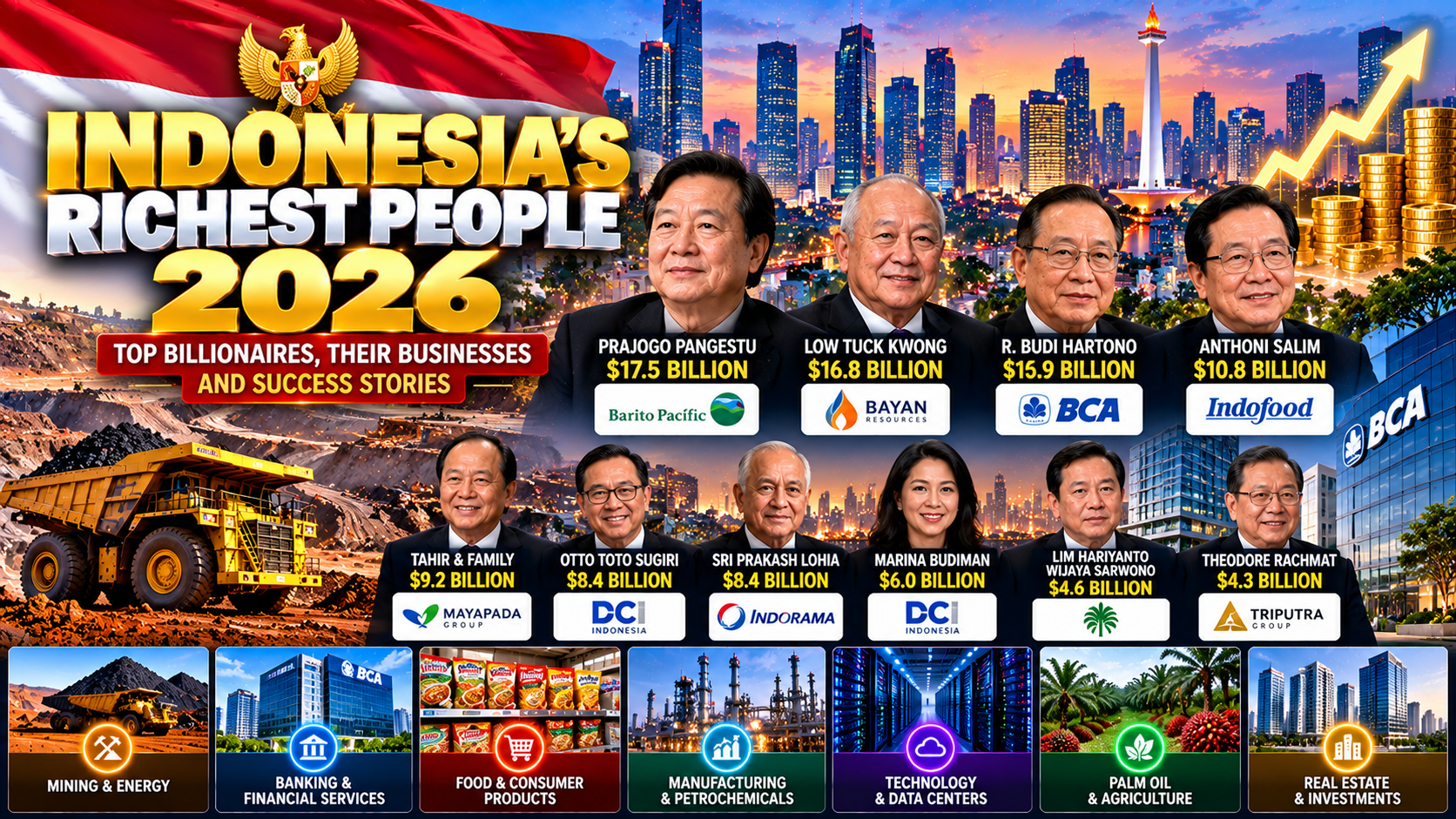
Indonesia is home to some of Southeast Asia’s most influential business leaders, with fortunes built across mining, energy, banking, manufacturing, food production, telecommunications, and technology. The country's natural resources, large consumer market, and growing digital economy have created opportunities for entrepreneurs and multigenerational business families.
In 2026, Indonesia's billionaire rankings have experienced significant changes as stock prices, commodity markets, and business valuations have shifted. Prajogo Pangestu, founder of Barito Group, was listed as Indonesia’s richest person in Forbes-based real-time data on August 13, with an estimated fortune of $17.5 billion. Low Tuck Kwong and R. Budi Hartono followed. However, a separate Bloomberg-based ranking reported that Sukanto Tanoto had taken the top position by June 30, illustrating how rankings can differ by source and valuation method. <Cite refs={["turn585976search0","turn585976search1"]}/>
This article explores ten of Indonesia’s most prominent billionaires, the businesses behind their wealth, and the industries that have shaped the country's economic landscape.
Important note: Billionaire rankings and net worth figures fluctuate. The table below uses a Forbes Real-Time snapshot reported on August 13, 2026. It is not a live ranking as of publication. Family fortunes and individual fortunes are identified separately where applicable.
Top 10 Richest People in Indonesia in 2026
Rank | Person or family | Estimated net worth | Main business sector |
|---|---|---|---|
1 | Prajogo Pangestu | $17.5 billion | Petrochemicals and energy |
2 | Low Tuck Kwong | $16.8 billion | Coal and energy |
3 | R. Budi Hartono | $15.9 billion | Banking and tobacco |
4 | Anthoni Salim | $10.8 billion | Food, banking and investments |
5 | Tahir and family | $9.2 billion | Banking, healthcare and property |
6 | Otto Toto Sugiri | $8.4 billion | Data centres and technology |
7 | Sri Prakash Lohia | $8.4 billion | Manufacturing and petrochemicals |
8 | Marina Budiman | $6 billion | Data centres and technology |
9 | Lim Hariyanto Wijaya Sarwono | $4.6 billion | Palm oil and mining |
10 | Theodore Rachmat | $4.3 billion | Investments and diversified businesses |
Source: Forbes Real-Time Billionaires data reported by Katadata on August 13, 2026. Values are estimates in US dollars and may have changed since that date. <Cite refs={["turn585976search0"]}/>
1. Prajogo Pangestu — $17.5 Billion
Prajogo Pangestu ranked first in the Forbes-based real-time Indonesian list on August 13, 2026, with an estimated net worth of $17.5 billion. He is the founder of Barito Group, a business group with interests spanning petrochemicals, energy, infrastructure, and natural resources.
Pangestu began his business career in the timber industry before expanding into other sectors. His business interests later developed into a broader portfolio of companies, including Barito Pacific and energy-related ventures.
Petrochemicals are important raw materials for manufacturing plastics, packaging, synthetic materials, and numerous industrial products. Energy businesses, meanwhile, supply essential resources to households and industries.
The value of Pangestu's publicly traded holdings can change substantially when share prices move. This is one reason his position in Indonesia's rich list has shifted during 2026.
His career illustrates how expansion from an established resource business into energy and industrial sectors can create a major business empire.
Main industries: Petrochemicals, energy and natural resources
Estimated net worth: $17.5 billion in the cited August snapshot
2. Low Tuck Kwong — $16.8 Billion
Low Tuck Kwong ranked second in the August 2026 Forbes-based snapshot, with an estimated fortune of $16.8 billion. He is best known as the founder of Bayan Resources, one of Indonesia's major coal producers.
Coal has played a significant role in Indonesia's export economy and electricity generation. Companies operating in the sector can earn substantial revenue when production volumes and commodity prices are favourable.
Low built his fortune through investments in mining and the development of large-scale coal operations. Bayan Resources became an important participant in Indonesia's resources sector, supplying customers in domestic and international markets.
However, coal businesses are exposed to changing global demand, environmental regulations, production costs, and the long-term transition toward lower-carbon energy sources.
Low's position among Indonesia's wealthiest entrepreneurs highlights the continuing financial importance of natural resources, even as the global energy industry evolves.
Main industries: Coal mining and energy
Estimated net worth: $16.8 billion in the cited August snapshot
3. R. Budi Hartono — $15.9 Billion
R. Budi Hartono ranked third, with an estimated fortune of $15.9 billion in the August 2026 snapshot. He is one of the leading figures behind the Djarum Group, a diversified business empire known for its tobacco business and investments.
The Hartono family's wealth is also closely associated with Bank Central Asia (BCA), one of Indonesia's largest private banks. Banking provides a significant source of business value through lending, deposits, payment services, and other financial activities.
The family's business interests extend beyond tobacco and banking into other investments, including consumer products and technology-related ventures.
Financial institutions can be valuable assets because they serve large customer bases and participate in a wide range of economic activities. Their market value, however, can fluctuate with interest rates, lending conditions, and investor expectations.
The Hartono family's long-standing position among Indonesia's wealthiest business owners illustrates the importance of diversified ownership across consumer and financial sectors.
Main industries: Banking, tobacco and diversified investments
Estimated net worth: $15.9 billion in the cited August snapshot
4. Anthoni Salim — $10.8 Billion
Anthoni Salim ranked fourth, with an estimated net worth of $10.8 billion. He is associated with the Salim Group, a diversified business group with interests in food production, consumer products, banking-related investments, and other industries.
One of the group's most prominent businesses is Indofood, a major Indonesian food company known for packaged foods and instant noodles. Its products serve consumers in Indonesia and international markets.
Food manufacturing can generate substantial business value through established brands, large distribution networks, efficient production, and repeat purchases.
The Salim Group also has broader investments through companies connected to the First Pacific group, giving it exposure to markets beyond Indonesia.
Anthoni Salim's business interests demonstrate how a combination of consumer brands, manufacturing, and diversified investments can support long-term wealth.
Main industries: Food, consumer products and investments
Estimated net worth: $10.8 billion in the cited August snapshot
5. Tahir and Family — $9.2 Billion
Tahir and his family ranked fifth, with an estimated combined fortune of $9.2 billion. Tahir is the founder of the Mayapada Group, which has interests in banking, healthcare, property, hospitality, and other businesses.
The group's portfolio includes Bank Mayapada and Mayapada Hospital, alongside real estate and investment holdings.
Healthcare has become an important business sector as demand grows for hospitals, specialist treatment, and modern medical facilities. Property and financial services provide additional sources of revenue and asset value.
Tahir is also known for philanthropic activities, including support for healthcare and education initiatives.
His family's position in Indonesia's billionaire rankings illustrates the role of diversified conglomerates that operate across essential services and investment markets.
Main industries: Banking, healthcare, property and investments
Estimated net worth: $9.2 billion in the cited August snapshot
6. Otto Toto Sugiri — $8.4 Billion
Otto Toto Sugiri ranked sixth, with an estimated fortune of $8.4 billion in the August snapshot. He is a prominent figure in Indonesia's technology sector and is associated with DCI Indonesia, a major data-centre operator.
Data centres provide the physical infrastructure required to store data, operate cloud services, host digital platforms, and support business computing. They are becoming increasingly important as companies adopt artificial intelligence, cloud computing, and digital services.
DCI Indonesia operates facilities designed to provide secure and reliable computing infrastructure to customers.
Demand for data centres can grow as businesses require more computing capacity, connectivity, storage, and power. However, the sector also requires significant investment in buildings, electricity, cooling, and technical operations.
Sugiri's fortune highlights how digital infrastructure has become an increasingly important source of wealth in Indonesia.
Main industry: Data centres and technology
Estimated net worth: $8.4 billion in the cited August snapshot
7. Sri Prakash Lohia — $8.4 Billion
Sri Prakash Lohia ranked seventh, with an estimated fortune of $8.4 billion. He is associated with Indorama, an international manufacturing group with significant interests in petrochemicals, polyester, fibres, and related industrial products.
Manufacturing businesses supply materials used across packaging, textiles, consumer products, and other industries. Their performance depends on production efficiency, raw-material costs, customer demand, and international trade.
Lohia's business activities extend beyond Indonesia, reflecting the global nature of modern industrial supply chains.
Petrochemical and textile-related businesses can benefit from large-scale production and established customer relationships, but they are also exposed to changes in commodity prices and manufacturing costs.
His success demonstrates how industrial production and international expansion can build substantial business wealth.
Main industries: Manufacturing, petrochemicals and fibres
Estimated net worth: $8.4 billion in the cited August snapshot
8. Marina Budiman — $6 Billion
Marina Budiman ranked eighth, with an estimated net worth of $6 billion. She is a cofounder of DCI Indonesia and one of the prominent women entrepreneurs in Indonesia's technology industry.
Data centres are essential to digital services, including online commerce, financial transactions, enterprise applications, and AI computing. Their importance has increased as organisations move more operations to cloud-based infrastructure.
Budiman helped establish a business serving the growing demand for reliable data-centre capacity. As digital adoption expands, companies need infrastructure that can support high availability, security, and increasing volumes of data.
The sector is capital-intensive, requiring investment in buildings, power systems, cooling, connectivity, and specialised technical staff. Its growth prospects depend on customer demand, electricity availability, and competition.
Budiman's success highlights the opportunities available to entrepreneurs who develop infrastructure that supports the broader digital economy.
Main industry: Data centres and digital infrastructure
Estimated net worth: $6 billion in the cited August snapshot
9. Lim Hariyanto Wijaya Sarwono — $4.6 Billion
Lim Hariyanto Wijaya Sarwono ranked ninth, with an estimated fortune of $4.6 billion. His business interests are associated with natural resources, including palm oil and mining.
Palm oil is a major agricultural commodity used in food production, household products, and other manufacturing applications. Mining businesses provide industrial materials and minerals that serve domestic and international markets.
Both sectors can generate significant wealth, but they are affected by commodity prices, environmental requirements, land-use concerns, operating costs, and international demand.
Businesses operating across agriculture and mining may benefit from diversification between different products and markets, although both industries remain exposed to resource-sector risks.
Lim's position reflects the continuing importance of Indonesia's natural-resource economy in the creation of private wealth.
Main industries: Palm oil, mining and natural resources
Estimated net worth: $4.6 billion in the cited August snapshot
10. Theodore Rachmat — $4.3 Billion
Theodore Rachmat rounded out the top 10 in the August 2026 snapshot, with an estimated fortune of $4.3 billion. He is a prominent Indonesian entrepreneur and investor associated with the Triputra Group.
Triputra has interests in several sectors, including agribusiness, manufacturing, mining, and other investments. A diversified business structure can provide exposure to different markets and sources of revenue.
Rachmat has a background in the Indonesian automotive industry and later developed broader business interests.
Diversified conglomerates can create value by investing in established operations, developing new businesses, and managing assets across multiple sectors. Their performance still depends on economic conditions, management decisions, and the financial health of individual businesses.
His career illustrates how industrial experience and long-term investment can contribute to a substantial business portfolio.
Main industries: Investments, manufacturing and diversified businesses
Estimated net worth: $4.3 billion in the cited August snapshot
Which Industries Create the Most Wealth in Indonesia?
Indonesia's billionaire landscape reflects the country's natural resources, large consumer market, financial sector, and growing digital economy.
1. Mining and energy
Coal, minerals, petrochemicals, and other resource businesses have created some of Indonesia's largest fortunes. Their values are influenced by global commodity prices, export demand, production costs, and regulations.
Prajogo Pangestu and Low Tuck Kwong are prominent examples of entrepreneurs whose wealth is closely connected to the resources sector.
2. Banking and financial services
Banking can generate value through lending, deposits, payment systems, and other financial products. The Hartono family's interests in BCA demonstrate the importance of financial services in Indonesia's billionaire economy.
3. Food and consumer products
Companies such as Indofood benefit from established brands, distribution networks, and demand from Indonesia's large population.
4. Manufacturing and petrochemicals
Industrial companies supply raw materials and manufactured products to businesses around the world. Manufacturing fortunes can benefit from production scale, technical expertise, and international markets.
5. Data centres and digital infrastructure
Indonesia's digital economy requires reliable data storage, cloud infrastructure, and computing capacity. Data-centre businesses have become more prominent as companies adopt online services and AI technologies.
6. Palm oil and agriculture
Palm oil and other agricultural commodities contribute to Indonesia's export economy. Businesses in these sectors can generate substantial value, although they also face environmental, regulatory, and commodity-price risks.
Why Do Indonesia's Billionaire Rankings Change?
Indonesia's richest-person rankings can change significantly over relatively short periods because many fortunes depend on publicly traded company shares.
Several factors influence the rankings:
Stock-market movements: Changes in share prices can increase or decrease the estimated value of major ownership stakes.
Commodity prices: Coal, petrochemical, and mineral prices affect the revenue expectations and valuations of resource companies.
Business transactions: Acquisitions, new investments, and changes in ownership can affect personal fortunes.
Currency exchange rates: Changes in the rupiah's value can alter the US-dollar equivalent of Indonesian wealth.
Private-company valuations: Some businesses are not publicly traded, making their valuations more dependent on estimates and comparable companies.
Different rankings can also use different methodologies. For example, a Bloomberg-based ranking reported Sukanto Tanoto as Indonesia's richest person on June 30, 2026, with an estimated fortune of $24.3 billion, while Forbes-based real-time data placed Prajogo Pangestu first in August. A later report using Bloomberg data continued to place Tanoto at the top in October. <Cite refs={["turn585976search1","turn585976search3"]}/>
For this reason, readers should always check the source and valuation date before comparing billionaire rankings.
How Indonesia's Richest People Built Their Fortunes
Although their industries differ, several patterns appear across Indonesia's wealthiest entrepreneurs.
Building large businesses: Ownership of established companies can create substantial long-term value.
Expanding into related industries: Businesses may diversify into finance, manufacturing, consumer products, or infrastructure.
Serving large markets: Indonesia's population and regional trade links provide opportunities for businesses to reach many customers.
Investing in essential sectors: Energy, food, banking, and digital infrastructure support broad economic activity.
Managing assets over time: Long-term ownership and strategic investment can help businesses expand across economic cycles.
Adapting to new demand: Growth in digital services, data centres, and modern manufacturing creates opportunities alongside traditional resource businesses.
These factors can support wealth creation, but business ownership also involves risks related to competition, economic conditions, regulation, and market volatility.
Frequently Asked Questions
Who is the richest person in Indonesia in 2026?
The answer depends on the source and date. Prajogo Pangestu ranked first in Forbes-based real-time data reported on August 13, 2026. Bloomberg-based reporting later placed Sukanto Tanoto at the top in October. <Cite refs={["turn585976search0","turn585976search3"]}/>
What is Prajogo Pangestu's net worth?
Forbes-based real-time data reported by Katadata estimated his fortune at $17.5 billion on August 13, 2026. His current net worth may differ as market values change.
Who is Low Tuck Kwong?
Low Tuck Kwong is a prominent Indonesian coal entrepreneur and founder of Bayan Resources. His wealth is closely associated with the mining and energy sectors.
Which Indonesian billionaires are involved in technology?
Otto Toto Sugiri and Marina Budiman are prominent figures in Indonesia's data-centre industry. Their businesses provide infrastructure that supports digital services and computing demand.
How much are Indonesia's richest people worth collectively?
The combined wealth of Indonesia's 50 richest people was reported at approximately 4,651 trillion rupiah in a 2026 analysis based on Forbes data. The exact total depends on the ranking methodology and valuation date. <Cite refs={["turn585976search2"]}/>
Why do different websites show different richest-person rankings?
Websites may use different valuation dates, data providers, and methods for estimating private businesses. Real-time rankings can change with stock prices, while annual rich lists use a specific cutoff date.
Are all Indonesian billionaires self-made?
No. Some built businesses themselves, while others inherited family holdings or expanded existing business groups. Many fortunes reflect a combination of entrepreneurship, investment, and family ownership.
Conclusion
Indonesia's richest people in 2026 represent a diverse range of industries, including mining, energy, banking, food production, manufacturing, and digital infrastructure. Prajogo Pangestu, Low Tuck Kwong, R. Budi Hartono, and Anthoni Salim are among the country's best-known business figures, while technology entrepreneurs such as Otto Toto Sugiri and Marina Budiman reflect the growing importance of digital infrastructure.
The country's billionaire rankings are not fixed. Changes in commodity markets, company valuations, and stock prices can quickly reshape the list, as demonstrated by the different rankings reported during 2026.
For readers interested in global business and finance, Indonesia's wealthiest entrepreneurs offer insight into the industries driving the country's economy and the business strategies that can create major fortunes. The key to interpreting any rich list is to consider not only the ranking, but also the source, date, and method used to calculate net worth.
Editorial source note: This article uses Forbes-based real-time figures reported on August 13, 2026, and references later Bloomberg-based reporting to explain ranking differences. Net worth estimates should not be treated as live valuations.