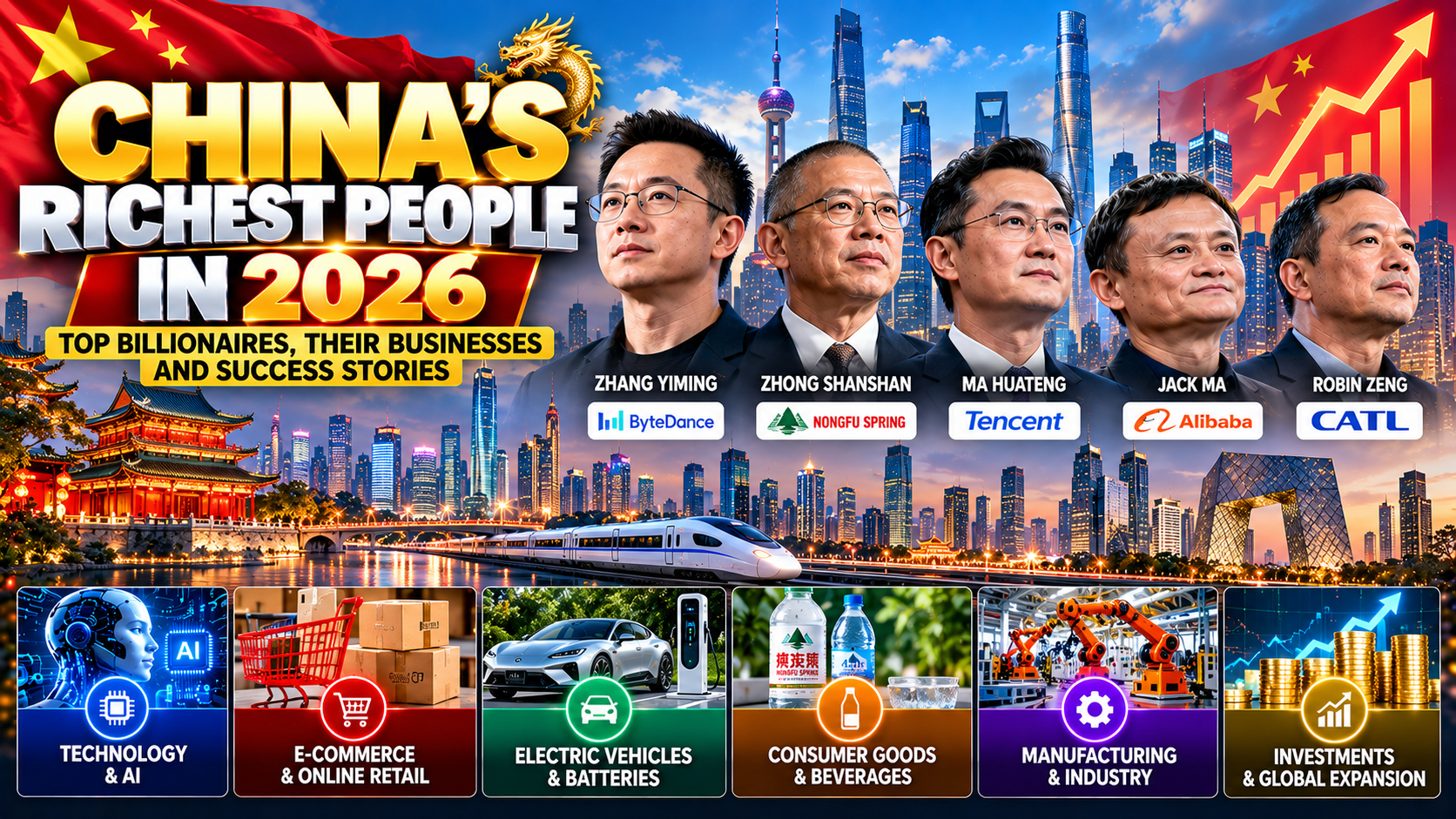
China richest has become one of the world's most important centers of entrepreneurship, manufacturing, technology, and business innovation. From social media platforms and e-commerce marketplaces to bottled water, electric vehicles, artificial intelligence, and advanced batteries, Chinese companies have created enormous fortunes for their founders and investors.
In 2026, China's wealthiest entrepreneurs represent a wide range of industries. Some built digital platforms used by hundreds of millions of people, while others established businesses supplying everyday consumer products, industrial equipment, and technology infrastructure. Their success stories reveal how changing consumer habits, technological advances, manufacturing capabilities, and access to large markets can create opportunities for business growth.
Among the most prominent names are Zhang Yiming, the co-founder of ByteDance, which owns TikTok and Douyin; Zhong Shanshan, the founder of beverage company Nongfu Spring; and Ma Huateng, the co-founder of Tencent. Other notable business leaders include Jack Ma of Alibaba, Robin Zeng of battery manufacturer CATL, and Lei Jun of Xiaomi.
Forbes' 2026 annual billionaire ranking placed Zhang Yiming at the top among mainland Chinese citizens, with an estimated fortune of $69.3 billion as of March 1, 2026. However, billionaire rankings can change as share prices and private-company valuations fluctuate. A later October 2026 estimate placed Zhang's fortune at approximately $84 billion. These figures reflect different valuation dates rather than a fixed amount of cash. Forbes' 2026 Chinese billionaire coverage and October 2026 estimates provide useful reference points.
This article explores China's richest people, how they built their fortunes, the companies behind their wealth, and the industries shaping the country's business landscape.
China's Richest People in 2026: An Overview
The following table uses estimated net worth figures reported around October 15, 2026. They are approximate snapshots, not guaranteed real-time values, and should not be treated as a permanent ranking.
Business leader | Estimated net worth | Main source of wealth |
|---|---|---|
Zhang Yiming | $84.0 billion | ByteDance, technology |
Zhong Shanshan | $59.9 billion | Beverages and pharmaceuticals |
Ma Huateng | $45.5 billion | Tencent, technology |
Robin Zeng | $45.2 billion | CATL, electric-vehicle batteries |
William Ding | $41.6 billion | NetEase, online games |
Liang Wenfeng | $40.0 billion | DeepSeek and investment activities |
He Xiangjian | $36.8 billion | Midea Group, home appliances |
Colin Huang | $28.7 billion | PDD Holdings and e-commerce |
Jack Ma | $26.2 billion | Alibaba and investments |
Chen Jianhua | $24.6 billion | Chemicals and industrial businesses |
Source: BillionaireList's China rankings, with estimates attributed to Forbes and dated October 15, 2026. Net worth and ordering can change frequently. The table focuses on mainland Chinese business figures and is not a ranking of every billionaire in Greater China.
1. Zhang Yiming: The Technology Entrepreneur Behind ByteDance
Zhang Yiming is widely recognized as China's wealthiest person in 2026. He co-founded ByteDance, the technology company behind TikTok, Douyin, and other digital products.
Born in Fujian, China, Zhang studied software engineering at Nankai University. Before establishing ByteDance, he worked in technology-related roles and developed an interest in internet products, information discovery, and personalized content.
He co-founded ByteDance in 2012. The company developed platforms that use algorithms to recommend videos, articles, and other content based on user interests and activity.
How ByteDance Became So Valuable
ByteDance's growth was supported by the expansion of mobile internet access and the popularity of short-form video. Rather than relying only on users actively searching for content, its recommendation systems helped people discover videos tailored to their interests.
TikTok expanded this model internationally, while Douyin served the Chinese market. ByteDance also developed advertising, e-commerce, and other commercial activities.
Several factors contributed to the company's growth:
Personalized recommendations: Algorithms help users discover content they are likely to watch.
Global reach: TikTok attracted audiences across many countries.
Advertising: Businesses can pay to reach relevant audiences.
Creator participation: Independent creators supply content that encourages users to return.
Product development: The company expanded into additional digital services and commercial opportunities.
Zhang's wealth is largely linked to his ownership interest in ByteDance. A company's estimated value can increase when investors expect strong future earnings, but its valuation can also fall because of competition, regulation, or changes in market sentiment.
ByteDance faces important challenges, including regulatory scrutiny, international data concerns, competition from other social platforms, and uncertainty surrounding its operations in certain markets.
Nevertheless, Zhang's career illustrates how a digital product can grow into a global business when it combines technology, audience engagement, and a scalable revenue model.
2. Zhong Shanshan: China's Beverage Billionaire
Zhong Shanshan built much of his fortune through Nongfu Spring, one of China's best-known bottled-water and beverage companies. He is also associated with pharmaceutical and healthcare-related businesses.
Unlike technology entrepreneurs whose fortunes depend on software platforms, Zhong's business success is rooted in consumer products that people purchase regularly.
Nongfu Spring became prominent in China's bottled-water market by developing a recognizable brand and expanding distribution. The company sells bottled water and other beverages, benefiting from consumer demand for convenient drinks.
The Business Strategy Behind Nongfu Spring
Consumer-product businesses depend on more than manufacturing an item. They must develop brand recognition, maintain product quality, secure distribution, and convince customers to purchase repeatedly.
Nongfu Spring's business model benefits from several factors:
Everyday demand: Water and beverages are products that customers buy regularly.
Brand identity: Packaging, advertising, and brand recognition help distinguish one product from competing options.
Distribution networks: Products must be available in supermarkets, convenience stores, restaurants, and other retail locations.
Product diversification: Additional beverage categories can help a company serve different consumer preferences.
Zhong's wealth demonstrates that a business does not need to develop sophisticated software or artificial intelligence to become extremely valuable. A company selling everyday products can also build a large fortune when it reaches a broad market and establishes a strong distribution system.
However, beverage companies face competition, changing consumer preferences, packaging costs, and public scrutiny regarding product quality and environmental impact.
3. Ma Huateng: The Entrepreneur Behind Tencent
Ma Huateng, also known as Pony Ma, co-founded Tencent in 1998. Tencent became one of China's largest technology companies through online communication, gaming, digital payments, and other internet services.
Its best-known products include WeChat, a multifunctional platform used for messaging, social networking, payments, and other digital activities in China.
Tencent also has substantial interests in online games and entertainment. Its investments and business partnerships extend across different areas of the technology industry.
How Tencent Built Its Digital Ecosystem
Tencent's growth illustrates the value of connecting multiple services within one digital environment.
WeChat allows users to communicate with friends, follow public accounts, interact with businesses, and access services. Tencent's gaming business provides another important source of revenue, while advertising and financial technology contribute to its broader operations.
Its business model benefits from network effects. A communication platform often becomes more useful when more people use it, creating an incentive for individuals and businesses to remain within the ecosystem.
Tencent's scale also creates opportunities for developers, advertisers, and commercial partners.
However, the company operates in a competitive and regulated environment. Its growth depends on user engagement, gaming demand, advertising budgets, technological innovation, and compliance with Chinese regulations.
Ma Huateng's success shows how a company can build significant value by connecting communication, entertainment, and commercial services in one ecosystem.
4. Robin Zeng: The Battery Entrepreneur Powering Electric Vehicles
Robin Zeng, also known as Zeng Yuqun, founded Contemporary Amperex Technology Limited, better known as CATL. The company is one of the world's leading manufacturers of batteries for electric vehicles and energy-storage systems.
The growth of electric vehicles has created demand for batteries that provide adequate range, charging speed, reliability, and cost efficiency. CATL supplies battery technology to automotive manufacturers and participates in the broader energy-storage market.
Why Battery Technology Creates Large Fortunes
Electric vehicles require sophisticated battery systems. Battery manufacturers must improve energy density, safety, durability, manufacturing efficiency, and production capacity while managing the cost of raw materials.
CATL's business depends on several major trends:
Growth in electric-vehicle adoption.
Demand for batteries from global automakers.
Expansion of renewable-energy storage.
Improvements in battery chemistry and manufacturing.
Competition over production costs and technical performance.
The battery industry requires significant research, specialized equipment, supply-chain management, and manufacturing investment. Companies that establish strong technical capabilities and long-term relationships with automakers can become strategically important suppliers.
Zeng's fortune reflects the commercial value of battery technology and the importance of electric vehicles in the global transition toward alternative transportation systems.
The industry also faces risks, including raw-material price changes, international trade restrictions, competition from other battery producers, and shifts in government incentives.
5. William Ding: Building an Online Gaming and Technology Business
William Ding, also known as Ding Lei, founded NetEase, a Chinese internet company known for online games, digital services, and related technology businesses.
NetEase became a major player in China's gaming industry, developing and publishing games for computer and mobile platforms. Gaming companies can generate revenue through game purchases, subscriptions, downloadable content, and optional in-game purchases.
How Online Gaming Generates Wealth
The gaming industry combines software development, storytelling, entertainment, community building, and digital distribution.
A successful game may attract users for years if its developers continue to release updates, introduce new features, and maintain an engaging experience. Some games also build communities that encourage users to interact with friends and other players.
NetEase has developed games and partnered with other companies to reach domestic and international audiences.
However, the industry is highly competitive. A game's popularity can decline, development costs can rise, and government rules can affect the market. Companies must continually invest in new content and technical improvements to retain players.
Ding's career demonstrates how entertainment products can become the foundation of a large technology company when supported by effective development, publishing, and distribution.
6. Liang Wenfeng: The Artificial Intelligence Entrepreneur Behind DeepSeek
Liang Wenfeng became one of China's most closely watched technology entrepreneurs through DeepSeek, an artificial intelligence company that attracted global attention for its AI models.
Liang also has a background in quantitative investment and is associated with High-Flyer, a quantitative hedge fund. His work illustrates the growing relationship between financial technology, computing infrastructure, and artificial intelligence.
DeepSeek drew attention by developing models designed to perform complex tasks involving reasoning, programming, and language generation. Its progress contributed to international discussions about the cost of developing advanced AI and the competitive position of Chinese technology companies.
Why AI Is Creating New Chinese Fortunes
Artificial intelligence has become a major area of investment worldwide. Businesses are exploring AI for software development, customer support, research, manufacturing, logistics, and many other applications.
Chinese AI companies operate in a competitive environment that includes large technology groups, specialist startups, universities, and research institutions.
Important factors in AI development include:
Access to advanced computing hardware.
The availability and quality of training data.
Research talent and engineering expertise.
Efficient model development and deployment.
Commercial applications that customers are willing to pay for.
DeepSeek's prominence shows how a relatively young technology business can attract considerable attention by challenging established assumptions about AI development.
However, a private company's valuation is not the same as its founder's liquid wealth. Estimates of Liang's fortune depend on assumptions about ownership, business value, and associated investments. Such estimates can be particularly uncertain when a company is not publicly traded.
7. He Xiangjian: The Home-Appliance Entrepreneur Behind Midea Group
He Xiangjian founded the business that developed into Midea Group, a major Chinese manufacturer of home appliances and industrial equipment.
Midea produces products including air conditioners, refrigerators, washing machines, kitchen appliances, and equipment used in commercial and industrial settings. The company has expanded its manufacturing and international operations over time.
The Opportunity in Household Products
Home appliances serve a broad consumer market. As household incomes, urbanization, and demand for modern conveniences change, consumers may purchase more appliances and replace older products.
Manufacturers must compete on pricing, reliability, energy efficiency, product design, and after-sales service.
Midea's development illustrates how manufacturing businesses can build value by combining production scale with product development and distribution.
The company also operates in industrial automation and related areas, allowing it to serve business customers as well as households.
He Xiangjian's career demonstrates that industrial manufacturing can create substantial wealth, even when it attracts less public attention than social media or artificial intelligence.
8. Colin Huang: The E-Commerce Entrepreneur Behind PDD Holdings
Colin Huang founded Pinduoduo, an e-commerce platform that became known for social shopping and value-oriented online retail. The company later developed into PDD Holdings, the parent company associated with Pinduoduo and the international marketplace Temu.
Pinduoduo gained attention in China by combining online shopping with promotional mechanics that encouraged users to share deals and purchase products at competitive prices.
Temu subsequently brought a value-focused shopping model to international markets, connecting consumers with a wide range of products.
How PDD Holdings Competes in E-Commerce
E-commerce companies must attract shoppers while managing customer acquisition costs, product quality, logistics, seller relationships, and competition.
PDD Holdings has benefited from a focus on price-sensitive customers and a broad selection of merchandise. Its platforms connect sellers with consumers and use digital tools to promote products.
The business also demonstrates how online marketplaces can scale without manufacturing every product themselves. Instead, the platform provides the infrastructure that enables transactions between buyers and sellers.
Nevertheless, e-commerce faces challenges involving shipping, returns, seller standards, regulation, consumer trust, and competition from established marketplaces.
Huang's fortune illustrates the potential of technology-enabled retail when a company builds a large customer base and a scalable marketplace model.
9. Jack Ma: The Founder Who Changed Chinese E-Commerce
Jack Ma co-founded Alibaba Group in 1999 with a group of partners. Alibaba developed into one of China's most influential e-commerce and technology businesses.
Its operations include online marketplaces, cloud computing, digital services, and other business activities. Alibaba helped connect businesses with consumers and suppliers through internet-based commerce.
Ma became a prominent business figure because of his role in Alibaba's early development and his public advocacy for entrepreneurship. He stepped down as chairman of Alibaba in 2019, although he remains widely associated with the company's history.
How Alibaba Changed Online Business
Alibaba's marketplace model helped businesses reach customers without having to establish their own physical retail networks everywhere they wanted to sell.
Its platforms created opportunities for merchants, manufacturers, wholesalers, and consumers to connect through digital services.
The company's broader development included technology infrastructure, logistics-related services, cloud computing, and other offerings designed to support commerce.
Alibaba's success illustrates several important business principles:
Marketplaces can scale: A platform can connect large numbers of buyers and sellers.
Trust is essential: Buyers need confidence in product quality, payments, delivery, and seller reliability.
Technology can reduce barriers: Digital tools can make it easier for small businesses to reach larger markets.
Competition never stops: E-commerce companies must continue improving their services as consumer expectations change.
Jack Ma's story remains an important example of Chinese internet entrepreneurship. His estimated wealth, however, is distinct from Alibaba's total market value and changes with the value of his investments and other assets.
10. Chen Jianhua: Wealth From Chemicals and Industrial Businesses
Chen Jianhua represents the industrial side of China's business economy. His fortune is associated with chemical manufacturing and industrial business interests.
Industrial companies often operate behind the scenes, supplying materials used in textiles, plastics, manufacturing, construction, and other sectors. Although consumers may not recognize their names, these businesses can play essential roles in larger supply chains.
Why Industrial Businesses Matter
Chemical manufacturers often need specialized equipment, technical expertise, dependable suppliers, and strong relationships with industrial customers.
Their financial performance can be influenced by raw-material costs, energy prices, demand from downstream industries, environmental requirements, and international trade conditions.
Businesses that manage production efficiently and deliver reliable products can build substantial operations over time.
Chen's position among China's wealthiest people illustrates that the country's billionaire economy extends beyond consumer-facing technology brands. Industrial production and materials businesses remain important sources of wealth.
Other Notable Chinese Billionaires to Watch
Beyond the ten names above, several other entrepreneurs have played important roles in China's business landscape.
Lei Jun: The Founder of Xiaomi
Lei Jun founded Xiaomi, a technology company known for smartphones, consumer electronics, connected devices, and electric vehicles.
Xiaomi built its brand by offering feature-rich devices at competitive prices and developing an ecosystem of connected products.
Its entry into electric vehicles illustrates how technology companies can expand into industries where software, hardware, manufacturing, and brand recognition intersect.
Wang Chuanfu: The Entrepreneur Behind BYD
Wang Chuanfu founded BYD, which developed from a battery business into a major manufacturer of electric vehicles and plug-in hybrid cars.
BYD's business combines battery technology, vehicle manufacturing, and other related operations. Its development illustrates the importance of integrating multiple parts of a supply chain in a competitive industry.
The electric-vehicle market remains sensitive to pricing, consumer demand, production costs, and international trade policy.
Wang Ning: The Businessman Behind Pop Mart
Wang Ning is associated with Pop Mart, the Chinese company known for collectible toys and character-based products.
Pop Mart built a consumer brand around product design, collectible characters, retail experiences, and surprise-box purchases. Its growth shows how intellectual property and consumer culture can become important business assets.
The company's future performance depends on product popularity, international expansion, consumer spending, and the ability to develop characters that remain commercially appealing.
What Industries Are Creating China's Biggest Fortunes?
China's wealthiest business leaders are active in several major industries. Understanding these sectors helps explain how the country's economy creates and changes large fortunes.
1. Technology and Digital Platforms
Technology has produced several of China's largest fortunes. ByteDance, Tencent, Alibaba, NetEase, and other companies built products and services for enormous online audiences.
Digital platforms can expand rapidly because software can serve additional users without requiring the same level of physical expansion as many traditional businesses. Nevertheless, large platforms still need significant investment in infrastructure, security, employees, and product development.
2. Artificial Intelligence
AI is an increasingly important source of business activity in China. Companies are developing language models, robotics, computer vision, chips, and software applications.
AI could improve productivity across many sectors, but commercial success depends on whether products solve practical problems at a sustainable cost. Investment in AI does not automatically translate into profits.
3. Electric Vehicles and Batteries
Electric vehicles and energy-storage technology have helped create opportunities for companies such as BYD and CATL.
Battery manufacturing, charging systems, vehicle software, and related infrastructure are important parts of this market. However, competition and the cost of developing new technology can place pressure on margins.
4. Consumer Goods and Beverages
Companies such as Nongfu Spring demonstrate the scale that consumer brands can achieve in a large domestic market.
Food, beverages, household goods, and personal products can generate recurring demand. Strong distribution, quality control, brand recognition, and pricing are essential to maintaining that demand.
5. E-Commerce and Online Retail
Alibaba, PDD Holdings, and other online marketplaces have changed how consumers shop and how businesses reach customers.
E-commerce offers broad market access, but companies must manage shipping, returns, advertising costs, customer service, and competition from other retailers.
6. Manufacturing and Industrial Equipment
China's manufacturing sector includes electronics, home appliances, machinery, chemicals, automotive components, and many other products.
Large manufacturers can benefit from production expertise, supplier networks, technical capabilities, and economies of scale. Their performance still depends on global demand, labor and energy costs, trade policies, and technological changes.
How Do Chinese Billionaires Calculate Their Net Worth?
A billionaire's net worth is generally estimated by adding the value of their assets and subtracting their liabilities.
Assets can include:
Shares in publicly traded companies.
Ownership stakes in private businesses.
Real estate and other investments.
Cash and financial holdings.
Other valuable assets.
Liabilities may include personal debt and other obligations included in the estimate.
For founders of publicly traded companies, share prices can cause major changes in estimated wealth. If a founder owns a large number of shares and the share price rises, the estimated value of that stake increases.
Private-company wealth is more difficult to estimate because shares may not trade regularly on public markets. Researchers may use funding rounds, comparable businesses, financial information, and other assumptions to estimate a company's value.
This explains why two rankings may report different fortunes for the same individual. The estimates may use different dates, valuation methods, exchange rates, or definitions of who is included.
A billionaire's estimated net worth should therefore not be confused with money immediately available in a bank account.
What Can Entrepreneurs Learn From China's Richest People?
The journeys of China's wealthiest business leaders reveal several lessons that can help entrepreneurs understand business growth. These principles do not guarantee extraordinary wealth, but they offer useful ways to evaluate business opportunities.
Focus on a Clear Customer Need
Nongfu Spring serves demand for beverages, while Xiaomi offers consumer electronics and Tencent provides digital communication and entertainment services.
Successful companies identify a need and develop products or services that customers are willing to use or purchase.
Build a Scalable Business Model
Digital platforms can reach large audiences, while manufacturers can expand production and distribution. Scalability allows a business to serve more customers without costs necessarily rising at the same rate as revenue.
However, rapid expansion can also create operational problems if quality, customer service, or cash flow is neglected.
Understand the Economics
Revenue alone does not demonstrate business success. Entrepreneurs must understand product costs, operating expenses, marketing costs, taxes, cash flow, and the amount of capital needed to grow.
A business with increasing sales can still struggle if its expenses grow faster than its income.
Invest in Innovation
Technology and manufacturing companies often need to improve products to remain competitive. Research and development can create new opportunities, but investment should be aligned with realistic customer demand and the company's financial capacity.
Build Trust and Brand Recognition
Customers are more likely to return when they trust a product or service. Reliability, transparency, quality, and effective customer support can help a business develop long-term relationships.
Adapt to Market Changes
Consumer preferences, technology, competition, and regulations can change quickly. Companies that monitor these changes and respond effectively may be better positioned to survive.
Adaptation does not always mean entering a new industry. It can also involve improving existing products, adjusting pricing, or making operations more efficient.
Is It Possible to Become Rich by Following These Business Models?
Studying successful entrepreneurs can provide useful ideas, but copying a famous company's strategy does not guarantee the same results.
The markets in which these businesses grew may have changed, and new competitors may already be serving the same customers. Entrepreneurs must evaluate the current market, available capital, relevant skills, and their own ability to execute.
A small business can apply similar principles on a more manageable scale. For example, an online seller can begin with a narrow product category, test customer demand, calculate profit margins, and expand only after establishing a reliable sales process.
A service business can start by solving one specific problem for a defined group of customers and then grow through referrals, partnerships, and repeat purchases.
The most practical goal is to build a sustainable business that meets customer needs and generates reliable income. Becoming a billionaire is an exceptional outcome, not a predictable result of hard work.
Frequently Asked Questions
Who is the richest person in China in 2026?
Zhang Yiming, the co-founder of ByteDance, topped Forbes' 2026 annual ranking of mainland Chinese billionaires. Forbes estimated his fortune at $69.3 billion as of March 1, 2026. Later estimates were higher, demonstrating how quickly billionaire wealth can change.
How did Zhang Yiming become so wealthy?
Zhang co-founded ByteDance, the technology company behind TikTok and Douyin. His fortune is primarily associated with his ownership stake in the company and its estimated business value.
Is Jack Ma still one of China's richest people?
Yes. Jack Ma remains among China's notable billionaires because of his Alibaba-related holdings and other assets. His estimated net worth changes with market conditions and the valuation of his investments.
Who is China's richest beverage entrepreneur?
Zhong Shanshan is a leading Chinese beverage entrepreneur. He built much of his fortune through Nongfu Spring, a major bottled-water and beverage company, and also has interests in pharmaceuticals.
Which industries produce the most Chinese billionaires?
Technology, e-commerce, manufacturing, consumer goods, electric vehicles, batteries, and finance are important sources of wealth. The relative importance of each sector changes as markets and company valuations evolve.
Why do China's billionaire rankings change so often?
Many wealthy Chinese entrepreneurs own shares in publicly traded companies. Changes in stock prices can quickly increase or decrease the estimated value of those holdings. Private-company valuations and changes in the broader economy can also affect rankings.
Are all Chinese billionaires technology founders?
No. Some built fortunes in beverages, manufacturing, chemicals, industrial equipment, real estate, and other sectors. China's billionaire population reflects a broad economy rather than a single industry.
Conclusion
China's richest people in 2026 illustrate the variety of ways business ownership can create enormous wealth. Zhang Yiming built his fortune through digital platforms, Zhong Shanshan through consumer products, Ma Huateng through internet services and gaming, and Robin Zeng through battery technology. Other business leaders, including William Ding, Liang Wenfeng, He Xiangjian, Colin Huang, Jack Ma, and Chen Jianhua, represent online entertainment, artificial intelligence, manufacturing, e-commerce, and industrial production.
Their careers demonstrate that large fortunes can emerge from different types of businesses. Some companies grow by serving millions of online users, while others succeed by manufacturing essential products or building strong consumer brands.
The broader lesson is that business growth depends on understanding customers, developing useful products, managing finances, adapting to competition, and building operations that can grow sustainably.
China's business landscape will continue to evolve as artificial intelligence, electric vehicles, consumer markets, and global trade reshape opportunities. The fortunes of its wealthiest entrepreneurs will likely change alongside those developments, making their companies important subjects for anyone interested in business, technology, and global wealth.