Malaysia is home to some of Southeast Asia’s most successful entrepreneurs and business families. Their fortunes span agriculture, aluminium manufacturing, banking, property development, retail, telecommunications, and energy. In 2026, Malaysia’s wealthiest business figures benefited from a stronger ringgit, economic growth, and a buoyant initial public offering (IPO) market.
According to Forbes’ Malaysia’s 50 Richest 2026 list, the combined wealth of the country’s 50 richest tycoons increased by nearly 30% to approximately US$116 billion. Robert Kuok retained the top position, while aluminium magnate Koon Poh Keong and his siblings rose to second place. Source: Forbes.
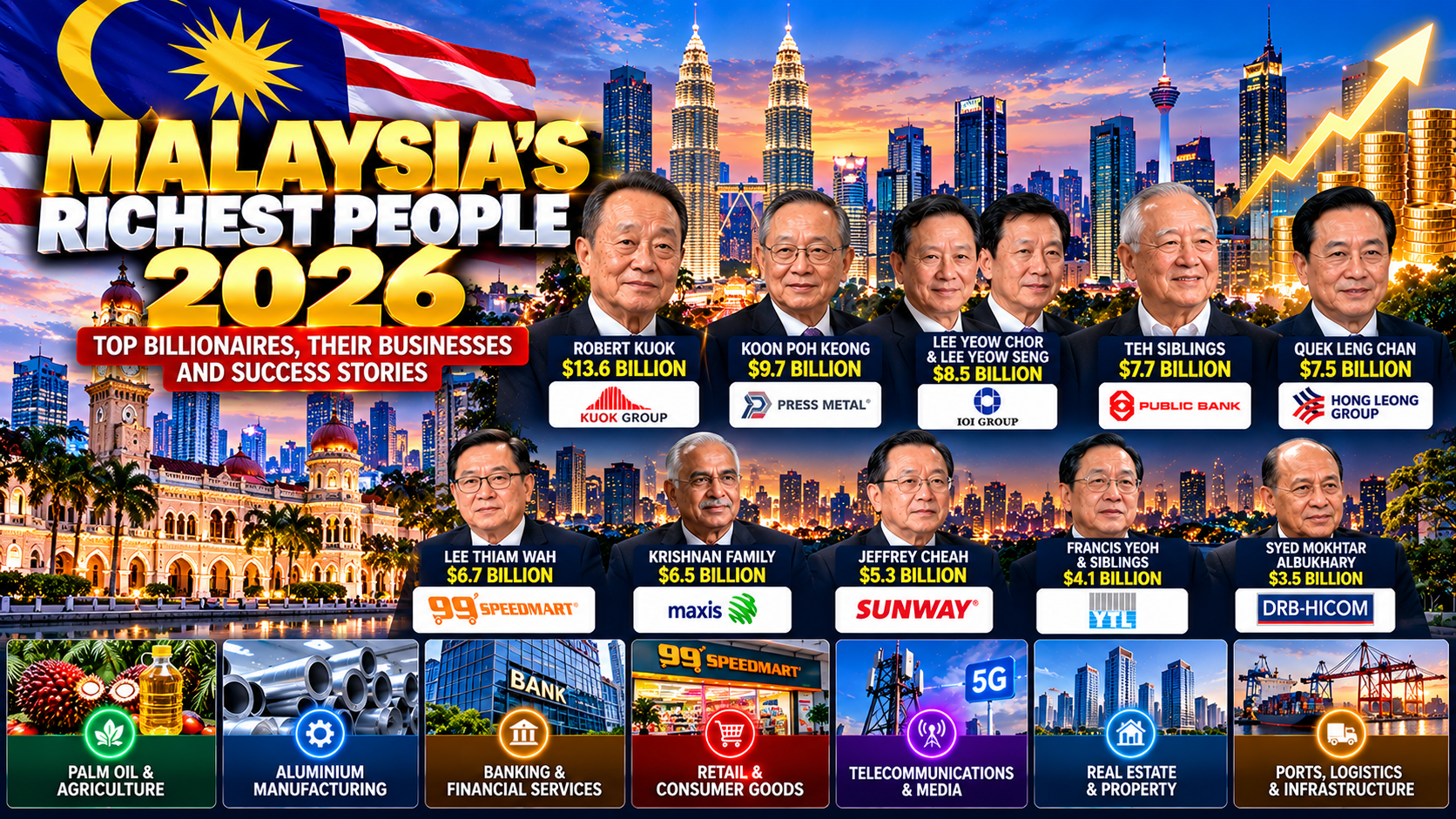
Who are Malaysia’s richest people in 2026, how did they build their fortunes, and which industries contribute most to their wealth? Here is a closer look at the top 10.
Top 10 Richest People in Malaysia in 2026
The following ranking uses Forbes’ annual Malaysia’s 50 Richest list, with net worth estimates calculated using stock prices and exchange rates as of March 27, 2026. Family fortunes are grouped where applicable.
Rank | Name | Estimated Net Worth | Main Business |
|---|---|---|---|
1 | Robert Kuok | $13.6 billion | Diversified conglomerate, commodities and hospitality |
2 | Koon Poh Keong and siblings | $9.7 billion | Aluminium manufacturing |
3 | Lee Yeow Chor and Lee Yeow Seng | $8.5 billion | Palm oil and property |
4 | Teh siblings | $7.7 billion | Banking and investments |
5 | Quek Leng Chan | $7.5 billion | Banking, property and investments |
6 | Lee Thiam Wah | $6.7 billion | Retail and convenience stores |
7 | Krishnan family | $6.5 billion | Telecommunications, media and investments |
8 | Jeffrey Cheah | $5.3 billion | Property, construction and healthcare |
9 | Francis Yeoh and siblings | $4.1 billion | Infrastructure, utilities and property |
10 | Syed Mokhtar Albukhary | $3.5 billion | Automotive, ports and diversified investments |
Source: Forbes Malaysia’s 50 Richest 2026, as reported by Bernama. All figures are estimates in US dollars and may change.
1. Robert Kuok — $13.6 Billion
Robert Kuok is Malaysia’s richest person in 2026. Known internationally as the “Sugar King,” Kuok built a diversified business empire with interests in commodities, agriculture, hospitality, property, shipping, and other investments.
His business journey began in commodity trading, including the sugar industry. Over time, the Kuok Group expanded into multiple markets, while associated investments helped establish a substantial presence across Asia.
The group’s wider business interests include hospitality and property, with investments linked to companies operating in several countries. This diversification has helped make Kuok one of Asia’s most prominent business figures.
Main wealth drivers: Commodities, agriculture, hospitality, property and diversified investments.
2. Koon Poh Keong and Siblings — $9.7 Billion
Koon Poh Keong and his siblings rank second on Malaysia’s 2026 rich list. Their wealth is closely associated with Press Metal Aluminium Holdings, a major aluminium producer with operations spanning important parts of the aluminium production chain.
Demand for aluminium across manufacturing, infrastructure, transportation and other industries can influence the company’s performance. In the year covered by Forbes’ ranking, Press Metal’s share-price gains contributed significantly to the family’s rising fortune.
Their story illustrates how industrial manufacturing can create substantial wealth when a company expands its operations and strengthens its position in international markets.
Main wealth drivers: Aluminium production, manufacturing and industrial investments.
3. Lee Yeow Chor and Lee Yeow Seng — $8.5 Billion
Brothers Lee Yeow Chor and Lee Yeow Seng rank third through their interests in IOI Group and its associated businesses.
IOI has a significant presence in palm oil and related industries, while its property operations add another major source of value. Palm oil is an important commodity for Malaysia, supplying ingredients used in food, personal care products and various industrial applications.
The brothers oversee different parts of the broader business, including plantation and property interests. Their position on the rich list reflects the importance of commodities, real estate assets and corporate valuations in building large fortunes.
Main wealth drivers: Palm oil, plantations, property development and investments.
4. The Teh Siblings — $7.7 Billion
The Teh siblings rank fourth, with their family wealth associated with Public Bank, one of Malaysia’s major banking institutions.
Their fortune is linked to the legacy of Public Bank founder Teh Hong Piow. Banking businesses can build long-term value through lending, deposits, financial services and shareholder returns, although their performance depends on economic conditions, credit quality and regulation.
The family’s wealth is assessed collectively in Forbes’ Malaysia rich list, rather than as a single individual fortune.
Main wealth drivers: Banking, financial services and investments.
5. Quek Leng Chan — $7.5 Billion
Quek Leng Chan is a leading Malaysian businessman whose wealth is associated with the Hong Leong Group and its diversified interests.
His business portfolio includes financial services, property and other investments. Hong Leong-related companies operate in different markets, giving the group exposure to banking, real estate and broader economic activity.
Although his ranking declined compared with the previous year’s list, Quek remained among Malaysia’s five wealthiest tycoons in 2026.
His position demonstrates how fortunes can shift even when business interests remain extensive, because share prices, exchange rates and asset valuations affect estimated net worth.
Main wealth drivers: Banking, property, manufacturing and diversified investments.
6. Lee Thiam Wah — $6.7 Billion
Lee Thiam Wah built his fortune in retail as the founder of 99 Speed Mart, one of Malaysia’s best-known minimarket chains.
The business expanded from a small shop into a nationwide retail operation. Its stores serve everyday consumer needs, including groceries, household essentials and other frequently purchased products.
The company’s expansion and stock-market performance helped increase Lee’s estimated fortune in 2026. His business illustrates how a retailer can grow by serving a broad customer base, opening more outlets and developing an efficient distribution network.
Main wealth drivers: Convenience retail, minimarkets and consumer goods.
7. The Krishnan Family — $6.5 Billion
The Krishnan family’s wealth is associated with a diversified portfolio that includes telecommunications, media and other investments.
Telecommunications companies generate revenue from connectivity services, while media businesses earn through advertising, subscriptions and related activities. These industries are evolving as consumer habits shift toward digital platforms and online entertainment.
Forbes tracks the family fortune collectively on its Malaysian rich list. As with other inherited or family-held business interests, valuations can change with company performance and the value of private investments.
Main wealth drivers: Telecommunications, media and diversified investments.
8. Jeffrey Cheah — $5.3 Billion
Jeffrey Cheah is the founder of Sunway Group, a Malaysian conglomerate with interests in property, construction, education, healthcare and other sectors.
Sunway developed from its industrial beginnings into a broad business group with major real estate and service operations. Its activities include property development, commercial facilities and education and healthcare services.
In 2026, Cheah’s estimated fortune increased substantially, supported by developments involving Sunway Group and its healthcare business. The group’s diversified structure gives it exposure to both property markets and service industries.
Main wealth drivers: Property development, construction, healthcare, education and investments.
9. Francis Yeoh and Siblings — $4.1 Billion
Francis Yeoh and his siblings are associated with the YTL Group, a Malaysian business group with interests in infrastructure, utilities, construction, property and other services.
Infrastructure and utility businesses can generate revenue from long-term projects and essential services. Property and construction operations provide additional opportunities, although performance depends on project execution, financing costs and economic conditions.
The family’s position in the top 10 reflects the role of large, diversified business groups in Malaysia’s economy.
Main wealth drivers: Infrastructure, utilities, construction, property and investments.
10. Syed Mokhtar Albukhary — $3.5 Billion
Syed Mokhtar Albukhary rounds out the top 10 richest people in Malaysia in Forbes’ 2026 annual ranking.
His business interests are associated with several sectors, including automotive, ports, logistics and other diversified investments. These industries play important roles in transportation, trade, manufacturing and supply chains.
His business portfolio reflects the value of operating across multiple sectors rather than relying on a single industry. However, the value of his holdings and his position on rich lists can change with market conditions and company valuations.
Main wealth drivers: Automotive, ports, logistics and diversified investments.
Which Industries Create the Most Wealth in Malaysia?
Malaysia’s richest people have built fortunes in several major industries. The 2026 ranking highlights five particularly important areas.
1. Manufacturing and Industrial Production
Industrial businesses can generate substantial wealth by producing materials used across global supply chains. Press Metal’s aluminium operations demonstrate how demand for industrial metals and strong company performance can affect billionaire fortunes.
2. Agriculture and Commodities
Palm oil, sugar and other commodities remain important to Malaysian business. Their prices, production costs and international demand can influence the value of companies involved in these markets.
3. Banking and Financial Services
Banking creates wealth through financial services, lending, deposits, investments and shareholder returns. The Teh family and Quek Leng Chan illustrate the prominence of financial services in Malaysia’s business landscape.
4. Retail and Consumer Businesses
Retailers such as 99 Speed Mart serve everyday consumer needs. Expanding store networks and efficient supply chains can help established businesses reach more customers and grow their revenue.
5. Property, Infrastructure and Healthcare
Property developers, infrastructure operators and healthcare businesses can benefit from long-term demand for housing, commercial space and essential services. Jeffrey Cheah’s Sunway Group illustrates how a diversified business can operate across several of these sectors.
Why Did Malaysia’s Billionaire Wealth Increase in 2026?
Forbes reported that the combined wealth of Malaysia’s 50 richest tycoons rose nearly 30% to US$116 billion in 2026, compared with US$90 billion a year earlier.
Several factors supported the increase:
Economic growth: Malaysia’s economy expanded by 5.2% in 2025, according to reporting on the Forbes list.
A stronger ringgit: Currency movements affected the US-dollar value of Malaysian assets.
Stock-market performance: Rising share prices increased the estimated value of publicly listed holdings.
IPO activity: New public listings created opportunities for investors and founders to realise or revalue their holdings.
Commodity demand: Businesses linked to aluminium, palm oil and other commodities benefited from changing market conditions.
These factors do not guarantee continued gains. Billionaire wealth is closely linked to market movements, and rankings can change as business valuations and exchange rates fluctuate.
Frequently Asked Questions
Who is the richest person in Malaysia in 2026?
Robert Kuok is the richest person in Malaysia on Forbes’ 2026 Malaysia’s 50 Richest list, with an estimated net worth of US$13.6 billion.
How much is Robert Kuok worth in 2026?
Forbes estimated Robert Kuok’s wealth at US$13.6 billion for its 2026 annual Malaysian rich list. His real-time net worth may differ as asset values and currency rates change.
Who is Malaysia’s second-richest person in 2026?
Koon Poh Keong and his siblings rank second on Forbes’ 2026 annual list, with a combined estimated fortune of US$9.7 billion, largely associated with Press Metal Aluminium Holdings.
What industries do Malaysia’s richest people operate in?
Malaysia’s wealthiest businesspeople have interests in commodities, agriculture, aluminium manufacturing, banking, retail, telecommunications, property, infrastructure, healthcare and other investments.
How does Forbes calculate net worth?
Forbes uses information such as shareholdings, financial statements, stock-market prices, exchange rates and other financial data. Private businesses may be valued by comparing them with similar publicly traded companies. Estimates can change over time.
Can Malaysia’s richest-person ranking change during 2026?
Yes. Stock prices, exchange rates, commodity prices and private-company valuations can change the estimated wealth of individuals and families. Forbes’ annual rich list uses a specified valuation date, while its real-time estimates may produce different rankings.
Conclusion
Malaysia’s richest people in 2026 demonstrate how fortunes can grow across a range of industries, from commodities and manufacturing to banking, retail and property. Robert Kuok retained the top position, followed by Koon Poh Keong and his siblings and the Lee brothers.
The ranking also shows that wealth is not static. Company performance, stock-market movements, economic growth and currency changes can all influence billionaire fortunes. For readers following Malaysia’s business landscape, these entrepreneurs and their companies provide a useful picture of the industries shaping the country’s economy.
Sources