Malaysia richest is home to some of Southeast Asia’s most successful entrepreneurs, investors, business families, and corporate leaders. Their fortunes have been built across commodities, palm oil, aluminum, property, banking, retail, telecommunications, healthcare, infrastructure, manufacturing, and technology.
According to Forbes’ 2026 Malaysia’s 50 Richest list, the combined wealth of the country’s 50 richest people reached approximately US$116 billion, up from US$90 billion the previous year. Forbes attributed the increase to Malaysia’s economic growth, a stronger ringgit, and a strong initial public offering market.
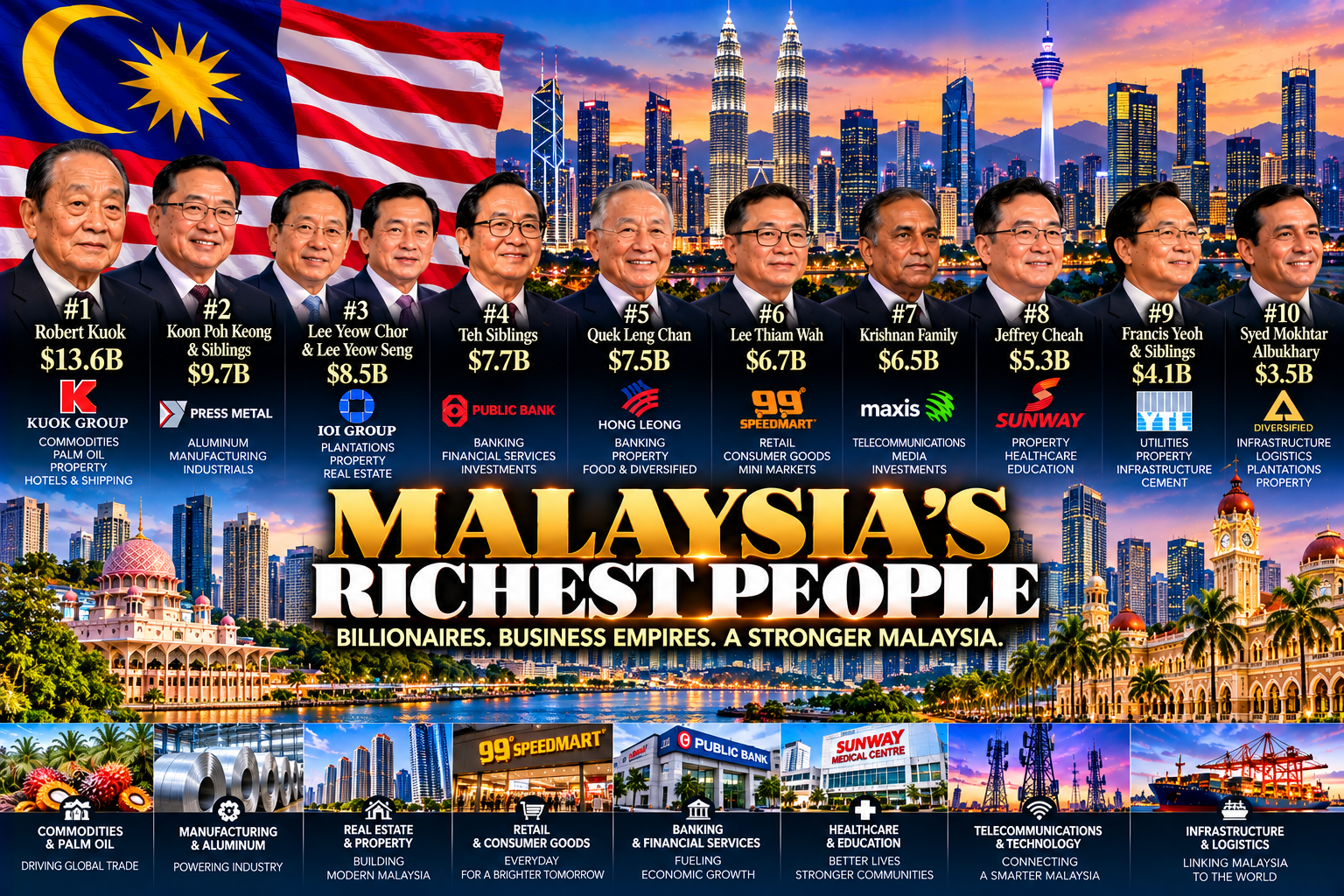
Robert Kuok remained Malaysia’s richest person with an estimated US$13.6 billion on Forbes’ 2026 annual list. Koon Poh Keong and his siblings ranked second with US$9.7 billion, followed by Lee Yeow Chor and Lee Yeow Seng with US$8.5 billion.
Malaysia’s Top 10 Richest People in 2026
Rank | Billionaire / Family | Estimated Wealth |
|---|---|---|
1 | Robert Kuok | US$13.6B |
2 | Koon Poh Keong & siblings | US$9.7B |
3 | Lee Yeow Chor & Lee Yeow Seng | US$8.5B |
4 | Teh siblings | US$7.7B |
5 | Quek Leng Chan | US$7.5B |
6 | Lee Thiam Wah | US$6.7B |
7 | Krishnan family | US$6.5B |
8 | Jeffrey Cheah | US$5.3B |
9 | Francis Yeoh & siblings | US$4.1B |
10 | Syed Mokhtar Albukhary | US$3.5B |
Forbes calculated the 2026 figures using stock prices and exchange rates as of March 27, 2026, while private companies were valued using comparisons with publicly traded businesses.
1. Robert Kuok: Malaysia’s Richest Businessman
Robert Kuok continued to hold the No. 1 position in Malaysia in 2026.
Forbes estimated his wealth at US$13.6 billion for its annual Malaysia ranking. His fortune is associated with commodities, palm oil, shipping, property, and hospitality.
Kuok began his business career trading commodities such as rice, sugar, and wheat flour in Johor. Over the decades, his business interests expanded into an international network.
One of his best-known achievements is the creation of the Shangri-La Hotels and Resorts chain, which began in 1971.
The wider Kuok business network also has interests in property, logistics, shipping, commodities, and other businesses across Asia.
Forbes has also reported that the next generation of the Kuok family is becoming increasingly involved in investment activities, including AI data-center opportunities.
2. Koon Poh Keong and His Siblings: Aluminum Manufacturing
Koon Poh Keong and his siblings ranked second with an estimated combined fortune of US$9.7 billion.
The family controls Press Metal Aluminium Holdings, which Forbes describes as Southeast Asia’s largest integrated aluminum producer.
Koon Poh Keong serves as group CEO, while other members of the family hold senior positions within the company.
Press Metal has benefited from demand for aluminum from industries such as electric vehicles, construction, renewable energy, and AI data centers.
Forbes reported that strong aluminum prices helped Press Metal shares rise substantially during the period used to calculate the 2026 ranking. The company also reported record profit in 2025 and continued expanding its production capacity.
3. Lee Yeow Chor and Lee Yeow Seng: Property and Plantations
Brothers Lee Yeow Chor and Lee Yeow Seng ranked third with a combined estimated wealth of US$8.5 billion.
They are closely associated with IOI Group, a Malaysian conglomerate with major interests in plantations and property.
The brothers moved up three places in the 2026 Forbes ranking after adding an estimated US$3.3 billion to their combined wealth. Forbes linked the increase partly to developments involving IOI’s real estate investment trust plans.
Their businesses demonstrate the continued importance of plantations and property development in Malaysia’s corporate economy.
4. Teh Siblings: Banking and Financial Services
The Teh siblings ranked fourth with an estimated combined wealth of US$7.7 billion.
Their fortune is closely connected with Malaysia’s financial-services sector.
Banking has historically been one of the country's major sources of large family fortunes. Financial institutions can create substantial shareholder wealth through lending, deposits, investment services, insurance, and other financial activities.
However, banking fortunes can fluctuate as interest rates, economic growth, loan demand, and stock-market valuations change.
5. Quek Leng Chan: Banking, Property and Diversification
Quek Leng Chan ranked fifth with approximately US$7.5 billion.
He is executive chairman of Hong Leong Co. (Malaysia), a privately held business group with interests including financial services, property, and other industries.
His position on Malaysia’s richest list demonstrates the importance of diversified conglomerates in the country.
Rather than depending on a single industry, large diversified groups can have exposure to several sectors, allowing their fortunes to move with different parts of the economy.
6. Lee Thiam Wah: Building a Retail Empire
Lee Thiam Wah ranked sixth with an estimated US$6.7 billion.
He is the founder and CEO of 99 Speedmart Retail Holdings, one of Malaysia’s largest convenience and mini-market chains.
Lee started his retail business on a small scale before expanding it into a nationwide network. The company’s public listing in 2024 helped establish a market valuation for the business and contributed to Lee’s billionaire status.
Forbes reported that his fortune nearly doubled in the period covered by the 2026 list, reaching US$6.7 billion.
His story illustrates how a consumer-focused business can grow into a major corporate enterprise through expansion, logistics, distribution, and brand recognition.
7. Krishnan Family: Telecommunications and Business Investments
The Krishnan family ranked seventh with an estimated US$6.5 billion.
The family has historically been associated with telecommunications, media, energy, and investment activities.
Telecommunications has played an important role in Malaysia's modern business economy as demand for mobile communications, broadband, digital services, and data infrastructure has grown.
The sector is also increasingly connected to cloud computing, artificial intelligence, data centers, and digital businesses.
8. Jeffrey Cheah: Property, Healthcare and Education
Jeffrey Cheah ranked eighth with an estimated fortune of US$5.3 billion.
He is the founder and executive chairman of Sunway Group, a diversified Malaysian conglomerate.
Sunway has interests across property development, healthcare, education, hospitality, infrastructure, and related businesses.
The company’s healthcare operations became particularly significant after Sunway Healthcare’s 2026 IPO. Forbes reported that the healthcare business raised approximately US$732 million, making it one of Malaysia’s largest IPOs in almost a decade.
Sunway’s development model demonstrates how property companies can expand into integrated communities containing residential developments, shopping centers, hospitals, universities, hotels, and infrastructure.
9. Francis Yeoh and Siblings: Utilities and Infrastructure
Francis Yeoh and his siblings ranked ninth with a combined estimated fortune of US$4.1 billion.
The family is associated with YTL Corporation, a diversified Malaysian business group with interests in utilities, property, hotels, cement, infrastructure, and technology-related activities.
YTL has also expanded its operations internationally.
Infrastructure businesses can benefit from long-term demand for electricity, construction, transportation, telecommunications, data centers, and other essential services.
10. Syed Mokhtar Albukhary: Infrastructure and Diversified Businesses
Syed Mokhtar Albukhary ranked tenth with an estimated fortune of US$3.5 billion.
His business interests have extended across infrastructure, logistics, ports, transportation, plantations, property, and other industries.
His position illustrates another important characteristic of Malaysian wealth: large business groups frequently operate across several sectors rather than concentrating entirely on one industry.
What Industries Create Malaysia’s Billionaire Wealth?
Malaysia’s wealthiest people represent a broad range of industries.
Commodities and Palm Oil
Commodities remain an important foundation of Malaysian business wealth.
Malaysia is a major producer and exporter of palm oil, while related industries include plantations, processing, trading, logistics, and consumer products.
Robert Kuok’s early career in commodity trading helped establish the foundation for his later business empire.
Aluminum and Manufacturing
The rise of Koon Poh Keong and his siblings highlights Malaysia’s importance in industrial manufacturing.
Press Metal has developed into a major aluminum producer, supplying industries that depend on aluminum for construction, transportation, electronics, packaging, and other applications.
The growth of AI data centers and electric vehicles has also created additional demand for materials and infrastructure.
Real Estate
Property remains one of Malaysia’s most important wealth-creation industries.
Major developers are involved in residential communities, commercial buildings, shopping centers, hotels, offices, industrial facilities, and integrated townships.
Property fortunes can increase through rising land values, development profits, rental income, and ownership of large commercial assets.
Retail and Consumer Businesses
Malaysia’s growing consumer economy has produced major retail entrepreneurs.
Lee Thiam Wah’s 99 Speedmart is a prominent example of a business that expanded from a small retail operation into a large national chain.
Consumer businesses can create significant value through scale, efficient distribution, strong purchasing power, and a large network of stores.
Banking and Finance
Banking is another major source of Malaysian billionaire wealth.
The country has several large financial institutions with extensive retail, corporate, investment, and wealth-management operations.
Family ownership of financial institutions has historically contributed to some of Malaysia’s largest fortunes.
Healthcare and Education
Healthcare and education are becoming increasingly important areas for major Malaysian conglomerates.
Sunway provides an example of a business group that has combined property development with hospitals and educational institutions.
These sectors can benefit from population growth, urbanization, rising incomes, and increasing demand for private services.
Telecommunications and Technology
Malaysia’s telecommunications and technology industries are also evolving rapidly.
Mobile networks, broadband, cloud computing, artificial intelligence, cybersecurity, data centers, and digital payments are creating new opportunities.
The country's strategic location in Southeast Asia also makes it relevant to regional digital infrastructure.
AI Is Changing Malaysia’s Business Landscape
Artificial intelligence is becoming relevant beyond traditional technology companies.
Forbes reported that demand connected with AI data centers helped support strong aluminum prices, benefiting Press Metal and the Koon family.
AI data centers require large amounts of electricity, construction materials, cooling equipment, networking infrastructure, and real estate.
This means companies involved in manufacturing, utilities, construction, property, telecommunications, and logistics can potentially benefit from the expansion of AI infrastructure.
Malaysia’s IPO Market and Billionaire Wealth
Initial public offerings have played an important role in Malaysia’s recent wealth creation.
Forbes reported that Malaysia had around 60 new listings during 2025, helping create a stronger public-equity environment.
Public listings can give companies access to capital while creating a transparent market valuation for founders and major shareholders.
For entrepreneurs, an IPO can also transform a privately held company into a publicly valued business.
However, public-company wealth can change quickly because share prices fluctuate every trading day.
Why Malaysia’s Richest People Rankings Change
Billionaire rankings are estimates rather than permanent measurements of wealth.
Forbes calculates publicly traded holdings using market prices at a specified date. Currency exchange rates can also affect the U.S.-dollar value of Malaysian fortunes.
Private companies are generally estimated using comparable public companies and other financial information.
For the 2026 Malaysia 50 Richest list, Forbes used stock prices and exchange rates from March 27, 2026.
Therefore, a person's real-time estimated wealth can differ from the figure shown on the annual Forbes list.
For example, Forbes currently shows Robert Kuok's real-time wealth separately from the US$13.6 billion figure used for the 2026 annual Malaysia ranking.
Family Businesses and Generational Wealth
Family businesses play a major role in Malaysia’s billionaire economy.
Some of the country's largest fortunes have been built over several generations, with family members taking leadership positions in companies and investment organizations.
The Kuok family is one example, with different generations involved in property, commodities, hospitality, and investment activities.
Family ownership can provide long-term continuity, but succession planning, professional management, governance, and adapting to new industries are important for maintaining a business empire.
Malaysia’s Global Business Connections
Malaysia’s richest people are increasingly connected to international markets.
Malaysian companies operate throughout Southeast Asia and maintain relationships with global supply chains.
Commodity businesses depend on international prices, manufacturing companies rely on regional trade, property groups attract international capital, and technology infrastructure connects Malaysia to the wider digital economy.
This international exposure means Malaysian billionaire fortunes can be affected by global interest rates, currency movements, commodity prices, trade conditions, technology investment, and economic growth.
The Future of Malaysia’s Wealthiest People
Several themes could influence Malaysia’s billionaire economy in the coming years.
These include:
Artificial intelligence and data centers
Semiconductor and electronics manufacturing
Renewable energy
Industrial materials
Palm oil and agricultural technology
Property development
Healthcare
Retail and e-commerce
Financial technology
Telecommunications
Infrastructure and logistics
Malaysia’s position within Southeast Asia gives its companies access to regional markets while its industrial base provides connections to global supply chains.
At the same time, established industries such as commodities, property, banking, and retail are likely to remain important sources of business wealth.
Final Thoughts
Malaysia’s richest people represent a diverse group of entrepreneurs, investors, business families, and corporate leaders.
Robert Kuok remains at the top of Forbes’ 2026 Malaysia 50 Richest list, followed by Koon Poh Keong and his siblings and Lee Yeow Chor and Lee Yeow Seng.
Their businesses span commodities, aluminum, plantations, property, banking, retail, telecommunications, healthcare, infrastructure, manufacturing, and technology.
Forbes’ 2026 list estimates that Malaysia’s 50 richest collectively hold approximately US$116 billion, reflecting the scale of the country's major businesses and the growing role of public markets, international investment, and new industries.
FAQs
Who is the richest person in Malaysia in 2026?
Robert Kuok is No. 1 on Forbes’ 2026 Malaysia’s 50 Richest list, with an estimated wealth of US$13.6 billion at the ranking’s valuation date.
How much are Malaysia’s 50 richest people worth?
Forbes estimates the combined wealth of Malaysia’s 50 richest at approximately US$116 billion in 2026.
What industries produce Malaysia’s richest people?
Major industries include commodities, palm oil, aluminum, manufacturing, property, banking, retail, telecommunications, healthcare, infrastructure, hospitality, and technology.
Who is Koon Poh Keong?
Koon Poh Keong is the group CEO of Press Metal Aluminium Holdings and ranked second with his siblings on Forbes’ 2026 Malaysia rich list. Press Metal is described by Forbes as Southeast Asia’s largest integrated aluminum producer.
Who is Malaysia’s richest retail entrepreneur?
Lee Thiam Wah, founder and CEO of 99 Speedmart Retail Holdings, ranked sixth on Forbes’ 2026 list with an estimated fortune of US$6.7 billion.
Is Robert Kuok still Malaysia’s richest person?
Yes. Robert Kuok retained the No. 1 position on Forbes’ 2026 Malaysia 50 Richest list.
How does Forbes calculate billionaire wealth?
Forbes uses publicly traded share prices and exchange rates at a specified valuation date and estimates private-company values using comparable public companies and other financial information.
Can Malaysia’s billionaire rankings change?
Yes. Share prices, currency movements, company valuations, IPOs, acquisitions, business performance, and other factors can change estimated billionaire wealth.