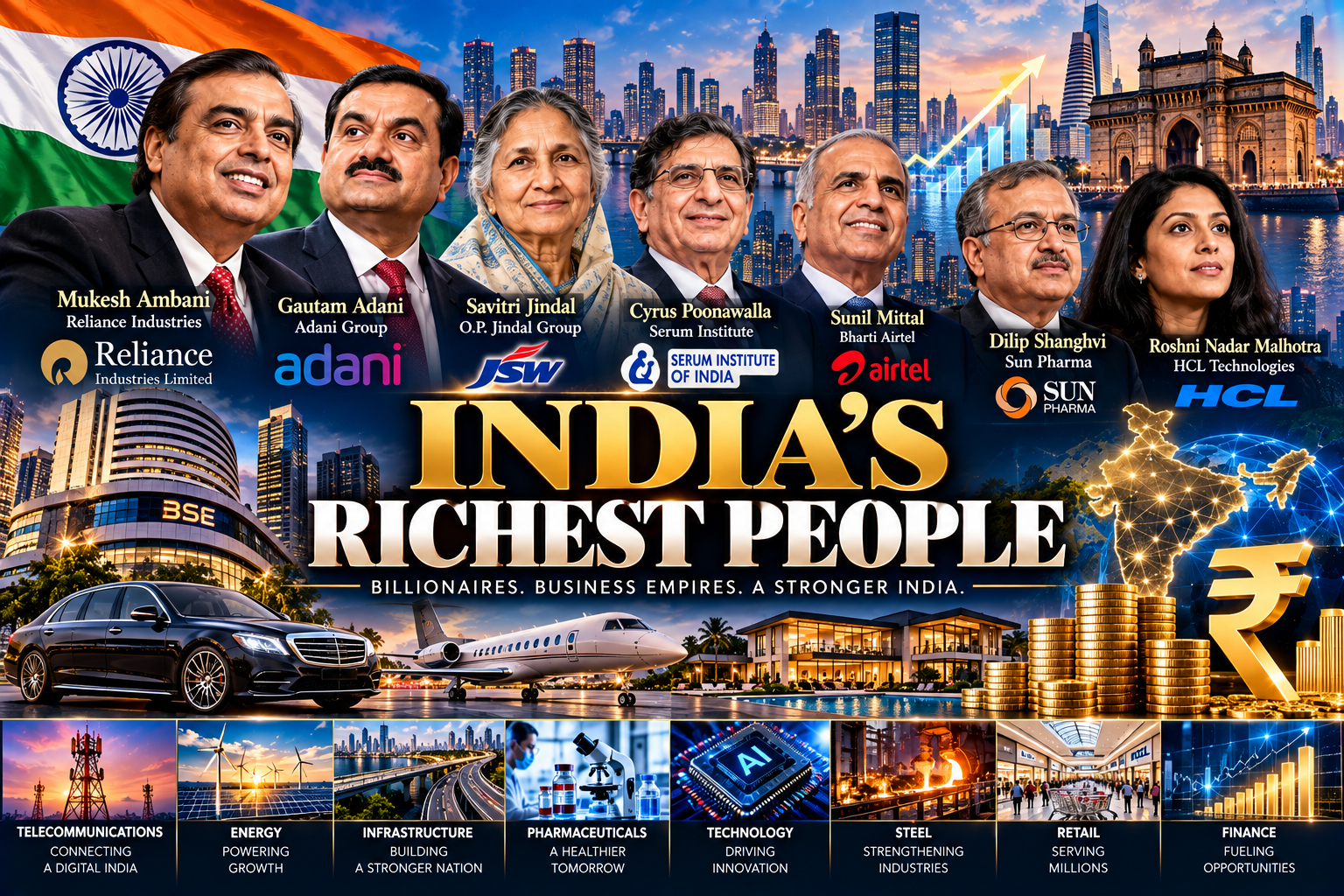
India has become one of the world's most important centers of billionaire wealth, with entrepreneurs and business families building enormous companies across telecommunications, energy, technology, pharmaceuticals, steel, infrastructure, retail, finance, and consumer products.
The country's richest people are closely connected to some of India's largest and most influential business groups. Their fortunes have grown through company ownership, entrepreneurship, investments, acquisitions, expanding consumer markets, and long-term business development.
According to Fortune India's 2026 ranking of India's Top 100 Billionaires, Mukesh Ambani ranks first with an estimated wealth of $91.12 billion, followed by Gautam Adani at $89.49 billion. Savitri Devi Jindal ranks third at $41.26 billion, while the Mistry family and Sunil Mittal & family rank fourth and fifth respectively.
These figures are estimates rather than cash balances, and billionaire rankings can change as share prices, company valuations, exchange rates, and ownership stakes change.
Who Is the Richest Person in India?
According to Fortune India's 2026 ranking, Mukesh Ambani is India's richest person, with estimated wealth of $91.12 billion based on the publication's August 7, 2026 valuation date and exchange rate.
Forbes' real-time profile also places Ambani among the world's wealthiest people, with his estimated net worth changing according to market conditions. Forbes reported a real-time figure of approximately $86.3 billion in September 2026.
The difference between these figures demonstrates why billionaire rankings should always be connected to a specific date and methodology.
1. Mukesh Ambani: Reliance Industries
Mukesh Ambani is chairman and managing director of Reliance Industries, one of India's largest diversified business groups.
Reliance has interests across petrochemicals, oil and gas, telecommunications, retail, media, financial services, and newer technology and energy businesses. Forbes describes Reliance as a company with approximately $125 billion in revenue and identifies Ambani's source of wealth as diversified.
One of Reliance's most important transformations has been its expansion into telecommunications through Jio.
Jio developed into one of India's largest digital and telecommunications businesses, with more than 500 million subscribers according to Forbes. Reliance has also expanded its financial-services operations through Jio Financial Services.
Reliance and Artificial Intelligence
Artificial intelligence is becoming another major part of Ambani's business strategy.
Forbes reported that Ambani announced plans for approximately $110 billion of investment in AI infrastructure across India over seven years.
Reliance has also invested heavily in renewable energy and other emerging technologies, showing how the group is attempting to diversify beyond its traditional energy and petrochemical businesses.
2. Gautam Adani: Infrastructure and Energy
Gautam Adani ranks second in Fortune India's 2026 list, with estimated wealth of $89.49 billion.
Adani is chairman of the Adani Group, a conglomerate with businesses spanning ports, airports, power generation, transmission, green energy, commodities, and infrastructure.
The Adani Group began in 1988 as a commodities trading business before expanding into infrastructure and energy. Forbes identifies Adani's source of wealth as infrastructure and commodities and classifies him as self-made.
Ports and Airports
Infrastructure is central to the Adani business empire.
The group controls Mundra Port, which Forbes identifies as India's largest port, and has become a major airport operator in India.
The group's businesses also include electricity generation and transmission, renewable energy, natural resources, logistics, and other infrastructure assets.
Renewable Energy
Adani has also placed significant emphasis on renewable energy.
Forbes reported that Adani has said he wants the group to become the world's largest producer of green energy and plans substantial investment in renewable-energy projects.
3. Savitri Jindal: Steel and Industrial Businesses
Savitri Devi Jindal ranks third in Fortune India's 2026 ranking with estimated wealth of $41.26 billion.
She chairs the O.P. Jindal Group, whose businesses have interests in steel, power, cement, infrastructure, and related industries.
Forbes identifies steel as the primary source of her wealth. After the death of founder Om Prakash Jindal in 2005, the family's companies were divided among his four sons, who went on to manage different parts of the business empire.
Today, companies connected to the family include JSW Steel, Jindal Steel & Power, JSW Energy, JSW Infrastructure, and other businesses.
Savitri Jindal's position is particularly notable because her fortune is linked to heavy industry rather than technology or consumer internet businesses.
4. The Mistry Family: Construction and Diversified Holdings
The Mistry family ranks fourth on Fortune India's 2026 list with combined estimated wealth of $34.13 billion.
The family has major interests connected to Tata Sons, along with businesses including Afcons Infrastructure and Sterling & Wilson Renewable Energy.
Their wealth illustrates the importance of large-scale infrastructure and diversified industrial businesses within India's economy.
The Mistry family's business history is also closely connected with the broader Tata corporate ecosystem, making its wealth structure different from the founder-driven technology companies commonly associated with modern billionaires.
5. Sunil Mittal and Family: Telecommunications
Sunil Mittal and his family rank fifth on Fortune India's 2026 list with estimated wealth of $29.83 billion.
Their primary business is Bharti Airtel, one of India's major telecommunications companies.
Airtel operates across mobile communications, broadband, digital services, and related telecommunications infrastructure.
The company's growth reflects India's enormous demand for mobile connectivity and internet services.
The telecommunications industry has also become increasingly connected to digital payments, cloud services, streaming, enterprise communications, and other technology markets.
6. Dilip Shanghvi: Pharmaceuticals
Dilip Shanghvi ranks sixth on Fortune India's 2026 list with estimated wealth of $26.84 billion.
He is the founder of Sun Pharmaceutical Industries, India's largest pharmaceutical company by market value according to Forbes.
Shanghvi began Sun Pharma in 1983 after borrowing money from his father to produce psychiatric medicines. The company expanded through organic growth and acquisitions and developed a substantial international presence.
Forbes estimates that roughly two-thirds of Sun Pharma's annual revenue comes from overseas markets, highlighting the global nature of India's pharmaceutical industry.
7. Roshni Nadar Malhotra: Information Technology
Roshni Nadar Malhotra ranks seventh on Fortune India's 2026 list with estimated wealth of $23.42 billion.
Her wealth is connected to HCL Technologies, one of India's major information-technology companies.
HCL's business spans technology services, software, cloud computing, engineering, cybersecurity, and digital transformation.
India's IT industry has created significant wealth by providing technology services to companies around the world.
Roshni Nadar Malhotra's position also demonstrates the growing role of women in India's billionaire and business landscape.
8. Cyrus Poonawalla: Vaccines and Healthcare
Cyrus Poonawalla ranks eighth on Fortune India's 2026 list with estimated wealth of $22.97 billion.
He founded the Serum Institute of India in 1966.
Forbes describes Serum as the world's largest vaccine maker by doses, producing more than 1.5 billion vaccine doses annually across products for diseases including measles, polio, and influenza.
The company became particularly well known internationally during the COVID-19 pandemic because of its role in producing the Covishield vaccine.
Poonawalla's fortune demonstrates how healthcare and pharmaceutical manufacturing can generate major businesses with international reach.
9. Kumar Mangalam Birla: Diversified Industries
Kumar Mangalam Birla ranks ninth on Fortune India's 2026 list with estimated wealth of $22.58 billion.
His business interests include companies connected to the Aditya Birla Group, one of India's major diversified business groups.
The group has interests spanning metals, cement, chemicals, financial services, fashion and retail, mining, and other industries.
Diversification has allowed the business group to participate in multiple areas of the Indian economy rather than depending on one industry.
10. Azim Premji: Technology and Wipro
Azim Premji ranks tenth on Fortune India's 2026 list with estimated wealth of $21.48 billion.
Premji built much of his fortune through Wipro, one of India's major technology-services companies.
Wipro developed from a consumer-products business into a global IT-services organization.
Premji is also well known for philanthropy. His charitable activities have supported education and other social initiatives in India.
India’s Billionaire Economy Is Highly Diverse
One of the most interesting characteristics of India's wealth landscape is the diversity of industries represented.
India's richest people have built fortunes in:
Telecommunications
Energy
Infrastructure
Steel
Pharmaceuticals
Healthcare
Information technology
Retail
Finance
Manufacturing
Consumer products
Real estate
Mining
Automotive businesses
This means India's billionaire economy is not dependent on one particular sector.
Technology and India's Wealth Creation
Technology is increasingly important to India's billionaire economy.
Companies such as HCL Technologies, Reliance Jio, and other technology-driven businesses have benefited from India's large population, expanding internet access, digital services, and global demand for IT expertise.
India's technology sector also creates opportunities for entrepreneurs outside the traditional billionaire families.
Startups in fintech, software, e-commerce, artificial intelligence, education technology, and digital services have attracted significant capital.
Pharmaceuticals and Healthcare
Healthcare is another major source of Indian wealth.
The country has developed a substantial pharmaceutical manufacturing industry, with companies supplying medicines and vaccines to domestic and international markets.
The fortunes of Cyrus Poonawalla and Dilip Shanghvi demonstrate the scale that healthcare businesses can achieve.
Fortune India's 2026 ranking places both Poonawalla and Shanghvi among India's ten wealthiest individuals.
Telecommunications and Digital India
India's telecommunications industry has undergone enormous change over the past decade.
Affordable mobile internet has helped expand digital services throughout the country.
Companies such as Reliance Jio and Bharti Airtel operate at the center of this transformation.
Telecommunications businesses are now connected with digital payments, entertainment, e-commerce, cloud computing, online education, and financial services.
This makes connectivity infrastructure an increasingly important part of India's wider digital economy.
Manufacturing and Infrastructure
India's billionaire landscape also reflects the country's expanding infrastructure requirements.
Steel, cement, ports, airports, power generation, roads, logistics, and construction are all essential to economic development.
The Adani Group, Jindal businesses, Mistry family interests, and Aditya Birla Group illustrate how industrial and infrastructure businesses remain major sources of wealth.
Retail and Consumer Markets
India's large and growing consumer market has created opportunities for retail entrepreneurs.
Radhakishan Damani is an important example.
He founded Avenue Supermarts, which operates the DMart supermarket chain. Forbes describes Damani as self-made and identifies retail and investments as his sources of wealth.
Damani's fortune illustrates how a relatively straightforward consumer business can become extremely valuable when it achieves large-scale expansion.
Why Billionaire Rankings Change
The wealth of India's richest people can change significantly from year to year.
Stock Prices
Publicly traded companies can experience large changes in market value, directly affecting the estimated wealth of shareholders.
Private Company Valuations
Privately held businesses require valuation estimates based on financial performance, transactions, comparable companies, and other factors.
Currency Exchange Rates
International rankings often convert Indian rupees into U.S. dollars, so currency movements can affect dollar-denominated wealth figures.
Business Performance
Revenue, profitability, acquisitions, expansion, and changing market conditions can influence company valuations.
Ownership Changes
Selling shares, transferring assets, inheritance, or restructuring family businesses can change individual wealth calculations.
How Billionaire Wealth Is Measured
A billionaire's net worth is generally an estimate of the value of assets minus liabilities.
Assets can include:
Public-company shares
Private businesses
Real estate
Investment portfolios
Cash and other financial assets
Family-company holdings
This is why a person with a $50 billion estimated net worth does not necessarily have $50 billion in cash.
Most billionaire wealth is often tied to ownership of businesses and other assets.
India's Growing Billionaire Population
India has become an increasingly important country in global billionaire rankings.
Hurun's Global Rich List 2026 reported that India had 57 new billionaire entrants, more than any country outside China and the United States. It also reported that Mukesh Ambani's wealth stood at approximately $109 billion under its methodology and valuation date.
Hurun's 2025 global list had already counted 284 Indian billionaires, placing India third globally.
Different lists produce different numbers because they use different valuation dates, residency definitions, exchange rates, and methodologies.
The Role of Family Businesses
Family businesses are particularly important in India's billionaire economy.
Some of India's largest fortunes have developed over multiple generations.
The Ambani, Jindal, Birla, Mistry, Mittal, and other business families have built or inherited substantial corporate assets.
At the same time, India has also produced self-made billionaires in technology, pharmaceuticals, retail, finance, and other industries.
This combination of established family businesses and newer entrepreneurial companies gives India's wealth landscape considerable diversity.
The Future of India's Richest People
The industries producing India's wealthiest people are likely to continue evolving.
Artificial intelligence, digital infrastructure, renewable energy, electric vehicles, healthcare, biotechnology, financial technology, and advanced manufacturing could create new fortunes.
At the same time, traditional sectors such as infrastructure, telecommunications, pharmaceuticals, retail, energy, and industrial manufacturing are likely to remain important.
The next generation of Indian billionaires could therefore come from both technology startups and large-scale industrial businesses.
Final Thoughts
India's richest people represent some of the country's most important businesses and industries.
Mukesh Ambani leads Fortune India's 2026 ranking, followed by Gautam Adani, Savitri Jindal, the Mistry family, and Sunil Mittal & family. The top ten also include entrepreneurs and business leaders connected to pharmaceuticals, technology, healthcare, diversified industries, and consumer markets.
Their stories demonstrate the diversity of India's business economy.
Some fortunes have been built through telecommunications and digital technology. Others have emerged from steel, infrastructure, pharmaceuticals, healthcare, retail, finance, and consumer businesses.
Because billionaire wealth changes with markets and company valuations, rankings should always be read as snapshots rather than permanent positions.
As India's economy continues to develop, emerging industries such as artificial intelligence, renewable energy, electric vehicles, biotechnology, and digital finance could create the country's next generation of major business fortunes.
FAQs
Who is the richest person in India in 2026?
According to Fortune India's 2026 ranking, Mukesh Ambani is ranked first with estimated wealth of $91.12 billion based on the ranking's methodology and August 7, 2026 valuation date.
Who is the second-richest person in India?
Gautam Adani ranks second in Fortune India's 2026 list, with estimated wealth of $89.49 billion.
Who is India's richest woman?
Savitri Devi Jindal ranks third overall in Fortune India's 2026 list, with estimated wealth of $41.26 billion.
What is Mukesh Ambani's main source of wealth?
Mukesh Ambani's wealth is primarily connected to Reliance Industries and its businesses across energy, telecommunications, retail, media, financial services, and other sectors.
Who founded Serum Institute of India?
Cyrus Poonawalla founded Serum Institute of India in 1966 and built it into one of the world's largest vaccine manufacturers by doses.
Who founded Sun Pharmaceutical Industries?
Dilip Shanghvi founded Sun Pharmaceutical Industries in 1983. Forbes identifies pharmaceuticals as his primary source of wealth and classifies him as self-made.
How many billionaires are there in India?
The number varies by source and methodology. Hurun's Global Rich List 2025 counted 284 Indian billionaires, while later rankings use different valuation dates and definitions.
Why do billionaire net worth figures differ between Forbes and Fortune?
Forbes and Fortune may use different valuation dates, exchange rates, asset estimates, ownership calculations, and methodologies. Fortune India's 2026 ranking specifically used an exchange rate of 95.2135 Indian rupees per U.S. dollar based on the August 7, 2026 spot close.
Which industries create the most billionaire wealth in India?
Major sources include telecommunications, energy, infrastructure, steel, pharmaceuticals, healthcare, technology, retail, finance, manufacturing, and diversified family businesses.