Thailand richest is one of Southeast Asia’s most important economies, with major business sectors spanning beverages, food, retail, telecommunications, energy, real estate, healthcare, logistics, manufacturing, and consumer products.
The country has produced some of Asia’s most influential business families and entrepreneurs. Many of Thailand’s wealthiest people built their fortunes through companies that expanded from domestic operations into international markets.
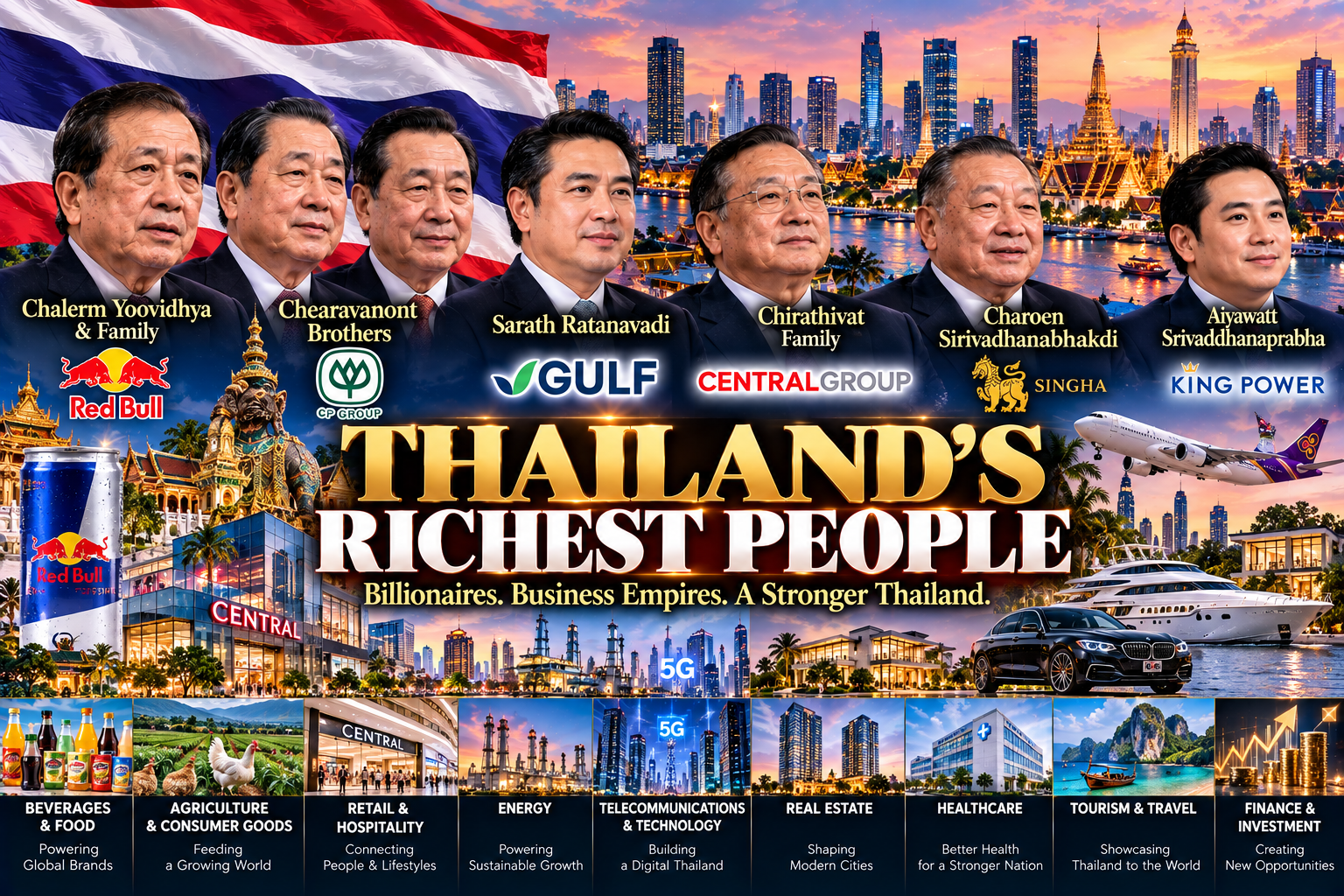
According to Forbes’ 2026 Thailand’s 50 Richest list, the combined wealth of the country’s 50 richest people reached approximately $187 billion, up 10% from $170.5 billion the previous year. Chalerm Yoovidhya and family, associated with Red Bull, retained the top position on the Thailand list with an estimated fortune of $47 billion. The Chearavanont brothers of Charoen Pokphand ranked second with $36.6 billion, while Sarath Ratanavadi ranked third with $17.6 billion.
Thailand’s billionaire economy is particularly notable for its strong family businesses. Several of the country's largest fortunes are connected to companies that have been developed across multiple generations.
Who Are Thailand’s Richest People?
The 2026 Forbes Thailand ranking includes wealthy families and entrepreneurs from a wide range of industries.
The top 10 were:
Chalerm Yoovidhya & family — $47 billion
Chearavanont brothers — $36.6 billion
Sarath Ratanavadi — $17.6 billion
Chirathivat family — $11.7 billion
Charoen Sirivadhanabhakdi — $11.5 billion
Chaiyawan family — $5.1 billion
Prasarttong-Osoth family — $3.7 billion
Sathien Sathientham — $2.8 billion
Aiyawatt Srivaddhanaprabha & family — $2.4 billion
Chachchon Ratanarak — $2.3 billion.
The minimum fortune required to appear on the 2026 list increased to approximately $555 million, compared with $420 million the previous year.
1. Chalerm Yoovidhya: The Red Bull Fortune
Chalerm Yoovidhya and his family are at the top of Forbes’ 2026 Thailand’s 50 Richest list.
The family's fortune is closely associated with Red Bull, one of the world's best-known energy-drink brands.
The business has developed a global presence far beyond Thailand. Forbes reported that Red Bull's annual revenue increased by more than 8% to approximately €12.2 billion in 2025, with worldwide sales approaching 14 billion cans.
The success of Red Bull demonstrates the potential of a consumer brand to grow from a local product into a global business.
Energy drinks have become a major international consumer category, and Red Bull's marketing, distribution, sponsorships, and sports partnerships have helped make the brand recognizable across many countries.
The Yoovidhya fortune therefore represents the power of global consumer branding in Thailand's billionaire economy.
2. Chearavanont Brothers: Charoen Pokphand Group
The Chearavanont brothers are associated with Charoen Pokphand Group, commonly known as CP Group.
The family ranked second on Forbes' 2026 Thailand list with an estimated $36.6 billion fortune.
CP Group has extensive interests across agriculture, food, retail, telecommunications, and other businesses.
The company's scale illustrates the importance of diversified conglomerates in Thailand.
Its businesses are connected to food production and distribution, consumer markets, telecommunications, and other sectors.
The group's expansion also reflects the growing importance of Southeast Asia's consumer economy.
3. Sarath Ratanavadi: Energy and Digital Infrastructure
Sarath Ratanavadi ranked third on Forbes' 2026 Thailand list with an estimated fortune of $17.6 billion.
He is CEO of Gulf Development, a diversified conglomerate with interests in telecommunications and digital infrastructure as well as energy.
Forbes notes that Gulf Development was created in 2025 through the merger of Gulf Energy Development and InTouch Holdings. The company also has exposure to Advanced Info Service and digital infrastructure.
Sarath's business interests illustrate how Thailand's traditional energy sector is becoming increasingly connected with technology and telecommunications.
Gulf has also expanded into banking and data-center infrastructure, giving the business exposure to several areas of Thailand's modern economy.
4. Chirathivat Family: Retail and Hospitality
The Chirathivat family ranked fourth on the 2026 Thailand's 50 Richest list with an estimated fortune of $11.7 billion.
The family is closely associated with the Central Group, one of Thailand's largest retail and consumer-business groups.
Central Group operates businesses connected to department stores, supermarkets, specialty retail, hospitality, and other consumer services.
Retail has played an important role in Thailand's economic development because of the country's growing urban population and expanding middle class.
The family's businesses also extend beyond Thailand, giving the group exposure to international consumer markets.
5. Charoen Sirivadhanabhakdi: Beverages and Real Estate
Charoen Sirivadhanabhakdi ranked fifth on Forbes' 2026 Thailand list with an estimated fortune of $11.5 billion.
His business interests include beverages, food and beverage operations, packaging, retail, and real estate.
His property portfolio includes interests connected to Frasers Property, an international real estate company.
Forbes reported that Frasers Property has been restructuring parts of its hospitality and industrial-property portfolio, with the objective of freeing capital for other opportunities.
This combination of consumer businesses and real estate demonstrates the diversified nature of some Thai family fortunes.
6. Chaiyawan Family: Finance and Consumer Businesses
The Chaiyawan family ranked sixth in Forbes' 2026 Thailand list with an estimated fortune of $5.1 billion.
The family's business interests are connected to Thailand's financial-services sector and other consumer-related activities.
Financial businesses can create substantial long-term value because they serve consumers and companies across the wider economy.
The family's presence on the list also demonstrates that Thailand's billionaire economy extends beyond the country's best-known beverage and retail conglomerates.
7. Prasarttong-Osoth Family: Healthcare and Aviation
The Prasarttong-Osoth family ranked seventh with an estimated $3.7 billion fortune.
The family is closely associated with Bangkok Dusit Medical Services, one of Thailand's major private healthcare groups.
Healthcare is an increasingly important business sector in Thailand, which has developed a strong medical-tourism industry and a large private healthcare market.
The family's interests have also included aviation, showing how major Thai business groups can operate across multiple industries.
8. Sathien Sathientham: Consumer Products and Retail
Sathien Sathientham ranked eighth on Forbes' 2026 list with an estimated fortune of $2.8 billion.
He is associated with Carabao Group, a Thai beverage company that competes in the energy-drink market.
The business has also expanded into other consumer activities, including retail.
Thailand's competitive beverage market has therefore created more than one billionaire fortune.
The Carabao story demonstrates how local brands can compete for consumers while also pursuing international markets.
9. Aiyawatt Srivaddhanaprabha: Retail and Sports
Aiyawatt Srivaddhanaprabha and his family ranked ninth on the 2026 Thailand's 50 Richest list with approximately $2.4 billion.
The family is associated with King Power, Thailand's major duty-free retail business.
The family is also internationally known through its ownership of Leicester City Football Club.
Duty-free retail is closely connected to Thailand's tourism industry, making the family's business particularly connected to international travelers.
10. Chachchon Ratanarak: Media and Family Wealth
Chachchon Ratanarak ranked tenth with an estimated fortune of $2.3 billion.
His wealth is connected to the Ratanarak family's business interests.
Forbes reported that media businessman Krit Ratanarak died and his fortune passed to his only son, Chachchon Ratanarak, who subsequently appeared on the 2026 list.
This demonstrates how inheritance and succession remain important elements of Thailand's billionaire landscape.
Thailand's Billionaire Economy Is Highly Diversified
Thailand's wealthiest people come from a surprisingly broad collection of industries.
Consumer Brands
Consumer products are one of Thailand's strongest sources of billionaire wealth.
Red Bull and Carabao demonstrate the international potential of Thai beverage brands.
Large consumer businesses can benefit from strong domestic demand while also expanding internationally.
Food and Agriculture
Thailand is a major agricultural and food-producing economy.
The Charoen Pokphand Group has built extensive businesses connected to food production, agriculture, distribution, and retail.
This sector connects Thailand's domestic economy with international food markets.
Energy
Energy is another major source of wealth.
Sarath Ratanavadi's business empire demonstrates how power generation can become a foundation for broader investments in telecommunications, digital infrastructure, and financial services.
Telecommunications and Technology
Thailand's digital economy is creating new opportunities for entrepreneurs and investors.
Telecommunications networks, data centers, cloud services, digital payments, and artificial intelligence infrastructure are becoming increasingly important.
Forbes reported that demand for AI data centers also contributed to major wealth gains for some Thai entrepreneurs in 2026.
Retail
Retail remains one of the country's largest private business sectors.
Central Group and King Power demonstrate the importance of department stores, supermarkets, specialty retail, and duty-free shopping.
Tourism is particularly important because millions of international visitors contribute to demand for hotels, restaurants, shopping centers, and travel-related services.
Real Estate and Thailand's Richest Families
Real estate has long been an important component of Thai business wealth.
Large property portfolios can include:
Shopping centers
Hotels
Office buildings
Residential developments
Industrial properties
Logistics facilities
Mixed-use developments
Charoen Sirivadhanabhakdi's business interests provide an example of how property can be integrated with beverage, retail, hospitality, and other businesses.
The expansion of data centers and industrial infrastructure is also creating new property opportunities.
AI Is Creating New Business Opportunities
Artificial intelligence is beginning to influence Thailand's billionaire economy.
AI requires substantial computing infrastructure, including data centers, electricity, telecommunications networks, and advanced equipment.
Forbes Thailand reported that Jareeporn Jarukornsakul's wealth increased sharply in 2026 as demand for AI data centers boosted interest in WHA Corporation's industrial and logistics developments.
Other Thai businesses are also positioning themselves around digital infrastructure and renewable electricity.
This shows how emerging technology can influence traditional industries such as real estate, power generation, and industrial development.
Thailand's Tourism Economy
Tourism is another important component of the country's business landscape.
Thailand attracts international visitors with its beaches, cities, cultural attractions, hospitality businesses, shopping centers, and medical services.
Tourism creates opportunities across:
Hotels
Airlines
Restaurants
Retail
Duty-free shopping
Entertainment
Healthcare
Real estate
The King Power business empire demonstrates the relationship between tourism and consumer spending.
Family Businesses and Generational Wealth
Family ownership is one of the defining characteristics of Thailand's billionaire economy.
Several of the country's richest fortunes are controlled by families rather than individual entrepreneurs.
Family businesses can provide continuity across generations, allowing companies to expand over decades.
However, succession, governance, ownership structures, and changing consumer preferences can influence how these businesses develop.
The 2026 Forbes list also demonstrates how fortunes can move between generations following the death of a business founder or family leader.
Why Thailand's Billionaire Rankings Change
Billionaire rankings are estimates and can change as asset values change.
Forbes' Thailand 50 Richest ranking uses information about stock holdings and financial data obtained from families, individuals, stock exchanges, regulators, and other sources. It also counts family wealth differently from the Forbes global billionaire ranking.
The valuation date is also important.
For the 2026 Thailand list, Forbes Thailand used financial and ownership information collected around June 18, 2026, with an exchange rate of 32.672 Thai baht per U.S. dollar.
Consequently, a person's wealth can appear different in another ranking published at a different time.
Thailand Richest People vs. Global Forbes Rankings
An important distinction exists between Forbes' Thailand-specific list and its annual global billionaire ranking.
Forbes Thailand's 2026 local ranking placed Chalerm Yoovidhya and family first with $47 billion. Meanwhile, Forbes' 2026 global billionaire ranking identified Dhanin Chearavanont as the highest-ranked Thai individual, at No. 135 globally, with $11.8 billion in the global methodology cited by Forbes Thailand.
The difference illustrates why readers should check the methodology before comparing billionaire rankings.
The Thailand 50 Richest list includes family wealth in a way that differs from the Forbes global list, which generally focuses on individual fortunes.
The Future of Thailand's Wealthiest People
Thailand's billionaire economy is likely to continue changing as new industries grow.
Several sectors could become increasingly important:
Artificial intelligence
Data centers
Renewable energy
Telecommunications
Electric vehicles
Healthcare
Logistics
E-commerce
Financial technology
Real estate
Tourism
Consumer brands
Traditional industries such as beverages, agriculture, retail, and energy are also likely to remain important.
The country's ability to combine established business groups with emerging technologies could create new opportunities for entrepreneurs and investors.
Final Thoughts
Thailand's richest people represent the country's diverse and evolving economy.
Chalerm Yoovidhya and his family demonstrate the global power of consumer brands through Red Bull. The Chearavanont brothers represent agriculture, food, retail, and telecommunications through CP Group. Sarath Ratanavadi illustrates the combination of energy, telecommunications, banking, and digital infrastructure. The Chirathivat family represents retail and hospitality, while Charoen Sirivadhanabhakdi combines beverages, retail, and real estate.
Together, these fortunes show that Thailand's wealth is not concentrated in one industry.
From energy and food to technology, healthcare, retail, tourism, real estate, and digital infrastructure, Thailand has developed a broad business ecosystem capable of producing major fortunes.
As the country's economy becomes increasingly connected to global markets and emerging technologies, the composition of Thailand's richest people will continue to evolve.
FAQs
Who is the richest person in Thailand?
According to Forbes' 2026 Thailand's 50 Richest ranking, Chalerm Yoovidhya and his family ranked first with an estimated fortune of $47 billion.
Who are the Chearavanont brothers?
The Chearavanont brothers are associated with Charoen Pokphand Group, one of Thailand's largest diversified business groups. They ranked second on Forbes' 2026 Thailand list with $36.6 billion.
Who is Sarath Ratanavadi?
Sarath Ratanavadi is the CEO of Gulf Development and is known for businesses spanning energy, telecommunications, digital infrastructure, and financial investments.
Which industries create the most billionaire wealth in Thailand?
Major industries include beverages, food, agriculture, retail, energy, telecommunications, real estate, healthcare, finance, logistics, and manufacturing.
Is Red Bull a Thai company?
Red Bull has Thai roots through the Yoovidhya family and has developed into a global energy-drink brand.
Why are family businesses important in Thailand?
Many of Thailand's largest companies were developed over multiple generations, allowing families to maintain substantial ownership and expand into new industries.
Why do Thailand's billionaire rankings change?
Changes in stock prices, company valuations, exchange rates, ownership stakes, business transactions, and methodology can affect estimated net worth.
Is billionaire net worth the same as cash?
No. Billionaire net worth is an estimate of the value of assets and ownership stakes. Much of a billionaire's wealth can be tied to businesses, shares, property, and other investments rather than cash.