Artificial Intelligence (AI) is transforming the modern world by changing how people work, communicate, learn, shop, and solve problems. From virtual assistants and smart devices to autonomous vehicles and advanced medical technologies, AI has become an important part of everyday life.
Businesses are increasingly using artificial intelligence to automate repetitive tasks, analyze information, improve customer experiences, and make better decisions. Educational institutions use AI-powered learning platforms, healthcare professionals explore AI-assisted diagnostic tools, and financial organizations apply machine learning to detect suspicious transactions.
The rapid development of generative AI has made artificial intelligence even more accessible. People can now use AI tools to write content, generate images, create videos, summarize documents, develop software, and explore complex topics.
In 2026, AI is no longer limited to research laboratories or large technology companies. Individuals, startups, small businesses, governments, and international organizations are exploring its potential across different industries.
However, artificial intelligence also creates challenges involving privacy, cybersecurity, misinformation, employment, copyright, and responsible technology use.
This article explores what artificial intelligence means, how it works, its major types, real-world applications, benefits, challenges, leading technologies, and the future of AI.
What Is Artificial Intelligence?
Artificial Intelligence is a branch of computer science that focuses on developing systems capable of performing tasks that typically require human intelligence.
These tasks may include learning from information, recognizing patterns, understanding language, solving problems, generating content, and supporting decisions.
AI systems use algorithms, data, statistical techniques, and computational models to perform specific tasks.
For example, a voice assistant can recognize spoken instructions and respond to questions. An image recognition system can identify objects in photographs, while a recommendation engine can suggest products based on a customer's interests and previous activity.
Artificial intelligence does not necessarily think or understand the world in the same way humans do. Most AI systems are designed to perform particular tasks using patterns learned from data.
Some important capabilities of artificial intelligence include:
Learning: Identifying patterns and improving performance using data.
Reasoning: Applying rules and information to solve problems.
Language processing: Understanding and generating human language.
Perception: Interpreting images, audio, and other sensory information.
Prediction: Estimating possible future outcomes.
Automation: Performing tasks with limited human intervention.
Content generation: Producing text, images, audio, video, and software code.
AI technology continues to develop, creating new possibilities for individuals and organizations.
How Does Artificial Intelligence Work?
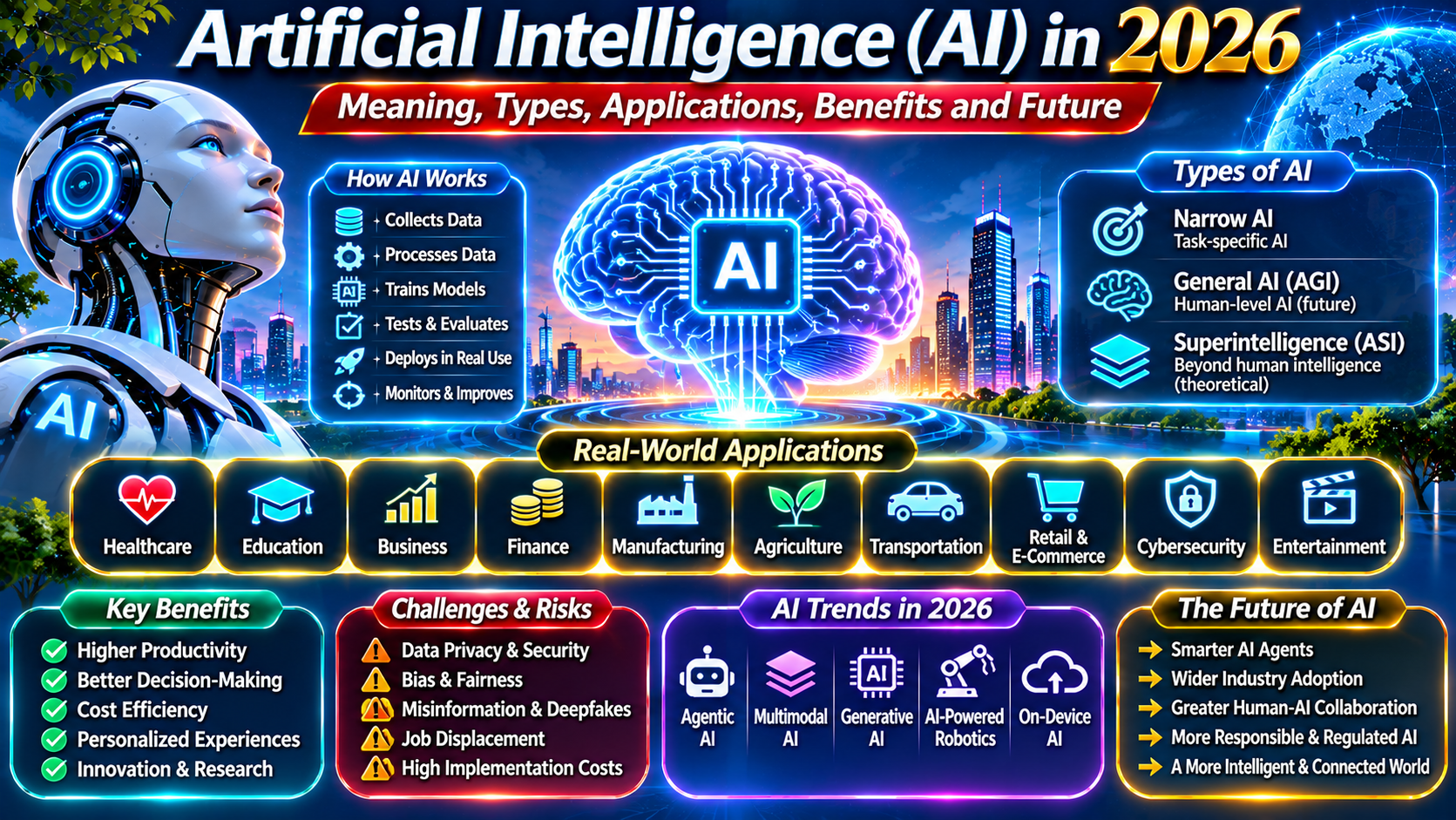
Artificial intelligence works through a combination of data, algorithms, mathematical models, and computing resources.
Although different AI systems operate in different ways, most modern AI applications follow several common stages.
1. Data Collection
AI systems need information to learn patterns and perform tasks.
Data may come from websites, documents, images, videos, sensors, databases, customer interactions, and other digital sources.
For example, an AI system designed to recognize photographs may be trained using a large collection of labeled images.
2. Data Processing
Raw information is often incomplete, inconsistent, or difficult to use directly.
Before training, data may need to be cleaned, organized, labeled, and converted into a suitable format.
The quality of training information can significantly influence the accuracy and reliability of an AI model.
3. Model Training
During training, an AI model processes examples and adjusts its internal parameters to identify patterns.
Machine learning algorithms use mathematical techniques to improve performance on a particular task.
For example, a model trained on financial transactions may learn to identify patterns associated with potentially fraudulent activity.
4. Testing and Evaluation
After training, AI models are evaluated using information that was not used during the training process.
Testing helps determine whether a model performs reliably and whether it makes unacceptable errors.
Developers may adjust the model, training data, or system design when performance is insufficient.
5. Deployment
Once an AI model is ready, it can be integrated into software, mobile applications, websites, business systems, or connected devices.
Users interact with the model through an interface, an application programming interface (API), or another connected system.
6. Monitoring and Improvement
AI systems require ongoing monitoring after deployment.
Developers and organizations may evaluate accuracy, security, performance, and user feedback.
Models may need updates when data changes, new risks appear, or business requirements evolve.
Major Types of Artificial Intelligence
Artificial intelligence can be classified in different ways. One common classification focuses on the capabilities of an AI system.
1. Narrow AI (Artificial Narrow Intelligence)
Narrow AI refers to systems designed to perform specific tasks.
Most artificial intelligence applications currently used in everyday life fall into this category.
Examples include:
Voice assistants.
Facial recognition systems.
Email spam filters.
Product recommendation engines.
AI translation tools.
Image recognition software.
Automated customer support.
Narrow AI can perform certain tasks extremely well, but it does not possess general human intelligence.
2. General AI (Artificial General Intelligence)
Artificial General Intelligence, or AGI, refers to a hypothetical form of AI capable of performing a broad range of intellectual tasks at a human-like level.
An AGI system would theoretically be able to learn, reason, adapt, and solve unfamiliar problems across different domains without being limited to one specialized task.
Despite significant advances in AI research, AGI has not been established as an achieved technology.
3. Artificial Superintelligence
Artificial Superintelligence, or ASI, is a theoretical concept describing an AI system that would exceed human intellectual capabilities across a wide range of activities.
It remains a subject of scientific research, philosophical discussion, and debate about long-term AI safety.
No verified artificial superintelligence currently exists.
Important Branches of Artificial Intelligence
AI includes several technical fields that support different applications.
1. Machine Learning
Machine learning is a branch of AI that allows computer systems to learn patterns from data and improve their performance without requiring every instruction to be manually programmed.
Machine learning is used in:
Fraud detection.
Product recommendations.
Demand forecasting.
Medical research.
Predictive maintenance.
Customer behavior analysis.
For example, an online shopping platform may use machine learning to recommend products based on customer browsing and purchasing patterns.
2. Deep Learning
Deep learning is a specialized area of machine learning that uses artificial neural networks with multiple processing layers.
These systems can identify complex patterns in large datasets.
Deep learning is important in image recognition, speech recognition, language processing, autonomous driving research, and generative AI.
3. Natural Language Processing
Natural Language Processing (NLP) enables computers to process and generate human language.
It supports applications such as translation, chatbots, voice assistants, document summarization, and sentiment analysis.
For example, NLP allows a customer service chatbot to understand a written question and generate a relevant response.
4. Computer Vision
Computer vision allows AI systems to interpret and analyze images and videos.
It is used in manufacturing inspections, medical imaging, security monitoring, retail analytics, and autonomous vehicle research.
A computer vision system may identify damaged products on a production line or recognize objects in a photograph.
5. Generative AI
Generative AI refers to artificial intelligence systems that can create new content based on patterns learned from training data and information provided by users.
These systems can generate:
Written articles and summaries.
Images and illustrations.
Videos and animations.
Music and audio.
Software code.
Presentations and reports.
Generative AI has made creative and technical tools more accessible, although generated content should be reviewed for accuracy, originality, and appropriate use.
6. Reinforcement Learning
Reinforcement learning is a machine learning approach in which an agent learns through interaction with an environment.
The agent receives feedback in the form of rewards or penalties and uses that information to improve its actions.
It has applications in robotics, simulation, game-playing systems, and certain optimization problems.
Real-World Applications of Artificial Intelligence
Artificial intelligence is influencing almost every major industry. Its applications range from everyday digital services to advanced scientific research.
1. AI in Healthcare
Healthcare is one of the most important areas where artificial intelligence is being explored.
AI systems can help medical professionals analyze information, review medical images, organize patient records, and support research.
Potential applications include:
Medical image analysis.
Early identification of possible disease patterns.
Drug discovery research.
Patient appointment management.
Medical documentation.
Remote patient monitoring.
Healthcare administration.
For example, AI-assisted imaging systems can help radiologists identify areas that may require closer examination.
AI is a supporting technology, not a replacement for qualified medical professionals. Clinical applications require appropriate testing, validation, and human oversight.
2. AI in Education
Artificial intelligence is changing how students access educational resources and how teachers organize learning activities.
AI-powered education platforms can provide personalized explanations, practice questions, language support, and learning recommendations.
Students may use AI tools to understand difficult subjects, summarize study materials, and improve writing skills.
Teachers can use AI to prepare lesson materials, generate practice exercises, and support administrative work.
However, students should develop their own understanding rather than relying entirely on AI-generated answers.
3. AI in Business
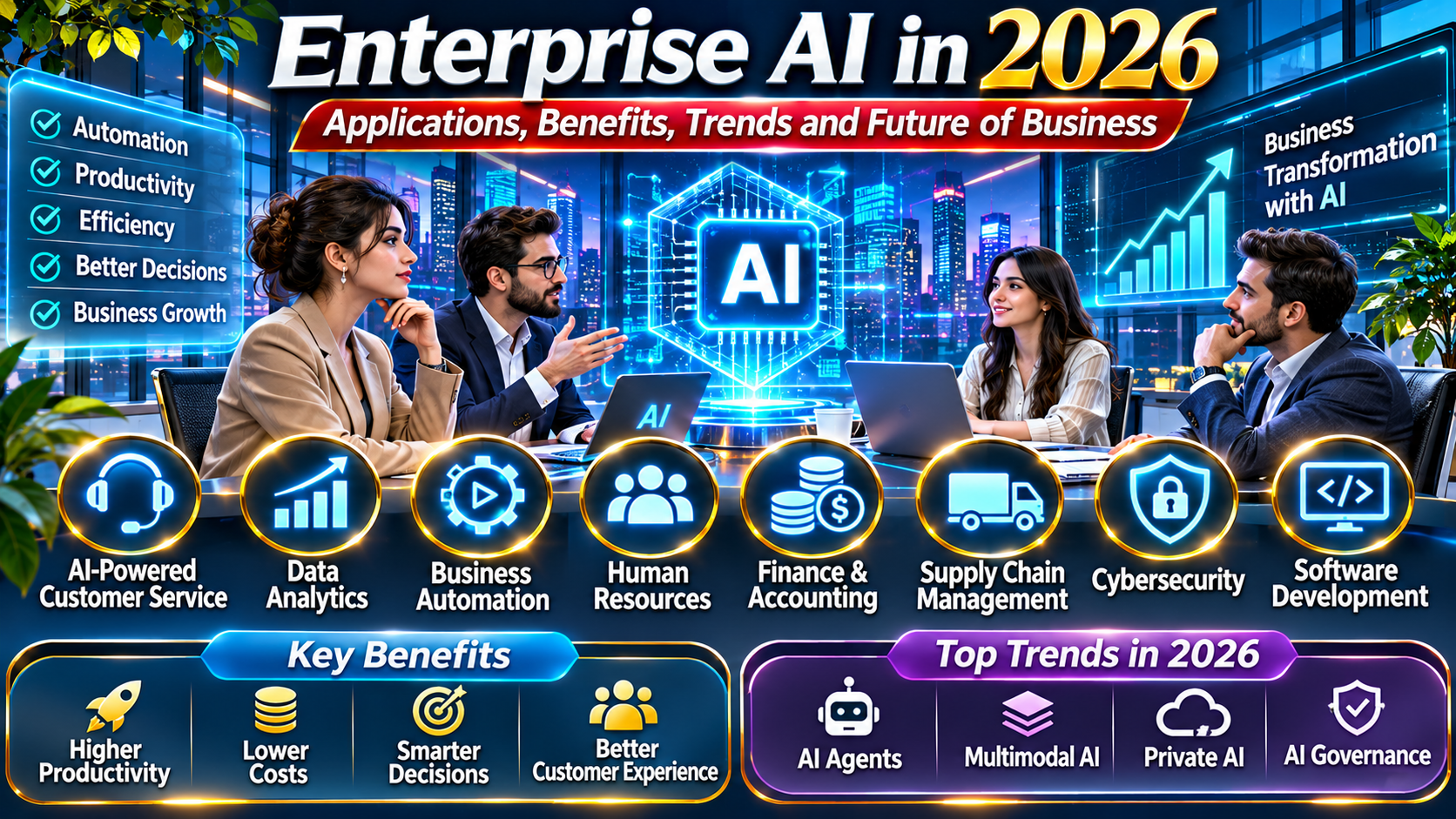
Businesses use AI to improve productivity, analyze information, automate workflows, and support customer relationships.
Common applications include:
Customer service chatbots.
Sales forecasting.
Marketing analysis.
Automated document processing.
Business intelligence.
Inventory management.
Employee productivity tools.
AI can help companies process information more quickly and identify opportunities for improvement.
4. AI in Banking and Finance
Financial institutions use AI to support fraud detection, transaction monitoring, customer service, risk assessment, and financial analysis.
Machine learning systems can identify unusual transaction patterns that may indicate suspicious activity.
Banks also use AI-powered assistants to answer routine customer questions and support digital services.
Financial decisions involving lending, compliance, and investment still require suitable controls and professional review.
5. AI in Transportation
Artificial intelligence is influencing transportation through traffic prediction, route optimization, driver assistance, and autonomous vehicle research.
Navigation applications use data and intelligent algorithms to estimate travel times and recommend routes.
Logistics companies use AI to optimize delivery schedules and manage transportation networks.
6. AI in Agriculture
Agriculture is increasingly using technology to improve productivity and resource management.
AI applications can help farmers monitor crops, analyze soil information, detect plant diseases, and manage irrigation.
Drones and computer vision systems can examine agricultural fields and identify areas that may require attention.
These technologies can support more efficient farming practices and help farmers make informed decisions.
7. AI in Manufacturing
Manufacturing companies use AI to improve production processes and product quality.
AI-powered systems can inspect products, monitor machines, identify defects, and estimate when equipment may require maintenance.
Predictive maintenance can help manufacturers reduce unexpected equipment failures and production interruptions.
8. AI in Retail and E-Commerce
Online retailers use AI to personalize shopping experiences and improve business operations.
Common applications include:
Product recommendations.
Customer behavior analysis.
Inventory forecasting.
Personalized advertising.
Automated customer support.
Visual product search.
AI can help retailers understand customer preferences and improve the shopping experience.
9. AI in Cybersecurity
Cybersecurity companies use artificial intelligence to detect suspicious activity and help protect digital systems.
AI can analyze network traffic, identify unusual login behavior, examine potentially harmful files, and support security investigations.
However, attackers can also use AI to create more convincing phishing messages and automate certain malicious activities.
Businesses need to combine AI security tools with strong passwords, multi-factor authentication, encryption, and employee awareness.
10. AI in Entertainment and Media
Artificial intelligence is changing how entertainment content is created and distributed.
AI tools can assist with video editing, animation, image generation, music production, subtitles, and content recommendations.
Streaming platforms use recommendation algorithms to suggest movies, television programs, and other content based on user activity.
Creative professionals can use AI as a supporting tool while maintaining human control over storytelling and artistic decisions.
Popular AI Tools and Platforms in 2026
A growing range of AI tools is available for individuals, businesses, developers, and creative professionals.
ChatGPT
<escape> </escape><Link url="https://chatgpt.com/" title="ChatGPT"/> is an AI assistant that can help with writing, research, brainstorming, coding, data analysis, and many other tasks.
It can support students, professionals, entrepreneurs, and organizations with everyday information and productivity needs.
Google Gemini
<Link url="https://gemini.google.com/" title="Google Gemini"/> is Google's AI assistant and model ecosystem. It supports tasks involving text, images, research, reasoning, and productivity.
Microsoft Copilot
<Link url="https://copilot.microsoft.com/" title="Microsoft Copilot"/> provides AI assistance for information discovery, writing, productivity, and other digital tasks.
Microsoft also integrates AI capabilities into its business software and cloud services.
Claude
<Link url="https://claude.ai/" title="Claude"/> is an AI assistant developed by Anthropic. It supports writing, analysis, coding, and working with documents.
Perplexity
<Link url="https://www.perplexity.ai/" title="Perplexity"/> is an AI-powered search and answer platform that helps users explore information and discover sources.
Midjourney
<Link url="https://www.midjourney.com/" title="Midjourney"/> is an AI image-generation platform used to create artistic and visual content from text prompts.
GitHub Copilot
<Link url="https://github.com/features/copilot" title="GitHub Copilot"/> is an AI coding assistant designed to help software developers write, understand, and improve code.
Runway
<Link url="https://runwayml.com/" title="Runway"/> provides AI-powered creative tools, including video-generation and editing capabilities.
Each tool has different features, limitations, pricing, and usage policies. Users should choose platforms according to their needs and verify important information produced by AI.
Benefits of Artificial Intelligence
Artificial intelligence provides several potential benefits to individuals, businesses, and society.
1. Increased Productivity
AI can help people complete repetitive tasks more quickly.
Writing assistance, document summaries, automated data processing, and intelligent search can reduce the time required for certain activities.
2. Improved Accuracy in Specific Tasks
AI systems can identify patterns in large datasets and support consistent analysis.
For example, AI-assisted quality inspection can help manufacturers identify certain product defects.
However, AI is not automatically accurate. Poor data and model limitations can produce mistakes.
3. Faster Decision Support
AI can analyze large amounts of information and present insights that help people evaluate different options.
Businesses can use AI-supported forecasting and analytics to make more informed decisions.
4. Cost Efficiency
Automation may reduce certain operational costs by minimizing repetitive manual work and improving resource utilization.
Businesses must still consider the costs of software, infrastructure, training, and ongoing maintenance.
5. Personalization
AI can help organizations provide recommendations and services based on customer preferences.
This is common in online shopping, entertainment platforms, digital advertising, and educational applications.
6. Improved Accessibility
AI-powered speech recognition, translation, text-to-speech, and assistive technologies can help people access information and digital services.
7. Innovation and Research
AI can support scientific research, product development, engineering, and creative experimentation.
Researchers use AI to analyze complex datasets and explore new possibilities in medicine, materials science, and other fields.
Challenges and Risks of Artificial Intelligence
Despite its advantages, artificial intelligence creates important challenges that require responsible management.
1. Data Privacy
AI systems may process personal information, financial records, business documents, and other sensitive data.
Organizations must establish appropriate privacy policies and protect information from unauthorized access.
Users should avoid entering confidential information into AI platforms unless they understand the platform's data-handling policies.
2. Cybersecurity Threats
AI systems can become targets for cyberattacks.
Attackers may attempt to manipulate models, steal information, exploit connected applications, or misuse AI-generated content.
Organizations need strong cybersecurity controls and regular security testing.
3. Bias and Fairness
AI models can produce biased results when training data contains historical inequalities or incomplete representation.
This can create problems in areas such as recruitment, lending, healthcare, and public services.
Developers should evaluate systems for fairness and monitor their performance across different groups and situations.
4. Job Displacement and Workforce Changes
Automation may change the way certain jobs are performed.
Some repetitive activities may require fewer human hours, while new roles may emerge in AI development, data management, cybersecurity, and technology operations.
Employees may need to develop new skills to adapt to changing workplace requirements.
5. Misinformation and Deepfakes
Generative AI can create realistic images, audio, and videos.
These technologies can be misused to produce misleading information, impersonate individuals, or manipulate public opinion.
Media verification and digital literacy are becoming increasingly important.
6. Copyright and Ownership Issues
AI-generated content raises questions about intellectual property, training data, licensing, and ownership.
Businesses and creators should understand relevant laws and platform terms before using generated content commercially.
7. High Implementation Costs
Developing and operating advanced AI systems can require significant computing resources, specialist employees, data infrastructure, and security investment.
Smaller organizations may face difficulties adopting complex systems.
8. AI Hallucinations
Generative AI can produce information that sounds convincing but is incorrect or unsupported.
Users should verify important facts, especially when AI is used for legal, financial, medical, or business decisions.
Artificial Intelligence and the Future of Jobs
AI is expected to influence the global workforce by changing how many professional activities are performed.
Some tasks may become automated, while other jobs may increasingly involve collaboration between people and AI systems.
For example, marketing professionals can use AI to analyze campaign performance and generate content ideas. Software developers can use coding assistants to review code and prepare tests. Financial analysts can use AI to organize information and explore business trends.
The future workplace will likely place greater importance on skills such as:
Critical thinking.
Problem-solving.
Communication.
Data literacy.
Digital skills.
Creativity.
AI literacy.
Adaptability.
Education and professional training will be important in helping workers adjust to technological changes.
Rather than viewing AI only as a replacement for human work, organizations should explore how it can support employees and improve the quality of their work.
AI Trends Shaping the World in 2026
Several developments are influencing how artificial intelligence is being used.
1. Agentic AI
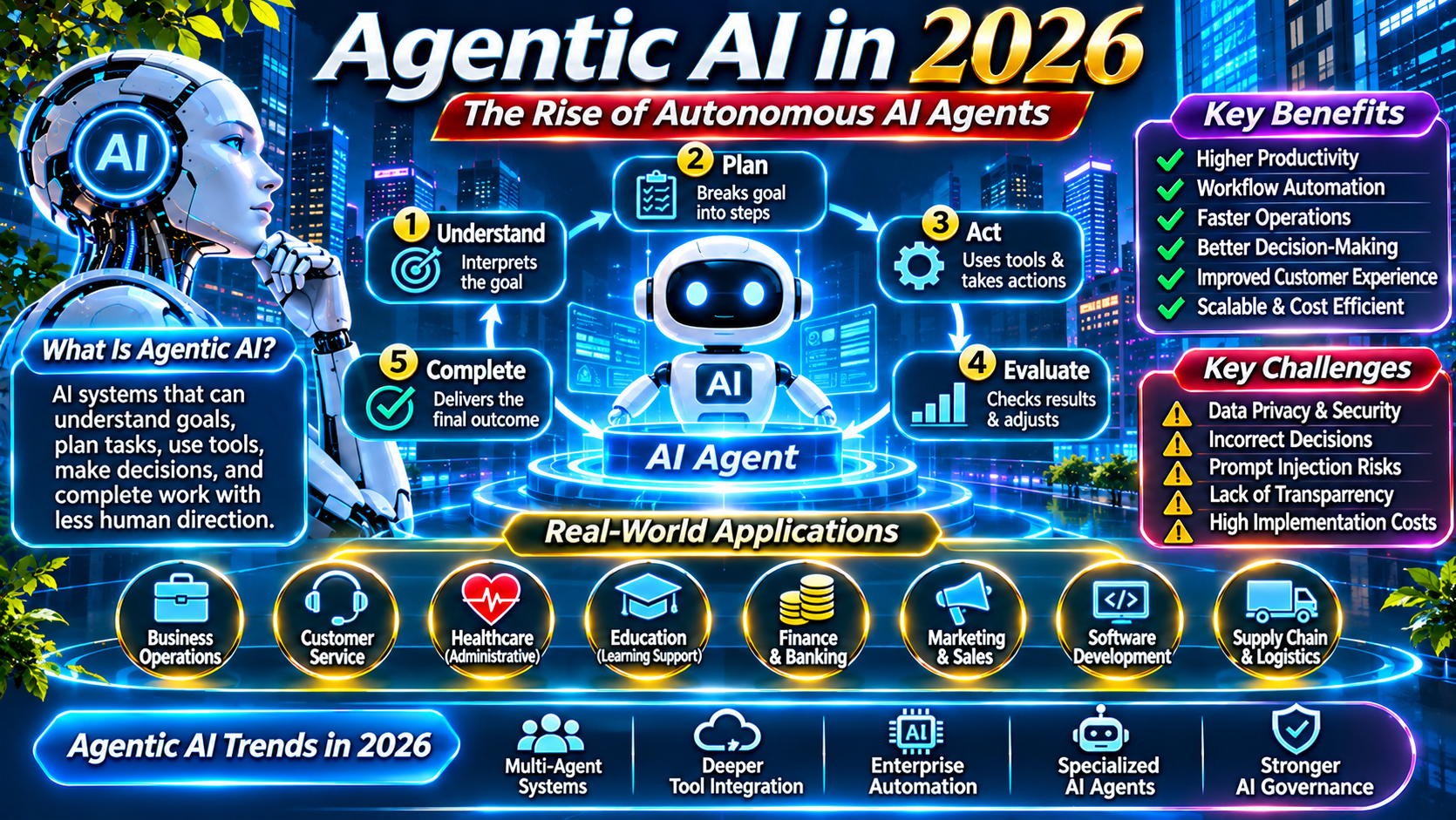
Agentic AI refers to systems that can work toward defined objectives by planning steps, using approved tools, and carrying out multi-stage tasks.
For example, an AI agent might help organize information, prepare a report, and update an approved business workflow.
These systems require careful permission management and human oversight.
2. Multimodal AI
Multimodal AI can process more than one type of information, including text, images, audio, and video.
This allows users to interact with AI in more flexible ways.
For example, a multimodal assistant may analyze a photograph, understand a spoken question, and generate a written explanation.
3. AI-Powered Robotics
Robotics is becoming more connected with artificial intelligence.
AI can help robots interpret their surroundings, recognize objects, and perform tasks in manufacturing, logistics, agriculture, and research.
4. On-Device AI
On-device AI allows certain AI tasks to run directly on smartphones, computers, and other devices.
This can improve response times and reduce the need to send all information to remote servers.
It may also provide privacy advantages for some applications, depending on device security and implementation.
5. AI in Scientific Research
AI is supporting research in areas such as medicine, chemistry, biology, materials science, and climate analysis.
It can help researchers process complex information and explore scientific questions more efficiently.
6. Small and Specialized AI Models
Not every AI application requires a large general-purpose model.
Smaller models designed for particular tasks can sometimes operate more efficiently and may be easier to deploy in specific environments.
7. Responsible and Regulated AI
Governments and organizations are developing policies to address AI safety, privacy, transparency, copyright, and accountability.
Responsible AI development is becoming an important part of long-term technology planning.
How Businesses Can Successfully Adopt Artificial Intelligence
Businesses should approach AI adoption strategically rather than introducing technology without a clear objective.
Step 1: Identify Business Needs
Organizations should identify problems that AI could help solve.
Examples include repetitive administrative tasks, slow customer service, inefficient reporting, and difficulty analyzing large datasets.
Step 2: Select Suitable AI Tools
Businesses should evaluate tools based on functionality, security, pricing, integration, and ease of use.
The most expensive or advanced platform is not necessarily the best choice.
Step 3: Prepare Data
Reliable data is essential for useful AI applications.
Companies should organize their information, correct errors, and establish appropriate access controls.
Step 4: Train Employees
Employees need to understand how to use AI tools effectively and responsibly.
Training should include fact-checking, data protection, cybersecurity, and awareness of AI limitations.
Step 5: Start With Small Projects
A pilot project can help businesses test AI before introducing it across the entire organization.
Companies can evaluate accuracy, costs, employee feedback, and measurable improvements.
Step 6: Monitor Performance
AI systems should be reviewed regularly to identify errors, security problems, and changes in performance.
Businesses should also assess whether the technology is delivering the expected value.
Step 7: Expand Responsibly
Once a project demonstrates reliable results, organizations can consider expanding its use.
Clear governance, accountability, and human supervision should remain part of the process.
The Future of Artificial Intelligence
Artificial intelligence is expected to become increasingly integrated into everyday technology and professional environments.
Future AI systems may offer more advanced reasoning, improved multimodal capabilities, stronger personalization, and better connections with digital tools.
Healthcare may benefit from AI-assisted research and administrative automation. Education may become more personalized through intelligent learning platforms. Manufacturing may use smarter robotics and predictive systems.
Businesses may increasingly rely on AI agents to support complex workflows, while individuals may use AI assistants for research, planning, communication, and creative projects.
However, technological progress must be balanced with responsible development.
Privacy, security, transparency, fairness, human control, and accountability will remain important considerations.
The future of artificial intelligence will depend not only on how powerful AI systems become, but also on how responsibly people develop and use them.
Frequently Asked Questions About Artificial Intelligence
What is artificial intelligence in simple words?
Artificial intelligence is technology that enables computers to perform tasks such as learning, recognizing patterns, understanding language, generating content, and solving certain problems.
What are the main types of artificial intelligence?
AI is commonly classified into narrow AI, artificial general intelligence, and artificial superintelligence based on theoretical capability. In practical technology development, important branches include machine learning, deep learning, natural language processing, computer vision, and generative AI.
What are examples of artificial intelligence?
Examples include virtual assistants, chatbots, recommendation systems, facial recognition, translation software, AI image generators, fraud detection systems, and self-driving vehicle research.
What is generative AI?
Generative AI is a type of artificial intelligence that creates new content, including text, images, audio, video, and software code, based on patterns learned from data.
How is AI used in everyday life?
AI is used in search engines, smartphones, navigation applications, online shopping recommendations, streaming platforms, digital assistants, spam filters, and translation tools.
What are the benefits of artificial intelligence?
AI can improve productivity, automate repetitive tasks, support decision-making, personalize services, analyze large datasets, and help researchers explore complex problems.
What are the disadvantages of AI?
Major concerns include privacy risks, cybersecurity threats, bias, inaccurate information, job disruption, copyright questions, and the cost of implementation.
Will artificial intelligence replace human jobs?
AI may automate some tasks and change certain occupations, but it can also create new roles and support existing workers. The impact will vary across industries and professions.
Which industries use artificial intelligence?
Healthcare, education, finance, manufacturing, agriculture, transportation, retail, entertainment, telecommunications, and cybersecurity all use or explore AI technologies.
What is the future of artificial intelligence?
The future of AI may include more capable AI agents, multimodal systems, intelligent robotics, personalized digital assistants, scientific research applications, and wider business automation.
Conclusion
Artificial Intelligence is one of the most influential technologies shaping the modern world. It is transforming industries by helping people analyze information, automate tasks, generate content, improve services, and solve complex problems.
From healthcare and education to banking, manufacturing, transportation, and entertainment, AI has become an important part of digital transformation.
In 2026, developments such as agentic AI, multimodal systems, intelligent robotics, and specialized AI models are creating new opportunities for individuals and organizations.
However, the benefits of artificial intelligence must be balanced with responsible use. Data privacy, cybersecurity, accuracy, fairness, and human oversight remain essential.
The future of AI will be shaped by the way people develop, regulate, and apply this technology. Organizations and individuals who understand its capabilities and limitations will be better prepared to benefit from the opportunities it creates.