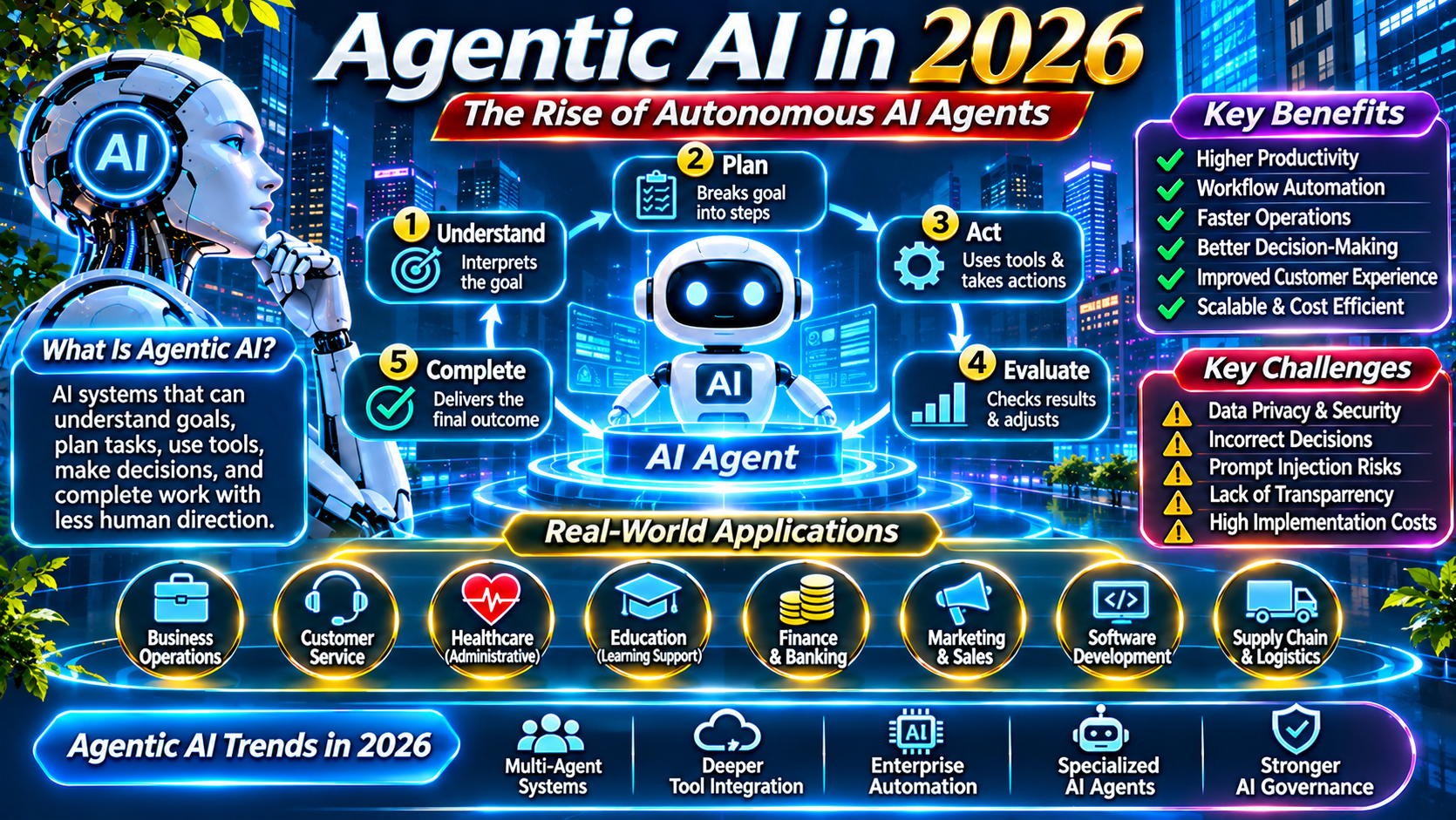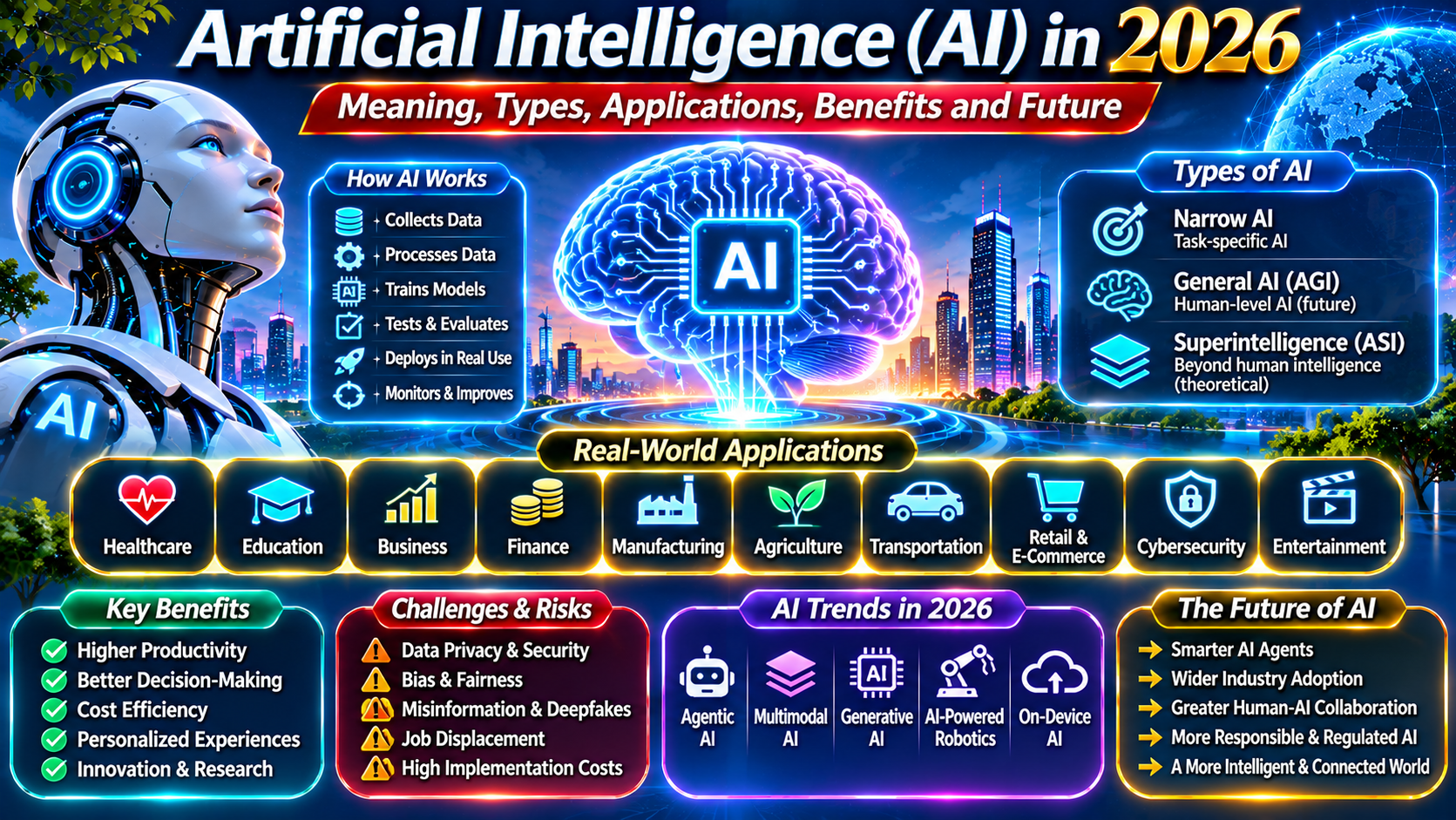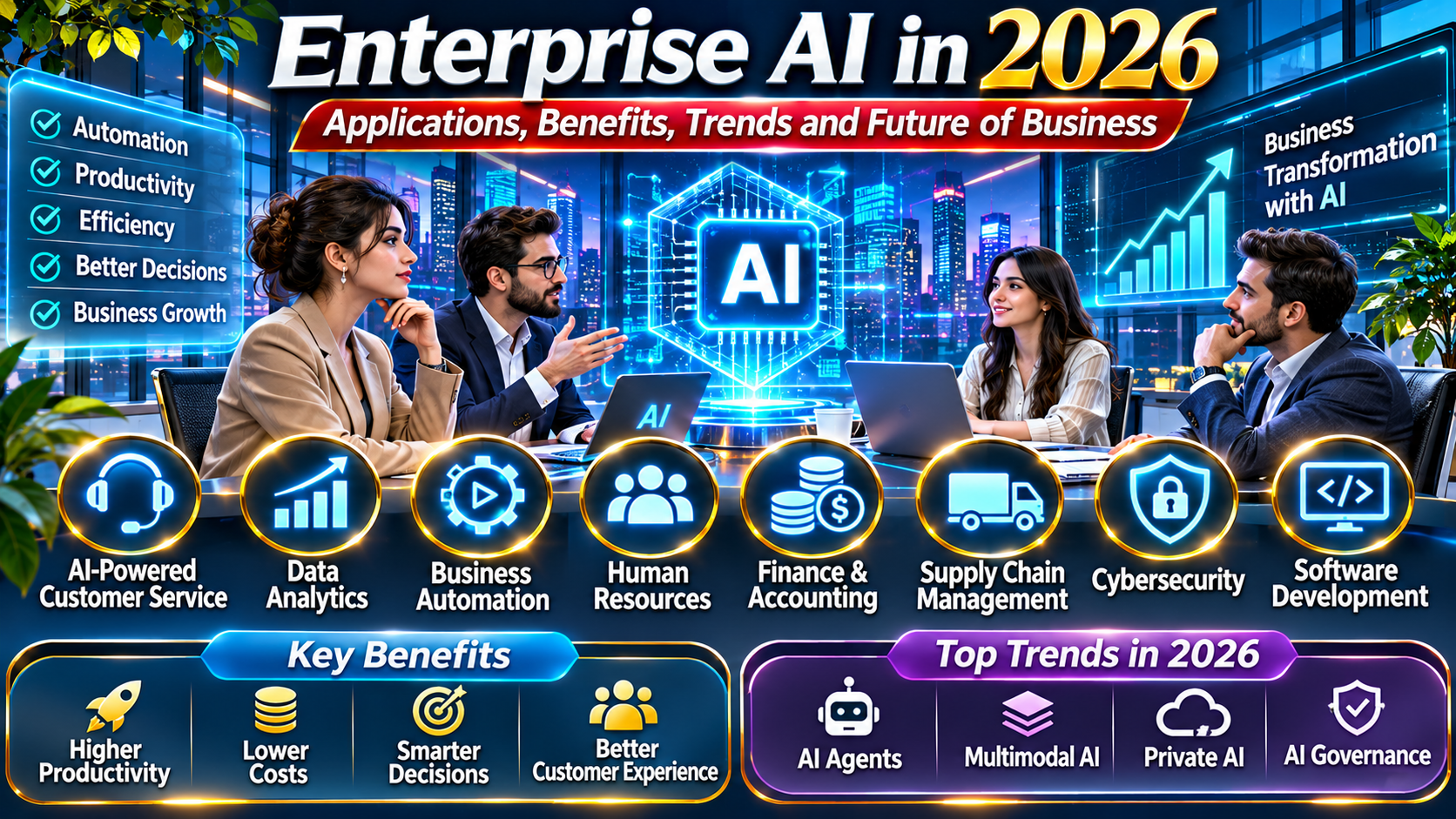
Enterprise AI refers to the use of artificial intelligence technologies across an organization's operations, systems, and business processes. It helps companies use data, automate activities, generate insights, and support decision-making on a large scale.
Unlike individual AI applications, enterprise AI is designed to operate within complex business environments. It may connect with customer relationship management (CRM) platforms, enterprise resource planning (ERP) systems, databases, communication tools, financial software, and cloud infrastructure.
Enterprise AI can include several technologies:
Machine learning: Analyzes data and identifies patterns to support predictions and decisions.
Generative AI: Creates text, images, reports, summaries, and other content.
Natural language processing: Helps computers understand and process human language.
Computer vision: Analyzes images and videos for business applications.
AI agents: Perform multi-step tasks using approved tools and systems.
Predictive analytics: Uses historical information to estimate future outcomes.
Intelligent automation: Combines AI with software automation to streamline workflows.
For example, a retail company can use enterprise AI to forecast product demand, recommend inventory levels, analyze customer feedback, and assist its customer service team.
The objective is not simply to introduce AI into a business. It is to use artificial intelligence to improve measurable business outcomes.
How Enterprise AI Works
Enterprise AI combines data, models, software applications, infrastructure, and governance to deliver useful business capabilities.
1. Enterprise Data Collection
AI systems need information to generate useful results. Businesses may collect data from customer records, financial systems, sales platforms, websites, documents, supply chains, and internal applications.
The quality of this information directly affects AI performance. Inaccurate, outdated, incomplete, or duplicated data can produce unreliable results.
2. Data Preparation and Integration
Collected information must be organized and made accessible to authorized AI systems.
Companies may use data warehouses, data lakes, application programming interfaces (APIs), and enterprise data platforms to connect information from different departments.
Data integration helps AI applications understand business information without depending on disconnected systems.
3. AI Model Selection
Organizations select AI models based on the task they want to complete.
A company might use a language model to summarize documents, a machine learning model to predict sales, or a computer vision model to inspect manufactured products.
Some businesses use externally hosted AI models, while others deploy private or customized models to meet specific requirements.
4. Integration With Business Applications
Enterprise AI becomes more useful when it connects with existing business software.
For example, an AI assistant integrated with a CRM platform could help employees summarize customer interactions, identify follow-up opportunities, and prepare responses.
Access permissions must be carefully managed so AI applications only retrieve or modify information they are authorized to use.
5. Monitoring and Improvement
AI systems require continuous evaluation.
Organizations should monitor accuracy, performance, cost, security, user feedback, and business impact. Models and workflows may need adjustments as business requirements and data change.
Major Applications of Enterprise AI
Enterprise AI has applications across almost every major business function. Its value depends on choosing practical use cases that solve real organizational problems.
1. AI-Powered Customer Service
Customer service is one of the most common applications of enterprise AI.
Businesses use AI chatbots and virtual assistants to answer frequently asked questions, provide product information, guide customers through processes, and support service teams.
An enterprise customer service assistant may:
Answer common customer questions.
Summarize previous conversations.
Route requests to the correct department.
Retrieve relevant product information.
Help agents prepare responses.
Identify recurring customer complaints.
More complex or sensitive issues should be transferred to qualified human employees.
2. Enterprise Data Analytics
Organizations generate large amounts of data through sales, marketing, operations, finance, and customer interactions.
AI can help analyze this information and identify patterns that may be difficult to discover through manual reporting.
For example, an enterprise analytics system may identify changes in customer demand, compare regional sales performance, and help management evaluate business trends.
AI-supported analytics can improve the speed of decision-making, although business leaders should verify important findings before acting on them.
3. Intelligent Business Automation
Enterprise AI can automate repetitive administrative and operational activities.
Examples include processing invoices, extracting information from documents, organizing emails, preparing reports, and routing approval requests.
Combining AI with robotic process automation (RPA) can help organizations manage workflows that involve multiple applications.
This can reduce manual effort and allow employees to focus on higher-value activities.
4. AI in Human Resources
Human resources departments can use AI to support recruitment, workforce planning, employee development, and internal communication.
Possible applications include:
Organizing job applications.
Drafting job descriptions.
Supporting employee training.
Summarizing workforce feedback.
Identifying skill-development needs.
Answering routine HR policy questions.
AI should not make unreviewed decisions about hiring, promotion, compensation, or employee performance. Human judgment and fair employment practices remain essential.
5. Enterprise Finance and Accounting
Financial departments can use AI to improve reporting, budgeting, forecasting, and transaction monitoring.
AI tools may help identify unusual expenses, summarize financial documents, classify transactions, and support cash-flow forecasting.
For example, an AI-assisted finance system can analyze historical spending and help identify departments with unusual budget changes.
Financial decisions still require accurate data, professional review, and appropriate internal controls.
6. Supply Chain Management
Supply chains involve suppliers, manufacturers, warehouses, transportation providers, and retailers.
AI can help organizations forecast demand, monitor inventory, evaluate supplier performance, and identify possible delivery disruptions.
Predictive systems can analyze historical sales, seasonal demand, transportation information, and market conditions.
This can support better inventory planning and reduce unnecessary costs.
7. Enterprise Cybersecurity
AI is becoming an important part of enterprise security operations.
AI-powered security platforms can analyze network activity, identify suspicious behavior, detect unusual login patterns, and help investigate potential incidents.
They can also support vulnerability management and security alert prioritization.
However, AI security tools should operate alongside established controls such as encryption, multi-factor authentication, access management, and regular software updates.
8. Software Development
AI coding assistants are helping enterprise development teams write, review, test, and document software.
Developers can use these tools to generate code suggestions, explain technical problems, create test cases, and understand unfamiliar codebases.
Agentic coding systems can also support more complex development tasks under appropriate permissions and human review.
Organizations should check generated code for security weaknesses, licensing concerns, correctness, and compatibility before deployment.
Enterprise AI Trends in 2026
Enterprise AI is evolving quickly. Organizations are moving from individual AI tools toward connected systems that can support entire workflows.
1. Agentic AI and Autonomous Workflows
Agentic AI is one of the most important developments in enterprise technology.
AI agents can work toward defined objectives by planning tasks, retrieving information, using approved tools, and completing multiple steps.
For example, an enterprise procurement agent might review a purchase request, check approved supplier information, compare available options, and prepare an approval recommendation.
More advanced systems may perform selected actions after receiving appropriate authorization.
However, autonomous AI creates additional risks involving access permissions, accountability, data security, and incorrect actions. Businesses need clear controls before allowing agents to operate in important workflows.
2. Enterprise AI Copilots
AI copilots are assistants integrated into business software to help employees complete everyday tasks.
They may summarize meetings, draft emails, analyze spreadsheets, prepare presentations, and retrieve internal information.
Enterprise copilots can improve productivity when they have access to relevant and properly governed business data.
3. Retrieval-Augmented Generation (RAG)
Retrieval-Augmented Generation, or RAG, connects generative AI models to external information sources.
Instead of relying only on information learned during model training, a RAG system retrieves relevant documents and uses them to prepare responses.
Businesses can use this approach to build internal knowledge assistants that search company policies, product documentation, technical manuals, and approved business records.
RAG can improve relevance and provide supporting sources, but it does not automatically eliminate incorrect answers. Retrieved information and generated responses still need appropriate validation.
4. Private and Sovereign AI
Some organizations need greater control over where their data is processed and how their AI systems operate.
Private AI deployments and sovereign AI infrastructure can help address requirements involving data residency, regulatory obligations, security, and organizational independence.
These approaches are particularly relevant to government agencies, financial institutions, healthcare organizations, and businesses operating across multiple countries.
5. Multimodal Enterprise AI
Multimodal AI can process different types of information, including text, images, audio, and video.
This creates opportunities for applications such as document analysis, visual quality inspection, meeting transcription, customer support, and industrial monitoring.
6. AI Governance and Risk Management
As AI becomes integrated into important business operations, organizations need policies that define how AI systems are selected, deployed, monitored, and controlled.
Governance includes data protection, transparency, human oversight, model evaluation, accountability, and risk management.
Deloitte's 2026 enterprise AI research highlights the gap between growing AI adoption and the governance required to scale autonomous agents responsibly.
Benefits of Enterprise AI for Businesses
Enterprise AI can create measurable value when organizations connect technology investments to business objectives.
1. Higher productivity: AI can assist employees with research, reporting, writing, analysis, and routine tasks.
2. Lower operational costs: Automation can reduce repetitive manual work and improve resource utilization.
3. Faster decision-making: AI-supported analytics can help management understand business information more quickly.
4. Better customer experiences: Intelligent assistants can provide faster responses and more relevant support.
5. Improved forecasting: Predictive models can help estimate demand, sales, inventory requirements, and financial trends.
6. Greater scalability: AI systems can support increasing volumes of business activity without requiring every task to be completed manually.
7. Stronger operational visibility: AI can help organizations identify patterns across departments and connected systems.
8. Increased innovation: Employees can use AI tools to explore ideas, develop prototypes, and improve existing products and services.
These benefits are not automatic. They depend on good implementation, appropriate data, employee adoption, and continuous measurement.
Challenges of Enterprise AI Adoption
Despite its potential, enterprise AI adoption involves important technical, financial, and organizational challenges.
1. Data Privacy and Security
Enterprise AI may process sensitive customer records, financial information, employee data, and confidential business documents.
Organizations must understand where information is stored, how it is processed, who can access it, and whether it is used to train external models.
Strong encryption, access restrictions, data classification, and vendor assessments are essential.
2. Poor Data Quality
AI systems depend on reliable information.
If company databases contain outdated records, inconsistent formats, or incorrect information, AI-generated insights may be unreliable.
Businesses should invest in data quality, integration, and management before scaling important AI applications.
3. High Implementation Costs
Enterprise AI may require investment in software licenses, cloud infrastructure, data engineering, cybersecurity, model development, and specialist employees.
Companies should calculate the total cost of ownership rather than considering only the initial software price.
4. Integration With Existing Systems
Many organizations depend on legacy software and complex IT environments.
Connecting AI systems to older applications can require additional development, APIs, data migration, and security testing.
Integration planning is therefore a major part of successful implementation.
5. AI Hallucinations and Inaccurate Results
Generative AI can produce responses that sound convincing but contain incorrect information.
This is especially risky in finance, healthcare, legal services, and other areas where mistakes can have serious consequences.
Organizations should use verification procedures, reliable information sources, and human review for high-impact decisions.
6. Employee Resistance and Skills Gaps
Employees may be uncertain about new AI tools, workplace changes, or the future of their roles.
Businesses should communicate clearly, provide training, and involve employees in workflow redesign.
7. Governance and Accountability
Organizations must establish responsibility for AI-generated decisions and actions.
They should define who approves AI systems, who monitors performance, how incidents are reported, and when human intervention is required.
8. Measuring Return on Investment
AI adoption does not automatically translate into financial success.
Companies need to measure whether AI projects improve productivity, reduce costs, increase revenue, improve customer satisfaction, or reduce operational risks.
How to Implement Enterprise AI Successfully
A structured implementation strategy can help businesses avoid unnecessary spending and achieve stronger results.
Step 1: Identify Business Problems
Start by identifying specific challenges that AI could help solve.
Examples include slow customer service, manual document processing, inaccurate demand forecasts, and repetitive reporting.
A clearly defined business problem is a better starting point than adopting AI simply because the technology is popular.
Step 2: Prioritize High-Value Use Cases
Evaluate potential AI projects according to expected benefits, implementation complexity, data availability, security risks, and costs.
Begin with projects that offer meaningful value and can be tested within a manageable scope.
Step 3: Prepare Business Data
Review the quality, accessibility, security, and ownership of company data.
Create appropriate data access policies and make sure AI applications only use information they are authorized to access.
Step 4: Select the Right AI Platform
Businesses should compare enterprise AI platforms based on their technical needs.
Important considerations include:
Model performance and reliability.
Data privacy and security.
Integration with existing software.
Administrative controls.
Scalability and performance.
Pricing and ongoing costs.
Vendor support and compliance requirements.
Step 5: Run a Pilot Project
Before deploying AI across the entire organization, test it with a limited group or business process.
A pilot allows teams to evaluate accuracy, user experience, cost, security, and operational impact.
Step 6: Establish AI Governance
Create clear policies for data use, model access, human review, risk management, and accountability.
Organizations should maintain records of important AI systems and regularly evaluate their performance.
Step 7: Train Employees
Employee training is essential for successful adoption.
Workers should understand how to use AI tools, recognize incorrect outputs, protect confidential information, and escalate problems.
Step 8: Measure Results and Scale
Use performance indicators to evaluate business outcomes.
Relevant measurements may include processing time, operating costs, customer satisfaction, error rates, revenue impact, and employee productivity.
Scale projects that demonstrate reliable results while improving systems that fail to meet expectations.
Leading Enterprise AI Platforms and Technologies
Several technology companies offer AI platforms and tools designed for enterprise environments.
Microsoft
Microsoft provides enterprise AI capabilities through Azure AI, Microsoft 365 Copilot, and related cloud services.
These technologies help organizations build AI applications, automate business tasks, analyze information, and integrate AI into productivity workflows.
Google Cloud
Google Cloud provides enterprise AI infrastructure, model development tools, data platforms, and generative AI services.
Its Vertex AI platform supports organizations developing, deploying, and managing machine learning and generative AI applications.
Amazon Web Services
Amazon Web Services offers enterprise AI services through Amazon Bedrock, Amazon SageMaker, and other cloud technologies.
Businesses can use these services to develop AI applications, work with foundation models, and build machine learning systems.
IBM
IBM provides enterprise AI technologies through its watsonx platform.
Its offerings focus on AI development, data management, governance, and business applications.
Salesforce
Salesforce integrates AI capabilities into customer relationship management and business applications.
Its AI tools can help organizations analyze customer information, support sales teams, and automate selected service workflows.
NVIDIA
NVIDIA provides GPUs, computing platforms, and software used to develop and operate advanced AI systems.
Its infrastructure is important for organizations building large-scale AI applications and enterprise AI environments.
Enterprise AI Across Different Industries
Enterprise AI is not limited to technology companies. It is being explored across many industries.
Banking and Financial Services
Banks can use AI for fraud detection, customer support, transaction analysis, risk assessment, and financial forecasting.
AI systems can help identify unusual financial patterns, but important lending and compliance decisions require appropriate controls and human oversight.
Healthcare
Hospitals and healthcare organizations can use AI to support administrative processes, medical documentation, appointment scheduling, research, and image analysis.
Clinical applications require careful validation and professional medical supervision.
Retail and E-Commerce
Retailers can use AI to recommend products, forecast demand, personalize customer experiences, and optimize inventory.
AI-powered customer assistants can also help shoppers find information and navigate purchasing processes.
Manufacturing
Manufacturers can use AI for predictive maintenance, automated quality inspection, production planning, and supply-chain management.
AI systems can analyze machine data to identify possible equipment problems before they cause major disruptions.
Telecommunications
Telecommunications companies can use AI to monitor network performance, detect service problems, improve customer support, and manage infrastructure.
Education
Educational institutions can use enterprise AI to support administrative work, student services, learning management, and institutional analytics.
Responsible use requires attention to student privacy, academic integrity, and the quality of educational content.
How to Measure Enterprise AI Success
Measuring results is essential because AI projects can generate significant costs without producing meaningful business value.
Organizations should define key performance indicators before deploying a solution.
Business area | Possible measurement |
|---|---|
Customer service | Response time and customer satisfaction |
Finance | Processing time and reporting accuracy |
Sales | Conversion rates and revenue per customer |
Human resources | Recruitment time and employee experience |
Manufacturing | Production efficiency and defect rates |
IT operations | Incident resolution time |
Cybersecurity | Detection and response times |
Supply chain | Inventory accuracy and delivery performance |
Businesses should also evaluate less visible costs, including employee training, model usage, data preparation, infrastructure, maintenance, and human review.
The Future of Enterprise AI
The future of enterprise AI will be shaped by increasingly capable models, autonomous agents, multimodal systems, private AI infrastructure, and deeper integration with business applications.
AI agents may become more capable of completing complex workflows involving several software systems. However, organizations will need stronger permission management, monitoring, audit trails, and human approval mechanisms.
Enterprise AI is also likely to become more specialized. Instead of relying on one general-purpose assistant, companies may use multiple AI systems designed for finance, customer service, software development, cybersecurity, and operations.
Another important development will be the integration of AI with physical operations. Robotics, connected equipment, and industrial AI systems may help manufacturers and logistics companies improve efficiency.
Data governance and security will remain major priorities. Organizations will need to protect sensitive information and ensure that AI systems behave reliably and responsibly.
The companies that achieve the greatest value will not necessarily be those using the largest number of AI tools. They will be those that connect AI capabilities to important business processes, prepare their data, develop employee skills, and measure meaningful outcomes.
Frequently Asked Questions About Enterprise AI
What is enterprise AI?
Enterprise AI is the use of artificial intelligence across business operations, systems, and workflows to improve productivity, automate tasks, analyze information, and support decision-making.
How is enterprise AI different from regular AI?
Regular AI can refer to any artificial intelligence application. Enterprise AI is specifically designed for organizational use, with greater attention to security, privacy, integration, scalability, governance, and business requirements.
What are examples of enterprise AI?
Examples include AI customer service assistants, automated invoice processing, predictive analytics, fraud detection, enterprise search, AI coding assistants, and supply-chain forecasting.
What is agentic AI in enterprise environments?
Agentic AI refers to systems that can plan and perform multiple steps toward a defined goal using approved tools and information. Enterprise agents may help automate workflows, investigate information, and support business operations.
What are the benefits of enterprise AI?
Enterprise AI can improve productivity, reduce repetitive work, support decision-making, enhance customer service, improve forecasting, and create new business opportunities.
Is enterprise AI secure?
Enterprise AI can be deployed with security and privacy controls, but no system is automatically secure. Businesses need access management, encryption, monitoring, vendor assessments, and appropriate governance.
Which industries benefit most from enterprise AI?
Banking, healthcare, retail, manufacturing, telecommunications, logistics, education, and technology are among the industries using or exploring enterprise AI.
How much does enterprise AI cost?
Costs vary depending on the AI platform, number of users, model usage, data infrastructure, integrations, security requirements, and implementation complexity. Businesses should evaluate total ownership costs before choosing a solution.
Can small businesses use enterprise AI?
Yes. Smaller organizations can use cloud-based AI platforms, customer service assistants, automation tools, and analytics solutions without developing their own large AI infrastructure.
What is the future of enterprise AI?
Enterprise AI is expected to become more integrated into business workflows through AI agents, specialized assistants, multimodal models, automation, and secure enterprise data platforms.
Conclusion
Enterprise AI Discover how enterprise AI transforms businesses through AI automation, intelligent agents, data analytics, and smarter workflows. Explore benefits, applications, and future trends.is transforming modern businesses by connecting artificial intelligence with everyday organizational processes. From customer service and finance to manufacturing, cybersecurity, and supply-chain management, AI is creating new ways to improve productivity and business performance.
In 2026, the focus is shifting from simple AI experimentation toward enterprise-wide adoption, agentic workflows, and measurable business results.
However, successful adoption depends on more than advanced models. Businesses must invest in reliable data, secure infrastructure, employee training, responsible governance, and effective integration.
Organizations that approach enterprise AI strategically can improve operations, support innovation, and build a stronger foundation for long-term competitiveness in an increasingly digital economy.