Artificial intelligence is changing how organizations operate, make decisions, serve customers, and compete in the global marketplace. From automating routine tasks to analyzing complex business data, AI technologies are helping companies improve productivity, reduce operational inefficiencies, and identify new opportunities for growth. As businesses expand their digital capabilities, Enterprise AI is becoming an important part of modern business strategy.
Enterprise AI refers to the use of artificial intelligence technologies across an organization to improve business processes, support decision-making, automate workflows, and create measurable value. Unlike isolated AI tools used for individual tasks, Enterprise AI focuses on integrating AI capabilities into business systems, departments, and organizational workflows.
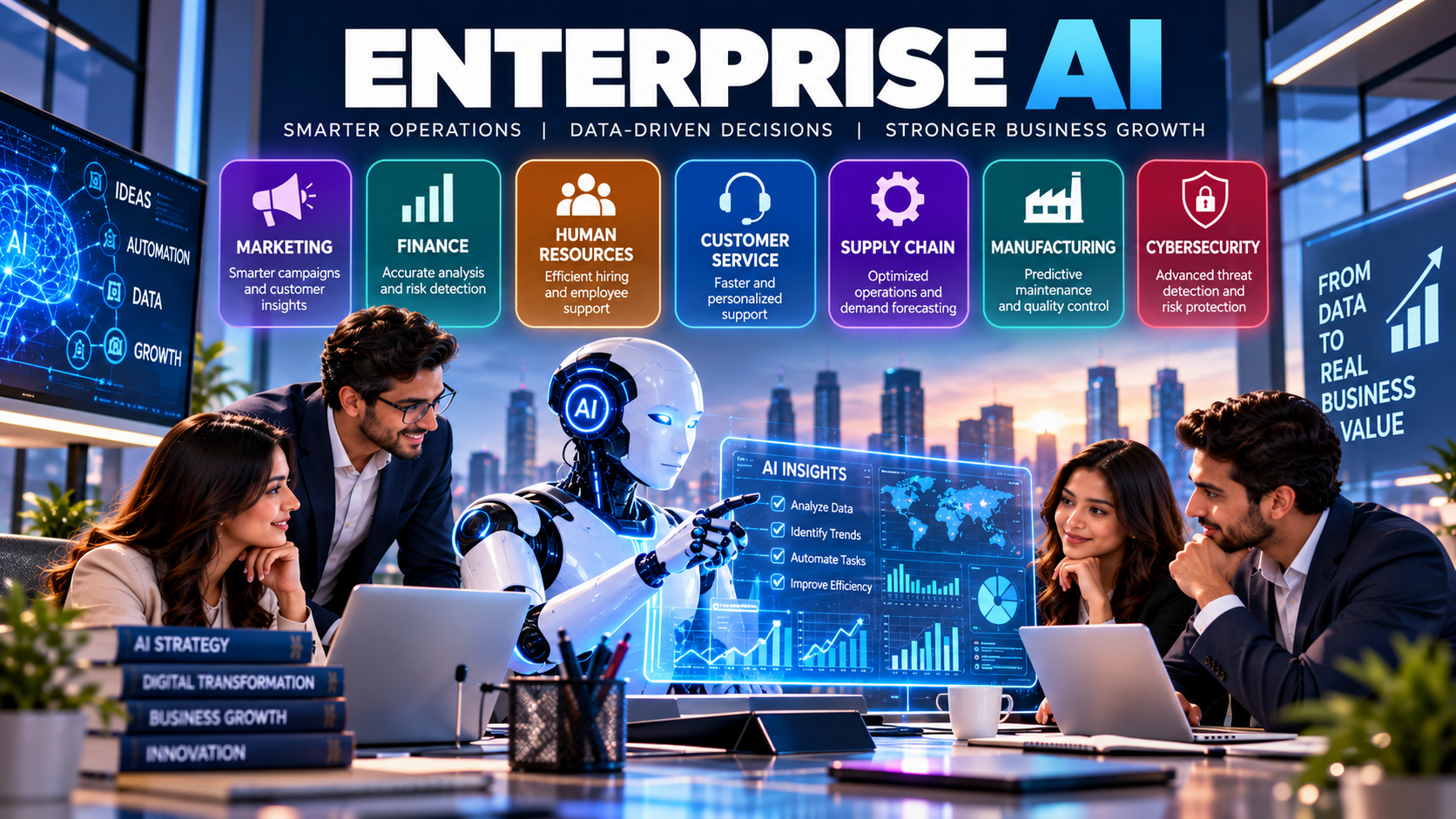
Companies can use Enterprise AI in areas such as customer service, marketing, finance, human resources, cybersecurity, supply chain management, and product development. When implemented responsibly, these technologies can help organizations respond more quickly to market changes and make better use of their data.
However, successful adoption requires more than purchasing AI software. Businesses must consider data quality, employee training, cybersecurity, privacy, governance, and the practical value of each application.
Understanding Enterprise AI and its business implications can help organizations develop effective strategies for adopting artificial intelligence and achieving sustainable growth.
What Is Enterprise AI?
Enterprise AI is the application of artificial intelligence technologies to business operations, strategic planning, and organizational decision-making.
It can include machine learning, natural language processing, computer vision, predictive analytics, generative AI, and AI-powered automation. These technologies help businesses analyze information, recognize patterns, generate content, assist employees, and automate selected activities.
For example, a financial department may use AI to identify unusual transactions, while a marketing team may use it to analyze customer behavior and personalize campaigns. A manufacturing company may use predictive models to identify equipment that requires maintenance.
Enterprise AI can also connect with existing business software, including customer relationship management systems, enterprise resource planning platforms, data warehouses, and internal knowledge systems.
The objective is to integrate AI into useful business processes rather than use technology simply because it is available.
A successful Enterprise AI strategy aligns technology investments with organizational goals, measurable outcomes, and appropriate risk controls.
Why Enterprise AI Matters for Modern Businesses
Businesses operate in an environment shaped by increasing competition, growing amounts of data, changing customer expectations, and continuous technological development.
Enterprise AI can help organizations address these pressures by improving the speed and consistency of selected tasks while providing additional insights for decision-makers.
1. Improving Operational Efficiency
Many organizations rely on repetitive activities such as processing documents, preparing reports, categorizing requests, and transferring information between systems.
AI-powered automation can reduce the manual effort required for suitable tasks and help employees focus on more complex responsibilities.
For example, an AI system may extract information from invoices and prepare it for review within a financial workflow. Employees can then verify the information instead of entering every field manually.
2. Supporting Better Decision-Making
Business leaders must evaluate information from multiple sources before making strategic decisions.
AI can help analyze historical performance, identify patterns, compare scenarios, and summarize large datasets. These capabilities may support decisions involving pricing, inventory, customer retention, and resource allocation.
AI-generated recommendations should still be evaluated against reliable evidence, business context, and human judgment.
3. Enhancing Customer Experience
Customers increasingly expect convenient services, timely responses, and relevant communication.
Enterprise AI can support customer service assistants, personalized recommendations, automated support routing, and analysis of customer feedback.
These applications may improve service efficiency while helping businesses understand customer needs more clearly.
4. Strengthening Competitiveness
Organizations that identify practical AI opportunities may improve their ability to respond to changing markets and customer expectations.
AI can support product development, market research, business forecasting, and the identification of operational improvements.
A competitive advantage depends on how effectively a company applies AI to real business problems, not simply on whether it uses advanced technology.
5. Supporting Business Growth
AI can help businesses manage increasing workloads, improve internal processes, and develop new products or services.
When organizations use AI to create genuine customer value and improve operational performance, it can contribute to long-term growth.
However, financial benefits depend on implementation costs, adoption rates, data quality, and the suitability of each use case.
Key Applications of Enterprise AI
Enterprise AI can support many departments and business functions. The most useful applications depend on organizational priorities, available data, and existing systems.
1. Enterprise AI in Marketing
Marketing teams use data to understand customers, develop campaigns, evaluate performance, and identify growth opportunities.
Enterprise AI can help analyze customer segments, summarize market research, generate content drafts, recommend campaign adjustments, and forecast demand.
For example, a company may analyze previous campaign performance to identify which customer groups respond to different messages.
AI can also support search engine optimization, content planning, audience analysis, and marketing automation.
However, businesses should review AI-generated content for accuracy, originality, brand consistency, and compliance with applicable advertising rules.
2. Enterprise AI in Finance
Finance departments manage budgets, financial reporting, transactions, forecasting, and risk assessment.
AI applications can assist with invoice processing, expense classification, anomaly detection, financial data analysis, and forecasting.
For example, an AI-powered system may identify unusual transaction patterns that require further investigation.
Financial decisions should not depend entirely on automated recommendations. Organizations need appropriate approval processes, audit trails, access controls, and human review.
3. Enterprise AI in Human Resources
Human resources teams manage recruitment, onboarding, employee development, workforce planning, and internal support.
AI can assist with drafting job descriptions, organizing training materials, answering routine policy questions, and summarizing workforce information.
Some organizations also explore AI-assisted recruitment tools, but these applications require particular care because biased data or poorly designed models can produce unfair outcomes.
Employers should assess systems for discrimination risks, protect candidate information, and ensure that important employment decisions receive appropriate human oversight.
4. Enterprise AI in Customer Service
Customer service is one of the most visible applications of Enterprise AI.
AI assistants can answer routine questions, retrieve information from approved knowledge bases, summarize conversations, and route requests to the appropriate department.
These tools may help businesses provide support outside standard working hours and reduce repetitive work for service teams.
However, customers should have a clear path to human assistance when a question is complex, sensitive, or outside the system's capabilities.
5. Enterprise AI in Supply Chain Management
Supply chains involve suppliers, inventory, transportation, demand forecasting, and delivery schedules.
AI can analyze historical sales, supplier performance, market conditions, and inventory data to help businesses plan operations.
For example, demand forecasting models may help retailers estimate future product requirements and reduce the risk of stock shortages.
The accuracy of these forecasts depends on reliable data and the ability to account for unusual events, changing customer behavior, and supply disruptions.
6. Enterprise AI in Manufacturing
Manufacturers can use AI to monitor equipment, identify defects, optimize production schedules, and predict maintenance requirements.
Computer vision systems may help inspect products for visible defects, while predictive models can identify patterns associated with equipment failure.
These applications can support quality control and operational efficiency, but they require suitable sensors, reliable data, technical expertise, and ongoing monitoring.
7. Enterprise AI in Cybersecurity
Cybersecurity teams can use AI to analyze network activity, detect suspicious behavior, prioritize alerts, and support incident investigations.
AI may help identify unusual login patterns or correlate events across multiple systems.
These capabilities can improve security operations, but they do not eliminate cyber risk. Businesses still need access controls, software updates, encryption, secure backups, employee training, and incident response procedures.
8. Enterprise AI in Research and Development
Research teams can use AI to analyze scientific literature, organize experimental data, generate hypotheses, and accelerate selected stages of product development.
In suitable industries, AI can help identify patterns that would be difficult to discover through manual analysis alone.
However, AI-generated findings must be validated through appropriate testing, domain expertise, and scientific methods before they are used to support important conclusions.
Enterprise AI vs. Traditional Automation
Enterprise AI and traditional automation both help businesses improve efficiency, but they work in different ways.
Traditional automation generally follows predefined rules and instructions. Enterprise AI may use statistical models or learned patterns to interpret information, generate responses, or make predictions.
Feature | Traditional automation | Enterprise AI |
|---|---|---|
Main approach | Executes predefined rules | Uses models to analyze, predict, classify, or generate |
Data handling | Works well with structured inputs and fixed processes | Can support structured and unstructured information |
Adaptability | Changes usually require rule updates | Some models can adapt through retraining or configuration |
Common applications | Scheduled reports and rule-based workflows | Forecasting, document analysis, intelligent assistants |
Human oversight | Depends on the process | Often needed to validate outputs and manage risk |
The two approaches can work together. A business might use AI to classify incoming documents and traditional automation to route them through an approved workflow.
Combining these technologies can be more effective than attempting to replace every existing process with AI.
Generative AI and Enterprise AI
Generative AI is an important part of the broader Enterprise AI landscape. It can produce text, summaries, images, code, and other forms of content based on user instructions and available context.
Businesses may use generative AI to draft reports, summarize meetings, assist software developers, prepare customer communications, and search internal knowledge resources.
For example, an employee may ask an internal AI assistant to summarize approved company policies or retrieve relevant information from organizational documents.
Enterprise deployments often require additional controls, including permission-aware access, secure data handling, source references, and restrictions on what information can be shared with external services.
Generative AI can produce inaccurate or misleading information. Employees should verify important outputs, particularly when they involve legal obligations, financial decisions, technical instructions, or customer commitments.
Benefits of Enterprise AI
When aligned with genuine business needs, Enterprise AI can provide several advantages.
Greater Productivity
AI can assist with repetitive information-processing tasks and help employees complete selected activities more efficiently.
Faster Information Access
AI-powered search and knowledge assistants can help employees find relevant information across approved documents and internal resources.
Improved Data Analysis
AI can identify patterns in large datasets and support forecasting, segmentation, and performance evaluation.
More Consistent Processes
Well-designed AI workflows can standardize selected tasks and reduce some forms of manual variation.
Enhanced Customer Support
AI assistants can respond to common inquiries and help service teams prioritize more complex cases.
Better Scalability
AI may help organizations handle increasing volumes of requests or information without increasing manual effort at the same rate.
Support for Innovation
Employees can use AI to explore ideas, test concepts, analyze feedback, and accelerate certain stages of product or service development.
These benefits are not automatic. Organizations should measure actual outcomes rather than assume that adopting AI will necessarily reduce costs or increase productivity.
Challenges of Enterprise AI Adoption
Despite its potential, Enterprise AI introduces technical, operational, financial, and ethical challenges.
1. Data Quality Problems
AI systems depend on the quality and relevance of the information they receive.
Incomplete records, outdated documents, inconsistent formats, and incorrect labels can reduce model performance.
Businesses should improve data quality, define ownership, and establish reliable processes for maintaining important datasets.
2. Privacy and Confidentiality
Enterprise AI systems may process sensitive customer information, employee records, financial data, or proprietary business documents.
Organizations should understand how providers process data, restrict access to authorized users, apply appropriate retention rules, and assess privacy obligations before deployment.
Employees should not enter confidential information into unapproved AI tools.
3. Security Risks
AI integrations can introduce new attack surfaces, including exposed credentials, insecure connections, excessive permissions, and vulnerabilities in connected applications.
Businesses should apply least-privilege access, secure authentication, system monitoring, and appropriate security testing.
AI systems that can take actions, modify records, or access sensitive resources require particularly careful permission management.
4. Inaccurate Outputs
AI systems can generate incorrect facts, misleading summaries, unreliable predictions, or unsuitable recommendations.
Organizations should establish verification procedures and determine which outputs can be used automatically and which require human approval.
5. Implementation Costs
Enterprise AI may involve software licensing, infrastructure, data preparation, integration, training, and ongoing maintenance.
Businesses should estimate the total cost of ownership and compare it with realistic, measurable benefits.
6. Employee Resistance
Employees may be concerned about changing responsibilities, unfamiliar tools, or the impact of automation on their jobs.
Clear communication, practical training, employee involvement, and realistic explanations of AI's role can help organizations manage these concerns.
7. Governance and Compliance
Different AI applications may involve different legal, regulatory, contractual, and ethical requirements.
Organizations should establish clear policies for approved tools, acceptable uses, data handling, human review, and incident reporting.
How to Implement Enterprise AI Successfully
A structured implementation process can help organizations move from experimentation to reliable business use.
Step 1: Identify a Business Problem
Start with a specific challenge rather than adopting AI without a clear purpose.
Examples include reducing the time required to process documents, improving customer support response times, or identifying patterns in sales data.
A well-defined problem makes it easier to evaluate whether AI is appropriate.
Step 2: Evaluate Data Readiness
Determine what information the AI system needs, where the data is stored, who owns it, and whether it is accurate and accessible.
Review privacy, security, and permission requirements before connecting business data to AI tools.
Step 3: Select Appropriate Technology
Evaluate AI platforms according to their capabilities, integration options, security features, privacy terms, reliability, cost, and support.
Consider whether an existing business application already provides the required functionality before introducing a separate tool.
Step 4: Start With a Pilot Project
Test the proposed solution on a limited use case with clear boundaries.
For example, an organization might begin by using AI to summarize internal reports rather than immediately automating important financial or operational decisions.
A pilot helps identify technical problems, user concerns, and limitations before a wider rollout.
Step 5: Establish Governance and Human Oversight
Define who can use the system, which data it can access, what actions it may perform, and when human approval is required.
Assign responsibility for reviewing outputs, handling errors, and responding to security incidents.
Step 6: Train Employees
Employees should understand the system's strengths, limitations, and approved uses.
Training should cover prompt quality, output verification, data privacy, security risks, and the escalation of uncertain or high-impact decisions.
Step 7: Measure Business Results
Track outcomes using clear performance indicators.
Depending on the project, these may include processing time, cost per task, error rates, customer satisfaction, employee adoption, or revenue impact.
Compare results with the original process to determine whether the AI solution delivers meaningful value.
Step 8: Expand Gradually
If the pilot produces reliable results, consider expanding the solution to additional teams or workflows.
Use lessons from the initial deployment to improve integration, governance, training, and monitoring.
Scaling should be based on evidence rather than pressure to adopt AI across every department at once.
Enterprise AI Governance and Responsible Use
AI governance refers to the policies, responsibilities, and controls that guide how an organization develops, purchases, deploys, and monitors AI systems.
Good governance helps businesses manage risk while allowing employees to use AI productively.
An effective Enterprise AI governance framework should include:
Approved tools: Maintain a clear list of AI systems employees are permitted to use.
Data protection: Define which information can be processed and under what conditions.
Access controls: Restrict AI systems to the information and actions required for their assigned tasks.
Human oversight: Establish review requirements for important or high-impact decisions.
Testing and evaluation: Assess accuracy, reliability, fairness, and performance before and after deployment.
Transparency: Explain AI use to relevant stakeholders when appropriate.
Monitoring: Track system behavior, errors, security events, and changing performance.
Accountability: Assign clear ownership for decisions, incidents, and corrective actions.
Governance should be proportionate to the level of risk. A tool that summarizes public information may require fewer controls than a system influencing employment decisions or accessing confidential financial records.
Measuring the Return on Investment of Enterprise AI
Organizations need to understand whether their AI investments produce sufficient business value.
Return on investment (ROI) can be evaluated by comparing the financial benefits of an initiative with its total costs.
Potential benefits include reduced processing costs, time saved, fewer errors, improved service quality, increased sales, and lower operational losses.
Costs may include software licenses, infrastructure, data preparation, integration, employee training, security controls, and ongoing maintenance.
Businesses should also consider indirect benefits, such as improved employee experience or faster access to information, while distinguishing measurable results from assumptions.
A practical Enterprise AI evaluation may track:
Average time required to complete a task.
Cost per transaction or processed document.
Accuracy and error rates.
Customer satisfaction.
Employee adoption and usage.
Frequency of manual corrections.
System availability and reliability.
Total implementation and operating costs.
For example, if an AI tool reduces document-processing time but creates a large volume of errors requiring manual correction, the net benefit may be limited.
Measuring performance across the complete workflow provides a more realistic view of the technology's value.
Enterprise AI for Small and Medium-Sized Businesses
Enterprise AI is not limited to large corporations. Small and medium-sized businesses can also benefit from practical AI applications.
A small business may use AI to draft marketing content, summarize customer feedback, organize support requests, analyze sales trends, or assist employees with internal documentation.
These applications can be useful when they address specific problems and fit the organization's budget and technical capabilities.
Smaller businesses should begin with manageable projects rather than purchasing complex systems that require significant maintenance.
They should also establish basic policies for data privacy, approved tools, access permissions, and output verification.
For many smaller organizations, the most effective starting point is an existing business application with built-in AI features, provided that its security and privacy terms meet business requirements.
The Future of Enterprise AI
Enterprise AI is likely to become increasingly integrated into everyday business software, decision-support systems, and organizational workflows.
AI agents may be able to complete multi-step tasks, interact with approved business applications, retrieve information, and coordinate activities under defined permissions.
These capabilities could improve productivity, but they also increase the importance of monitoring, access controls, testing, and human accountability.
Multimodal AI systems that process text, images, audio, and other forms of information may support new applications in customer service, quality inspection, research, and training.
Businesses may also place greater emphasis on smaller specialized models, private deployment options, and tools that offer stronger control over sensitive information.
The future of Enterprise AI will not depend solely on technological progress. It will also depend on the quality of organizational data, employee capabilities, customer trust, and responsible governance.
Companies that focus on practical use cases and measurable outcomes will be better positioned to determine where AI creates genuine value.
Conclusion
Enterprise AI is transforming how businesses analyze information, automate workflows, support employees, and serve customers. By integrating artificial intelligence into areas such as marketing, finance, human resources, cybersecurity, manufacturing, and customer service, organizations can explore new ways to improve productivity and make informed decisions.
However, successful adoption requires more than selecting an advanced AI platform. Businesses must prepare their data, protect sensitive information, train employees, establish governance, and measure performance.
A gradual, problem-focused implementation approach allows organizations to evaluate benefits while managing risks and costs.
As AI technology continues to evolve, businesses that combine innovation with human expertise, responsible oversight, and clear strategic objectives can use Enterprise AI to support efficiency, resilience, and sustainable long-term growth.
Frequently Asked Questions About Enterprise AI
What is Enterprise AI?
Enterprise AI is the use of artificial intelligence technologies across business operations to automate tasks, analyze data, support decisions, improve customer experiences, and create organizational value.
What are the main benefits of Enterprise AI?
Key benefits include improved productivity, faster data analysis, better access to information, more efficient workflows, enhanced customer service, and support for business innovation.
What are examples of Enterprise AI?
Examples include AI-powered customer service assistants, financial anomaly detection, predictive maintenance, document processing, sales forecasting, marketing analytics, and cybersecurity monitoring.
How is Enterprise AI different from generative AI?
Enterprise AI is a broad term covering AI applications across an organization. Generative AI is a category of AI that creates content such as text, images, code, and summaries. Generative AI can be one component of an Enterprise AI strategy.
Is Enterprise AI suitable for small businesses?
Yes. Small businesses can use AI for practical tasks such as customer support, content drafting, document processing, and sales analysis. They should choose solutions that match their budgets, data requirements, and security needs.
What are the biggest challenges of Enterprise AI?
Common challenges include poor data quality, privacy risks, cybersecurity vulnerabilities, inaccurate outputs, implementation costs, employee resistance, and the need for responsible governance.
How can a company implement Enterprise AI?
A company should identify a specific business problem, assess data readiness, select appropriate technology, test a pilot project, establish governance, train employees, and measure results before expanding adoption.
How can businesses measure Enterprise AI success?
Businesses can track productivity, processing time, error rates, customer satisfaction, adoption, operating costs, and financial return. Metrics should reflect the specific objectives of each AI project.