
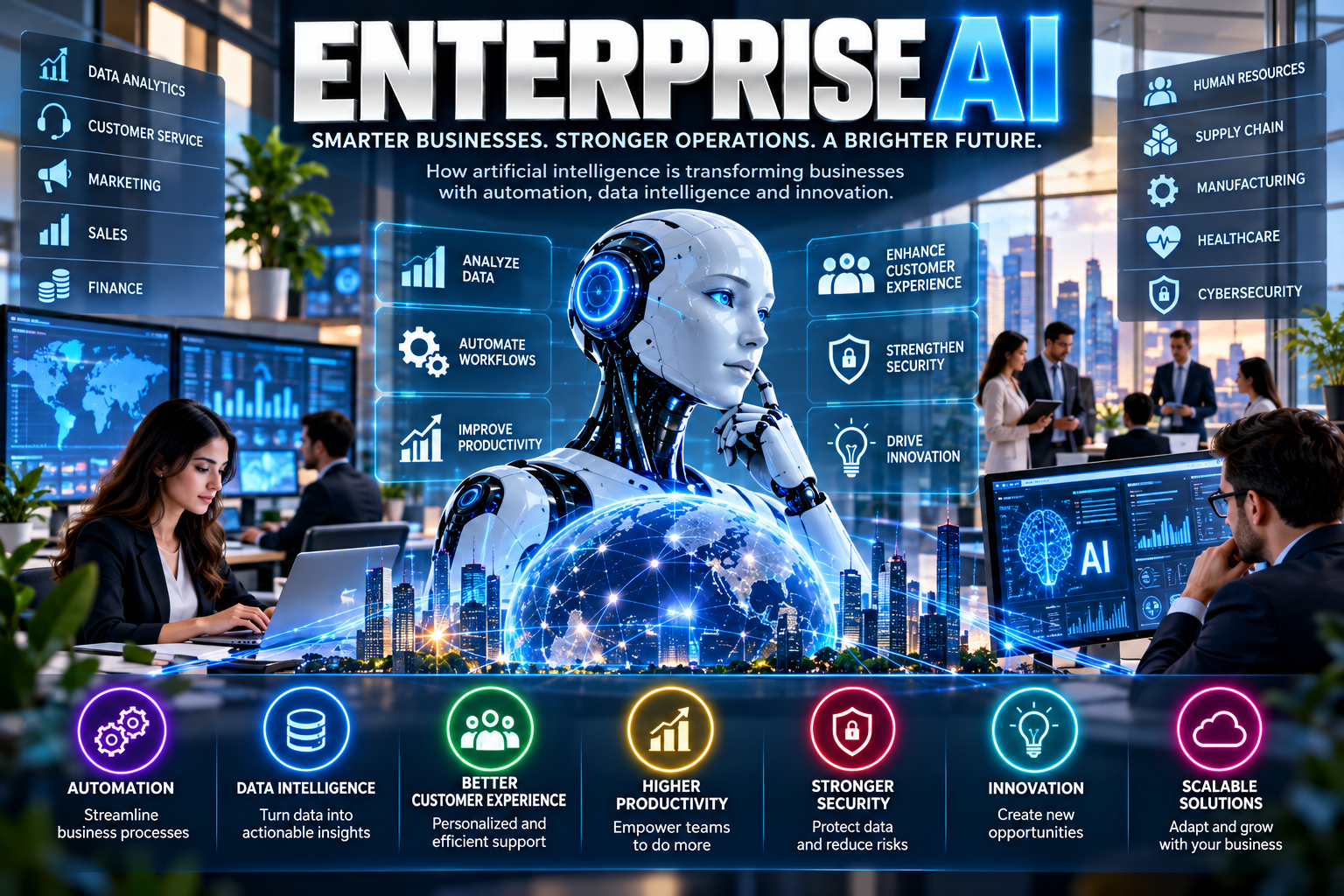
Artificial intelligence is moving beyond experimentation and becoming an important part of how modern businesses operate. Enterprise AI refers to the use of artificial intelligence within organizations to improve workflows, analyze information, automate tasks, support employees, serve customers, and make business decisions.
Companies are increasingly moving from simple AI assistants toward systems that can connect with business data, applications, and workflows. Recent enterprise research shows that organizations are increasingly using AI for substantive, delegated work rather than only basic question answering or content generation.
The growth of enterprise AI is changing industries ranging from finance and healthcare to retail, manufacturing, marketing, logistics, technology, and professional services.
What Is Enterprise AI?
Enterprise AI is the application of artificial intelligence to business operations and organizational processes.
Unlike consumer AI tools that may be used individually, enterprise AI is generally designed around organizational requirements such as:
Business data
Internal workflows
Security
Access controls
Compliance
Productivity
Customer service
Analytics
Automation
Decision support
Enterprise AI can include machine-learning systems, generative AI, predictive analytics, AI assistants, computer vision, recommendation engines, and AI agents.
The objective is generally not simply to introduce AI into a company. Instead, organizations need to determine where AI can produce measurable business value.
Why Enterprise AI Is Growing
AI adoption among businesses has been increasing.
The OECD reported that 20.2% of firms across OECD countries used AI in 2025, compared with 14.2% in 2024 and 8.7% in 2023. Adoption was significantly higher among large businesses, with 52.0% using AI compared with 17.4% of small businesses.
This difference illustrates an important aspect of enterprise AI: access to technology alone does not guarantee successful adoption.
Businesses also need appropriate data, infrastructure, skilled employees, governance, cybersecurity, and processes.
Enterprise AI vs. Traditional Business Software
Traditional software generally follows predefined instructions.
Enterprise AI can add a layer of pattern recognition, prediction, natural-language interaction, and automation.
For example, traditional customer-service software might route a ticket according to predefined rules. An AI-enabled system could analyze the customer's message, identify the issue, summarize the conversation, retrieve relevant information, and suggest an appropriate response.
This does not necessarily mean that traditional software is being replaced. Instead, AI is increasingly being integrated into existing business systems.
Enterprise Generative AI
Generative AI can create or transform content such as:
Text
Reports
Emails
Images
Presentations
Code
Summaries
Research notes
Customer responses
Businesses can use generative AI to support employees across many departments.
Common applications include drafting documents, summarizing meetings, analyzing information, creating marketing content, assisting developers, and answering questions about internal knowledge.
The next stage involves connecting generative AI to organizational systems so it can perform more structured tasks.
The Rise of AI Agents
AI agents represent an important development in enterprise AI.
Instead of only responding to a prompt, an AI agent can potentially use tools, retrieve information, follow workflows, and complete multiple steps toward a goal.
Enterprise research published in August 2026 describes a shift from AI assistance toward AI execution, with organizations increasingly delegating substantive work to agents connected to business context and tools.
Potential enterprise-agent applications include:
Research
Software development
Sales operations
Recruiting
Marketing
Customer support
Data analysis
Document processing
Business operations
However, organizations need appropriate permissions, monitoring, testing, and human oversight before allowing AI agents to perform high-impact actions.
Enterprise AI in Customer Service
Customer service is one of the most visible applications of enterprise AI.
AI can help businesses:
Answer common questions
Classify customer requests
Summarize conversations
Search knowledge bases
Translate communications
Recommend responses
Identify customer issues
Route complex cases to employees
AI can operate alongside human representatives rather than replacing every customer-service interaction.
Human involvement remains particularly important for complicated, sensitive, or high-impact cases.
Enterprise AI in Marketing
Marketing teams can use AI to analyze audiences, develop content, summarize research, generate ideas, and personalize communications.
Possible applications include:
Content generation
Customer segmentation
Campaign analysis
Market research
Search optimization
Social media analysis
Email personalization
Advertising analysis
AI can accelerate content production, but businesses still need human review to maintain accuracy, brand consistency, originality, and appropriate messaging.
Enterprise AI in Sales
Sales organizations can use AI to analyze customer information and support sales representatives.
AI applications may include:
Lead qualification
Customer research
Sales forecasting
Proposal drafting
Meeting summaries
CRM updates
Account analysis
Follow-up recommendations
AI can reduce administrative work and allow sales teams to spend more time on customer relationships.
Enterprise AI in Finance
Financial departments generate significant amounts of structured and unstructured information, making them an important area for AI applications.
Enterprise AI can support:
Financial forecasting
Expense analysis
Invoice processing
Fraud detection
Risk analysis
Financial reporting
Document review
Budget analysis
Because financial information can be highly sensitive, security and governance are particularly important.
Enterprise AI in Healthcare
Healthcare organizations can use AI to support administrative and analytical processes.
Potential applications include:
Medical-document summarization
Administrative automation
Scheduling
Research assistance
Medical-image analysis
Patient communication
Operational forecasting
Healthcare AI requires careful consideration of privacy, safety, accuracy, clinical oversight, and applicable regulations.
Enterprise AI in Manufacturing
Manufacturing companies can use AI to analyze production systems and improve operational efficiency.
Potential applications include:
Predictive maintenance
Quality control
Demand forecasting
Production planning
Supply-chain optimization
Robotics
Computer vision
Inventory management
AI can analyze data from connected machinery and identify patterns that may indicate equipment problems.
Enterprise AI in Supply Chains
Global supply chains involve many variables, including inventory, transportation, demand, suppliers, weather, costs, and geopolitical conditions.
AI can help companies analyze these variables and improve planning.
Possible applications include:
Demand forecasting
Inventory optimization
Route planning
Supplier analysis
Logistics management
Warehouse automation
Risk monitoring
The value of AI in supply chains depends heavily on the quality and timeliness of the underlying data.
Enterprise AI and Data
Data is the foundation of many enterprise AI systems.
Organizations may have information spread across:
Customer relationship systems
Enterprise resource planning platforms
Databases
Documents
Emails
Data warehouses
Cloud applications
Internal knowledge bases
AI systems become more useful when they can access relevant, reliable, and appropriately governed business information.
However, companies should not assume that connecting every data source to an AI system is automatically beneficial.
Data access should follow appropriate security and privacy controls.
AI Governance
Enterprise AI requires governance because AI systems can affect business decisions, employees, customers, and sensitive information.
NIST's AI Risk Management Framework is designed to help organizations incorporate trustworthiness considerations into the design, development, use, and evaluation of AI systems.
Enterprise AI governance can include:
AI policies
Risk assessments
Access controls
Data governance
Model monitoring
Human oversight
Documentation
Testing
Incident response
Compliance processes
Governance should evolve as AI applications become more capable.
Enterprise AI and Cybersecurity
Security is one of the most important considerations when implementing AI.
Organizations must protect both their business data and the AI systems themselves.
Potential concerns include:
Sensitive-data exposure
Unauthorized access
Prompt injection
Model manipulation
Data poisoning
Insecure integrations
Excessive agent permissions
Third-party risks
Cyberattacks
NIST's AI Risk Management Framework emphasizes managing AI-related risks throughout the lifecycle of AI systems.
Businesses should therefore treat AI security as part of their overall cybersecurity strategy.
Enterprise AI and Employees
AI is changing how employees perform knowledge work.
Instead of completing every task manually, employees may increasingly collaborate with AI systems that can research, summarize, draft, analyze, and execute selected workflows.
The OECD's 2026 research on SMEs found that AI adoption is increasing, while strategic and secure integration into business operations remains uneven. Skills gaps, maintenance costs, and time constraints were among the barriers identified in the research.
This means employee training is an important part of enterprise AI adoption.
Workers may need to learn:
AI literacy
Prompting
AI-assisted research
Data handling
AI verification
Cybersecurity
Responsible AI practices
Workflow automation
Benefits of Enterprise AI
Enterprise AI can provide several potential benefits.
Improved Productivity
AI can automate repetitive tasks and help employees complete information-heavy work faster.
Better Data Analysis
AI can process large amounts of information and identify patterns that may be difficult to detect manually.
Faster Customer Service
AI can handle routine inquiries and help employees resolve complex cases more efficiently.
Automation
AI agents can potentially execute multi-step workflows under appropriate controls.
Personalization
Businesses can use AI to tailor services and communications to customer needs.
Operational Efficiency
AI can help organizations identify inefficiencies in processes, inventory, logistics, and resource allocation.
Challenges of Enterprise AI
Despite its potential, enterprise AI also presents significant challenges.
Data Quality
AI systems can produce unreliable results when the underlying data is incomplete, outdated, inconsistent, or inaccurate.
Security
Connecting AI to business systems can create new security risks if permissions and integrations are not properly controlled.
Privacy
AI applications may process sensitive employee, customer, financial, or proprietary information.
Accuracy
Generative AI can produce incorrect information, sometimes with convincing language.
Cost
Enterprise AI may require investment in infrastructure, software, integration, training, and skilled employees.
Skills Gaps
Businesses need employees who understand both AI technology and the organization's specific processes.
Change Management
Employees may need support and training as AI changes established workflows.
Measuring Enterprise AI Success
Companies should measure AI projects using business outcomes rather than simply counting the number of AI tools deployed.
Useful metrics may include:
Time saved
Cost reduction
Revenue impact
Customer satisfaction
Employee productivity
Error reduction
Response time
Conversion rates
Process completion time
Quality improvements
A successful enterprise AI project should ideally solve a clearly defined business problem.
How to Implement Enterprise AI
A practical enterprise AI strategy can follow several stages.
1. Identify Business Problems
Start with business challenges rather than technology.
2. Select High-Value Use Cases
Choose workflows where AI can provide measurable benefits.
3. Evaluate Data
Determine whether the necessary information is available, accurate, secure, and accessible.
4. Establish Governance
Define policies for security, privacy, access, oversight, and responsible AI use.
5. Run a Pilot
Test the system with a limited group or workflow.
6. Measure Results
Compare performance against clear business metrics.
7. Train Employees
Teach employees how to use AI effectively and safely.
8. Integrate With Business Systems
Connect successful AI applications with appropriate company tools and workflows.
9. Monitor Continuously
Track performance, security, accuracy, costs, and user feedback.
10. Scale Carefully
Expand successful applications while maintaining governance and oversight.
The Future of Enterprise AI
Enterprise AI is likely to move increasingly from individual productivity toward organization-wide workflow automation.
Research published in 2026 indicates that frontier organizations are increasingly connecting AI systems with business context and tools, allowing them to delegate more substantive work.
Future enterprise AI systems may increasingly combine:
Generative AI
AI agents
Enterprise data
Automation
Cloud computing
Business applications
Robotics
Advanced analytics
This could create organizations where AI participates in many stages of a business process while employees provide direction, judgment, review, and accountability.
The transition will not necessarily happen equally across industries or companies. Smaller organizations may face greater challenges involving skills, costs, and secure implementation, while highly regulated industries may require additional controls.
Final Thoughts
Enterprise AI is becoming an important part of modern business transformation.
The technology can help organizations analyze information, automate repetitive tasks, support employees, improve customer experiences, optimize operations, and create new products and services.
However, successful enterprise AI requires more than purchasing an AI tool.
Businesses need reliable data, appropriate infrastructure, cybersecurity, employee training, governance, human oversight, and clear measurements of business value.
As AI develops from an assistant into systems capable of performing increasingly complex workflows, the key question for businesses will be how to integrate these capabilities responsibly and effectively.
Enterprise AI is therefore not simply a technology upgrade. It represents a broader change in how organizations can structure work, use information, and deliver value.
FAQs About Enterprise AI
What is Enterprise AI?
Enterprise AI is the use of artificial intelligence within business operations to support employees, automate workflows, analyze information, serve customers, and improve decision-making.
What is the difference between AI and Enterprise AI?
General AI applications can be designed for broad consumer or individual use, while enterprise AI is typically integrated with organizational data, workflows, systems, security controls, and business objectives.
What are common Enterprise AI use cases?
Common applications include customer service, marketing, sales, finance, cybersecurity, data analysis, software development, human resources, manufacturing, and supply-chain management.
What are AI agents in business?
AI agents are systems that can use AI models, tools, data, and workflows to complete multi-step tasks, potentially with human supervision.
Is Enterprise AI only for large companies?
No. Businesses of different sizes can use AI, although adoption can vary according to resources, technical capabilities, data availability, and security requirements.
What are the biggest Enterprise AI challenges?
Important challenges include data quality, cybersecurity, privacy, accuracy, costs, skills gaps, governance, integration, and organizational change.
How can businesses start using Enterprise AI?
Businesses can begin by identifying a specific problem, selecting a measurable use case, evaluating the required data, establishing governance, running a pilot, measuring results, and scaling successful applications.
What is the future of Enterprise AI?
Enterprise AI is increasingly moving toward connected, agentic systems that can work with business data and tools to perform more complex tasks and workflows.