The Philippines richest has produced some of Southeast Asia’s most influential entrepreneurs and business families. Their fortunes span ports, infrastructure, property development, retail, banking, food and beverages, aviation, healthcare, telecommunications, and consumer businesses.
According to Forbes’ 2026 Philippines’ 50 Richest list, the combined wealth of the country’s 50 richest people and families was estimated at $79 billion, down from $86 billion the previous year. The figures were calculated using stock prices and exchange rates as of July 17, 2026, and the list includes family fortunes.
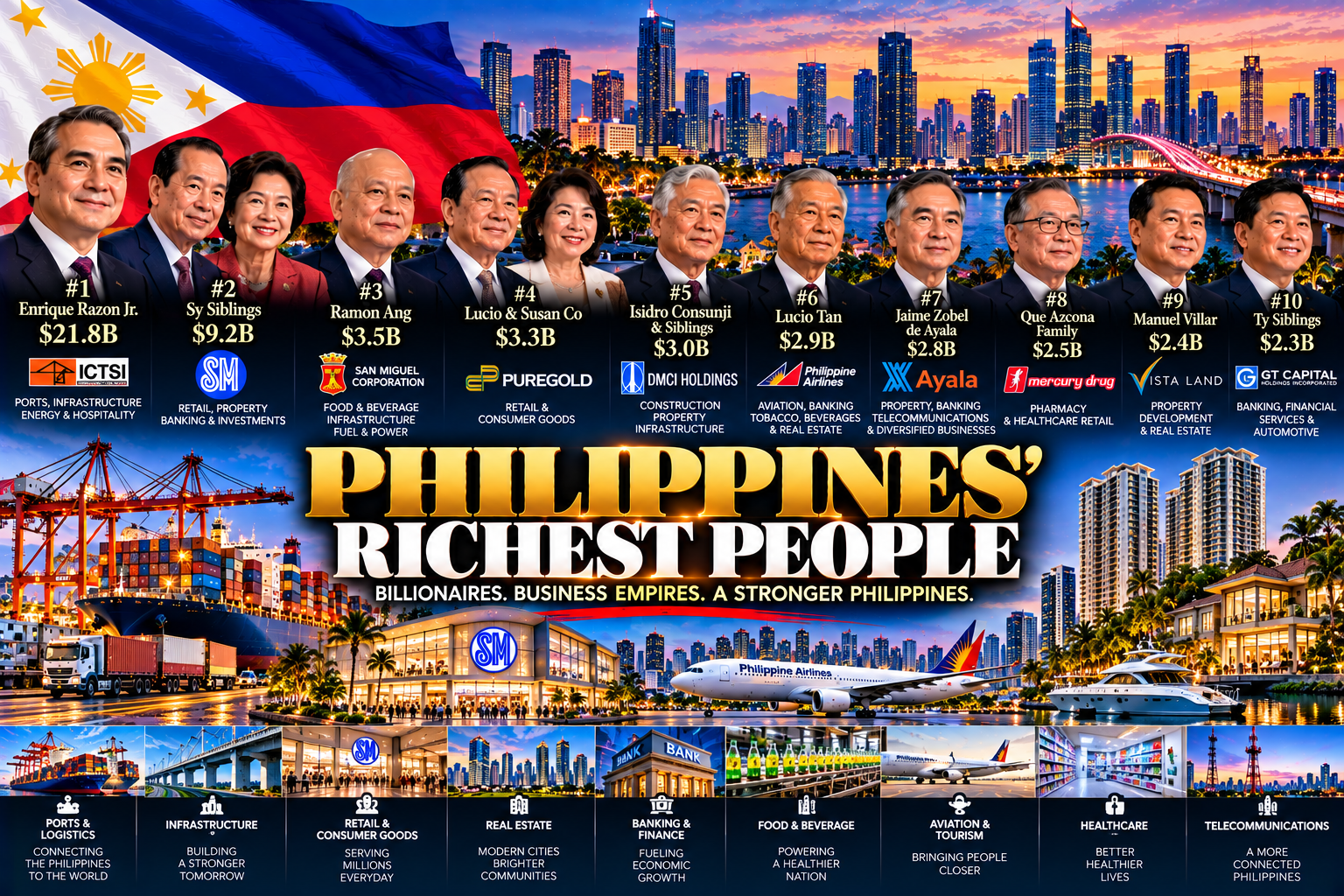
For the first time, Enrique Razon Jr. occupied the top position, with an estimated fortune of $21.8 billion on the 2026 list. The Sy siblings ranked second with $9.2 billion, while San Miguel chairman Ramon Ang ranked third with $3.5 billion.
Who Are the Philippines’ Richest People?
The 2026 Forbes list illustrates how diversified Philippine wealth has become. Major fortunes come from both traditional industries and newer areas such as infrastructure, digital businesses, logistics, and technology.
The top 10 on Forbes’ 2026 Philippines list were:
Enrique Razon Jr. — $21.8 billion
Sy siblings — $9.2 billion
Ramon Ang — $3.5 billion
Lucio and Susan Co — $3.3 billion
Isidro Consunji and siblings — $3.0 billion
Lucio Tan — $2.9 billion
Jaime Zobel de Ayala — $2.8 billion
Que Azcona family — $2.5 billion
Manuel Villar — $2.4 billion
Ty siblings — $2.3 billion
These figures represent a particular valuation date and can change as publicly traded shares, exchange rates, and private-company valuations change.
1. Enrique Razon Jr.: Ports, Infrastructure, and Hospitality
Enrique Razon Jr. became the Philippines’ richest person on Forbes’ 2026 list, with an estimated $21.8 billion fortune at the list's valuation date.
Razon is chairman of International Container Terminal Services Inc. (ICTSI), a major global port operator headquartered in the Philippines. Forbes describes ICTSI as the Philippines’ largest ports operator by revenue, with operations spanning the Asia-Pacific, Eastern Europe, Africa, and the Americas.
His business interests extend beyond ports. Through Prime Infrastructure and other investments, Razon has interests in infrastructure, water, energy, and natural resources. His hospitality business, Bloomberry Resorts, operates Solaire casino resorts in the Philippines.
The expansion of ICTSI helped drive a significant increase in his wealth during the period measured for the 2026 Forbes list.
2. Sy Siblings: Retail and Property
The Sy siblings represent one of the Philippines’ best-known business families.
Their wealth is associated with the SM Group, whose interests include retail, malls, banking, and property development. The family fortune is also closely connected with SM Prime Holdings, one of the country's major property companies.
Forbes estimated the Sy siblings' combined fortune at $9.2 billion for the 2026 list. Their position was affected by a decline in the share price of SM Prime Holdings during the measured period.
The SM business model demonstrates how retail and property development can operate together. Shopping malls can generate retail activity while surrounding residential, office, hotel, and commercial developments create additional sources of revenue.
3. Ramon Ang: San Miguel and Diversified Businesses
Ramon Ang, chairman and CEO of San Miguel Corporation, ranked third on the 2026 list with an estimated $3.5 billion fortune.
San Miguel is one of the Philippines' largest diversified conglomerates. Its business interests extend beyond its traditional beverage operations into food, infrastructure, fuel and energy, packaging, and other businesses.
Ang's wealth illustrates the role of large conglomerates in the Philippine economy. However, billionaire fortunes connected to listed companies can change substantially when share prices move.
4. Lucio and Susan Co: Retail and Consumer Goods
Lucio and Susan Co ranked fourth on Forbes' 2026 list with a combined fortune of approximately $3.3 billion.
The couple cofounded Puregold Price Club, a major supermarket and hypermarket chain in the Philippines. Forbes reports that the business grew from its first location in Mandaluyong City to nearly 800 stores across the country.
The Cos also control Cosco Capital, which has interests in areas including liquor distribution and real estate.
Their story demonstrates the scale that can be achieved through retail networks serving a large domestic consumer market.
5. Isidro Consunji and Siblings: Construction and Property
Isidro Consunji and his siblings ranked fifth, with a combined fortune estimated at $3 billion in Forbes' 2026 Philippines list.
Their wealth is associated with DMCI Holdings, a diversified company with interests in construction, property, infrastructure, power, and other businesses.
Construction and property development remain important components of the Philippine economy because urbanization and population growth continue to support demand for housing, commercial buildings, infrastructure, and other developments.
6. Lucio Tan: Aviation, Banking, Tobacco, and Real Estate
Lucio Tan ranked sixth on the 2026 Forbes list with an estimated fortune of $2.9 billion.
His business interests span several major industries, including banking, aviation, tobacco, beverages, spirits, and real estate.
One major development in 2026 involved Philippine Airlines. The airline, led by Tan's grandson Lucio Tan III, agreed in July 2026 to acquire up to 34 new aircraft from Airbus and Boeing, with an estimated combined list price exceeding $12 billion.
Philippine Airlines reported 2025 revenue of 184 billion pesos and net profit of 9.6 billion pesos, according to Forbes.
7. Jaime Zobel de Ayala: Property, Banking, and Diversified Businesses
Jaime Zobel de Ayala ranked seventh with an estimated $2.8 billion fortune on Forbes' 2026 list.
The Ayala business legacy is associated with a broad portfolio of Philippine enterprises, including property development, banking, telecommunications, infrastructure, and other investments.
The Ayala name has been closely connected with the development of major business districts and urban projects in the Philippines, particularly in Metro Manila.
8. Que Azcona Family: Pharmacy and Healthcare Retail
The Que Azcona family ranked eighth with an estimated $2.5 billion fortune.
Their wealth is associated with Mercury Drug, one of the Philippines' best-known pharmacy and healthcare retail businesses.
The company's nationwide presence demonstrates the importance of healthcare retail and consumer services in the Philippine economy.
Pharmacy chains can combine retail operations with healthcare-related products and services, creating a business model tied to recurring consumer demand.
9. Manuel Villar: Real Estate and Retail
Manuel Villar ranked ninth on the 2026 list with an estimated $2.4 billion fortune.
Villar is chairman of property developer Vista Land & Lifescapes. Forbes reports that his largest asset is his stake in Villar Land Holdings, which is developing Villar City, a large master-planned community south of Manila.
His broader business interests include shopping malls, property investment trusts, home improvement, supermarkets, and other real estate-related businesses.
Villar's businesses illustrate the connection between residential development, retail, commercial property, and large-scale urban planning.
10. Ty Siblings: Banking and Financial Services
The Ty siblings ranked tenth on Forbes' 2026 Philippines list with an estimated combined fortune of $2.3 billion.
The family is associated with the GT Capital business group and interests spanning banking, financial services, automotive businesses, and other investments.
Financial services have played an important role in the development of Philippine corporate and consumer markets by providing financing, banking services, investment products, and other financial infrastructure.
Real Estate and the Philippines’ Wealthiest Families
Real estate is one of the most important sectors represented among the Philippines' wealthiest families.
Large property businesses often combine several activities, including residential developments, shopping malls, offices, hotels, industrial facilities, and mixed-use communities.
The Sy family, Consunji family, Ayala interests, and Villar businesses all demonstrate different approaches to property and urban development.
Real estate wealth can be affected by land values, rental income, property demand, interest rates, construction costs, and the performance of publicly traded property companies.
Retail and Consumer Businesses
Retail remains another major source of billionaire wealth in the Philippines.
The country's large consumer population supports businesses ranging from supermarkets and pharmacies to shopping malls and food companies.
Puregold, SM, Mercury Drug, and other major consumer businesses demonstrate the scale that can emerge from extensive retail networks.
Consumer companies can also benefit from brand recognition, distribution networks, supply-chain efficiency, and expanding middle-class consumption.
Ports and Infrastructure
Infrastructure is increasingly important to the Philippine economy because the country relies heavily on transportation networks connecting islands, cities, businesses, and international markets.
Enrique Razon's ICTSI represents one example of how a Philippine company can build an international infrastructure business. The company operates ports across multiple regions of the world.
Other wealthy Philippine families have built businesses around construction, property, utilities, transportation, energy, and telecommunications.
Banking and Financial Services
Banking has long been an important source of corporate wealth in the Philippines.
Large business families have established or controlled financial institutions that serve individuals, companies, investors, and other organizations.
Banking fortunes can be influenced by interest rates, loan growth, asset quality, capital markets, and economic conditions.
The sector also connects with other industries because large conglomerates frequently require financial services to support property development, infrastructure, manufacturing, and expansion.
Food, Beverages, and Manufacturing
Food and beverages represent another major part of Philippine business.
San Miguel is a particularly prominent example, having expanded beyond its traditional beverage roots into a broad range of businesses.
The sector benefits from recurring consumer demand, extensive distribution networks, manufacturing capabilities, and established brands.
Other Philippine business groups also have interests in food distribution, supermarkets, consumer products, and related manufacturing.
Aviation and Tourism
The Philippines' geography makes transportation and tourism strategically important.
The country is made up of thousands of islands, creating demand for air travel, shipping, airports, hotels, resorts, and other tourism infrastructure.
Lucio Tan's business interests illustrate how aviation can intersect with banking, beverages, tobacco, and real estate. Philippine Airlines' planned aircraft purchases in 2026 also demonstrate the capital requirements involved in expanding a major airline.
Tourism and hospitality can create additional opportunities for property developers, transportation companies, restaurants, and entertainment businesses.
Technology and the Digital Economy
Technology is becoming increasingly important to the Philippine economy.
E-commerce, digital payments, telecommunications, online services, fintech, and business-process outsourcing have created new opportunities for entrepreneurs and established corporations.
Although many of the country's largest fortunes still originate in traditional industries, technology can influence how established companies operate.
Retailers are adopting digital commerce, banks are expanding mobile services, property companies are using smart-building technologies, and logistics companies are adopting data-driven systems.
Why Billionaire Rankings Change
Billionaire rankings are not fixed.
Forbes' 2026 Philippines list demonstrates this clearly. The combined wealth of the 50 richest fell from $86 billion to $79 billion, while several individual fortunes changed significantly.
Several factors can affect reported wealth:
Stock-market movements
Currency exchange rates
Company earnings
Property valuations
Business acquisitions
Debt levels
Ownership changes
Private-company valuations
Family ownership structures
Forbes stated that its 2026 Philippine figures were based on stock prices and exchange rates as of July 17, 2026. The methodology also differs from the Forbes World’s Billionaires ranking because the Philippine list includes family fortunes.
How Billionaire Wealth Is Measured
A billionaire's reported net worth generally represents the estimated value of assets minus liabilities.
For publicly traded companies, ownership stakes can be estimated using current or specified stock prices.
For private companies, researchers may use financial information, comparable companies, transactions, and other valuation methods.
As a result, billionaire figures should be viewed as estimates rather than cash held in a bank account.
The Role of Family Businesses
Family businesses play a major role in the Philippines' corporate landscape.
Several fortunes on the 2026 Forbes list are shared among siblings, spouses, or extended family members. This structure allows businesses to remain under family control across generations.
Family-owned companies can benefit from long-term ownership, established relationships, accumulated business knowledge, and succession planning.
At the same time, transferring ownership between generations can create challenges involving leadership, governance, valuation, and strategic direction.
The Future of Philippine Wealth
The industries behind Philippine wealth are likely to continue evolving.
Infrastructure development, urbanization, digital commerce, financial technology, healthcare, renewable energy, logistics, and tourism could all influence future business growth.
At the same time, traditional sectors such as property, retail, banking, food, beverages, and manufacturing remain significant.
The rise of digital platforms could also allow new entrepreneurs to build businesses with regional or international reach.
Final Thoughts
The Philippines' richest people represent a wide range of industries and business models. Enrique Razon Jr.'s international ports and infrastructure businesses, the Sy family's retail and property interests, Ramon Ang's diversified San Miguel empire, the Cos' supermarket network, the Consunji family's property and construction businesses, and the other major family enterprises illustrate the breadth of Philippine corporate wealth.
Forbes' 2026 figures also show that billionaire fortunes can change considerably as markets, currencies, company valuations, and economic conditions move.
Understanding the Philippines' wealth landscape therefore requires looking beyond individual net-worth figures and examining the companies, industries, ownership structures, and economic forces behind them.
FAQs
Who is the richest person in the Philippines in 2026?
Forbes' 2026 Philippines’ 50 Richest list placed Enrique Razon Jr. at No. 1 with an estimated fortune of $21.8 billion based on valuations as of July 17, 2026.
What is Enrique Razon Jr.'s main source of wealth?
Razon's primary source of wealth is ports. He chairs International Container Terminal Services Inc., which operates ports in several international markets.
Who are the Sy siblings?
The Sy siblings are members of the family associated with the SM Group, with major interests in retail, property, malls, and banking.
Who is Ramon Ang?
Ramon Ang is chairman and CEO of San Miguel Corporation, one of the Philippines' major diversified conglomerates. He ranked third on Forbes' 2026 Philippines list with $3.5 billion.
Who is the richest real estate businessman in the Philippines?
Several wealthy Philippine families have major real estate interests. Manuel Villar is particularly associated with property development through Vista Land & Lifescapes and Villar Land Holdings.
How many people are included in the Forbes Philippines richest list?
Forbes' 2026 Philippines list includes the country's 50 richest people and families. Their combined estimated wealth was $79 billion.
Do billionaire rankings remain the same throughout the year?
No. Rankings can change as stock prices, exchange rates, company valuations, and ownership stakes change.
Why does Forbes sometimes show different wealth figures for the same person?
Different Forbes lists may use different valuation dates and methodologies. The Philippines 50 Richest list also includes family fortunes, while the global billionaire ranking generally evaluates individual fortunes.