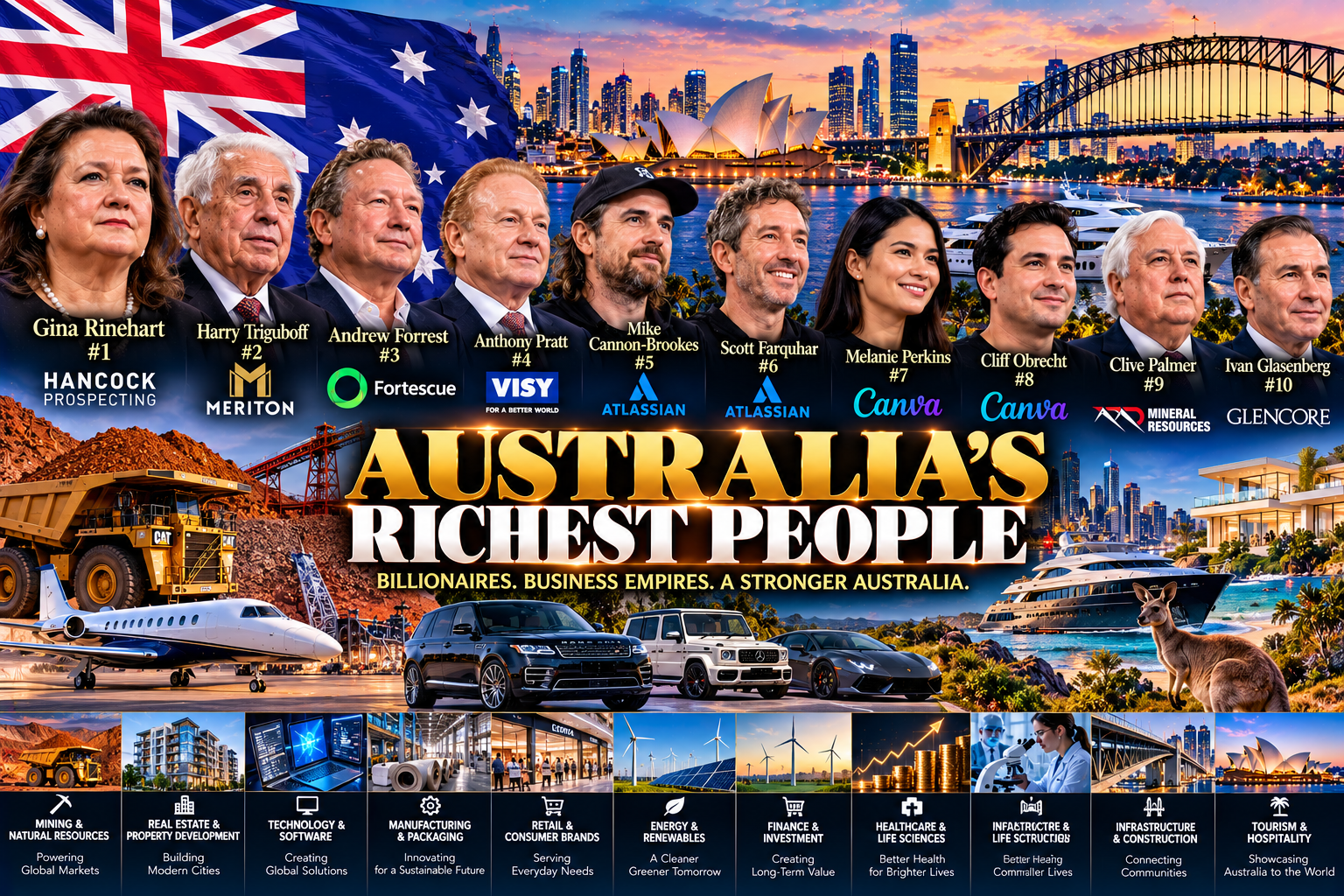
Australia richest's has produced some of the world's most successful mining magnates, property developers, technology entrepreneurs, retailers, investors, and business families. The country's enormous natural-resource base has historically created major fortunes, but technology, real estate, software, healthcare, infrastructure, and consumer businesses are becoming increasingly important parts of Australia's billionaire economy.
According to Forbes' 2026 Australia’s 50 Richest list, the combined fortune of the country's 50 wealthiest people reached approximately US$254 billion, an increase of $11 billion from the previous year. Forbes' published list placed Gina Rinehart at No. 1, followed by Harry Triguboff and Andrew Forrest.
However, billionaire rankings can change quickly because public-company shares and private-company valuations move over time. A September 2026 update from The Australian recalculated its Richest 250 list and placed property developer Harry Triguboff at the top with an estimated $36.4 billion, followed by Gina Rinehart at approximately $35.46 billion.
This difference illustrates why billionaire rankings should always be considered alongside their valuation date and methodology.
Who Are Australia’s Richest People?
Australia's wealthiest individuals and families have built their fortunes across a surprisingly diverse collection of industries.
Major sources of Australian billionaire wealth include:
Mining and natural resources
Real estate and property development
Technology and software
Manufacturing
Retail
Energy
Finance and investments
Healthcare
Infrastructure
Consumer products
Data centers
Mining remains particularly important. Gina Rinehart and Andrew Forrest both built major fortunes through iron ore, while other billionaires have developed businesses in property, technology, packaging, software, retail, and healthcare.
1. Gina Rinehart: Mining and Natural Resources
Gina Rinehart is one of Australia's most prominent mining billionaires and the executive chairwoman of Hancock Prospecting.
Forbes' 2026 Australia list placed Rinehart first with an estimated fortune of $24.6 billion based on data used for that ranking. Forbes subsequently reported a real-time estimate of around $25.8 billion in September 2026.
Her wealth is primarily connected to iron ore. Hancock Prospecting's major asset is the Roy Hill iron ore project in Western Australia, which began shipping iron ore to Asian markets in 2015.
Rinehart has also expanded Hancock's interests beyond traditional iron ore. Her investments have included rare earth minerals, natural gas, lithium, and agriculture.
Forbes describes Rinehart as Australia's richest citizen and notes that Hancock Prospecting has become one of Australia's most significant privately controlled companies.
Mining Remains a Major Source of Wealth
Australia's mineral resources have played a central role in the country's economy for decades.
Iron ore, coal, lithium, gold, rare earths, and other commodities support large export industries and have created substantial private fortunes.
Commodity prices can also cause significant changes in billionaire wealth because many mining fortunes are linked directly or indirectly to company valuations.
2. Harry Triguboff: Real Estate and Meriton
Harry Triguboff is one of Australia's best-known property developers and the founder of Meriton.
Forbes' 2026 published Australia list estimated his fortune at $22.6 billion, making him the country's second-richest person in that edition. Forbes' real-time profile showed an estimated net worth of approximately $23.7 billion in September 2026.
A later September 2026 update from The Australian placed Triguboff first on its recalculated Richest 250 list, estimating his wealth at $36.4 billion. The publication attributed the change partly to the rising value of Meriton's extensive property holdings and land banks.
Triguboff's business is strongly associated with apartment development.
Meriton has built tens of thousands of apartments, particularly in Sydney and southeastern Queensland. Forbes says the company has constructed more than 79,000 apartments.
His wealth demonstrates how Australia's housing demand and urban development can generate very large private fortunes.
3. Andrew Forrest: Mining and Energy
Andrew Forrest founded Fortescue Metals Group in 2003 and built a major fortune through Australia's iron ore industry.
Forbes' 2026 global list estimated Forrest and his family at $20.3 billion using its March valuation date, while Forbes' September real-time profile showed approximately $17.6 billion.
Fortescue remains a major iron ore company, but Forrest has also invested heavily in renewable energy through privately held Squadron Energy.
Forbes reports that Squadron Energy paid approximately A$4 billion for CWP Renewables in 2022, expanding Forrest's interests in wind and renewable energy.
This represents a broader trend among resource entrepreneurs: expanding beyond traditional mining into energy, infrastructure, and other sectors.
4. Anthony Pratt: Packaging and Manufacturing
Anthony Pratt is the executive chairman of Visy, a major packaging and recycling business.
Forbes estimated his real-time fortune at approximately $11.6 billion in September 2026.
The Pratt family's business history dates back to the establishment of Visy in Melbourne in 1948. Anthony Pratt expanded the business internationally and also owns Pratt Industries in the United States.
Packaging is an important but often overlooked industry because almost every major consumer and industrial supply chain depends on packaging.
Pratt's fortune demonstrates how manufacturing businesses can create significant long-term wealth when they achieve scale across multiple markets.
5. Mike Cannon-Brookes: Software and Technology
Mike Cannon-Brookes is the co-founder of Atlassian, the Australian software company known for products such as Jira and Confluence.
Forbes' September 2026 real-time profile estimated Cannon-Brookes' fortune at approximately $12.8 billion.
Cannon-Brookes and Scott Farquhar founded Atlassian after graduating from university and initially financed the company with credit cards.
Atlassian became one of Australia's most successful technology companies, serving hundreds of thousands of customers around the world.
Cannon-Brookes has also invested in energy and infrastructure, including renewable energy projects and AGL Energy.
His career illustrates how Australia's technology sector has created billionaire-scale fortunes alongside the country's traditional mining and property industries.
6. Scott Farquhar: Atlassian and Software
Scott Farquhar co-founded Atlassian with Mike Cannon-Brookes.
Forbes estimated Farquhar's real-time net worth at approximately $11.9 billion in September 2026.
Farquhar stepped down as Atlassian's co-CEO in 2024 but continued as a board member and adviser while pursuing philanthropic activities.
His wealth is largely connected to his ownership in Atlassian, meaning changes in the company's market valuation can have a substantial impact on his estimated fortune.
The rise of Atlassian also demonstrates Australia's growing role in global enterprise software.
7. Melanie Perkins and Cliff Obrecht: Canva
Melanie Perkins and Cliff Obrecht are the co-founders of Canva, the Australian online graphic-design platform.
Forbes' 2026 Australia list placed the couple among the country's wealthiest people after Canva reached a valuation of approximately $42 billion in August 2025. Their combined fortune was estimated at about $15.1 billion in that Forbes ranking.
Canva allows individuals, businesses, educators, and organizations to create presentations, social-media graphics, documents, marketing materials, and other visual content.
Its international growth helped establish another important source of Australian billionaire wealth: scalable software businesses.
Technology companies can potentially grow across global markets without requiring the physical infrastructure associated with traditional industries.
8. Clive Palmer: Mining and Business
Clive Palmer is another Australian billionaire whose fortune is strongly connected to mining and natural resources.
The September 2026 Australian Richest 250 update estimated Palmer's wealth at approximately $22.75 billion, placing him fourth in that particular ranking.
Palmer's business interests have included mining, property, tourism, and other commercial ventures.
His wealth demonstrates another characteristic of Australia's billionaire economy: significant fortunes can be connected to ownership of resource assets and businesses whose values fluctuate with commodity markets.
9. Ivan Glasenberg: Global Commodities
Ivan Glasenberg is associated with the global commodities industry and formerly served as chief executive of Glencore.
The September 2026 Australian Richest 250 update estimated his fortune at approximately $20.45 billion, placing him among the country's wealthiest residents or citizens in that ranking.
Glasenberg's career highlights the international nature of Australia's resource economy.
Australia is a major exporter of minerals and energy commodities, so individuals who build businesses around mining, trading, logistics, and commodity markets can become extremely wealthy.
10. The Next Generation of Australian Wealth
Australia's billionaire landscape is continuing to evolve.
Traditional industries such as mining and property remain powerful, but new fortunes are emerging from:
Artificial intelligence
Data centers
Software
Digital platforms
Healthcare
Renewable energy
Cybersecurity
Infrastructure technology
A September 2026 report identified Oliver Curtis, co-founder of AI data-center company Firmus, as a potential major new entrant to Australia's wealth rankings if a proposed valuation and public listing materialize. The report emphasized that such a valuation remained subject to the proposed transaction actually occurring.
This illustrates how AI infrastructure and data centers could become important sources of new wealth.
Mining and Australia's Billionaire Economy
Mining continues to dominate Australia's wealth landscape.
The country has substantial reserves of:
Iron ore
Coal
Gold
Lithium
Nickel
Copper
Rare earth minerals
The global transition toward electric vehicles, renewable energy, batteries, and advanced electronics has also increased attention on minerals needed for modern technologies.
However, mining wealth is highly sensitive to commodity prices.
When iron ore or other mineral prices decline, the market value of mining companies can fall, potentially reducing billionaire net worth estimates.
Real Estate and Australia's Wealthiest People
Property is another major pillar of Australian private wealth.
Harry Triguboff is one of the clearest examples. His Meriton business has focused heavily on apartment development in major urban markets.
Property fortunes can be influenced by:
Housing demand
Population growth
Interest rates
Construction costs
Land values
Rental conditions
Development approvals
Apartment prices
Australia's major cities, particularly Sydney and Melbourne, have created opportunities for large-scale developers.
Technology Is Changing Australia's Billionaire Landscape
For decades, Australia's richest people were heavily concentrated in mining, property, and traditional industries.
Technology has added a new category of billionaire wealth.
Atlassian and Canva demonstrate how Australian-founded software companies can reach global markets.
The technology sector also creates wealth indirectly through data centers, cloud infrastructure, cybersecurity, artificial intelligence, and semiconductor-related businesses.
This does not mean traditional industries are disappearing. Instead, Australia's wealth economy is becoming more diversified.
Renewable Energy and the New Resource Economy
Australia has significant renewable-energy potential because of its large landmass and strong solar and wind resources.
Several wealthy Australians have invested in renewable energy and infrastructure.
Andrew Forrest has expanded his interests into renewable energy through Squadron Energy, while Mike Cannon-Brookes has invested in renewable-energy projects and energy infrastructure.
The combination of natural resources and renewable energy could become an important part of Australia's future business landscape.
How Billionaire Wealth Is Calculated
A billionaire's net worth is generally an estimate of the value of assets such as:
Publicly traded shares
Private-company ownership
Real estate
Investment holdings
Other business assets
Forbes' 2026 Australia list used shareholding and financial information from families, individuals, stock exchanges, annual reports, and analysts. Public-company fortunes were calculated using stock prices and exchange rates from January 23, 2026, while private companies were valued using comparisons with similar publicly traded businesses.
This is why Forbes' published annual ranking can differ substantially from a real-time ranking several months later.
Why Australia's Richest People Rankings Change
Billionaire rankings can change rapidly.
The main factors include:
Stock Prices
Publicly listed shares can rise or fall significantly within weeks.
Commodity Prices
Mining fortunes can change when iron ore, gold, lithium, or other commodity prices move.
Private Company Valuations
Technology and private businesses can experience major valuation changes after funding rounds, acquisitions, or market reassessments.
Currency Movements
Because many international billionaire rankings use U.S. dollars, changes in the Australian dollar can affect reported wealth.
Property Values
Large property portfolios can change in estimated value as housing and commercial real estate markets change.
The difference between Forbes' early-2026 list and the September Australian update is a clear example of this volatility.
Australia’s Global Billionaire Presence
Australia has a relatively small population compared with countries such as the United States, China, and India, but it has produced a notable number of billionaires.
Forbes' 2026 global list included Gina Rinehart, Harry Triguboff, Andrew Forrest, and other Australians among the world's wealthiest people.
Their businesses often have an international dimension.
Australian billionaires participate in global markets through:
Mining exports
International software
Global investments
Manufacturing
Real estate
Renewable energy
Consumer brands
Financial markets
The Future of Australia's Wealthiest People
Several sectors are likely to remain important to Australia's billionaire economy.
Mining and Critical Minerals
Demand for minerals used in batteries, electronics, infrastructure, and energy technologies could keep mining central to Australian wealth.
Artificial Intelligence
AI software and infrastructure are creating new opportunities for entrepreneurs and investors.
Data Centers
The growth of cloud computing and AI is increasing demand for large-scale data-center infrastructure.
Real Estate
Population growth and urban development continue to support Australia's property sector.
Renewable Energy
Solar, wind, storage, transmission, and other energy infrastructure could create new business opportunities.
Healthcare
Pharmaceuticals, medical technology, healthcare services, and biotechnology are increasingly important areas for investment.
Final Thoughts
Australia's richest people come from a diverse range of industries, although mining and property remain particularly important.
Gina Rinehart represents Australia's powerful mining sector, Harry Triguboff represents large-scale property development, and Andrew Forrest combines mining with major renewable-energy investments. Meanwhile, Mike Cannon-Brookes, Scott Farquhar, Melanie Perkins, and Cliff Obrecht demonstrate the wealth-creation potential of Australian technology companies.
The rankings also show why billionaire wealth should not be viewed as a fixed number. Share prices, commodity markets, exchange rates, property valuations, and private-company estimates can significantly change fortunes within a short period.
Australia's future billionaire economy is therefore likely to include both established industries and emerging sectors such as artificial intelligence, data centers, renewable energy, healthcare technology, and advanced infrastructure.
FAQs
Who is Australia's richest person in 2026?
Forbes' published 2026 Australia 50 Richest list placed Gina Rinehart first with an estimated $24.6 billion based on its January 23, 2026 valuation date. A later September 2026 real-time Forbes page also identified Rinehart as Australia's richest person, with an estimated $25.6 billion.
Who is Harry Triguboff?
Harry Triguboff is the founder of Meriton, one of Australia's major apartment-development companies. His wealth is primarily associated with real estate.
Who is Australia's richest technology entrepreneur?
Australia has several major technology fortunes. Mike Cannon-Brookes and Scott Farquhar built Atlassian, while Melanie Perkins and Cliff Obrecht founded Canva. Their estimated fortunes change with the valuations of their companies.
What industry creates the most billionaire wealth in Australia?
Mining has historically been one of Australia's most important sources of billionaire wealth, particularly through iron ore and other natural resources. Property, technology, manufacturing, retail, and finance are also significant sources.
How did Gina Rinehart build her fortune?
Rinehart built her fortune through Hancock Prospecting and its mining interests, particularly iron ore. She later expanded the family's business interests into areas including rare earths, gas, lithium, and agriculture.
How did Mike Cannon-Brookes become a billionaire?
Cannon-Brookes co-founded Atlassian with Scott Farquhar. The company grew into a global software business, and his ownership stake became the primary source of his billionaire wealth.
Why do billionaire rankings change?
Rankings change because stock prices, commodity prices, exchange rates, company valuations, property values, and ownership stakes change over time.
Are Australia's billionaires mostly self-made?
Australia's wealthiest people include both entrepreneurs who built companies and individuals whose fortunes are connected to family businesses or inherited assets. The Forbes methodology includes both individual and family fortunes on its Australia list.