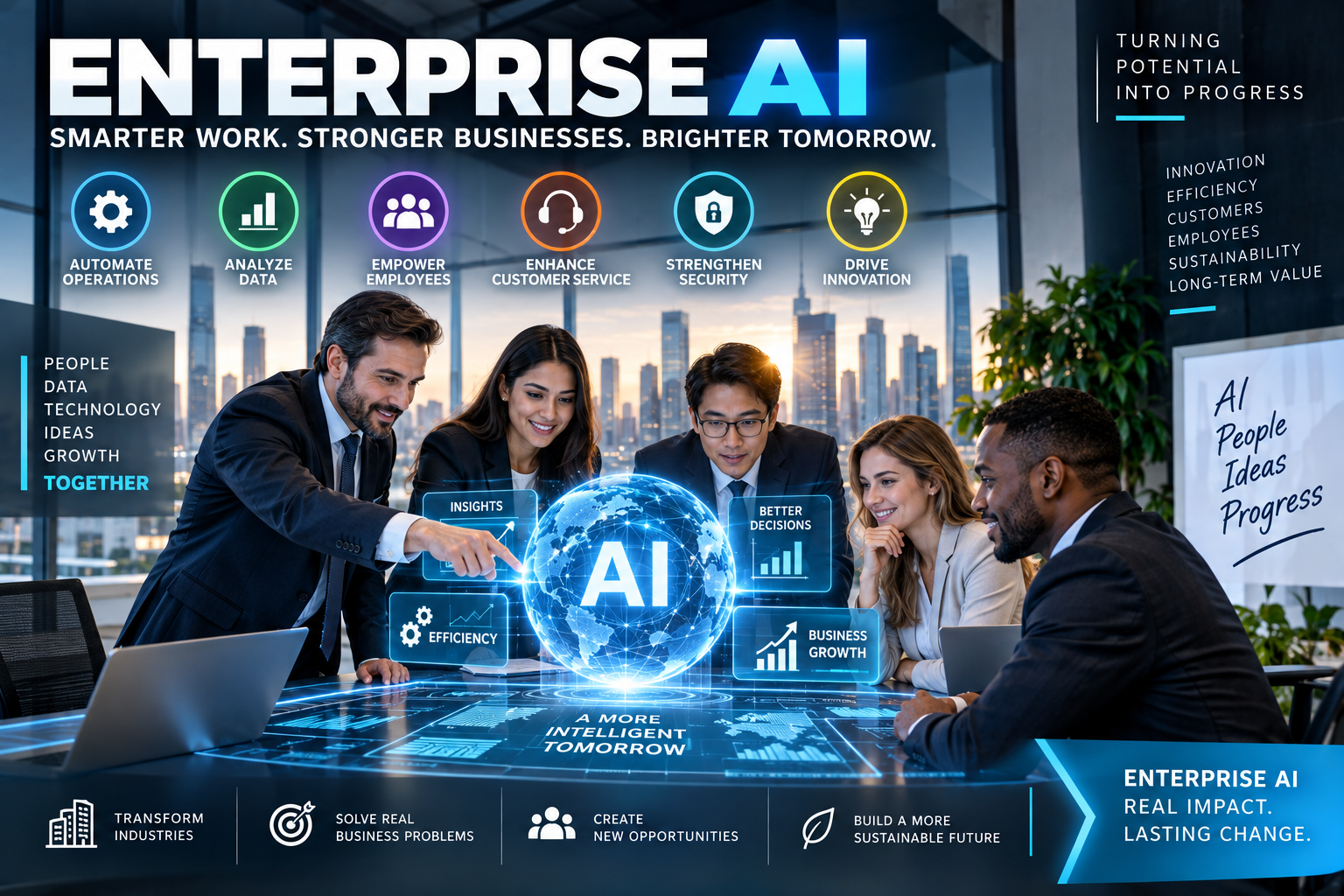
Artificial intelligence is rapidly becoming one of the most important technologies shaping the future of business. While consumer AI tools have attracted significant attention, a much broader transformation is taking place inside organizations through Enterprise AI.
Enterprise AI refers to the use of artificial intelligence across business operations to improve decision-making, automate processes, analyze data, serve customers, support employees, and create new products and services. Unlike basic AI applications designed for individual users, Enterprise AI is built around the complex needs of organizations, including security, scalability, governance, integration, and business performance.
From financial institutions and manufacturers to retailers, healthcare organizations, technology companies, and professional services firms, businesses are exploring how AI can create measurable value.
What Is Enterprise AI?
Enterprise AI is the application of artificial intelligence technologies throughout an organization to solve business problems and improve operations.
It can include machine learning, generative AI, natural language processing, computer vision, predictive analytics, intelligent automation, and AI-powered decision-support systems.
For example, a company might use Enterprise AI to analyze customer feedback, forecast demand, detect fraud, automate document processing, assist employees with research, or provide personalized customer support.
The key difference is that Enterprise AI is connected to an organization's broader infrastructure and objectives. It is not simply about using an AI chatbot. It involves integrating intelligent systems into real business workflows.
Why Enterprise AI Matters
Businesses generate enormous amounts of information every day. Emails, financial records, customer interactions, sales data, operational reports, documents, and digital transactions can contain valuable insights.
The challenge is turning this information into useful decisions.
AI can process large quantities of data much faster than humans and identify patterns that might otherwise be difficult to detect.
Enterprise AI can also help organizations automate repetitive work. Employees can spend less time on routine administrative activities and more time on strategic, creative, and customer-focused responsibilities.
For companies operating in competitive markets, these improvements can contribute to greater efficiency, faster decision-making, and better customer experiences.
Enterprise AI and Generative AI
Generative AI has significantly expanded the possibilities for Enterprise AI.
Generative AI systems can create and transform content such as text, summaries, reports, software code, images, and other digital material.
Businesses can use these capabilities in areas such as marketing, customer service, software development, research, internal communications, and knowledge management.
An employee could use an enterprise AI assistant to summarize a long document, search internal knowledge, prepare a report, or organize information from multiple sources.
However, enterprise environments require stronger controls than casual consumer use. Organizations need to consider data privacy, access permissions, accuracy, intellectual property, security, and regulatory requirements.
Improving Business Productivity
One of the biggest potential benefits of Enterprise AI is improved productivity.
Many employees spend significant amounts of time searching for information, preparing documents, entering data, responding to repetitive requests, and completing administrative tasks.
AI-powered tools can automate or accelerate some of these activities.
For example, an internal AI assistant could help employees locate information across approved company documents. An AI system could summarize meetings and identify follow-up actions. Another system could classify incoming customer requests and route them to the appropriate department.
When implemented effectively, these capabilities can reduce unnecessary manual work and allow employees to focus on higher-value activities.
Enterprise AI in Customer Service
Customer service is another major area of Enterprise AI adoption.
AI-powered virtual assistants can handle common questions, provide information, and assist customers around the clock.
More advanced systems can analyze customer conversations and help human agents understand the customer's history and needs.
AI can also identify recurring complaints and common service problems by analyzing large quantities of customer interactions.
However, human support remains important. Complex complaints, sensitive situations, and high-value customer relationships often require empathy and human judgment.
The strongest customer-service strategies may therefore combine AI automation with human expertise.
AI-Powered Business Analytics
Traditional business analytics often requires teams to collect, clean, analyze, and interpret information before producing reports.
Enterprise AI can accelerate parts of this process.
AI systems can identify patterns in sales, operations, customer behavior, financial performance, and other business data.
For example, a retailer could use AI to identify changing demand patterns. A manufacturer could analyze equipment data to identify potential maintenance requirements. A financial company could examine transactions for unusual activity.
AI-generated insights can help decision-makers understand complex information more quickly, although important decisions should still involve appropriate human oversight.
Predictive Analytics and Forecasting
Enterprise AI can also help businesses make predictions.
Predictive models can analyze historical information to estimate future outcomes, such as demand, customer behavior, equipment failures, or financial trends.
Accurate forecasting can help companies plan inventory, staffing, budgets, production, and other resources.
However, predictions are not guarantees. Economic conditions, consumer behavior, unexpected events, and data quality can affect results.
Businesses should therefore treat AI forecasts as decision-support tools rather than unquestionable answers.
Enterprise AI in Finance
Financial departments can use AI for several applications.
AI can assist with expense processing, invoice classification, fraud detection, financial forecasting, risk analysis, and reporting.
Automation can reduce the amount of repetitive work performed manually while potentially improving consistency.
Financial institutions can also use AI to analyze transactions and identify unusual patterns that may require investigation.
Because financial data is highly sensitive, organizations need strong security controls and appropriate governance when deploying AI systems.
Enterprise AI in Healthcare
Healthcare organizations can use AI to improve administrative and analytical processes.
Potential applications include medical research, document analysis, scheduling, patient communication, operational forecasting, and decision support.
AI can help healthcare professionals process large amounts of information, but high-stakes medical decisions require appropriate professional judgment and oversight.
Privacy and security are especially important because healthcare organizations handle highly sensitive information.
The future of Enterprise AI in healthcare will depend on balancing technological innovation with safety, accuracy, privacy, and patient trust.
AI in Manufacturing and Supply Chains
Manufacturing companies can use AI to improve production and supply-chain operations.
Computer vision systems can inspect products for potential defects. Predictive maintenance models can analyze equipment data and identify signs of possible problems.
AI can also help businesses forecast demand, optimize inventory, improve logistics, and identify supply-chain disruptions.
These applications can potentially reduce waste and improve operational efficiency.
As factories become increasingly connected, Enterprise AI may become a central component of intelligent manufacturing systems.
Enterprise AI and Cybersecurity
Cybersecurity is becoming increasingly complex as organizations adopt cloud services, remote work, connected devices, and digital applications.
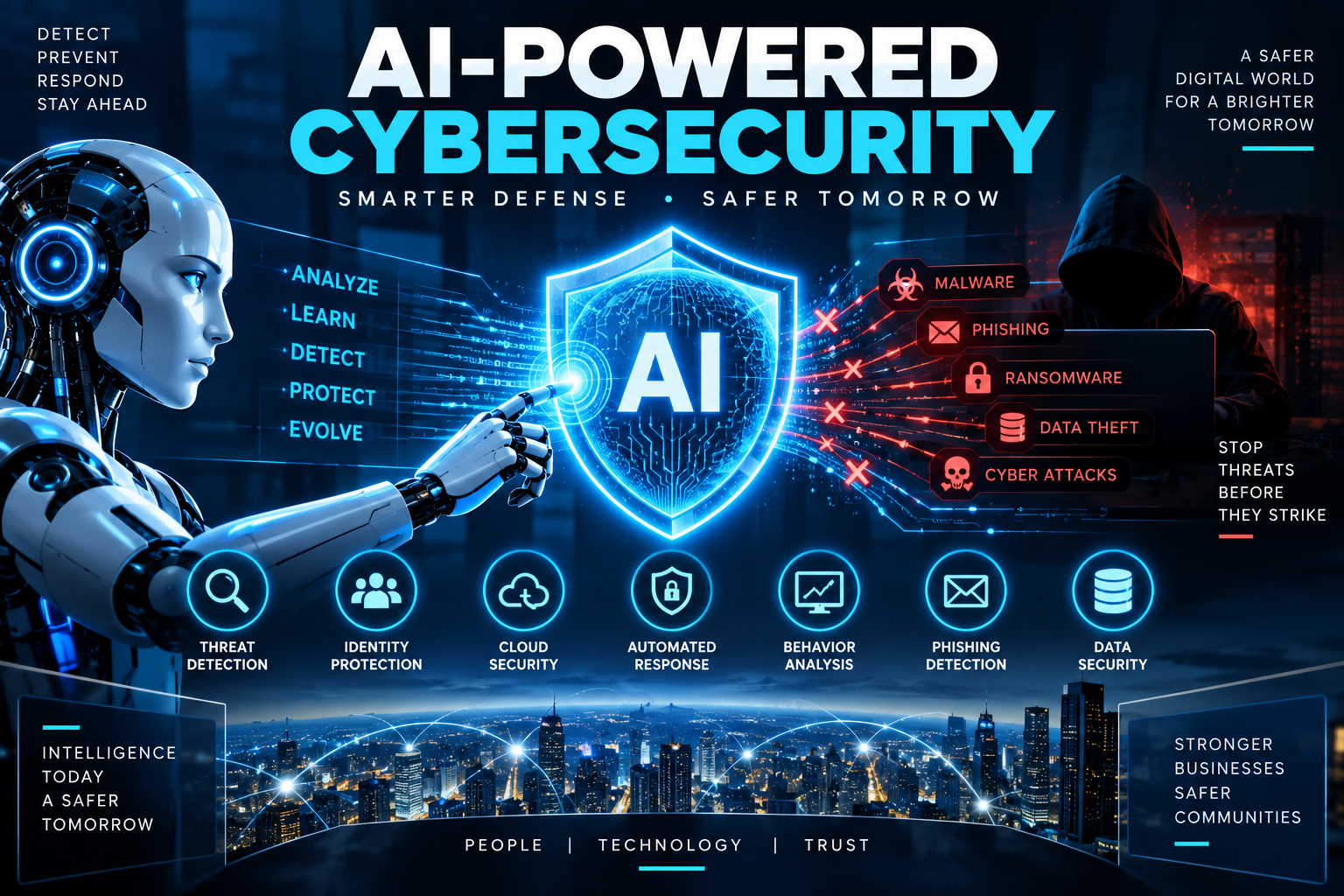
Enterprise AI can help security teams analyze large volumes of security events, identify unusual behavior, prioritize alerts, and support incident investigations.
AI can potentially detect patterns associated with compromised accounts, suspicious network activity, phishing attempts, or other threats.
However, AI also creates new security risks. Organizations must protect AI systems, control access to sensitive information, and ensure that employees understand how AI tools should be used securely.
The Importance of AI Governance
Enterprise AI cannot be managed effectively through technology alone.
Organizations need clear AI governance policies that define how AI systems are developed, deployed, monitored, and evaluated.
Governance can address issues such as:
Data privacy
Security
Access control
Accuracy
Transparency
Human oversight
Regulatory compliance
Intellectual property
Responsible AI usage
A strong governance framework helps organizations capture the benefits of AI while reducing unnecessary risks.
Data: The Foundation of Enterprise AI
AI systems depend heavily on data.
Poor-quality, incomplete, outdated, or biased data can lead to unreliable results.
Businesses should therefore invest in data management, data quality, security, and appropriate access controls.
Organizations also need to understand where their data comes from and who is allowed to use it.
For Enterprise AI projects, the quality of the underlying data can be just as important as the sophistication of the AI model.
Challenges of Enterprise AI
Despite its potential, Enterprise AI implementation can be challenging.
One major challenge is integration. AI systems often need to connect with existing software, databases, cloud platforms, and business processes.
Another challenge is cost. Building and maintaining AI infrastructure, training employees, securing data, and managing models can require significant investment.
Employee adoption is also important. Workers may be uncertain about how AI will affect their jobs or may not understand how to use new tools effectively.
Organizations should therefore provide training and communicate clearly about the purpose of AI implementation.
AI and the Future of Work
Enterprise AI is likely to change many jobs rather than simply eliminate them.
Routine activities may become increasingly automated, while employees may spend more time on problem-solving, creativity, relationship management, strategy, and decision-making.
This shift will increase the importance of digital and AI literacy.
Employees who understand how to work effectively with AI tools may be able to improve their productivity and expand their capabilities.
Companies will also need to invest in reskilling and professional development as job requirements evolve.
How Businesses Can Successfully Adopt Enterprise AI
Companies should avoid adopting AI simply because it is popular.
A successful strategy begins with identifying specific business problems.
Organizations can then determine whether AI provides a practical solution and establish measurable objectives.
Starting with smaller pilot projects can allow businesses to test an AI system before expanding it across the organization.
Companies should also establish security and governance requirements from the beginning rather than adding them later.
Employee involvement is equally important. The people who use a system every day can provide valuable insight into how AI should fit into existing workflows.
Measuring the Success of Enterprise AI
AI projects should be evaluated according to business outcomes.
Useful measurements may include productivity improvements, cost reductions, response times, customer satisfaction, error rates, revenue growth, or operational efficiency.
A technically impressive AI system does not automatically create business value.
Organizations should regularly evaluate whether an AI application is actually improving the problem it was designed to solve.
Continuous monitoring is especially important because business conditions and data can change over time.
The Future of Enterprise AI
The future of Enterprise AI will likely involve increasingly intelligent systems integrated into everyday business operations.
AI assistants may become common workplace tools, helping employees search information, analyze data, communicate with customers, and complete routine tasks.
AI agents may also perform multi-step workflows under appropriate controls, moving organizations beyond simple question-and-answer systems toward more automated business processes.
At the same time, businesses will face growing expectations around security, transparency, privacy, and responsible AI.
The companies that benefit most from Enterprise AI will likely be those that combine advanced technology with strong data management, employee skills, governance, and clear business objectives.
Conclusion
Enterprise AI is transforming the way modern organizations operate.
From customer service and finance to manufacturing, cybersecurity, healthcare, analytics, and supply-chain management, AI can help businesses automate tasks, analyze information, improve decisions, and create new opportunities.
However, successful AI adoption requires more than purchasing an AI tool. Organizations need high-quality data, secure infrastructure, skilled employees, effective governance, and measurable business goals.
Enterprise AI should ultimately serve people and business objectives rather than becoming technology for its own sake.
As AI continues to evolve, organizations that learn how to combine artificial intelligence with human creativity, judgment, and expertise will be better prepared for the future of work and competition.
Frequently Asked Questions About Enterprise AI
1. What is Enterprise AI?
Enterprise AI is the use of artificial intelligence across an organization to improve business operations, automate tasks, analyze data, support employees, and enhance customer experiences.
2. How is Enterprise AI different from regular AI?
Enterprise AI is specifically designed for organizational environments and focuses on scalability, security, governance, integration, and business objectives.
3. What are the benefits of Enterprise AI?
Major benefits can include improved productivity, automation, faster decision-making, better customer service, advanced analytics, cost efficiency, and new business opportunities.
4. How is generative AI used by businesses?
Companies can use generative AI to create content, summarize documents, assist employees, analyze information, support software development, and improve customer interactions.
5. Does Enterprise AI replace employees?
Enterprise AI can automate certain tasks, but it does not necessarily replace entire jobs. In many cases, it can augment employees and allow them to focus on higher-value responsibilities.
6. Why is data important for Enterprise AI?
AI systems depend on data to generate insights and predictions. High-quality, secure, and relevant data helps organizations achieve more reliable results.
7. What is AI governance?
AI governance is the framework of policies, controls, and processes used to ensure that AI systems are developed and used securely, responsibly, transparently, and appropriately.
8. What industries use Enterprise AI?
Enterprise AI can be applied across industries including finance, healthcare, manufacturing, retail, technology, logistics, telecommunications, education, and professional services.
9. What are the challenges of Enterprise AI?
Common challenges include data quality, security, integration, implementation costs, employee adoption, regulatory requirements, accuracy, and responsible AI management.
10. What is the future of Enterprise AI?
The future is likely to include more AI assistants, intelligent automation, predictive analytics, AI agents, personalized business services, and deeper integration between AI and everyday organizational workflows.